
The Mechanics of Prompt-Directed Synthesis: How Flash TTS Really Works
The core shift in Gemini 3.8 Flash TTS is that direction text is no longer a separate control channel—it's part of the same token stream as the words being spoken. When I pass a script with [whispers, trembling] embedded inline, the model isn't running a post-hoc prosody overlay on top of a neutral rendering. It's conditioning the autoregressive generation itself, treating the cue as performance context that shapes acoustic decisions at every step. This is fundamentally different from the SSML paradigm where I'd say <prosody rate="slow"> and get a mechanical parameter change.
The engine parses script metadata and conversational tags to track multi-speaker turns within a single request. Each speaker persona gets its own acoustic latent vector, and the model maintains that identity across turn boundaries. When I define two characters in one script, the engine keeps their timbres and cadences distinct without me orchestrating separate API calls per speaker.
For custom voices, the POST /v1beta/voices endpoint generates a persistent voice_id from a descriptive prompt—"warm, mid-30s female narrator with a slight Southern accent and measured pacing"—rather than from audio samples alone. That identifier persists across requests, meaning I design a persona once and reference it everywhere without re-describing it.
flowchart TD
    A[Raw Script Input] --> B[Text Normalizer]
    B --> C[Inline Directive Parser]
    C -->|Separates spoken text from performance cues| D[Context Buffer for Lookahead]
    D -->|Performer context fed to synthesis engine| E{Latency Profile}
    E -->|Real-time low latency| F[Gemini 3.8 Flash-Lite TTS]
    E -->|Long-form fidelity| G[Gemini 3.8 Flash TTS]
    F --> H[Audio Synthesis]
    G --> H
    H --> I[Post-Processing]
    I --> J[Playback]
    D -->|Buffering introduces latency before synthesis| F
    D -->|Buffering introduces latency before synthesis| G
The tension here is immediate: natural-language direction requires lookahead. To infer emotional arc across a paragraph, the model needs to see enough context to understand the trajectory—but that means buffering before the first audio token emerges. Flash-Lite's low-latency target collides with this requirement. In practice, chunk-by-chunk streaming produces disjointed prosody at sentence boundaries because each chunk lacks the surrounding context that would inform its delivery.
The architecture difference between tiers is straightforward. Flash handles 130+ languages with high-fidelity acting and expressive pacing—it's for audiobooks and character dialogue. Flash-Lite covers 101+ languages and optimizes for throughput and cost, sharing the core voice library but sacrificing nuance for speed. Both accept the same direction format, but the fidelity ceiling and the language matrix differ.
Acoustic Failure Modes: Where Prompt-Directed TTS Breaks in Practice
The most consequential failure is directive-text leakage—the model literally speaks the instruction instead of performing it. When I embed [whispers, trembling] in a script, the autoregressive decoder sometimes treats those tokens as transcript content rather than as performance cues. The output audio says "whispers, trembling" aloud. This happens because the model doesn't have a separate channel for instruction versus content; both live in the same token stream, and the boundary between them is a learned distinction rather than a structural one.
The conditions that worsen this are specific. Long multi-paragraph generations give the model more opportunities to lose track of which tokens are direction versus dialogue. Compound cues—multiple stacked directives like [sighs, pauses, then whispers]—increase the ambiguity because each cue transforms the performance context, and the model's attention drifts toward literal interpretation. Code-switching compounds the problem: when a script blends English technical terms into a non-English passage, the model's routing between languages competes with its routing between instruction and content.
Emotional drift and intensity overshoot appear when extended emotional arcs push the model past its stability envelope. An "excited" cue applied across several paragraphs can produce runaway pitch shifts, dynamic range compression, or clipping that sounds unnatural by the third paragraph. The model amplifies its own initial choices—each token's prosody conditions the next, so a strong emotional start compounds rather than stabilizes.
Multi-speaker bleeding manifests as persona inversion across rapid turn transitions. In a two-character dialogue with quick back-and-forth, Speaker A can inherit Speaker B's pitch, timbre, or accent cadence after an interruption or a fast switch. The acoustic latent vectors cross-contaminate because the model's turn-boundary tracking degrades when context is short.
Paralinguistic requests—coughing, laughter, crying, heavy breathing—are prone to phoneme stutter loops and uncanny artifacts. The model attempts to synthesize non-linguistic vocalizations using the same acoustic machinery that produces speech, and the result is often a robotic glitch or an endless loop rather than a smooth human-like sound. These are the hardest edge cases because the model has no dedicated pathway for non-speech sounds; it's extrapolating from speech tokens into a domain where those tokens don't map cleanly.
The Leakage Problem: Mitigation Strategies for Directive Text Contamination
The operational answer to leakage is to stop relying on freeform inline cues in production. The most robust approach I'd reach for is structured metadata: define a JSON schema where the script text is a separate field from the performance direction, then strip the direction field entirely before sending text to the synthesis endpoint. This eliminates leakage structurally—the model never sees the cue tokens, so it can't speak them. The tradeoff is immediate: structured tags lose the expressive nuance of natural-language direction. A JSON field "emotion": "excited" is blunter than [excited, slightly breathless, building intensity]. The model has less to work with, so the output is more uniform.
| Strategy | Leakage Risk | Expressive Range | Implementation Cost | Failure Mode When It Fails |
|---|---|---|---|---|
| Raw inline tags | High | Very high (nuanced, compound cues) | Minimal (just embed in text) | Cue text spoken verbatim |
| Structured JSON metadata | Low | Moderate (constrained to schema fields) | Medium (schema design + parsing layer) | Model ignores schema, reads JSON as text |
| Pre-synthesis cue extraction | Low-Medium | Moderate-High (LLM can preserve nuance) | High (LLM layer + verification harness) | LLM misses cues, dialogue text misclassified as cues |
| Separate direction/script API fields | Very low | Low (rigid separation limits spontaneity) | High (API design + client changes) | Direction field still leaks when concatenated |
Pre-synthesis cue extraction sits in the middle—using an LLM to pull cues out of raw text and pass only the clean dialogue to TTS—preserves more nuance than JSON but adds an extra inference layer and its own failure modes. The extraction model might misclassify legitimate dialogue as cues, particularly when a character literally says "whispering" in a script. For a practical build, I'd pair this with a verification harness that feeds a test corpus of scripts with inline cues to the TTS model, logs when the output contains cue text verbatim, and benchmarks your stripping logic against that ground truth. You can then compare the transcript of the generated audio against the cues for fingerprint similarity, catching leaks that a human ear might miss.
A related failure—multi-speaker crossover—also warrants evaluation tooling. A dialogue generator that creates synthetic multi-turn conversations with two distinct personas, fed through Flash TTS using separate voice_id values, can be scored with an embedding-based similarity metric to detect when Speaker A drifts toward Speaker B's acoustic signature across turn boundaries. Rapid back-and-forth with short turns is the worst case, so test interruptions explicitly.
For loudness, an EBU R128 / LUFS normalizer with 80Hz high-pass filtering and per-segment compression is the standard fix for emotional overdrive. But aggressive limiting homogenizes the acting quality you're paying for—test on a small corpus of emotionally varied paragraphs before scaling.
Determinism, Caching, and Quality Regression: The Testing Nightmare
The first thing that breaks in prompt-directed TTS is your testing harness. Generative autoregressive synthesis exhibits variance across identical requests—same input text, same voice_id, same parameters, different audio output. This kills golden-file testing outright. I can't diff two WAV files byte-for-byte and call it a pass, because the waveform is a stochastic sample from a learned distribution, not a deterministic rendering. There's no fixed reference to compare against.
So the testing problem shifts from "does the output match the golden file" to "does the output still sound like it should"—and that's a perceptual question. I need embedding-based audio similarity metrics that compare the generated audio against a reference in a learned acoustic space, scoring timbre drift, prosody distribution, and emotional character rather than waveform equality. It's fuzzier and more expensive to run, but it's the only honest measurement available.
Regression testing across model versions makes this worse. When Google ships a new checkpoint or a prompt-handling update, a test suite built on perceptual similarity thresholds starts flagging false positives—or worse, silently passes a version that dropped a language or shifted a voice's accent in ways your metric doesn't capture. This is why I'd treat a frozen test corpus as a yearly maintenance task, not a one-time build. It needs to be re-anchored to each model version's output distribution, or your thresholds drift into meaninglessness.
The production answer is to stop hoping for deterministic synthesis and instead cache aggressively. For any conversation path that repeats—greetings, error responses, fixed narration beats—pre-render the audio once at build time and serve the cached file. That gives you a deterministic state you actually control, with waveform equality tests, no variance, no regression harness needed for those paths. Reserve live synthesis for the genuinely dynamic content. Perceptual metrics stay, but they govern fewer, more critical paths.
Cross-Locale Voice Stability and the Language Coverage Gap
A voice_id created from a 30-second English sample is an acoustic fingerprint, not a universal identity. When you force that voice to speak a tonal language like Mandarin or Vietnamese, the synthesizer has to map an English-derived formant distribution onto phonemes that require pitch contours and tone categories the source sample never encoded. The result is degradation: accent flattening where the voice loses its regional character and becomes accent-neutral, formant drift where the timbre itself shifts into an uncanny, synthetic-sounding register, and tonal inaccuracy where the model approximates pitch patterns it never saw in training data. This isn't a minor defect—it's a hard limit of sample-based voice creation.
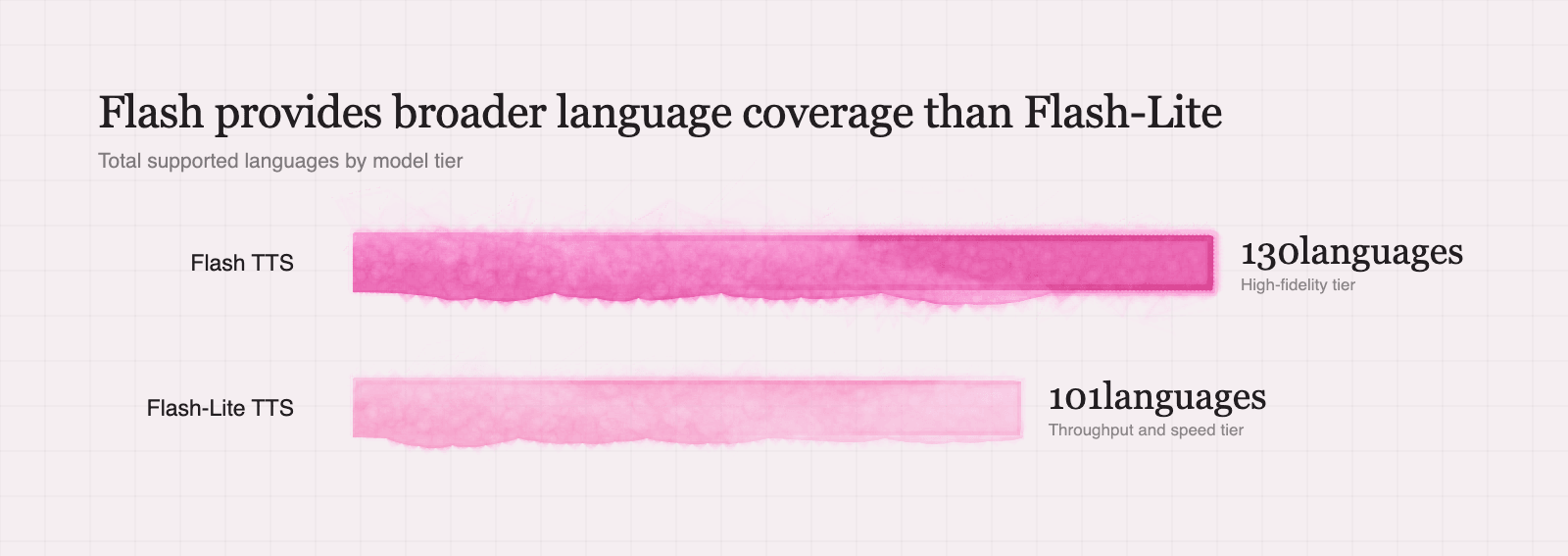
The language coverage gap compounds this. Flash covers 130+ languages; Flash-Lite covers 101+. The gap isn't just a count—it's which languages are missing. Lower-resource languages in the 101–130 range are precisely the ones where cross-locale voice transfer degrades most, because the model has less data to infer correct pronunciation and prosody from. A voice that's stable in English and French can break completely when asked to handle a dialect that only exists in the 130+ tier.
The mitigation is architectural, not a post-hoc fix. The pattern I'd reach for is locale-specific voice IDs: create a separate voice_id per language or language family from samples in that language, rather than forcing one persona across everything. The 30-second cloning process is cheap enough that a per-locale design is manageable—define the character once in the prompt, then adapt the voice description to each target language's acoustic requirements. For tonal languages, re-prompt the voice with locale-specific descriptors that encode the necessary tonal patterns, like "Mandarin-capable narrator with clean tone contours" rather than relying on the English sample to carry it. And build a multi-voice fallback: a set of pre-tested voice IDs per locale that you can switch between at runtime if one degrades.
stateDiagram-v2
    voice_id_english_base: Created from English sample
    voice_id_shifted: Forced into tonal language - accent flattening, formant drift
    voice_id_optimized: Re-prompted with locale-specific descriptors - restored acoustic stability

    voice_id_english_base --> voice_id_shifted: source-language mismatch (English sample → tonal language)
    voice_id_shifted --> voice_id_optimized: locale-aware re-prompting
    voice_id_optimized --> voice_id_english_base: multi-voice fallback (switch to original for English content)
    voice_id_shifted --> voice_id_english_base: multi-voice fallback (revert when degradation detected)
Flash vs Flash-Lite: Real Latency vs Long-Form Tradeoffs
The spec sheet says Flash-Lite is the low-latency model and Flash is the fidelity model, but that distinction obscures the real operational fight. Flash-Lite's speed advantage only materializes if you stream continuously, and continuous streaming conflicts with the lookahead requirement of natural-language direction. To infer prosody across a sentence boundary, the model needs to see enough context beyond that boundary to understand the emotional arc. Small chunks—ones that would give you a fast first audio token—deprive the model of that context, producing disjointed prosody where each sentence sounds like a separate performance with no continuity. The result is a paradox: the very thing that makes Flash-Lite fast also degrades the output quality to the point where it's not defensible for expressive content.
So when do you use Flash for real-time work? The answer is surprisingly often. For conversational agents where performance quality matters—the kind where a dead monotone response would undermine the product—Flash's richer prosody inference at short chunk sizes can actually produce a better-sounding real-time experience than Flash-Lite's faster but shallower rendering. The effective latency difference between them in an interactive setting is often smaller than the quality difference. Flash-Lite shines when latency is genuinely critical and the content is formulaic—read-aloud of a stock response, a weather brief, a simple confirmation. It falls apart when you need acting, and the acting is the product.
| Production-Critical Dimension | Gemini 3.8 Flash TTS | Gemini 3.8 Flash-Lite TTS | Cartesia (Sonic) | ElevenLabs (v3) |
|---|---|---|---|---|
| TTFA at small chunk sizes (1–2 sentences) | Higher (needs more context to infer prosody) | Lower (but prosody suffers from context deprivation) | Very low (<100–150ms, SSM-optimized) | Moderate (context-dependent) |
| TTFA at large chunk sizes (full paragraphs) | Competitive (lookahead satisfied, stable prosody) | Higher than expected (lookahead buffering dominates) | Very low (optimized for streaming regardless of chunk) | Moderate |
| Language coverage | 130+ | 101+ | ~15–30 | 30+ |
| Emotional expression fidelity | High (rich non-verbal cues, long-form stable) | Moderate (shallower prosody inference) | Low-moderate (focused on speed over acting depth) | High (deep domain tuning in acting) |
| Throughput for batch dubbing | Good (handles long-form steadily) | Excellent (parallel batch processing at high volume) | N/A (not designed for batch) | Good |
| Cost scalability | Higher (fidelity tier pricing) | Lower (high-volume cost-efficient) | Moderate | Higher (per-character pricing) |
| Streaming vs pre-rendered performance | Strong in pre-rendered, weaker in streaming | Strong in streaming, weaker in pre-rendered | Purpose-built for streaming | Strong in pre-rendered, weak in streaming |
The chunk-size-versus-prosody conflict is the real decision point. If your use case can tolerate a full paragraph as the smallest streaming unit, Flash-Lite gives you near-Flash quality at lower cost. If you need sub-sentence streaming for interruptions and turn-taking in a voice bot, Flash may actually be the better pick despite its higher nominal TTFA, because the prosody continuity at small chunks matters more than raw speed. Don't let the model name fool you—measure with your own prompts, not the marketing demo.
The Streaming Paradox: Buffering Cost for Emotional Accuracy
The instinct when building a voice agent is to stream aggressively: send three to five words per request, get audio back as fast as possible, start playback immediately. With prompt-directed TTS, that instinct is wrong. A three-word chunk carries no emotional arc. The model can't infer that a sentence is building toward exasperation if it only sees the first four words. It renders those four words with flat, disconnected prosody, and the next chunk renders with its own flat prosody, and the seams between them are audible as a performance that never establishes a character. You get the lowest possible time-to-first-audio and the worst possible listening experience.
The fix is lookahead, which means accepting latency you were trying to avoid. The model needs enough surrounding context—typically a full sentence or clause beyond the current boundary—to understand the trajectory before it commits to the first acoustic token. So the first request in a session is deliberately large: a batch containing the opening script plus lookahead context, enough for the engine to establish the emotional arc. Once that arc is set, you can shrink subsequent chunks because the model is now continuing a performance rather than inventing one from scratch. A shared prefix cache or session-level context holds the established prosody across requests, so chunk two inherits what chunk one established instead of re-deriving it.
The production pattern I'd build is a hybrid: pre-render the first line at build time for guaranteed-instant playback, then stream the continuation with lookahead buffered behind it. The user hears audio immediately, and by the time the pre-rendered opener finishes, the live stream has enough context to continue coherently.
sequenceDiagram
    participant C as Client
    participant B as Streaming Buffer
    participant G as Gemini 3.8 Flash-Lite TTS
    C->>G: Batch A - opening script + lookahead context
    Note over C,G: Buffer-size negotiation - large first batch to establish emotional arc
    G-->>B: First audio chunk returned
    B-->>C: Immediate playback from buffer
    C->>G: Subsequent request - smaller chunk, session context held
    Note over C,G: Post-arc chunks shrink because prosody continues, not re-invents
    G-->>B: Continuation audio streamed
    B-->>C: Gapless playback as buffer drains
The negotiation is the whole game: spend tokens and latency up front to establish the arc, then claw the speed back once the model has a performance to continue.
Cost, Billing, and Hidden Token Consumption
The billing model for prompt-directed TTS is dual-dimension, and that's where budgets quietly die. You're charged across input text tokens on one axis and generated audio seconds on the other. The audio axis is intuitive—you pay for what you generate. The text axis is the trap, because it counts everything you send, including directive text. Worse, directives embedded inline count as transcript tokens even when you strip them before synthesis, because the strip happens in your middleware, not in Google's meter. You pay for the tokens you deleted.
This means verbose inline directing tags are a direct cost leak. A script studded with [whispers, trembling, pauses, then continues with building intensity] inflates input token consumption substantially without adding a single second of output audio. The audio your user hears is the same duration; the bill is not. Compounding this, if you run retries—because directive leakage forced a re-generation, or because a watermark check failed—you pay the full dual-dimension cost again for the same content.
The optimization I'd reach for is moving directions into a separate metadata path that doesn't get billed as transcript. If your architecture sends script text and performance direction as distinct fields, the direction field still costs tokens on the text axis, but you're no longer paying to have the model parse inline cues out of transcript it was going to speak anyway. That's a real reduction, not a rounding error.
The second lever is pre-aggregating directives. Rather than repeating a cue per sentence, hoist it to the block level once—establish "narrator, warm and measured" at the top of a chapter, not at every paragraph. The model holds the established persona across the block via session context, so you pay for the persona description once instead of N times.
Third, design cost-aware prompts from the start: budget your directive token allowance per script length and treat it as a first-class constraint in prompt template design, the same way you'd cap a system prompt. And account for retry economics honestly—if a given script has a 15% regeneration rate due to cue ambiguity, your effective per-minute cost is 15% higher than the naive calculation, and fallback to a different tier during incidents carries its own token and audio costs. Bake that into the unit economics before you quote a price, or the margin surprise arrives with the first billing cycle.
Resources
Updated 2026-09-22 by Mehran Mozaffari.
Related posts
15 October 2026
Beyond Silence Timers: Dissecting TYGER and the Mechanics of Full-Duplex Voice Turn-Taking
10 September 2026
Qwen3-ASR 1.7B on Nari Labs: Inside a 40ms Streaming ASR Stack
3 September 2026
CPU-Only Speech AI: Squeezing Real ASR and TTS Out of Commodity Hardware
2 September 2026
MAI-Transcribe 2: The Hidden Gem in Speech-to-Text That Most Teams Are Overlooking
31 August 2026
PhoneLLM Alpha 1: A Deep Dive into the Low-Latency Voice Agent Brain
30 August 2026
PhoneLLM Alpha 1: A Deep Dive into Self-Hosted Voice AI