Agentic Design School

My Books

Four living books I write and maintain as the core curriculum of my Agentic Design School — released, not published. Each one is treated like software: updated regularly, versioned with release notes, and built in the open on GitHub.

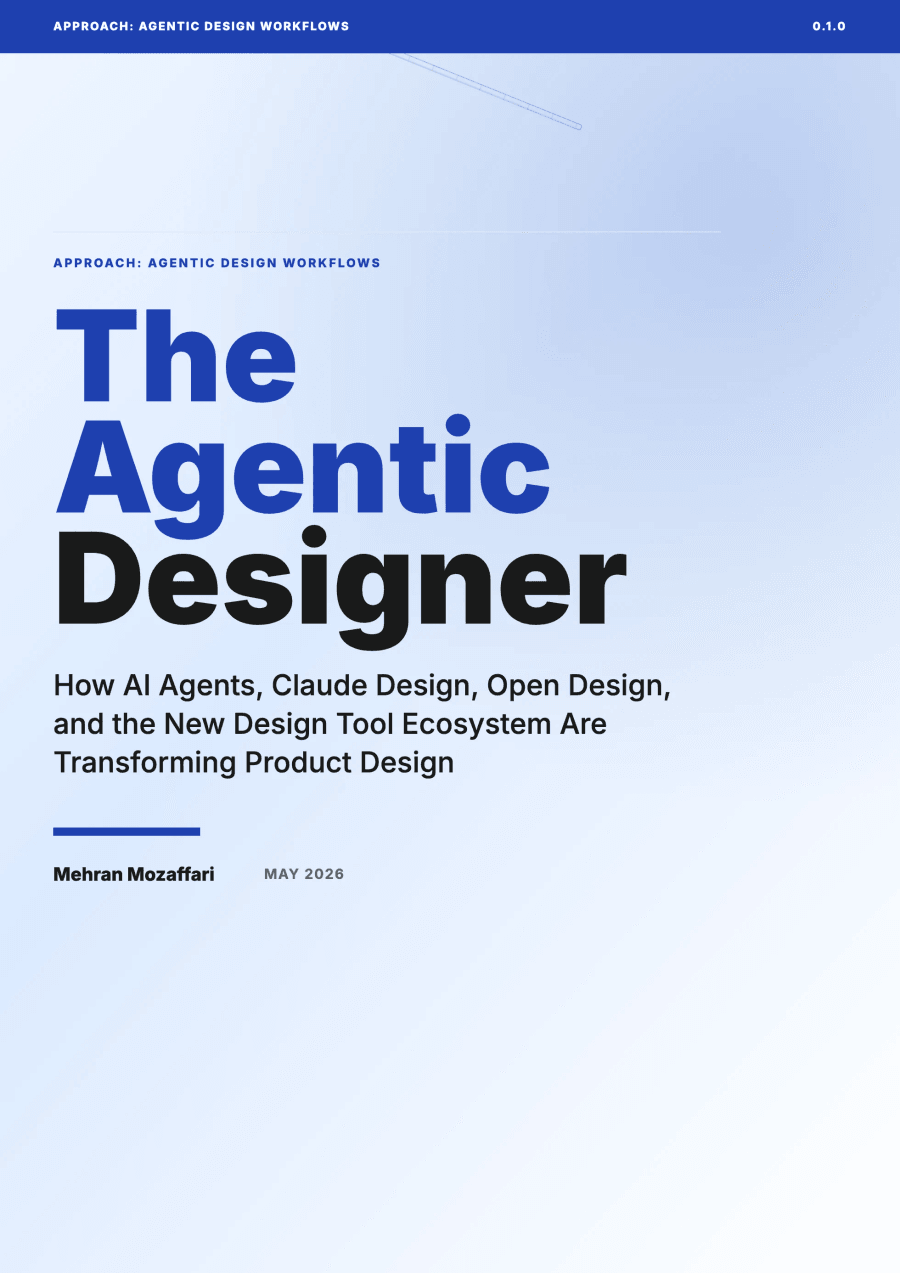
The Agentic Designer cover

The Agentic Designer

Mehran Mozaffari · 2026 · Fundamentals · 17 chapters · Free

The book I wrote for the moment design stopped being something you do only in a canvas. It covers the agentic design paradigm end to end: agent platforms, design-for-agents harnesses, design-as-code workflows, and orchestrating more than one agent without the work turning to mush.

It is written for two people at once — the designer who is curious about agents and suspicious of the hype, and the engineer building design tooling who needs to understand what designers actually protect. Both get the same material: how the operating model changes, what moves to code, what stays judgement.

Fourteen chapters plus three appendices of battle-tested prompts and copy-paste examples, and four real case studies written with honest assessments — including the parts that fell apart.

Contents17 chapters — show
  1. 01The Agentic Design Paradigm
  2. 02Your Agent Toolkit
  3. 03Teaching Agents to Design
  4. 04Design-as-Code
  5. 05Paper and Pencil
  6. 06Open Design and OpenPencil
  7. 07Huashu Design
  8. 08Design Systems and Tokens
  9. 09Motion and Video
  10. 10MCP Integrations
  11. 11Multi-Agent Design Teams
  12. 12Production UI from Design
  13. 13Real-World Case Studies
  14. 14The Future of Agentic Design
  15. 15Tool Comparison Matrix
  16. 16MCP Server Reference
  17. 17Prompt Library
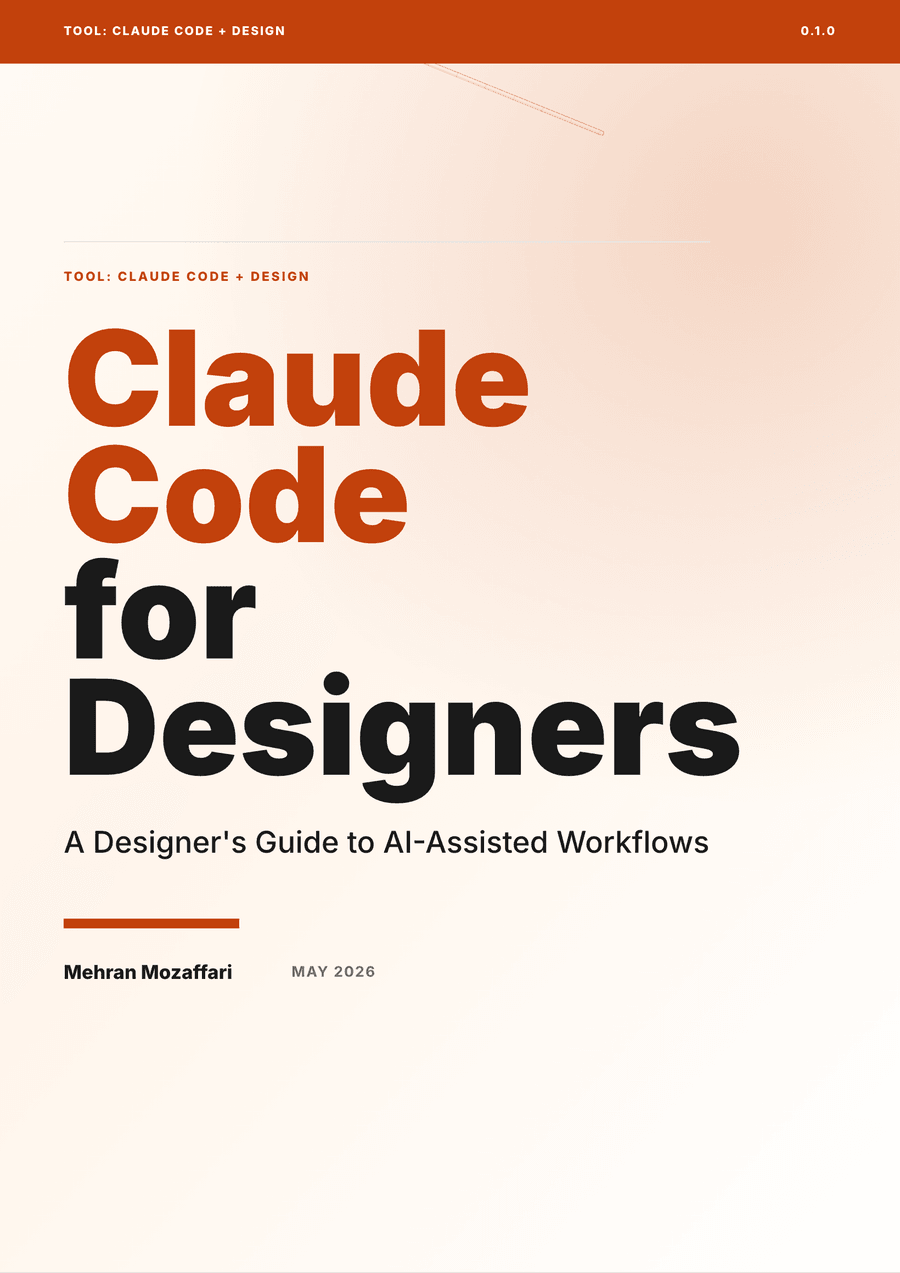
Claude Code for Designers cover

Claude Code for Designers

Mehran Mozaffari · 2026 · Hands-on · 13 chapters · Free

A practical roadmap for visual designers and product managers moving into design engineering. It starts where most guides refuse to: at the terminal, assuming no prior comfort with it, and gets you to a working prototype before asking you to understand anything clever.

From there it covers the parts that actually decide whether AI-assisted design work survives contact with a real project — prompting for design rather than for prose, teaching an agent your design language, tokens and design systems at scale, and the handoff from design to production.

Ten main chapters and three reference appendices, with prompt templates and step-by-step terminal guides. The goal throughout is to work directly with coding agents without turning the job into a programming manual, and without losing your designer sensibility.

Contents13 chapters — show
  1. 01The Design-Code Gap
  2. 02Getting Started (No Terminal Fear)
  3. 03Your First Design Prototype
  4. 04The Art of Prompting for Design
  5. 05Teaching Claude Your Design Language
  6. 06Design Systems at Scale
  7. 07Automating Design Workflows
  8. 08Connecting Your Design Tools
  9. 09From Design to Production
  10. 10The AI Design Tool Landscape
  11. 11Command Reference
  12. 12Pricing, Plans, and Limits
  13. 13Troubleshooting and FAQ
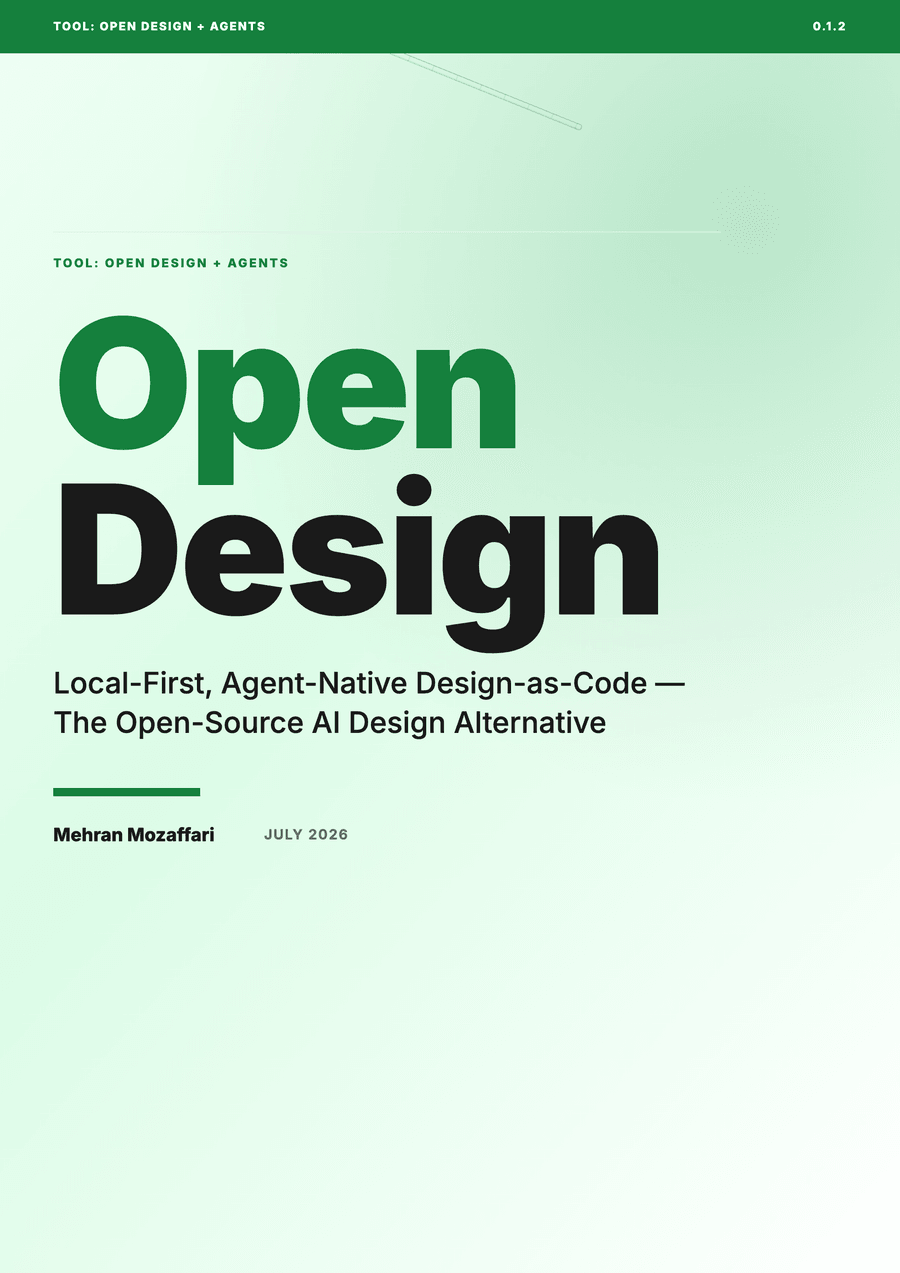
Open Design cover

Open Design

Mehran Mozaffari · 2026 · Design Systems · 20 chapters · Free

Open Design is an open-source design harness for AI coding agents, and this is its field guide. It runs locally — skills, DESIGN.md brand systems, plugins, an MCP server, and a sandboxed preview and export loop — so an agent can produce real design artifacts instead of describing them.

The argument underneath is about independence. Local-first and agent-native means your brand system, your components and your output pipeline stay yours: no vendor holds the file format, and no cloud service sits between an idea and a rendered artifact.

Sixteen chapters and four appendices, including 150 brand systems, the plugin ecosystem, multi-agent design teams, case studies, and an honest chapter on evaluating whether this stack is right for your organisation.

Contents20 chapters — show
  1. 01The Local-First Design Machine
  2. 02Install and Architecture
  3. 03Your First Artifact
  4. 04The Skills System
  5. 05150 Brand Systems
  6. 06Web and Mobile Prototypes
  7. 07Decks, Motion, and Images
  8. 08The Preview and Export Pipeline
  9. 09The Plugin Ecosystem
  10. 10The MCP Server
  11. 11Choosing Your Agent
  12. 12Multi-Agent Design Teams
  13. 13Case Studies
  14. 14Evaluating the Stack for Your Organization
  15. 15The Future of Local-First Autonomous Design
  16. 16Building Your Own Design Pipeline
  17. 17Command and CLI Reference
  18. 18Skills, Brand Systems, and Plugins Index
  19. 19Troubleshooting and FAQ
  20. 20A Visual Tour of the Open Design UI
Agentic Sport Analytics cover

Agentic Sport Analytics

Mehran Mozaffari · 2026 · Practitioner · 76 chapters · Free

The evidence-contract field guide: how to build automated sport analytics that you can actually defend. It is organised around five verbs — watching, tagging, modelling, interpreting, and acting — and it refuses to let a number travel without the provenance that earned it.

The full chain is here and measured, not asserted: capture and lens choice, homography and per-frame calibration under broadcast dynamics, detection and the AGPL licensing decision that comes with it, tracking and re-identification, segmentation with foundation models, 2D keypoints to 3D biomechanics, and spatio-temporal ball-trajectory recovery.

Then the harder half — simulation and counterfactuals done honestly, where vision-language models help and where they lie, the agent harness itself, a live coaching cockpit with real latency numbers, sensors and fusion, and a full chapter on deployment, licensing, rights and ethics. Everything is measured end to end on pickleball and rugby league, with a laboratory chapter for reproducing the book's claims yourself.

Contents76 chapters — show
  1. 01Watching
  2. 02Why This Book Exists: The Five Verbs of Sport Analytics
  3. 03The Evidence Contract & Data Provenance
  4. 04Sport Rules as Formal Systems
  5. 05Capture: Cameras, Lenses, Shutter, Placement
  6. 06Data Engineering for Sport Video
  7. 07Calibration I: Homography, Intrinsics, Distortion
  8. 08Calibration II: Broadcast Dynamics, GMC, and Per-Frame H_t
  9. 09Tagging
  10. 10Detection: YOLO, RF-DETR, and the AGPL Decision
  11. 11Tracking & Identity: Metrics, ReID, and Role Priors
  12. 12Segmentation & Foundation Models: SAM 2/3, DINOv3
  13. 13The Body in Motion: 2D Keypoints to 3D Biomechanics
  14. 14Smashing the Ball Wall: Spatio-Temporal Trajectory Recovery
  15. 15Identity: Who Is Who
  16. 16Multi-Camera Geometry, Line Calls, 3D Reconstruction
  17. 17Audio & Multimodal Cues: The Free Sensor
  18. 18Video Understanding: Action Recognition, Spatio-Temporal
  19. 19Event Data & the Common Representation
  20. 20Modelling
  21. 21Annotation: The Ground-Truth Workflow
  22. 22Automatic Eventing: State Machines, Confidence, Review Queues
  23. 23Statistics for Sport Practitioners
  24. 24Rating Systems: DUPR, ELO, Glicko, and Skill
  25. 25Expected Value: xG, VAEP, EPV, and Their Sport Transplants
  26. 26Tactical ML: Graphs, Equivariance, and Honest Forecasting
  27. 27Simulation & Counterfactuals: The Honest Rebuild
  28. 28Interpreting
  29. 29Where Vision-Language Models Help, and Where They Lie
  30. 30From Numbers to Narrative: Reports, Scouting, Coach UX
  31. 31The Agent Harness for Sport Analytics
  32. 32The Live Coaching Cockpit: Real-Time Systems, Honestly Measured
  33. 33Acting
  34. 34Practice Design & Interventions: The Acting Loop
  35. 35Sensors & Hardware: Wearables, Smart Courts, the Fusion Spine
  36. 36Deployment, Licensing, Rights & Ethics
  37. 37The Laboratory: Reproducing the Book's Claims
  38. 38The Frontier: What's Changing in 2025-2026
  39. 39The Book as a System: How to Use It (Human + Agent)
  40. 40The Claims Register
  41. 41The Book as a System
  42. 42The Frontier
  43. 43Why This Book Exists: The Five Verbs of Sport Analytics
  44. 44The Evidence Contract & Data Provenance
  45. 45Sport Rules as Formal Systems
  46. 46Capture: Cameras, Lenses, Shutter, Placement
  47. 47Data Engineering for Sport Video
  48. 48Calibration I: Homography, Intrinsics, Distortion
  49. 49Calibration II: Broadcast Dynamics, GMC, and Per-Frame H_t
  50. 50Detection: YOLO, RF-DETR, and the AGPL Decision
  51. 51Tracking & Identity: Metrics, ReID, and Role Priors
  52. 52Segmentation & Foundation Models: SAM 2/3, DINOv3
  53. 53The Body in Motion: 2D Keypoints to 3D Biomechanics
  54. 54Smashing the Ball Wall: Spatio-Temporal Trajectory Recovery
  55. 55Identity: Who Is Who
  56. 56Multi-Camera Geometry, Line Calls, 3D Reconstruction
  57. 57Audio & Multimodal Cues: The Free Sensor
  58. 58Video Understanding: Action Recognition, Spatio-Temporal
  59. 59Event Data & the Common Representation
  60. 60Annotation: The Ground-Truth Workflow
  61. 61Automatic Eventing: State Machines, Confidence, Review Queues
  62. 62Statistics for Sport Practitioners
  63. 63Rating Systems: DUPR, ELO, Glicko, and Skill
  64. 64Expected Value: xG, VAEP, EPV, and Their Sport Transplants
  65. 65Tactical ML: Graphs, Equivariance, and Honest Forecasting
  66. 66Simulation & Counterfactuals: The Honest Rebuild
  67. 67Where Vision-Language Models Help, and Where They Lie
  68. 68From Numbers to Narrative: Reports, Scouting, Coach UX
  69. 69The Agent Harness for Sport Analytics
  70. 70The Live Coaching Cockpit: Real-Time Systems, Honestly Measured
  71. 71Practice Design & Interventions: The Acting Loop
  72. 72Sensors & Hardware: Wearables, Smart Courts, the Fusion Spine
  73. 73Deployment, Licensing, Rights & Ethics
  74. 74The Laboratory: Reproducing the Book's Claims
  75. 75The Frontier: What's Changing in 2025-2026
  76. 76The Book as a System: How to Use It (Human + Agent)