
The O(4N) Coordinate Bottleneck in Vision-Language Grounding
Every time I profile a modern vision-language model deployed for GUI automation or document parsing—whether it is Florence-2, Qwen2.5-VL, or Qwen3-VL—the primary latency bottleneck traces back to the exact same design compromise: autoregressive coordinate tokenization.
To make bounding boxes digestible to standard causal language architectures, existing architectures discretize continuous spatial coordinates into vocabulary tokens. A bounding box is serialized as text integers or quantized spatial bins, formatted into strings like <box>[ymin, xmin, ymax, xmax]</box> or discrete indices from <loc0> to <loc1000>. Because the model treats spatial localization as an ordinary next-token prediction task, predicting a single object box requires four serial forward passes through the LLM decoder.
Token 1 (ymin) → Token 2 (xmin) → Token 3 (ymax) → Token 4 (xmax)
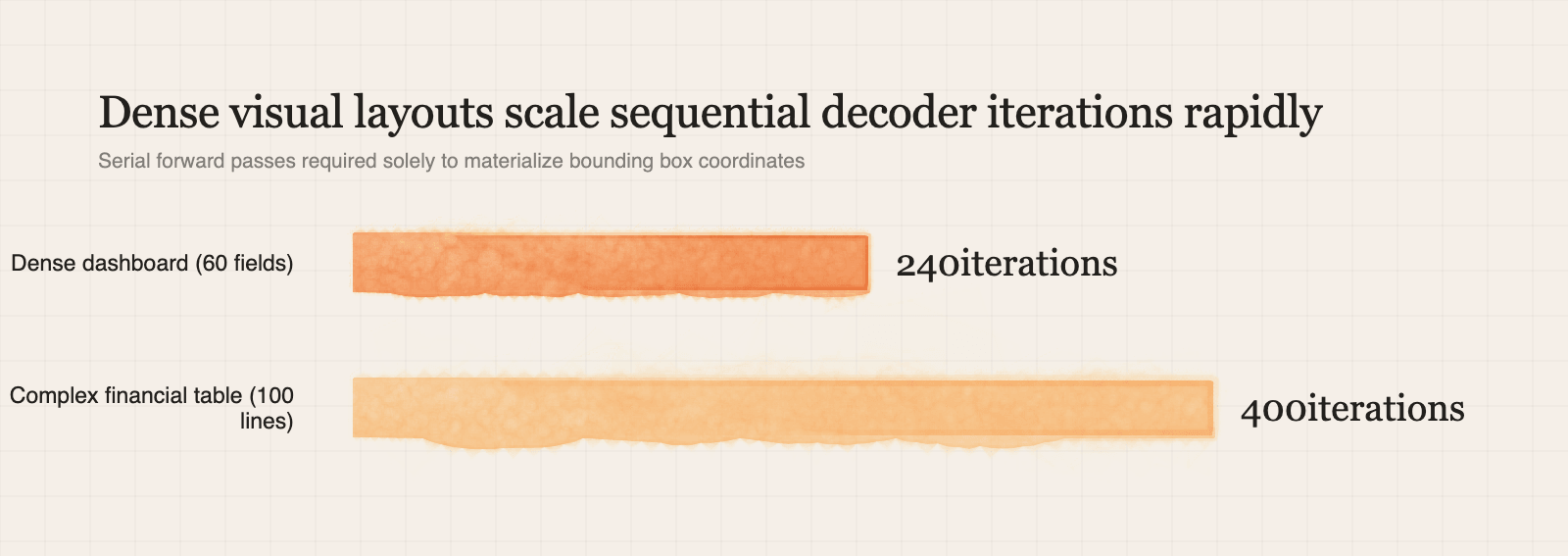
In academic benchmarks with two or three isolated referring targets, this $O(4N)$ computational tax stays hidden. But the moment you drop an autoregressive VLM onto a dense enterprise interface or a multi-column document, the architecture collapses under its own sequential weight. A dense dashboard with 60 clickable icons and form fields demands at least 240 serial decoder iterations solely to materialize coordinates. A complex financial table or invoice containing 100 text lines requires 400 forward passes. The vision encoder processes the visual features in a single forward step, but the text decoder spends seconds crawling sequentially across coordinate tokens, pinning GPU compute and destroying real-time interactivity.
The second, more insidious penalty of autoregressive coordinate generation is geometric incoherence through cascading token drift. In standard causal language modeling, each token is conditioned on all preceding sampled tokens:
$$P(x_{\text{max}} \mid y_{\text{min}}, x_{\text{min}}, y_{\text{max}})$$
If subtle noise or floating-point variance causes the sampling distribution to place $y_{\text{min}}$ slightly off-target, that spatial error is immediately baked into the KV cache. The subsequent tokens condition directly on that corrupted initial coordinate. The downstream coordinates often compensate aggressively to satisfy learned semantic prior ratios, resulting in collapsed bounding boxes, inverted dimensions, or skewed aspect ratios. As I've observed when integrating post-processing layers in Supervision at 50k Stars: A Deep Dive into the Post-Processing Layer That Makes Vision Models Usable, heuristic cleaning cannot salvage boxes whose fundamental geometry was mangled by autoregressive drift. Treating an inherently continuous, four-dimensional geometric primitive as an autoregressive Markov chain has always been a square peg in a round hole.
Deconstructing LocateAnything: MoonViT, Qwen2.5-3B, and Atomic Box Heads
NVIDIA LocateAnything-3B addresses this bottleneck by abandoning discrete coordinate binning in favor of an atomic geometric regression architecture. Rather than forcing an LLM to play text-tokenizer games with continuous space, the model couples a high-capacity vision encoder to a lightweight language core, then bifurcates the output into parallelized prediction heads.
flowchart TB
  top["MoonViT-SO-400M Vision Encoder via 2-Layer MLP Projector"]
  a["Autoregressive Causal Language Head"]
  b["Qwen2.5-3B-Instruct Transformer Backbone"]
  c["Atomic Parallel Box Decoding Regression Head"]
  base["Dual Prediction Stream: Discrete Text Tokens and Continuous Box Coordinates"]
  top --> a & b & c
  a & b & c --> base
The vision component relies on MoonViT-SO-400M, a 400-million-parameter vision transformer specifically optimized for high-resolution feature preservation and spatial token fidelity. In dense GUI layouts and micro-typography, generic low-resolution vision backbones smudge sub-16-pixel icons and table borders into undifferentiated patch latents. MoonViT-SO-400M preserves patch-level geometric fidelity, outputting dense spatial visual tokens that capture subtle pixel boundaries.
These visual features pass through a lightweight 2-layer MLP projector that matches the visual embedding dimensionality to the input latent space of Qwen2.5-3B-Instruct. Choosing a 3-billion-parameter language core is an intentional design choice for edge and local workstation deployment. At 3B parameters, the model easily fits within 8 to 12 GB of VRAM in FP16 or INT8 precision, making local execution on single workstation GPUs entirely viable.
The core mechanical breakthrough sits at the output layer of the Qwen2.5-3B backbone. Standard grounding VLMs route all hidden states through a single linear head mapped to the vocabulary tokenizer. LocateAnything-3B introduces a structural fork:
- Autoregressive Causal Language Head: A conventional linear projection layer producing vocabulary logits for dialogue, reasoning chains, and conversational context.
- Parallel Box Decoding (PBD) Regression Head: A dedicated non-autoregressive regression module that directly ingests the backbone's cross-attended latent states and emits continuous normalized four-dimensional bounding vectors $[y_{\text{min}}, x_{\text{min}}, y_{\text{max}}, x_{\text{max}}] \in [0, 1]^4$ in a single forward pass.
By predicting all four coordinates simultaneously as an atomic continuous vector, the model eliminates the causal dependency that causes aspect ratio collapse. The regression head predicts the full bounding envelope natively, treating coordinates as coupled geometric boundaries rather than four isolated linguistic terms. Furthermore, this regression head works on top of pre-training across the massive LocateAnything-Data corpus (138 million language queries mapped across 785 million bounding boxes), providing the spatial priors necessary to handle referring expressions, UI icons, and OCR layouts without relying on autoregressive trial-and-error.
Fast, Slow, and Hybrid Decoding: How PBD Breaks the Sequential Tax
To balance real-time throughput with edge-case spatial disambiguation, LocateAnything-3B implements three distinct decoding regimes: Fast Mode, Slow Mode, and Hybrid Mode.
stateDiagram-v2
    [*] --> FastPBD: Receive Visual Query
    FastPBD: Atomic Parallel Box Decoding (Fast Mode)
    FastPBD --> EvaluateConfidence: Emit Atomic Box Candidates

    state EvaluateConfidence <<choice>>
    EvaluateConfidence --> HighThroughputEmission: Confidence >= Threshold
    EvaluateConfidence --> FallbackSlowMode: Spatial Ambiguity or Confidence < Threshold

    HighThroughputEmission: High-Throughput Output Stream
    HighThroughputEmission --> FastPBD: Next Grounding Target
    HighThroughputEmission --> [*]: Query Complete

    FallbackSlowMode: Slow Mode Autoregressive Next-Token Prediction
    FallbackSlowMode --> VerifyAndRecover: Sequential Coordinate Verification

    VerifyAndRecover: Boundary Disambiguation
    VerifyAndRecover --> HighThroughputEmission: Context Resolved
    VerifyAndRecover --> FastPBD: State Recovery (Return to Parallel Emission)
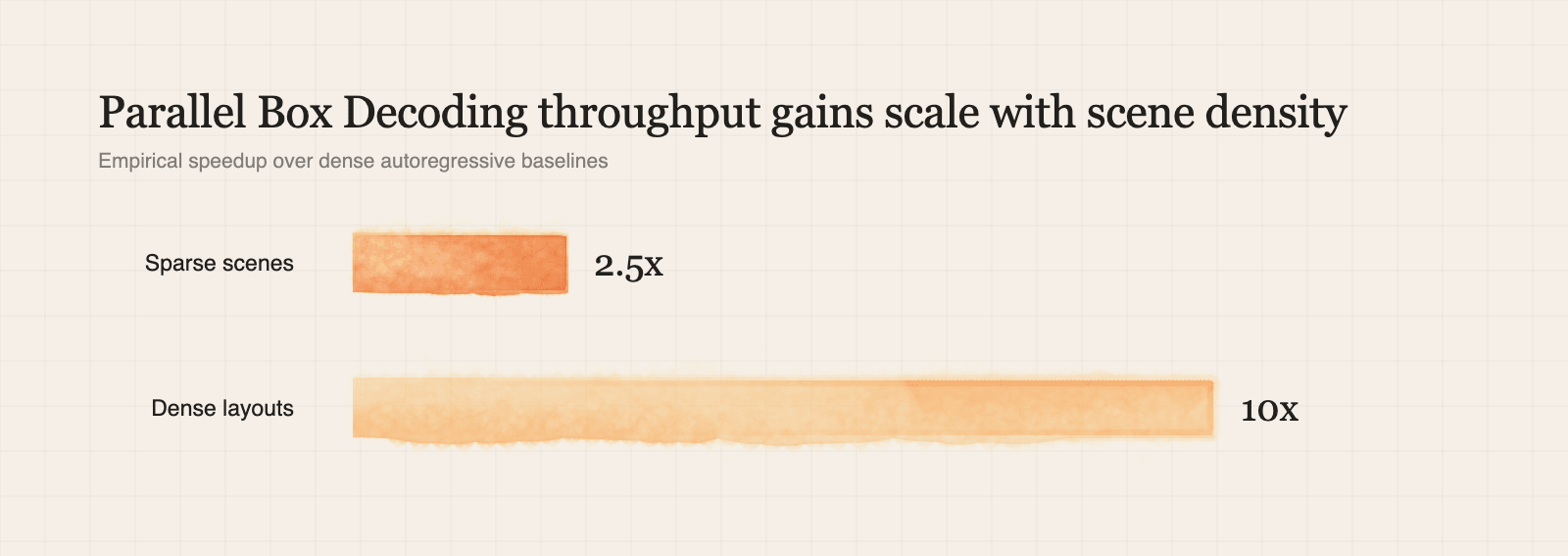
Fast Mode enforces pure Parallel Box Decoding. Instead of paying the $O(4N)$ serial tax, the model executes a single forward pass to emit the atomic box coordinates. On dense targets, this transforms box emission from an iterative autoregressive loop into parallel tensor operations. On an NVIDIA H100 GPU, Fast Mode achieves sustained throughputs of approximately 12.7 boxes per second. Compared against dense autoregressive baselines like Qwen3-VL, this yields empirical speedups ranging from $2.5\times$ on sparse scenes up to $10\times$ on densely packed document layouts and complex application interfaces. The throughput scaling factor directly correlates with target density: the more boxes requested per image, the wider the performance gap grows against autoregressive baselines.
Slow Mode preserves legacy autoregressive tokenization. The model reverts to token-by-token Next-Token Prediction across spatial coordinate bins. While Slow Mode sacrifices the $10\times$ throughput dividend, it retains full causal attention across every generated coordinate, functioning as a fallback mechanism for fine-grained verification.
Hybrid Mode is the default production runtime. The engine routes all incoming visual grounding prompts through the atomic PBD regression head first. As the regression head computes bounding coordinates, an internal confidence evaluation module scores the candidate box against two criteria:
- Prediction margin and regression confidence across the visual patch latents.
- Spatial ambiguity metrics, specifically detecting unresolvable overlapping boundaries or multi-entity occlusion.
When the confidence score meets or exceeds the operating threshold, Hybrid Mode streams the continuous box coordinates directly to the client at maximum throughput. If visual clutter, occlusion, or ambiguous phrasing drops the confidence score below the threshold, the runtime branches dynamically to Slow Mode. The autoregressive causal head activates to perform sequential token generation, disambiguating the bounding perimeter step-by-step. Once the ambiguous region is parsed, the runtime recovers back to the high-throughput parallel emission state for subsequent targets.
The operational reality I watch closely with Hybrid Mode is tail-latency jitter. In synchronous UI automation loops where predictable frame pacing is mandatory, dynamic fallback causes the decoding clock to drop from sub-100ms parallel emission down to multi-second autoregressive generation on noisy frames. For hard real-time SLAs, locking the runtime explicitly to Fast Mode—and pairing it with an external verification heuristic—is often far safer than accepting unpredictable P99 latency spikes in production.
Architectural Positioning: PBD vs. DETR Detectors vs. Autoregressive VLMs
When evaluating where LocateAnything-3B belongs in an inference stack, I view visual grounding as pulled between three distinct engineering philosophies: dedicated set-prediction detectors, modular GUI and document parsers, and generalist autoregressive vision-language models.
On one extreme sit dedicated object detectors like Grounding DINO and YOLO-World. By executing bipartite matching through Hungarian loss over fixed sets of continuous bounding queries, they achieve unmatched real-time throughput—often running at 30 to 60 frames per second on commodity edge hardware. But their operational ceiling is brutally low: they lack a general language backbone. You can ask Grounding DINO to locate "blue submit button," but ask it to locate "the cancel button that triggers an irreversible charge," and the model breaks down because it cannot reason across multi-step visual semantics. As I've explored when configuring multi-stage tracking pipelines in The $720-Per-Hour Trap: How to Actually Build a Basketball AI Pipeline on RF-DETR, BoT-SORT, and a VLM, pairing a fast detector with a downstream reasoning layer is always an option, but it fragments state management across multiple models.
To bridge that gap without full end-to-end VLMs, engineering teams frequently assemble modular pipelines like OmniParser, stitching together YOLOv8 icon detectors, PaddleOCR engines, and an external LLM planner. While modular pipelines avoid the latency of running vision transformers on every token, they introduce compounded inference latencies, boundary synchronization overhead, and semantic blindness—the vision detector cannot leverage the LLM's world model during initial localization.
Pure autoregressive VLMs like Qwen2.5-VL and Florence-2 solve semantic fusion by unifying everything under next-token prediction. Their reasoning capabilities are fluid, and they drop straight into standard serving infrastructure like vLLM. Yet they pay the catastrophic $O(4N)$ tokenization tax on every dense layout.
LocateAnything-3B stakes out an aggressive middle ground. It preserves the conversational reasoning and arbitrary text conditioning of Qwen2.5-3B while borrowing the atomic spatial regression philosophy of dedicated detectors via Parallel Box Decoding. However, this hybrid design imposes a steep infrastructure penalty: because PBD decouples box regression from standard causal token generation, you cannot deploy it on vanilla vLLM or TensorRT-LLM without custom Triton kernels or Eagle forks. It trades upstream framework portability for localized coordinate throughput.
| Paradigm | Exemplar Models | Coordinate Representation | Decoding Latency / Throughput | Conversational Reasoning | Architectural Serving Standardization |
|---|---|---|---|---|---|
| Pure Autoregressive VLMs | Qwen2.5-VL, Florence-2 | Quantized text tokens (<loc0>–<loc1000> or raw text numbers) |
High latency; $O(4N)$ serial next-token forward passes per box | Full multi-turn dialogue, native tool calling, and interleaved reasoning | High; runs natively on vLLM, SGLang, and Hugging Face |
| DETR-Style Set Detectors | Grounding DINO, YOLO-World | Continuous float vectors $[x, y, w, h]$ | Ultra-low latency; single-pass Hungarian-matched set prediction (30–60+ FPS) | Minimal to none; rigid phrase matching without multi-step causal reasoning | High for specialized vision runtimes (TensorRT, ONNX), non-LLM serving |
| Modular GUI Parsers | OmniParser (YOLOv8 + OCR) | Pipelined: discrete detector boxes + extracted text strings | Medium-to-high latency; multi-model pipeline orchestration overhead | Pipelined; external LLM handles reasoning over parsed element trees | High for individual microservices, poor for unified atomic deployment |
| Hybrid Atomic VLMs | LocateAnything-3B | Atomic continuous vectors via PBD regression head (with token fallback) | Low latency in Fast Mode (~10× faster than autoregressive); variable in Hybrid | Moderate-to-high; Qwen2.5-3B language core with free-form queries | Low; requires custom PBD kernels, unsupported by stock vLLM or SGLang |
Failure Modes Under Pressure: Latency Jitter, Tiny Targets, and Spatial Occlusion
While the throughput gains of Parallel Box Decoding look compelling on synthetic benchmarks, deploying LocateAnything-3B into production exposes sharp failure boundaries that every operator must anticipate.
The most disruptive operational hazard is tail-latency jitter under Hybrid Mode. The default runtime promises the best of both worlds—PBD throughput on obvious boundaries with autoregressive Next-Token Prediction fallback when confidence dips. In production, this creates catastrophic P99 variance. When a web agent navigates from a clean landing page into a visually cluttered modal or an obfuscated canvas, the drop in regression confidence triggers the autoregressive causal head. A decoding loop operating smoothly at 12 to 15 boxes per second suddenly stalls by an order of magnitude, dropping to standard sequential token generation. In real-time browser automation or interactive agent loops, that 2.5× to 10× latency spike breaks synchronous client timeouts and unpredictably stretches execution budgets. If an automation harness requires predictable frame pacing, locking the engine strictly to Fast Mode and handling ambiguity through downstream application logic is vastly preferable to permitting runtime fallback.
Fast Mode, however, introduces its own failure mode: spatial hallucination and duplicate clustering under visual occlusion. Because the atomic regression head emits bounding vectors in parallel without passing through an explicit Non-Maximum Suppression (NMS) layer or sequential token conditioning, it cannot autoregressively suppress overlapping candidates. In dense multi-column spreadsheets, fine-grained OCR documents, or complex desktop interfaces where elements nest inside containers—such as icons inside nested modals—the parallel head frequently generates duplicated, slightly offset bounding envelopes or coalesces adjacent distinct entities into a single bounding perimeter. Relying solely on internal cross-attention to resolve spatial overlap without Hungarian matching or NMS creates brittle outputs on crowded screens.
Hardware resolution and patch token granularity present a second mechanical ceiling. MoonViT-SO-400M offers excellent spatial fidelity compared to standard generic vision transformers, but it remains bounded by its underlying patch token grid. On high-DPI desktop viewports—such as a 4K display where interactive controls like window-close buttons, micro-favicons, or table sorting chevrons occupy an area of 8 to 14 pixels—the target geometry collapses below the patch embedding resolution. The projection layers blur these sub-character targets into adjacent pixel latents, causing the atomic regression head to emit drifting coordinates that miss the actual click target by several pixels. Without an upfront tiling or dynamic crop-and-zoom pre-processing pipeline, native screen grounding on 4K layouts remains unreliable.
Finally, the 3-billion-parameter language core imposes strict cognitive limits on multi-hop spatial reasoning. While Qwen2.5-3B reliably parses direct semantic targets ("Settings tab", "Export to CSV"), it degrades sharply when queries demand compositional spatial reasoning. If a prompt requires chaining multiple spatial conditions—such as "click the third checkbox below the active blue filter that is not disabled"—the 3B backbone lacks the working memory and relational depth to resolve the dependency chain. It frequently grounds the first matching visual primitive rather than the correct contextual element.
Running LocateAnything in Production: Custom Serving, VRAM Budgets, and Licensing
Deploying LocateAnything-3B outside a local research script immediately exposes infrastructure friction that standard model benchmarks gloss over. The most urgent barrier is engine compatibility. The modern inference ecosystem—vLLM, TensorRT-LLM, SGLang, and TGI—is optimized for standard autoregressive causal language modeling over vocabulary logits. These runtimes achieve high throughput through continuous batching and PagedAttention over token-based KV caches. Because Parallel Box Decoding branches latent states into an auxiliary continuous regression MLP, stock serving engines simply do not know what to do with it. You cannot stand up an off-the-shelf vLLM endpoint with nvidia/LocateAnything-3B without either falling back to slow token generation or writing custom Triton kernels and fork extensions based on the NVlabs/Eagle codebase. In practice, running PBD today means maintaining a custom PyTorch or Triton Inference Server container with dedicated worker processes.

Memory planning introduces another sharp constraint. On paper, a 3-billion-parameter backbone is refreshingly lightweight—requiring roughly 6 GB in FP16 or under 4 GB in quantized formats. But the vision processing pipeline shifts the memory equation drastically when ingesting full-resolution desktop displays or scanned documents. MoonViT-SO-400M computes patch embeddings that preserve spatial fidelity, which means feeding an uncompressed 4K screen (3840×2160) can swell the visual prefix into 2,000 to 2,500+ visual tokens per frame before generation even begins. The prefill memory and KV-cache allocations required for these long multi-modal sequence lengths easily push activation overhead beyond 10 GB. While an isolated prompt fits comfortably on a workstation GPU, scaling to concurrent request batches quickly exhausts the 24 GB VRAM ceiling of commodity hardware like an RTX 4090 or A10G, triggering out-of-memory crashes unless you enforce strict batch limits or aggressive dynamic downsampling.
The final hurdle is legal. While NVIDIA published the model integration code under the permissive Apache 2.0 license, the model checkpoint weights on Hugging Face are restricted under the NVIDIA Research License. This license prohibits direct commercial utilization without a separate commercial agreement from NVIDIA. For engineering teams building commercial agent platforms or document processing SaaS products, dropping these weights straight into production is a non-starter. Permissive alternatives like Florence-2 (MIT) or Qwen2.5-VL (Apache 2.0) remain the default choices for commercial deployment, leaving LocateAnything-3B best suited for academic research, internal prototyping, or generating high-accuracy offline pseudo-labels to distill into commercially licensed architectures.
| Model | Runtime Engine Compatibility | GPU Memory Footprint (High-Res/4K) | Commercial Licensing Viability |
|---|---|---|---|
| LocateAnything-3B | Custom only; requires dedicated Triton/PyTorch workers or Eagle forks (unsupported by stock vLLM) | ~14–18 GB VRAM under 4K visual token prefill; volatile under concurrency | Restricted; NVIDIA Research License (non-commercial only without enterprise agreement) |
| Qwen2.5-VL (3B/7B) | Native; fully supported in vLLM, SGLang, and Hugging Face pipelines | ~12–16 GB VRAM; heavy KV-cache expansion over long coordinate token chains | Permissive; Apache 2.0 allows unrestricted commercial deployment |
| Florence-2 (Base/Large) | Specialized; requires custom Hugging Face pipeline wrappers, but well-integrated | ~4–8 GB VRAM; highly compact sequence lengths with lightweight vision representations | Permissive; MIT license allows full commercial integration and redistribution |
Applied System Patterns: Building Robust Grounding Pipelines
To turn LocateAnything-3B into a dependable engine, an architecture must actively mitigate its known vulnerabilities: sub-pixel drift on micro-targets, boundary merging in dense parallel decoding, and prefill memory bloat.
For teams building a low-latency local desktop GUI automation agent, the objective is a sub-150ms OS-level interaction loop that maps user instructions directly to desktop click coordinates on high-resolution viewports. Serving LocateAnything-3B in a dedicated Triton container pinned strictly to Fast Mode avoids the unpredictable P99 latency spikes that occur when default Hybrid Mode encounters visual clutter. However, to prevent sub-pixel coordinate drift on tiny icons under 16 pixels—which vanish inside MoonViT patch aggregations—the pipeline should place an upstream dynamic viewport cropping utility ahead of the model. By slicing the active application window into focused bounding regions before passing them to the visual encoder, the system preserves click accuracy before routing resolved coordinates to the OS mouse-event dispatcher.
Document automation presents a different challenge. In a high-throughput complex document and table boundary parser, the pipeline must ingest dense multi-column layouts, invoice grids, and form boundaries at tens of pages per second without being strangled by serial coordinate tokens. Here, the LocateAnything-3B PBD regression head can run at full throttle, emitting bounding boxes in parallel batches. To compensate for PBD’s tendency to merge adjacent bounding envelopes across tightly spaced tabular data—where parallel regression skips inter-token boundary conditioning—the architecture should feed the emitted candidate boxes into an Apache 2.0 layout graph assembler paired with a local PaddleOCR worker. The OCR worker provides character-level anchor boundaries, allowing the downstream assembler to snap and split merged model outputs against ground-truth text contours.
Finally, for developers implementing a real-time open-vocabulary video stream object grounder, continuous frame processing demands tight latency and memory management. Running full vision-language inference on every video frame is an anti-pattern; continuous MoonViT visual token allocations create immense GPU prefill memory pressure that rapidly exhausts a 24 GB card. Instead, host LocateAnything-3B with warm worker pools to process sampled keyframes, resolving open-vocabulary textual queries into spatial anchors. Then, feed those bounding envelopes directly into a lightweight tracker like ByteTrack to interpolate coordinates across intermediate frames at interactive rates. Similar to the temporal separation patterns explored in What I Learned Stitching Together Homography, Tracking, and Temporal Detection in a Custom Vision Pipeline, decoupling semantic visual localization from frame-by-frame coordinate tracking gives you the semantic agility of an advanced generalist grounding model while maintaining smooth, real-time throughput.
Resources
Updated 2026-09-27 by Mehran Mozaffari.
Related posts
22 September 2026
Audio8 ASR Infinite: What It Actually Takes to Listen Forever
14 September 2026
Supervision at 50k Stars: A Deep Dive into the Post-Processing Layer That Makes Vision Models Usable
9 September 2026
What I Learned Stitching Together Homography, Tracking, and Temporal Detection in a Custom Vision Pipeline
8 September 2026
Basketball ReID Done Right: The Case for a Three-Tier Tracking Stack
8 September 2026
The $720-Per-Hour Trap: How to Actually Build a Basketball AI Pipeline on RF-DETR, BoT-SORT, and a VLM
8 September 2026
Monocular Tennis Analytics: What a Single iPhone Actually Can and Can't Measure