
Beyond the Chat Loop: Joining WebRTC Rooms as a Native Peer
Every attempt I have seen to shoehorn real-time voice into classic web architectures eventually crashes against the same wall: the request-response chat loop. Web developers naturally gravitate toward standard HTTP endpoints or raw WebSocket connections, treating audio as discrete chunks of binary data routed through a backend translation gateway. But audio is not serialized JSON with extra bytes. The moment you introduce bidirectional duplex communication—where human and machine must negotiate speaking turns, micro-pauses, and overlapping utterances within a sub-500-millisecond window—traditional transport abstractions collapse under jitter, buffering delays, and clumsy connection handshakes.
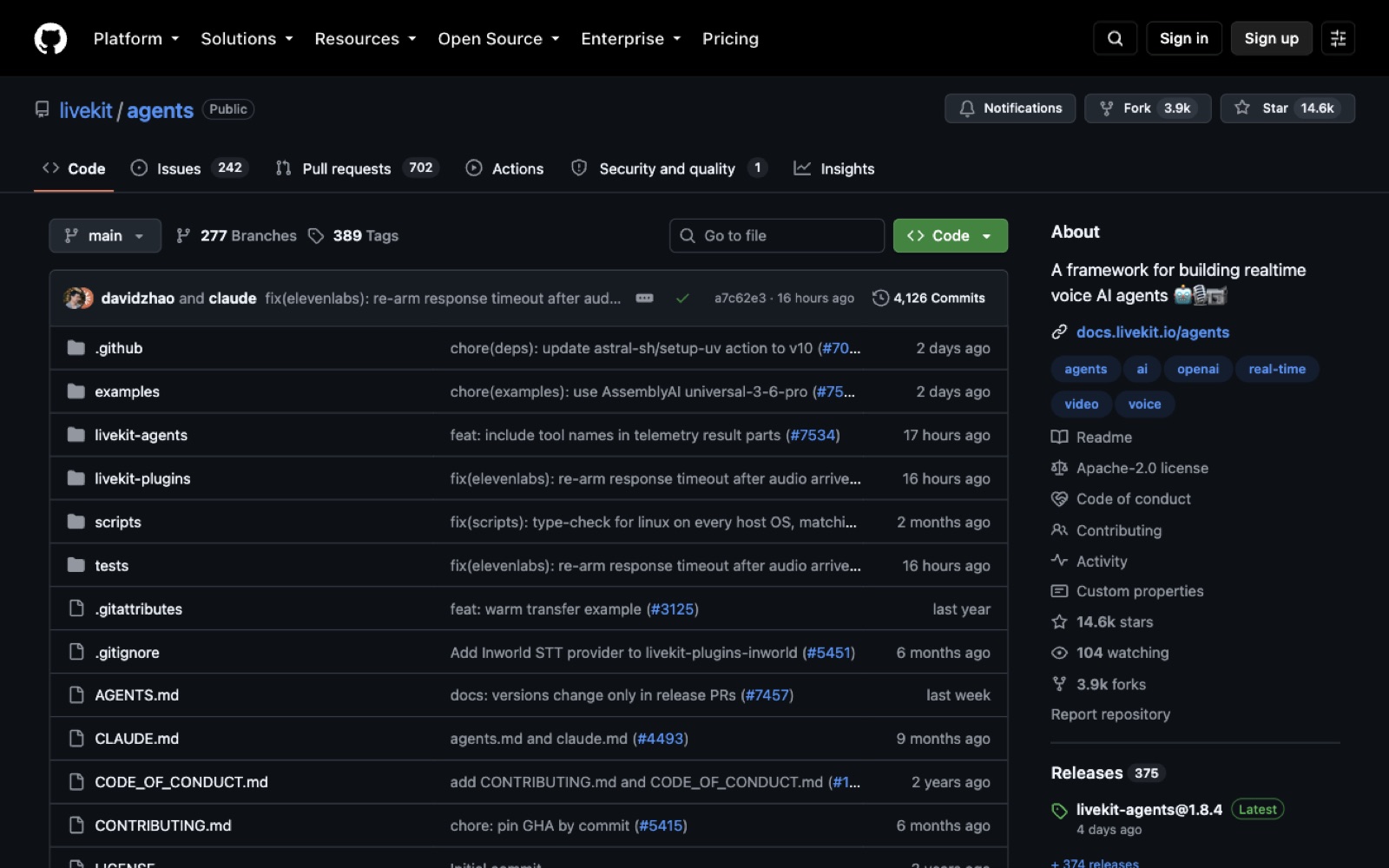
LiveKit Agents breaks out of this trap by fundamentally changing the agent's role in the topology: the agent is not a bot listening behind an API gateway; it joins the Selective Forwarding Unit (SFU) as a native WebRTC peer.
                                 ┌────────────────────────┐
                                 │   LiveKit SFU Room     │
                                 │  (Media Router / RTP)  │
                                 └────┬──────────────┬────┘
                 WebRTC Media Tracks  │              │  Subscribed / Published
               (Opus Audio, H.264/VP8)│              │  Raw RTP Tracks
                                      ▼              ▼
                               ┌─────────────┐ ┌─────────────┐
                               │ End Client  │ │ Agent Worker│
                               │ (Mic / Cam) │ │  (Runtime)  │
                               └─────────────┘ └─────────────┘
When an agent worker boots inside the livekit-agents runtime, it does not poll a job queue or open a bespoke WebSocket tunnel to the browser. It publishes and subscribes directly to Real-time Transport Protocol (RTP) media tracks inside an active LiveKit room. By interacting directly with the SFU at the media layer, the worker inherits the entire battle-tested suite of WebRTC network primitives without custom engineering:
- Native jitter buffers,
- Forward Error Correction (FEC),
- Negative Acknowledgement (NACK) packet-retransmission requests, and
- Dynamic bandwidth adaptation.
Subscribing directly to raw media tracks means the worker consumes the user's incoming microphone stream and camera or screen-share feeds as synchronized RTP streams. Conversely, the agent generates and publishes its own synthetic audio and video tracks straight back to the room. This eliminates transcoding hops and translation proxies.
More importantly, it unlocks arbitrary multi-party topologies that would otherwise require monstrous backend orchestration. Because the agent is merely another participant in the room roster, sessions are not restricted to rigid 1:1 client-server tunnels. A single room can host two human participants, a real-time translator agent listening to one track and publishing to another, and an autonomous assistant tracking the conversation. In Beyond Prompt Coaxing: Why the Deterministic Harness Is the Real Architecture of Production AI Agents, I argued that the deterministic harness wrapping a model dictates operational viability far more than prompt phrasing. Joining an SFU as a native peer is the media-layer realization of that principle: you stop treating connectivity as a custom application-level problem and anchor the agent directly into real-time infrastructure.
Cascaded Pipeline vs. Native Multimodal: Latency Compounding and Interruption Thrashing
When architecting a conversational voice agent, the most consequential design choice is whether to deploy a modular cascaded pipeline—Speech-to-Text (STT) into an LLM into Text-to-Speech (TTS)—or bind directly to a native speech-to-speech multimodal model such as the OpenAI Realtime API or Gemini Multimodal Live.
The cascaded pipeline offers provider sovereignty and cost control. You can pair Deepgram for sub-150ms transcription, a fine-tuned open-weights model for reasoning, and Cartesia or ElevenLabs for expressive speech synthesis. However, cascaded pipelines pay a punishing arithmetic penalty. The total turn-to-turn latency compounds across every interface boundary:
$$\text{Total Latency} = \text{Audio Buffer Capture} + \text{STT Streaming Latency} + \text{LLM Time-To-First-Token} + \text{TTS First-Frame Synthesis} + \text{WebRTC Ingest}$$
Under pristine network conditions, a well-tuned cascaded pipeline can hit 700 to 900 milliseconds. But when network jitter or provider queueing spikes, turn latency quickly slips past 1.5 seconds. In voice interfaces, this creates conversational deadlock: the human assumes the system died and says, "Hello?", right as the LLM's first token batch arrives at the TTS engine.
Native speech-to-speech models bypass this compounding tax by operating directly on incoming audio tokens and streaming synthesized audio out, slashing perceived turn latency down to 300 to 500 milliseconds. But regardless of model architecture, the true crucible of real-time conversational voice is turn detection and interruption handling.
Without robust hardware or software Acoustic Echo Cancellation (AEC) on the client, the agent’s own TTS output playing through the user’s speakers leaks directly into the microphone track. A naive Voice Activity Detection (VAD) module will detect incoming acoustic energy, assume the user is trying to speak, and cut off the agent mid-word. This induces "interruption thrashing," where the agent repeatedly silences itself on its own acoustic feedback.
sequenceDiagram
    autonumber
    actor User as User Microphone
    participant Room as LiveKit Room (SFU)
    participant Worker as Agent Worker Runtime
    participant VAD as Worker VAD
    participant LLM as In-Flight LLM Stream
    participant TTS as TTS & Audio Queue

    Note over Worker,TTS: Agent is actively streaming synthetic audio to Room
    User->>Room: User speaks mid-sentence (barge-in audio)
    Room->>Worker: Deliver incoming RTP audio frames
    Worker->>VAD: Analyze incoming frames for speech activity
    VAD-->>Worker: Speech detected (barge-in confirmation)
    Worker->>LLM: Abort active token generation stream
    Worker->>TTS: Flush queued audio frames & clear playback buffer
    Worker->>Room: Mute published synthetic audio track
    Note over Worker,Room: Conversational turn yielded to user
To resolve this, the livekit-agents worker runtime couples energy-based VAD with semantic turn-detection models capable of distinguishing meaningful user interjections from ambient background clatter or trailing room echo. When a genuine interruption occurs, the worker executes a clean abort sequence: it immediately terminates the downstream LLM token generation stream, purges all pending audio frames in the TTS playback buffer, cuts the active WebRTC output track, and yields the turn back to the human.
The Telephony Bridge: Surviving Narrowband SIP, G.711, and Mobile Jitter
Building an agent that performs cleanly in a WebRTC browser session is straightforward compared to answering a phone call over the Public Switched Telephone Network (PSTN). Traditional telephony introduces severe acoustic degradation that catches unprepared voice pipelines off-guard.
Through LiveKit SIP ingress, inbound calls from carriers like Twilio or Telnyx enter the room as standard WebRTC participants. The worker interacts with the telephone caller through the identical room interface it uses for high-end web clients. But the underlying media payload is radically compromised.
WebRTC browser clients negotiate the full-band Opus codec, which samples audio at 48 kHz. Opus preserves the rich harmonic overtones and high-frequency consonants that modern acoustic models rely on to distinguish phonemes. PSTN phone trunks, by contrast, are anchored to legacy narrowband standards: specifically G.711 ($\mu$-law and A-law) sampling at a meager 8 kHz, or occasional wideband AMR bridges at 16 kHz.
┌──────────────────────────────────────────────────────────┐
│ Opus (WebRTC): 48 kHz Full-Band Spectrum                 │
│ [======================================================] │
└──────────────────────────────────────────────────────────┘
┌───────────────────────────┐
│ G.711 (PSTN): 8 kHz       │
│ [===============> Truncated High Frequencies             │
└───────────────────────────┘
Downsampling to 8 kHz violently lops off acoustic information above 3.4 kHz. In this truncated band, unvoiced fricatives and plosives—such as the acoustic distinctions between 'f', 's', and 'th', or 'b', 'p', 't', and 'd'—blur into muddy approximations. If your agent is processing conversational narrative, an LLM's language prior can often correct for STT mistranscriptions. But when a caller reads out an alphanumeric string—such as an email address, postal code, flight confirmation number, or account password—the language prior offers zero context. The STT engine will hallucinate digits and transpose characters with staggering regularity.
Defending against narrowband telephone degradation requires deliberate operational adjustments:
- Phonetic Verification Prompts: Instruct the agent's system prompt to break alphanumeric collection into isolated digit clusters, confirming characters with standard phonetic equivalents rather than attempting to ingest uninterrupted strings.
- Dual-Tone Multi-Frequency (DTMF) Fallback: For mission-critical identifiers like payment card numbers or national IDs, bypass voice recognition entirely. Use LiveKit SIP’s inbound DTMF capture to let users punch digits directly into their keypad, routing precise integer strings directly into the agent’s execution context.
- Resilient Jitter Management: Mobile callers frequently shift between cellular towers or experience packet loss bursts. Because VAD algorithms can misread audio dropouts as completed conversational turns, tuning minimum silence thresholds and configuring proactive Forward Error Correction on the SIP bridge is essential to prevent the agent from jumping in before the caller finishes their sentence.
Architectural Tradeoffs: Media-Server Runtimes vs. Pipelines and Managed Platforms
The real-time voice and multimodal AI landscape has bifurcated into distinct design philosophies: managed telephony SaaS platforms, frame-level pipeline orchestrators, and media-server-native agent runtimes. Choosing between them is not a matter of developer convenience; it is an architectural commitment that dictates your cost structure, data boundaries, and operational footprint.
Turnkey voice platforms like Vapi and Retell AI offer undeniable speed. You configure a JSON schema, wire up an HTTP webhook for tool executions, and deploy an operational telephony bot in an afternoon. But that convenience carries a steep tax. Beyond the rigid lock-in of proprietary orchestration, managed voice vendors charge platform premiums—often $0.05 to $0.15 per minute on top of underlying speech and model costs. At enterprise volume, that toll compounds rapidly. More critically, closed SaaS architectures forfeit data sovereignty. If you operate under strict HIPAA requirements, defense standards, or banking privacy mandates where raw caller audio cannot leave a dedicated, air-gapped Virtual Private Cloud (VPC), managed voice wrappers are an immediate non-starter.
Frame-pipeline frameworks like Pipecat approach the problem from the opposite direction: transport neutrality. Pipecat models conversation as a directed acyclic graph of typed frames flowing through discrete processors for transcription, generation, and synthesis. It is an exceptionally clean abstraction for frame-level digital processing manipulation, custom audio filtering, or projects that need to switch transports across bare WebSockets, local audio hardware, or Daily WebRTC rooms. However, Pipecat intentionally leaves external media scaling, Selective Forwarding Unit (SFU) network topology, and worker dispatching to external infrastructure.
| Architectural Dimension | Media-Server Native (LiveKit Agents) | Frame-Pipeline First (Pipecat) | Managed Voice SaaS (Vapi / Retell) |
|---|---|---|---|
| Transport Ownership | Tightly coupled to native WebRTC SFU; direct RTP media track subscription and publishing. | Transport-neutral; processes audio and data frames across WebSockets, Daily WebRTC, or custom transports. | Closed, proprietary cloud transport; media flow is abstracted behind webhooks and REST endpoints. |
| Audio DSP & VAD Customization | Deep control over server-side VAD thresholds, semantic turn detection, and custom audio filters. | Full frame-level pipeline control; arbitrary insertion of custom DSP nodes, audio filters, and frame branches. | Minimal; restricted to dashboard sensitivity sliders and provider-defined turn-taking heuristics. |
| Multimodal Video Support | Native and synchronized; camera and screen-share RTP tracks ingested directly alongside audio. | Possible via custom video frame pipelines, but requires manual synchronization across transports. | Absent or severely limited; architected almost exclusively as voice-only telephony pipelines. |
| Operational Complexity | High; requires self-hosting SFU clusters, ICE/TURN traversal, SIP ingress, and worker pools. | Moderate; requires managing custom pipeline runners and provisioning external media transports. | Low; turnkey managed cloud infrastructure with zero media routing operations. |
LiveKit Agents anchors itself firmly as a media-server-native runtime. Because the agent runtime is bound directly to the LiveKit SFU, you inherit true multimodality without stitching together secondary streaming pipelines. An agent can subscribe to a caller's screen-share or camera track, sample video frames into vision models like Gemini Multimodal Live, and coordinate contextual voice responses across multi-party rooms. You pay zero per-minute platform markups, retaining full infrastructure sovereignty over your media and compute.
The trade-off is the sheer weight of operational ownership. Adopting LiveKit Agents means your team owns the media layer. You are responsible for deploying and maintaining SFU clusters, configuring STUN/TURN servers for NAT traversal, managing SIP trunks, and maintaining high-availability worker pools. For simple inbound phone menus, that infrastructure footprint is unjustified overkill. But when building bespoke, multi-party, multimodal applications where data isolation and sub-second performance are non-negotiable, media-server-native architecture is the only durable choice.
Production Worker Mechanics: Event Loop Starvation and Kubernetes Pod Draining
Deploying LiveKit Agents into production demands an operational mindset shift: these workers are not stateless HTTP microservices. In traditional web services, a container processes an ephemeral request in a few hundred milliseconds, allowing a Kubernetes Horizontal Pod Autoscaler (HPA) to scale replica sets up and down at will. A livekit-agents worker, by contrast, is a long-lived, stateful daemon. Once claimed by a room through the LiveKit Dispatch system, a single worker process binds to the active WebRTC session for the entire duration of the conversation, routinely holding open media streams for 10 to 40 minutes.
Treating these stateful processes like standard web pods creates immediate production failures. If an autoscaling event or deployment rollout issues a termination instruction, Kubernetes default behavior sends a process termination interrupt and kills the pod after a brief grace window, dropping live customer calls mid-sentence.
stateDiagram-v2
    state "Initializing" as Initializing
    state "Registered with Dispatcher" as RegisteredWithDispatcher
    state "Claimed by Room" as ClaimedByRoom
    state "Streaming Media" as StreamingMedia
    state "Draining (rejecting new dispatch assignments while completing active sessions)" as Draining
    state "Graceful Pod Termination" as GracefulPodTermination

    [*] --> Initializing
    Initializing --> RegisteredWithDispatcher : Worker boots and establishes connection
    RegisteredWithDispatcher --> ClaimedByRoom : Room dispatch assigned
    ClaimedByRoom --> StreamingMedia : Subscribes to tracks and streams media
    StreamingMedia --> ClaimedByRoom : Session concludes / awaiting next room
    RegisteredWithDispatcher --> Draining : Pod eviction notice received
    StreamingMedia --> Draining : Pod eviction notice received
    Draining --> GracefulPodTermination : All active room sessions finish
    GracefulPodTermination --> [*]
To survive deployments without dropping calls, you must integrate your orchestration directly with worker lifecycle states. When a pod receives an eviction notice, the agent process must immediately transition into a draining state via the LiveKit Dispatch API. In this state, the worker unregisters from the dispatch pool to reject all incoming room assignments while keeping active media pipelines untouched until each participant disconnects. To prevent Kubernetes from prematurely killing draining workers, you must explicitly configure your deployment manifests with an extended terminationGracePeriodSeconds—often between 1800 and 3600 seconds—giving ongoing customer calls ample room to conclude naturally.
The second operational hazard is event loop starvation inside Python's runtime. The worker relies heavily on Python's asyncio to multiplex high-frequency incoming RTP media frames, outgoing synthesized audio, and external WebSocket streams. However, teams often attempt to run local Voice Activity Detection (such as Silero VAD), lightweight ONNX turn-detection models, or video frame transformations directly on the main worker thread.
Because standard CPython execution is bound by the Global Interpreter Lock (GIL), any synchronous, CPU-intensive inference or image processing executed on the main event loop blocks asynchronous task scheduling. In a web server, a 50-millisecond block merely nudges response latency. In real-time WebRTC audio, a 50-millisecond block starves the audio jitter buffer, causing immediate packet loss, robotic playback distortion, and broken synthetic speech.
Maintaining clean voice streams requires strict thread isolation. All CPU-intensive workloads—from local VAD tensor passes to frame downscaling—must be offloaded to dedicated thread pools via asyncio.to_thread or routed to external background processes. Furthermore, you must enforce a conservative concurrency ceiling per worker daemon, typically bounding capacity to five to ten concurrent rooms per CPU core, ensuring the event loop always has the processing headroom needed to service real-time audio frames without stutter.
Multimodal Realities: Token Budgets, MCP Tool Latency, and Audio Fillers
The moment you expand an agent from voice-only into real-time visual streaming, the primary engineering constraint shifts from audio packet jitter to token burn and conversational dead air. Subscribing to an incoming 720p or 1080p WebRTC camera or screen-share track and pumping frames directly into multimodal models like Gemini Multimodal Live or OpenAI Realtime will bankrupt your token budget in minutes if left unmetered.
Continuous 30-frame-per-second video ingestion is unsustainable for conversational inference. In my experience, raw frame streaming provides diminishing returns for conversational context anyway. The practical operational pattern is aggressive downsampling: clamp visual ingestion to one frame every one to two seconds, or bind frame capture strictly to conversational turns and significant visual delta events. By executing client-side motion estimation or keyframe difference hashing before dispatching an image frame into the model context, you preserve the visual grounding needed for interactive debugging or object inspection while keeping token ingestion within reasonable economic bounds.
Incoming WebRTC Video (30 fps) ──► [Keyframe Difference Filter] ──► 0.5–1 fps ──► Multimodal Context
The second major friction point occurs when coupling voice interactions with the Model Context Protocol (MCP). As I explored in Beyond Polling: The Engineering Reality of MCP Events in ChatGPT, external tool discovery and execution introduce non-deterministic execution times. In a text UI, a user tolerates a three-second spinner while an MCP tool queries an inventory database or fetches an account profile. In real-time voice, human conversational cadence expects an acoustic response within 400 to 800 milliseconds. A two-second pause across an open audio track feels like a dropped call; the user instinctively asks, "Are you still there?", just as your tool completes.
Solving this requires decoupling tool execution from acoustic turnaround. The worker runtime must detect an incoming tool invocation and immediately synthesize an acoustic filler—such as "Looking that up right now" or "Checking your records"—before the external MCP transport finishes resolving.
This introduces a state reconciliation dilemma: if the user speaks while the tool is executing, the worker must manage the race condition. If the caller says, "Never mind, check my other order," naive runtimes either discard the interruption or swallow the caller's new intent once the original tool returns. Resilient production workers cancel the pending asynchronous tool task, purge the intermediate context frame, and re-anchor the LLM's prompt window on the caller's newest utterance.
Applied Architectures: Production Patterns to Build on LiveKit Agents
The combination of native WebRTC media routing, SIP telephony integration, and multimodal track handling unlocks several high-leverage application architectures that bypass the limitations of traditional chatbot wrappers.
For teams building customer service automation, an immediate high-value pattern is a Telephony Support Dispatcher with DTMF Keypad Capture and Warm Human Handoff. In this design, incoming telephone calls hit a LiveKit SIP trunk ingress, which maps the PSTN connection into an isolated WebRTC room. A worker running Deepgram Nova STT and an LLM orchestration layer manages caller intake and runs verification routines via MCP-connected database tools.
To bypass the acoustic degradation of 8 kHz G.711 telephony audio—where spoken letters and numbers routinely scramble—the architecture binds DTMF audio event listeners to capture sensitive account numbers and payment details directly from keypad presses. When the caller requires human escalation, the worker does not drop or transfer the call across blind carrier routes. Instead, it invites an authenticated human staff member into the existing LiveKit room, provides a silent audio briefing over client data channels, and gracefully mutes its own audio track once the human takes over.
For technical education and customer onboarding, developers can deploy a Real-Time Screen-Share Debugger and Interactive Software Onboarding Guide. Here, the end client publishes an encoded browser or terminal screen-share track into the room alongside their microphone. An agent worker subscribes to the video track, passes frames through an adaptive keyframe downsampler, and feeds them into the Gemini Multimodal Live API.
The worker evaluates code edits and console errors in real time, delivering synchronous spoken guidance while pushing exact cursor highlights and target bounding boxes back to the user interface through LiveKit client Data APIs. The critical failure mode to guard against here is event loop starvation: running local image downsampling or compression directly on Python's primary thread will block audio packet dispatching, turning synthetic speech into garbled noise. Offloading visual frame transforms to a background thread pool is mandatory.
Finally, internal collaboration benefits from a Multi-Party Meeting Assistant with Silent Co-Pilot and Spoken Interventions. By joining a multi-speaker conference as an independent room participant, the agent subscribes to multiple human audio tracks concurrently.
An asynchronous background LLM worker listens continuously, performing live transcription and querying knowledge bases to stream verified notes and action items into a companion UI over client RPC. Meanwhile, the agent's main conversational worker configures its semantic turn detector with a high activation threshold, remaining silent until a participant addresses it directly by name. Using Cartesia TTS for sub-200ms speech generation, it delivers concise spoken answers before returning to passive monitoring, avoiding the acoustic feedback and interruption loops that plague naive meeting bots.
Resources
Updated 2026-10-03 by Mehran Mozaffari.
Related posts
15 October 2026
Beyond Silence Timers: Dissecting TYGER and the Mechanics of Full-Duplex Voice Turn-Taking
10 September 2026
life-recorder: Owning the Ambient Capture Pipeline With an iPhone and a Mac
31 August 2026
PhoneLLM Alpha 1: A Deep Dive into the Low-Latency Voice Agent Brain
30 August 2026
PhoneLLM Alpha 1: A Deep Dive into Self-Hosted Voice AI
26 August 2026
PhoneLLM Alpha 1: Retraining Nemotron 3 Nano for the 650-Millisecond Voice-Agent Budget
1 November 2026
Code Mode vs Function Calling for Multi-Step Agents