
The Claim That Consumer Laptops Can Generate Three Hundred Tokens Per Second
The prospect of local developer hardware streaming 24B-parameter coding completions at three hundred tokens per second sounds like a hardware generation skip. When claims circulate that an automated coding pass with an LLM produced a bespoke Metal runtime—dubbed "Molten"—delivering 300+ tps for an unannounced architecture on hypothetical silicon, my immediate reaction is not disbelief in the aspiration, but scrutiny of the mechanical physics. As an applied operator evaluating whether to anchor local workflows to custom-synthesized kernels or mature ecosystems, I look past prompt-engineered runtime demonstrations to evaluate what is actually moving across the physical bus.
Developers building autonomous coding harnesses face an immediate fork: do we treat bespoke, hand-crafted kernels targeting alternative model architectures as viable infrastructure today, or do we wait for standardized framework adoption like Apple MLX to catch up? Running an agent locally demands low-latency iterative completions. When you run multi-turn loops that inspect repositories, parse ASTs, and generate patches, generation velocity governs whether an agent feels like an interactive peer or a background batch job.
The mechanical thesis underlying these high-throughput assertions is simple: bypassing self-attention KV caches fundamentally relocates the execution bottleneck from memory bus saturation to sequential compute scheduling. Standard autoregressive transformer decoding stalls because every forward step drags millions of historical key-value pairs out of unified RAM into compute cores. If a system swaps that expanding historical state for a recurrent continuous-time dynamical system or state-space formulation, the token generation step no longer scales memory sweeps with sequence length.
Yet reaching three hundred tokens per second on a mid-sized model remains constrained by memory physics unless the compute graph changes fundamentally. Evaluating whether such speeds represent a practical local agent runtime requires looking at how raw weights, state updates, and silicon memory channels intersect when an execution graph strips away general-purpose framework abstractions.
The Silicon Arithmetic That Makes Dense 24B Token Generation Seem Impossible
The arithmetic of autoregressive decoding provides a hard reality check on any throughput claim. In a standard dense model, generating a single token requires every parameter to traverse the memory bus once from RAM to the GPU execution units. No amount of clever shader authoring or kernel fusion can circumvent the raw volume of bytes that must cross those physical memory channels.
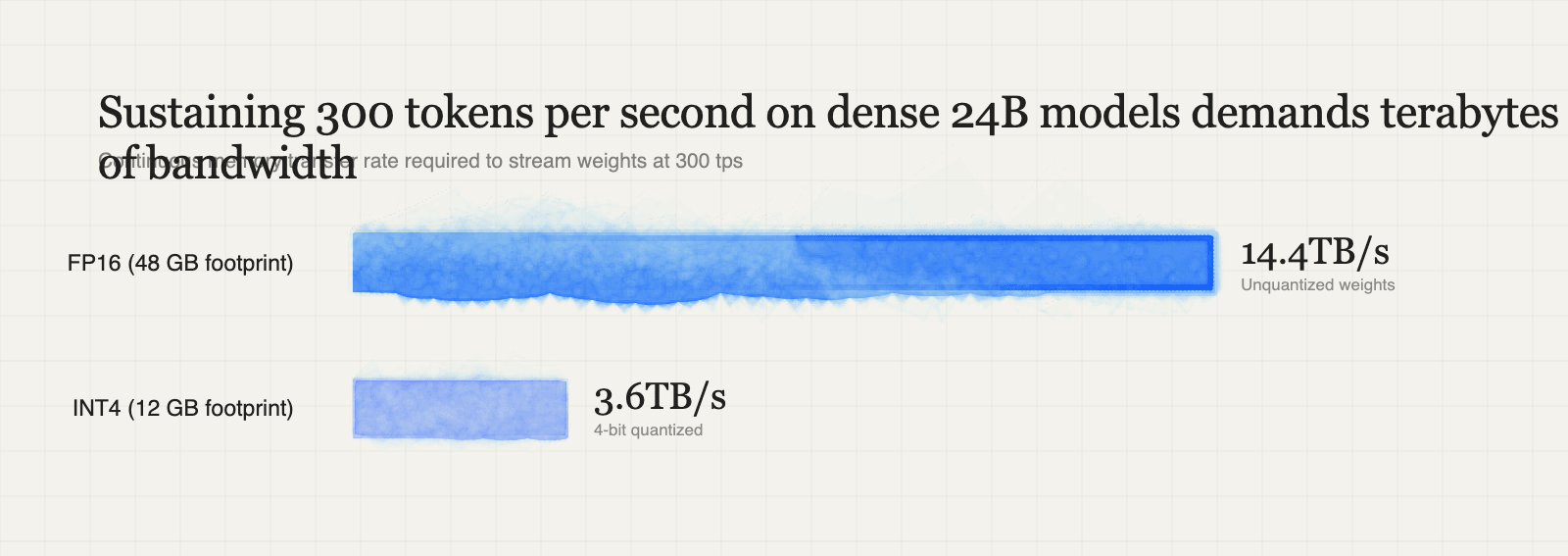
To evaluate whether a 24B parameter model can mechanically hit 300 tokens per second, calculate the required memory transfer rate using simple arithmetic:
$$\text{Required Bandwidth} = \text{Model Size in Bytes} \times \text{Tokens Per Second}$$
At 16-bit precision (FP16 or BF16), a 24B parameter model occupies roughly 48 GB of memory. Sustaining 300 tokens per second at that size would require sweeping 48 GB through the memory controller 300 times each second, demanding an impossible 14.4 TB/s of continuous throughput. Even if quantized down to standard 4-bit integers (INT4), the raw weight footprint sits near 12 GB. To generate 300 tokens per second from that 12 GB representation requires:
$$12\text{ GB} \times 300\text{ tps} = 3.6\text{ TB/s}$$
Compare that figure to actual consumer silicon. High-tier laptop processors featuring unified memory architectures deliver real-world memory bandwidth between 300 GB/s and 800 GB/s. A chip providing 400 GB/s can mechanically sustain a maximum theoretical ceiling of roughly 33 tokens per second on a dense 12 GB model, assuming zero bus contention from the operating system, display compositing, or intermediate activations. Pushing a 400 GB/s bus to 300 tps on a 24B model would require crushing the model weights down to roughly 1.33 GB total—an average precision of approximately 0.44 bits per parameter.
Before adopting any specialized runtime promising extreme generation rates on a laptop, I check this hardware ceiling directly: take your chip's verified memory bandwidth in gigabytes per second, divide it by your model's on-disk footprint in gigabytes, and treat the resulting number as an absolute physical ceiling on dense autoregressive throughput. When an engine claims 300+ tps for a 24B parameter model on a notebook, it cannot be executing a dense, full-parameter sweep across unified RAM on every token step. It either relies on severe low-bit quantization that degrades reasoning, aggressive speculative drafting, or an architecture that discards the conventional memory sweep entirely.
Constant-State Dynamical Operators Trade Bus Traffic for Register Residency
The reason non-transformer architectures like Liquid Foundation Models and State-Space Models alter this equation lies in how they represent historical sequence context. Transformers rely on an attention mechanism that scales its key-value cache linearly with sequence length ($O(N)$ memory reads per step). In contrast, dynamical systems reformulate context as a continuous-time hidden state vector $h_t$ governed by a fixed parameter transition matrix ($O(1)$ constant state updates).
timeline
    title Evolution of local edge inference architectures
    section First Wave
        CPU Matrix Loops : Host DRAM sweeps
                         : Unfused naive GEMM kernels
    section Second Wave
        Unified Metal Graphs : Apple MLX and llama.cpp runtimes
                             : O(N) expanding KV-cache sweeps across UMA bus
    section Third Wave
        Register-Pinned Recurrence : Constant-state continuous dynamical updates
                                   : State transitions kept in threadgroup SRAM
Because an LFM or linear RNN processes incoming tokens by updating a bounded state vector rather than reading past keys and values across the memory bus, token generation avoids the expanding memory traffic of long-context self-attention. The primary challenge shifts from bus saturation to sequential operator execution: the transition $h_t = f(h_{t-1}, x_t)$ must execute strictly token-by-token.
To maximize throughput in this regime, an engine cannot rely on generalized framework runtimes that bounce intermediate tensor buffers through unified RAM between graph nodes. General-purpose frameworks introduce command encoding latency, thread synchronization barriers, and memory buffer round-trips that dominate execution time when individual token compute times drop below a few milliseconds.
Achieving exceptional generation speeds on recurrent operators requires implementing the transition differential equation directly in raw Metal Shading Language (MSL). A bespoke kernel maps the fixed state vector directly into local GPU threadgroup SRAM or register files, keeping intermediate state resident across time steps instead of round-tripping to unified RAM. By eliminating runtime graph dispatch overhead and memory bus transit for the recurrent state, the execution pipeline circumvents the memory bandwidth wall that traps standard attention mechanisms.
However, trading bus traffic for register residency exposes a different set of engineering boundaries. As I explore when examining native daemons for private local coding, specialized runtimes require tight management of Apple Silicon's execution cores. When an engine attempts to pin complex continuous-time update matrices inside GPU registers, excessive register pressure triggers threadgroup spilling. What looked like an $O(1)$ constant-time state update quickly degrades if compiler allocations spill intermediate state vectors into main memory, causing command buffers to stall on sequential launch overhead.
What High-Frequency Trading Learned When Bypassing General Operating Systems
Automated trading infrastructure reached a design junction a decade ago that mirrors the mechanical choices facing local agent runtimes today. When market participants competed on order execution velocity, standard POSIX networking stacks became unusable. Traversing kernel space, waiting on OS context switches, and queueing network frames across generic socket buffers introduced tens of microseconds of non-deterministic latency. Market infrastructure responded by bypassing the kernel entirely: binding network interface card ring buffers directly to user space via DPDK or Solarflare OpenOnload, pinning execution threads to dedicated CPU cores, and locking L3 cache lines to hold working order books.
I expect local agent runtimes to undergo an identical bifurcation as generation speeds accelerate. Standard execution engines like Apple MLX or PyTorch act as general-purpose operating systems for tensors. They maintain dynamic compute graphs, manage generalized device memory pools, insert runtime validation fences, and handle arbitrary tensor transformations. This generality is invaluable when prototyping diverse network topologies, but it acts like a POSIX networking stack in a high-frequency execution loop. When individual forward passes drop under three milliseconds, the overhead of graph compilation, command buffer dispatch, and multi-stream synchronization begins to consume a major fraction of total wall-clock time.
To extract hundreds of tokens per second from consumer silicon, execution loops will increasingly bypass these generalized runtimes in favor of dedicated, model-specific compute kernels. An engine targeting a single continuous-time architecture strips away general tensor abstractions to execute hardcoded operator equations directly against bare GPU command encoders. Working state lives locked inside GPU threadgroup memory or SIMD registers, matching how trading systems keep order books pinned within CPU cache lines. Every instruction cycle is dedicated solely to evaluating state transitions and low-bit weight products.
Yet this level of performance isolation enforces a punishing tradeoff between raw token velocity and operational versatility. High-frequency trading firms discovered that kernel-bypass codebases are brittle monoliths: modifying an order type or deploying to a differing network controller architecture often broke low-level memory alignments and required rewriting bespoke assembly routines. A model-specific Metal runtime introduces identical architectural rigidity. Stripping out dynamic graph capabilities sacrifices dynamic sequence batching, multi-head attention fallback, and flexible context lengths. You obtain an ultra-low-latency execution engine tuned exclusively to a solitary model checkpoint and a singular GPU core layout. The moment you need your agent to alter its context format, ingest a multi-modal frame, or swap to an updated parameter revision, that hand-tuned execution pipeline shatters.
Re-Engineering the Agentic Loop Around High-Frequency Local Generation
Treating token generation as an instantaneous stream rather than a high-latency batch event forces a total reconstruction of the surrounding agent harness. When an agent produces completions at several hundred tokens per second, the operational bottleneck instantly migrates out of the model decoder into stream parsing, workspace verification, and semantic grounding.
To deploy a high-speed recurrent runtime without losing semantic coherence, an engineering team must construct a multi-layered harness around the raw inference process.
mindmap
  root((Recurrent Agent Harness))
    AST Validation
      Streaming tree-sitter parsing
      Grammar constraint masking
      Malformed block rejection
    State Checkpointing
      Scheduled hidden-state flushes
      Reference state resets
      Numerical drift monitoring
    External Retrieval Stores
      Vector repository indexing
      Exact lexical token lookups
      Hybrid context injection
    Kernel Synchronization
      Command buffer completion tracking
      Threadgroup barrier management
      Host device event dispatch
Because recurrent dynamical systems compress sequence history into a bounded state vector rather than reading past tokens through a KV cache, they exhibit structural amnesia on exact lexical tokens. An agent looping through complex software repositories cannot rely on a recurrent hidden state to retain exact variable declarations or UUIDs from thousands of tokens prior. The runtime must be paired with an external semantic retrieval index and a local vector store. As I argued when evaluating how an agent that edits its own harness must not be its own kernel, decoupling core generation from external context management keeps the agent grounded. The harness must inject verified workspace context into the recurrent state at structured intervals rather than trusting the model's internal memory matrix.
Simultaneously, the sheer volume of output demands real-time structural validation. Generating code at extreme speeds increases the rate of syntactically invalid output when using aggressive low-bit representations. Instead of accumulating a multi-thousand-token response before invoking a compiler, the harness must attach a streaming concrete syntax tree parser directly to the token stream. Using incremental tree-sitter bindings, the harness inspects generated code blocks in real time, detecting malformed syntax trees or truncated control blocks within tokens of generation. If the stream diverges from expected grammar structures, execution halts immediately, preventing broken code from triggering external side effects.
Finally, managing numerical health requires explicit state-reset protocols. Continuous-time state updates accumulated over thousands of forward passes cause hidden state vectors to drift when running in half precision. To prevent degenerative outputs, the harness must enforce a maximum trajectory length, checkpointing the agent's structural progress to an external journal and re-anchoring the recurrent state.
Engineers evaluating a custom runtime should benchmark viability using an automated logit-comparison test suite. Run a deterministic prompt sequence through the custom Metal engine and an unquantized FP32 reference implementation on CPU. Measure the mean squared error and top-1 logit agreement at step 10, step 500, and step 5,000. If the custom engine's logit distribution diverges or exhibits accumulated variance across long horizons, you are looking at state drift that will corrupt long-range reasoning in production.
Microarchitectural Rigidity and the Maintenance Tax of Generated Runtimes
The fundamental liability of deploying LLM-generated inference engines lies in microarchitectural over-fitting. When an LLM authors raw Metal Shading Language compute shaders to maximize token velocity, it achieves throughput by hardcoding threadgroup dimensions, register allocations, and SIMD-group memory layouts to match a specific chip configuration. This mechanical tuning operates without abstraction barriers. If a kernel is tuned to saturate the exact threadgroup cache and register file capacity of one particular processor variant, moving that binary to an entry-level base chip or a larger multi-cluster variant introduces immediate execution pathologies.
On smaller core layouts, oversized threadgroup reservations cause compilation aborts or force the Metal driver to spill active registers to device memory, dropping throughput by an order of magnitude. On larger configurations with expanded compute clusters, static thread assignments leave execution pipelines underutilized. Furthermore, an LLM-synthesized runtime relies on undocumented memory layout assumptions and aggressive compiler flags that break across standard macOS driver updates. When Apple refines its Metal compiler pipeline or changes GPU thread scheduling heuristics, an unmaintained bespoke shader engine becomes an uncompilable artifact.
Hardware physics imposes an equally rigid host-side limit on sustained developer workflows. Benchmark sprints that demonstrate 300+ tokens per second measure brief bursts, not persistent agent operation. Driving Apple Silicon compute clusters at theoretical ceilings consumes significant package power. In a notebook chassis, passive and compact active cooling systems cannot continuously dissipate that thermal output under continuous execution. Within minutes of sustained agent looping, macOS thermal management throttles GPU clock frequencies by 30 to 50 percent, flattening the engine's throughput advantage.
Simultaneously, the operating system enforces aggressive memory protection limits under its jetsam subsystem. If a high-throughput runtime locks up extensive unified memory allocations while competing with an IDE, compiler toolchains, and browser instances, macOS issues uncatchable termination signals (EXC_RESOURCE) to reclaim system memory.
Deciding whether to build on a bespoke recurrent runtime or standard frameworks comes down to operational scope. If your agentic workload demands high-speed speculative autocomplete or ephemeral code drafting on a standardized, dedicated hardware fleet, hand-tuned recurrent compute kernels justify their operational costs. The raw velocity advantage transforms the editing experience. But for complex, long-running agent loops that require architectural longevity, deep repository contexts, multi-model flexibility, and multi-file stability, you should anchor your infrastructure to mature, maintained frameworks like Apple MLX and llama.cpp. General-purpose runtimes pay a deliberate token-per-second tax to provide compiler portability, numerical stability, and predictable execution across the actual silicon on your desk.
Resources
(no official sources were available to link)
Updated 2026-10-24 by Mehran Mozaffari.
Related posts
4 October 2026
Turning Production Coding Agents into RL Environments: The Mechanics, Failure Modes, and Economics of Capture Proxies
8 September 2026
diagram-design: What Actually Happens When Your Agent Draws Instead of Compiles
5 September 2026
Ripwire: A Deterministic Call-Graph Primer for Coding Agents
3 September 2026
FFmpeg Skill: The Deterministic Control Plane for Media-Specific AI Agents
27 August 2026
Herdr Keeps Coding Agents Running Across Lids, Reboots, and SSH Hops: How the Client-Server Split Actually Works
27 August 2026
Stringing Skills Together: A Field Guide to Jeffrey's Skills.md (jsm)