
What Monid Actually Does: The Three Jobs It's Claiming to Collapse Into One
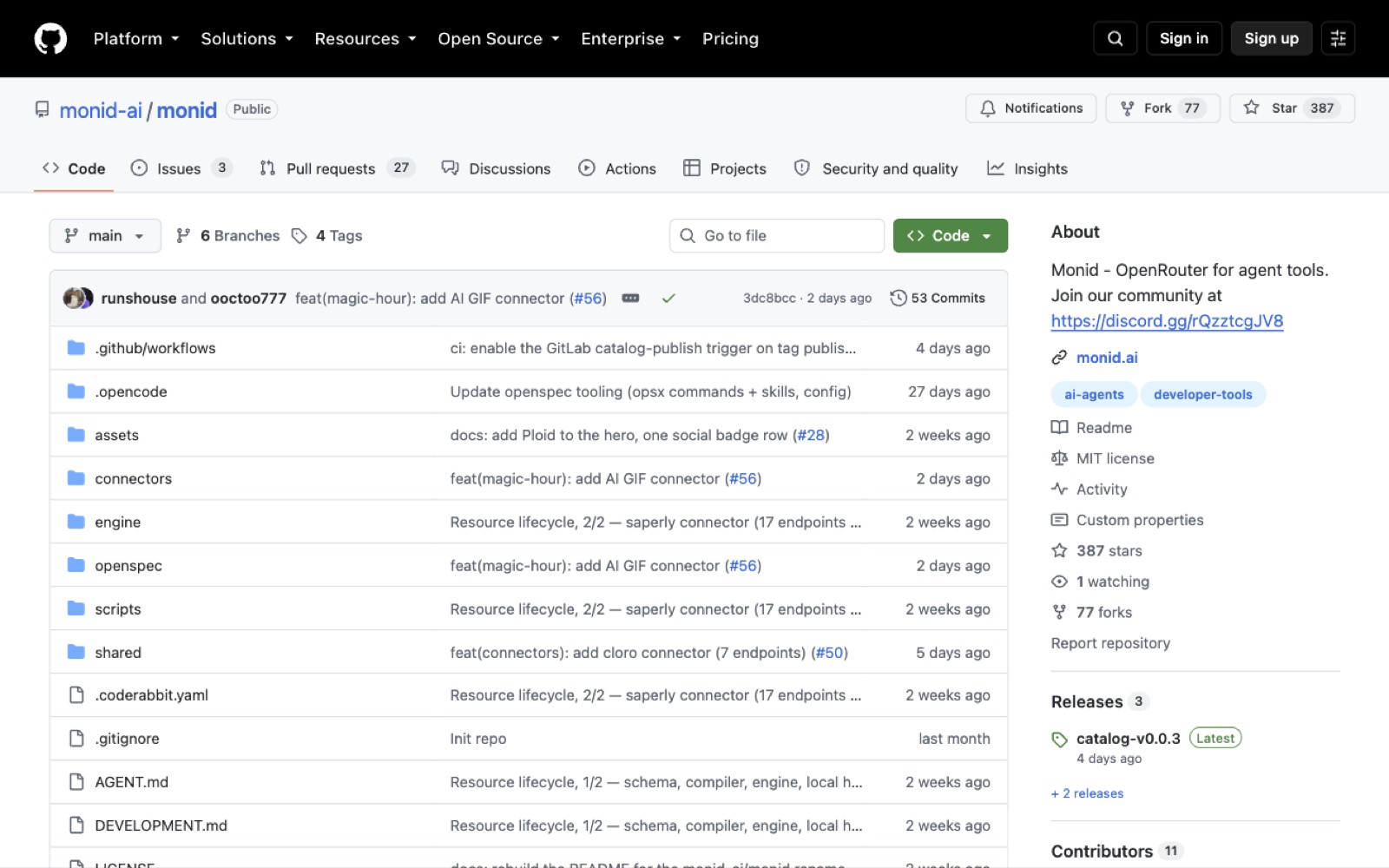
When I first saw the "OpenRouter for agent tools" framing, my instinct was to file it under API aggregation—another gateway that normalizes a bunch of endpoints behind a single SDK. That's underselling it. Monid is attempting something structurally different: it's collapsing three distinct problems—runtime discovery, execution proxying, and metered billing—into a single horizontal layer that sits between your agent and roughly 2,000 third-party APIs.
Let me unpack each layer separately, because conflating them is how teams misjudge the tradeoffs.
Discovery. A plain MCP server ships with a fixed set of tool definitions that get loaded into context at session start. That's fine for ten tools. It collapses at two thousand—you'd blow the context window before the agent even begins reasoning about the task. Monid's answer is a meta-tool layer: the agent calls search_tools with a natural-language or category query, gets back a shortlist of candidates with names, descriptions, and price-per-call metadata, then calls inspect_tool on one to retrieve its parameter schema. Nothing about those 2,000 APIs is in context until the agent explicitly asks for it.
Execution. This is where Monid diverges from a pure protocol. The agent doesn't actually call the upstream API directly—it calls run_tool against the Monid gateway, and Monid handles parameter translation, injects the vendor's auth credentials, executes the HTTP request, and normalizes the response back into a format the agent can parse. You never hold a key for the SEO scraper or the lead-generation API. You're not managing vendor-specific rate limits or response shapes. The gateway is doing that work on your behalf.
Billing. Here's the part that makes the OpenRouter analogy actually apt. Monid meters individual tool calls against a single wallet balance. You don't pay a monthly subscription to seven different data vendors—you prepay into one account and get billed per invocation. That's a real economic shift for agent builders who need breadth without committing to recurring SaaS costs.
The critical distinction I'd draw: OpenRouter aggregates model providers behind one interface, but models are relatively homogeneous—they all take text in and emit text out. Monid aggregates APIs that have wildly divergent input schemas, output shapes, rate limits, and failure modes. The abstraction layer is doing far more normalization work, which means the failure surface is proportionally larger. The analogy holds for the billing and routing mechanics, but it undersells the complexity of what's actually being proxied.
The three layers are also tightly coupled. Runtime discovery is useless without execution proxying—an agent finding a tool it can't invoke is just a wasted roundtrip. And execution proxying without metered billing leaves you back at the multi-account problem. That coupling is why Monid feels like a coherent product rather than three half-features bolted together.
The Meta-Tool Loop: How Runtime Discovery Actually Consumes Tokens and Time
The pitch for runtime discovery is seductive: "Don't load 2,000 tool schemas into your context window." That's true as far as it goes, but it's a deferral strategy, not an elimination. The context cost doesn't disappear—it shifts to execution time, and you pay for it in round-trips instead of tokens.
Let me trace the loop concretely. Your agent gets a task: "Find the top 10 SEO competitors for a niche e-commerce site." It calls search_tools with that query. That's one LLM round-trip to generate the search call, plus the response parsing. The registry returns a shortlist of maybe five candidates—each with a name, description, and price-per-call. The agent reads those descriptions and picks one. That decision is another round-trip. Now it calls inspect_tool to get the parameter schema for the chosen tool. Another round-trip. It constructs the arguments, calls run_tool, gets the response. Another round-trip. Four LLM round-trips before the agent has actually accomplished anything.
Contrast that with a pre-loaded MCP schema. The tool definition is sitting in context from session start. The agent sees it, constructs arguments, and executes. One round-trip. The cost is paid up front—you've burned maybe 500 tokens per tool definition in your system prompt, but you've saved three round-trips per invocation.
The math only works in Monid's favor when you have a genuinely massive tool catalog and you're invoking a tiny fraction of it per session. For fifteen tools, pre-loading is strictly better. For two thousand, dynamic discovery is the only option that fits in context. The real design question isn't whether discovery is good or bad—it's when to cache.
Here's my rule of thumb: if an agent is going to invoke the same tool more than twice in a session, cache the inspected schema in agent memory or a local store. The inspect_tool call is pure overhead after the first time—you're fetching the same JSON schema you already have. Similarly, if the agent is working through a batch of similar tasks (e.g., enriching 100 leads with the same API), it should pin that tool for the duration. Rediscovering on every single call is how you burn execution tokens on ceremony.
The other failure mode I'd flag: ambiguous schema returns create retry loops. If inspect_tool gives you a schema where a parameter is underspecified or the description is vague, the agent will hallucinate an argument and fail validation. Then it retries, fails again, and eventually has to go back to search_tools with a refined query. That loop costs three to six round-trips for what should have been a single invocation.
flowchart TD
    A[Agent receives task] --> B[Call search_tools with semantic query]
    B --> C[Monid registry returns shortlist: names, descriptions, price-per-call]
    C --> D[Agent selects candidate tool]
    D --> E[Call inspect_tool for parameter schema]
    E --> F{Schema parameters ambiguous?}
    F -->|Yes| G[Return to search_tools with refined query]
    G --> B
    F -->|No| H[Construct run_tool with required arguments]
    H --> I[Monid gateway injects upstream auth, calls third-party API]
    I --> J[Monid formats response, returns to agent]
    J --> K[Agent continues task execution]

    L["Cost note: each loop iteration = one LLM round-trip.<br/>2,000 tools never in context simultaneously."] -.-> B
The Billing Abstraction: Single Wallet vs. Self-Hosting Reality
Here's the tension I keep coming back to with Monid specifically, and it's the one that determines whether it's actually right for a given team. The hosted version solves a real pain point: no more managing individual accounts with fifteen different data vendors, no more enterprise procurement cycles for a scraper you'll use twice a month. You fund one wallet and everything just works. That's the "OpenRouter for agent tools" pitch, and it's genuinely good.
But the open-source transition—MIT license on the core router—changes the calculus in ways that aren't obvious from the marketing. Self-hosting the engine means you bring your own keys. The orchestration layer is free, but the upstream SaaS endpoints aren't. You're back to provisioning, managing, rotating, and funding API keys for every connector you actually use. The MIT license buys you code ownership and the ability to modify the routing logic. It does not buy you access to the 2,000 API catalog without paying for it.
So what does MIT licensing actually give you? Three things, as I see it. First, you can inspect the routing and discovery logic—understand exactly how the meta-tool layer works, audit for security issues, and ensure the proxy isn't doing anything you don't want it to. Second, you can extend it. If Monid doesn't have a connector for a specific API you need, you can write your own and plug it into the self-hosted engine. Third, you can run it in your own infrastructure, which matters for enterprises with strict data-residency requirements or PII concerns. That's not nothing, but it's also not "free infrastructure."
The wallet exhaustion issue is the one that bites in production. In a multi-step autonomous agent run—say, a deep research task that calls ten different tools across thirty invocations—depleting the balance mid-execution kills the entire workflow. There's no graceful degradation built in. The tool call just fails, the agent retries, fails again, and eventually gives up on the whole task. I've seen this pattern in similar pay-per-call architectures, and the mitigation is always the same: enforce per-agent and per-session budget caps, and implement a checked checkpoint so that if the wallet hits zero, the agent can persist its progress and resume after a top-up rather than losing everything.
The other billing-adjacent gotcha: metered pricing makes cost estimation hard. A single call to a fast DNS lookup tool might cost fractions of a cent. A Puppeteer-driven scraping job might take 45 seconds and cost substantially more. The gateway abstracts both behind the same run_tool interface, so the agent has no native sense of cost when it's selecting between overlapping tools. If you don't explicitly constrain discovery via namespace or tag filtering to a curated subset with predictable pricing, you'll get surprosed by the bill at the end of the month.
The honest framing I'd give a team evaluating this: hosted Monid is the real product—it's the "one wallet, 2,000 APIs" promise. The open-source engine is a transparency and extensibility play that's valuable, but it doesn't replicate the hosted economics without you doing significant key-management work. Decide which one you actually want before you commit.
Schema Drift and the Unmapped Error Problem: Where the Wrapper Breaks First
The gateway abstraction is only as stable as the least stable API it wraps. That's the structural weakness nobody puts on the landing page. When you proxy 2,000 third-party endpoints, you inherit 2,000 independent change schedules. A vendor renames company_domain to domain in their response, or adds a new required field to their request body, and suddenly your run_tool call returns a validation error the agent can't interpret. The registry schema Monid published two weeks ago no longer matches reality. The agent doesn't know that—it just knows the tool it inspected doesn't work.
What "breaking" actually looks like in a trace is mundane and expensive. The agent calls run_tool with what the schema said were valid parameters. Upstream returns a 400 because a field is now required that wasn't before. Monid translates that into a structured error, the agent reads it, decides to re-inspect, gets the same stale schema because the connector definition hasn't been updated, and constructs the same failing call. Three or four iterations later it gives up and reports failure to the user—or worse, decides the task is complete and returns partial results. That's the silent-failure variant, and it's the one that damages trust.
The error-mapping problem is subtler and, in my view, more damaging. Self-correcting agents depend on being able to distinguish "you hit a rate limit, back off and retry" from "you're blocked by Cloudflare, switch providers" from "the upstream is down, fall back to another connector." A 429, a 403, and a 502 each demand different recovery logic. If the gateway flattens all three into a generic gateway 500—which is the path of least resistance when you're normalizing heterogeneous vendors—the agent loses its ability to reason about recovery. It can only retry blindly, and blind retries on a 403 just burn budget.
Then there's the over-selection problem. When the catalog contains fifteen connectors that all do "Google search scraping," they are not equivalent. Different freshness, different result shapes, different reliability under load. An agent without strict provider pinning will pick whichever one ranks highest in the semantic search for that particular phrasing of the query—and that selection can differ run to run. Two identical tasks produce two different output formats, and your downstream parser breaks on one of them. The fix is system-level pinning: constrain discovery to one audited connector per capability, and only fall back deliberately rather than letting cosine similarity decide. I'd treat unconstrained discovery across overlapping providers as a production bug, not a feature.
Latency and Timeout Asymmetry: Why a Unified Gateway Hides More Than It Solves
A single run_tool interface implies a single performance contract. There isn't one. A DNS lookup connector returns in 40 milliseconds. A Puppeteer-driven scraper that has to render JavaScript, wait for network idle, and extract structured data can take 45 seconds—sometimes longer under load. Both accept the same call, both look identical to the agent, and the agent's HTTP client has one timeout setting.
This is where the abstraction actively hurts. If your agent framework defaults to a 30-second request timeout—which is a common default—it will drop connections on every slow connector while the fast ones sail through. Worse, the drop happens client-side, so the gateway has already dispatched the upstream request and may have already incurred the cost. You pay for a call you never received an answer to, and the agent sees a timeout it can't distinguish from a genuine upstream failure. It retries, pays again, times out again. A scraping-heavy workflow can burn its whole budget on dropped connections before anyone notices the timeout was never tuned for the tool mix.
What a production agent actually needs is per-tool timeout budgets, and those budgets have to come from somewhere. Ideally the gateway passes through observed latency percentiles per connector so the agent—or more realistically, the orchestration layer above it—can set a timeout proportional to the tool's real distribution rather than a global constant. If Monid doesn't surface that, you're left discovering the asymmetry the hard way, in production, one timeout at a time.
The longer-term answer for genuinely slow connectors is async execution: submit the call, get a job handle back immediately, and poll or await a callback rather than holding a synchronous connection open for 45 seconds. Synchronous run_tool semantics work beautifully for fast lookups and badly for scrapers, enrichment pipelines, and anything that touches a headless browser. If the connector catalog skews toward the slow end—and scraping/lead-gen/financial-data feeds do—synchronous execution is the wrong default.
For the immediate question of whether the gateway passes latency through or masks it: masking is the safer assumption unless you've verified otherwise. A proxy that reports only success/failure hides the per-tool performance profile your agent needs to make timeout and routing decisions. Instrument it yourself on the client side—record wall-clock time per tool name—and you'll find out within a day which connectors need special handling.
The Auth Model Question: Utility APIs vs. User-Scoped OAuth
This is the distinction that most often gets lost when people compare Monid to Composio or Arcade, and it's the one that should drive the buy decision more than catalog size. They are not competitors solving the same problem differently. They are solving structurally different problems that happen to both involve "agents calling external APIs."
Monid's model is shared organizational credentials against utility data feeds. When your agent queries an SEO competitor set or pulls a lead list, it's authenticating as you—the developer, the account holder—against a vendor that sells data access. There's no end user in the auth loop. The gateway holds the vendor key, meters the call, and bills your wallet. This is exactly the right shape for data retrieval: search, enrichment, scraping, financial feeds, media generation. Nobody needs to "log in" as anything for those.
Composio and Arcade's model is per-user delegated OAuth. When your agent needs to create a GitHub PR as the logged-in engineer, post to that engineer's Slack, or write to their Notion, the auth is user-scoped—each end user grants the agent access to their own accounts, tokens refresh on their session, and revocation has to propagate correctly. That's a hard, multi-tenant problem Monid deliberately doesn't solve, because it's a different problem. The data-feed model has no end user to delegate from.
Nango sits on yet another axis: it hands you the integration code and you own the vendor keys and the sync logic. Full control, full observability, and you're now the one maintaining every upstream connection. It's the bring-your-own-everything approach.
Where the line falls for a real system: if your agent's job is reading data the developer is entitled to, Monid's model applies cleanly. If your agent's job is acting on behalf of a specific user inside that user's private accounts, Monid's model doesn't apply at all, and you want Composio/Arcade or a self-built OAuth flow. Most non-trivial agents need both, which means running two auth paths side by side—one metered and shared, one delegated and per-user—and being careful not to conflate them. Reaching for Monid to post to a user's Notion is the mistake to avoid; it's not what the utility-feed key architecture is built for. There's a related pattern worth studying in Borrowing the User's Browser: How BrowserSkill Solves Agent Auth Without Leaking Secrets, which tackles the user-scoped side of this boundary directly.
| Dimension | Monid | Composio / Arcade | Nango | Standard MCP servers |
|---|---|---|---|---|
| Auth model | Shared developer/vendor keys for utility feeds; no end-user delegation | Per-user delegated OAuth with multi-tenant token refresh and revocation | Developer-owned vendor keys; you manage every upstream credential yourself | Whatever the individual server implements; no unified auth layer |
| Discovery | Dynamic meta-tool (search_tools → inspect_tool → run_tool) |
Pre-built toolkits, generally static per session | Code-defined functions; static by construction | Static pre-load of tool definitions into session context |
| Cost model | Pay-per-call against a single wallet | Platform subscription plus per-user session billing | Bring-your-own-keys; you pay each vendor directly | Bring-your-own-keys or free; you fund each server |
| Run location | Monid gateway (hosted) or self-hosted engine | Cloud-hosted sandboxed execution | Your own infrastructure | Local or remote client runtime |
| Best-fit use cases | SEO, lead-gen, scraping, financial data, media gen—broad utility data at runtime | Acting as a specific user in GitHub, Slack, Notion, CRM | B2B multi-tenant auth, data syncing, API proxying you want to own | A small, fixed, hand-picked tool set per agent session |
Prompt Injection and Data Exfiltration: The Security Surface Nobody Budgets For
The security model of a dynamically discovered tool catalog is fundamentally different from a fixed one, and most teams don't notice until it's too late. When an agent calls search_tools against an open registry, the connector descriptions that come back enter the agent's context as trusted-seeming text. If any of those connectors is community-contributed or unvetted, its description, its parameter comments, or its returned payload can carry adversarial instructions. The agent doesn't distinguish "this is a tool description" from "this is an instruction" any better than it distinguishes tool output from user input unless you make it.
The concrete attack is mundane. A connector description reads something like a task instruction, the agent follows it, and now you've got a data exfiltration primitive. Combine that with the fact that every run_tool call routes payloads—including whatever PII your agent has assembled—through a third-party gateway, and you've got two exposure paths: injection on the way in, leakage on the way out.
The mitigations I'd actually implement, in order of impact:
Constrain discovery, always. Never let a production agent discover across the full catalog. Use namespace or tag filtering to whitelist an audited subset—say, twenty connectors you've read the schemas for and whose upstream vendors you trust. Unconstrained discovery is a research-mode feature, not a production default. If an agent needs a tool outside the whitelist, that should be an explicit escalation, not a silent fallback.
Sanitize every output before it hits context. Put a parsing layer between Monid's response and the agent's next reasoning step. Strip HTML, cap payload size, and—critically—neutralize anything that reads like an instruction. This is the same discipline you'd apply to any untrusted retrieval; tool output is just another untrusted channel.
Treat the gateway as a data boundary. If your agent handles PII, the hosted gateway is a sub-processor and belongs in your DPA conversation. If that's a non-starter, self-host the engine so payloads never leave your infrastructure—that's the real reason the MIT license matters here, not the cost story.
The failure mode I'd watch for is a team that audits its own prompt injection defenses carefully and then routes untrusted connector output straight into the same context without realizing they've opened a second front.
Comparing the Discovery Models: Two-Stage Meta-Tools vs. Pre-Loaded Schemas
Run the token math and the argument resolves itself. Two thousand tool schemas at a rough average of 500 tokens per definition—name, description, full parameter schema—is on the order of a million tokens resident in your context before the agent has done anything. That's not a tuning problem; it's impossible with current context windows, and even where it fits, the model's attention degrades badly across that much near-duplicate tooling. Static MCP pre-loading works beautifully for a curated set of ten or twenty tools and falls off a cliff past that.
Dynamic discovery trades context for round-trips. Instead of a million tokens resident, you carry a handful of meta-tool definitions and pay two to three gateway round-trips per external action—search_tools to get candidates, inspect_tool to pull the schema, run_tool to execute. Your context stays under a couple thousand tokens throughout. You've converted a space problem into a latency problem, which is the right trade when the catalog is huge and you touch a small fraction of it per session.
But the honest framing is that this is a determinism tradeoff as much as a resource one. Pre-loaded schemas are fixed at session start. The agent sees the same tools, in the same order, every run. Dynamic discovery introduces a semantic search step, and semantic search is not deterministic—the same query can return a different candidate ranking across runs, especially when fifteen connectors claim overlapping capabilities. Two identical tasks produce two different tool selections and two different output shapes. That variance is the real cost, and it shows up downstream in your parsers.
The hybrid is where I'd land for anything real: pin the top handful of tools you know you'll use—say five—directly into context, cache their inspected schemas locally, and reserve the discovery loop for genuine novelty. You get determinism on the 80% hot path and flexibility on the tail. The pinned set costs maybe 2,500 tokens, which is nothing, and those tools skip the meta-tool ceremony entirely.
sequenceDiagram
    participant A as Agent Run A (Static MCP)
    participant C as Context Window
    participant G as Monid Gateway

    Note over A,C: Latency axis — Run A
    A->>C: Session start: load ALL tool schemas
    Note over C: ~1M tokens resident — does NOT fit
    A->>C: Forced to drop tools / truncate catalog
    A->>A: Agent picks from surviving subset
    A->>G: Single call to chosen tool
    G-->>A: Result
    Note over A: Zero extra round-trips, but catalog crippled

    participant B as Agent Run B (Monid-style)
    participant C2 as Context Window
    participant G2 as Monid Gateway

    Note over B,C2: Latency axis — Run B
    B->>C2: Session start: context empty of tool schemas
    Note over C2: Under 2k tokens throughout
    B->>G2: Round-trip 1 — search_tools query
    G2-->>B: 3 candidate tools returned
    B->>G2: Round-trip 2 — inspect_tool on chosen
    G2-->>B: Parameter schema delivered
    B->>G2: Round-trip 3 — run_tool with arguments
    G2-->>B: Result
    Note over B: 3 extra gateway hops before execution, context stays small
The divergence is the whole story: Run A starts with everything and can't fit it; Run B starts with nothing and buys exactly what it needs, three hops at a time.
What to Build on Top: Practical Agent Projects Using Runtime Routing
The most useful thing to build first is a cost-aware research agent with mixed discovery. The architecture is deliberately lopsided: pre-pin three reliable connectors—one search provider, one data enrichment service, one media extraction tool—to handle roughly 80% of calls, and only fall into the discover/inspect loop when a pinned tool fails or the task lands outside known categories. The agent keeps a local JSON schema cache for the pinned set so it never re-inspects something it already knows, and it reserves the semantic search path for genuine novelty. You wire this together with the Monid CLI and skills for the discovery side, the local cache as the fast path, and per-tool timeout configuration so the slow media extractor doesn't get killed by a global 30-second default. The thing to watch for is staleness—that pinned set will drift out from under you as upstream schemas change. Build a weekly CI job that re-inspects the pinned tools and flags diffs before they break in production. The other trap is an agent that falls back to discover on every task that doesn't match its expected shape, silently tripling its round-trip cost and its bill. Make the fallback path explicit and logged.
A second build worth doing is a lead-generation pipeline with budget enforcement. This one pulls from a metadata provider, enriches with social and SEO data, and scores leads against a threshold—standard enrichment work, but wrapped in a per-session budget tracker that checks remaining wallet balance before every single run_tool call. The point isn't the pipeline; it's the checkpointing. You hook the billing endpoint for balance checks, a state store for mid-workflow checkpoints, and a queue for delayed retries, so that when the wallet runs dry the agent persists its partial result and resumes after a top-up instead of dying mid-tree. Watch for the enrichment connectors specifically: some take 30-plus seconds and will trip a naive timeout, and unvetted scrapers in the catalog will block or lag unpredictably. Ration the enrichment set to a whitelist you've actually tested under load.
The third project—and the one I'd build if I were running MCP clients in production—is a converged tool-wrapper for MCP clients with fallback handling. You stand up a local MCP server that wraps Monid's remote discovery, but you insert a translation layer that maps upstream 429/403/502 responses into clean, agent-parseable error codes, plus a fallback router that re-routes to a secondary provider when the primary times out after eight seconds. Expose the whole thing to Claude Desktop or Cursor as a single server and you've turned a fragile catalog into a resilient one. The critical caveat: if the gateway masks upstream errors as generic 500s, your fallback logic never fires, because it has nothing to branch on. Inspect actual Monid payloads in staging before you trust any error translation, and map only the concrete signatures you've observed. Don't cache inspected schemas too aggressively either—the wrapper goes stale the moment an upstream vendor changes shape, and then it's confidently routing calls against a schema that no longer exists.
Resources
Updated 2026-09-15 by Mehran Mozaffari.
Related posts
10 September 2026
Unbundling the Hype: How Prompt-to-3D, MCP, and Collaborative Generative Workflows Actually Fit Together
5 September 2026
Shot Composer Deep Dive: Browser-Based 3D Blocking with an MCP Spine
4 September 2026
Marrying a CEO agent to a craft pipeline
30 August 2026
Monid: The OpenRouter for Agent Tools – A Deep Dive into Dynamic Tool Discovery, Unified Billing, and the Hidden Costs of Abstraction
8 June 2026
Code-as-Room: Thirteen Stages From a Top-Down Photo to a Render-Ready Blender Scene
31 October 2026
Unreal Engine Skills for Claude Code: How Epic Bypassed the Binary Asset Barrier to Mutate Live Viewports