Should You Trade With TradingAgents? Confine It to the Research Sandbox
The Verdict: Treat TradingAgents as an Asynchronous Hypothesis Generator, Not an Autonomous Desk
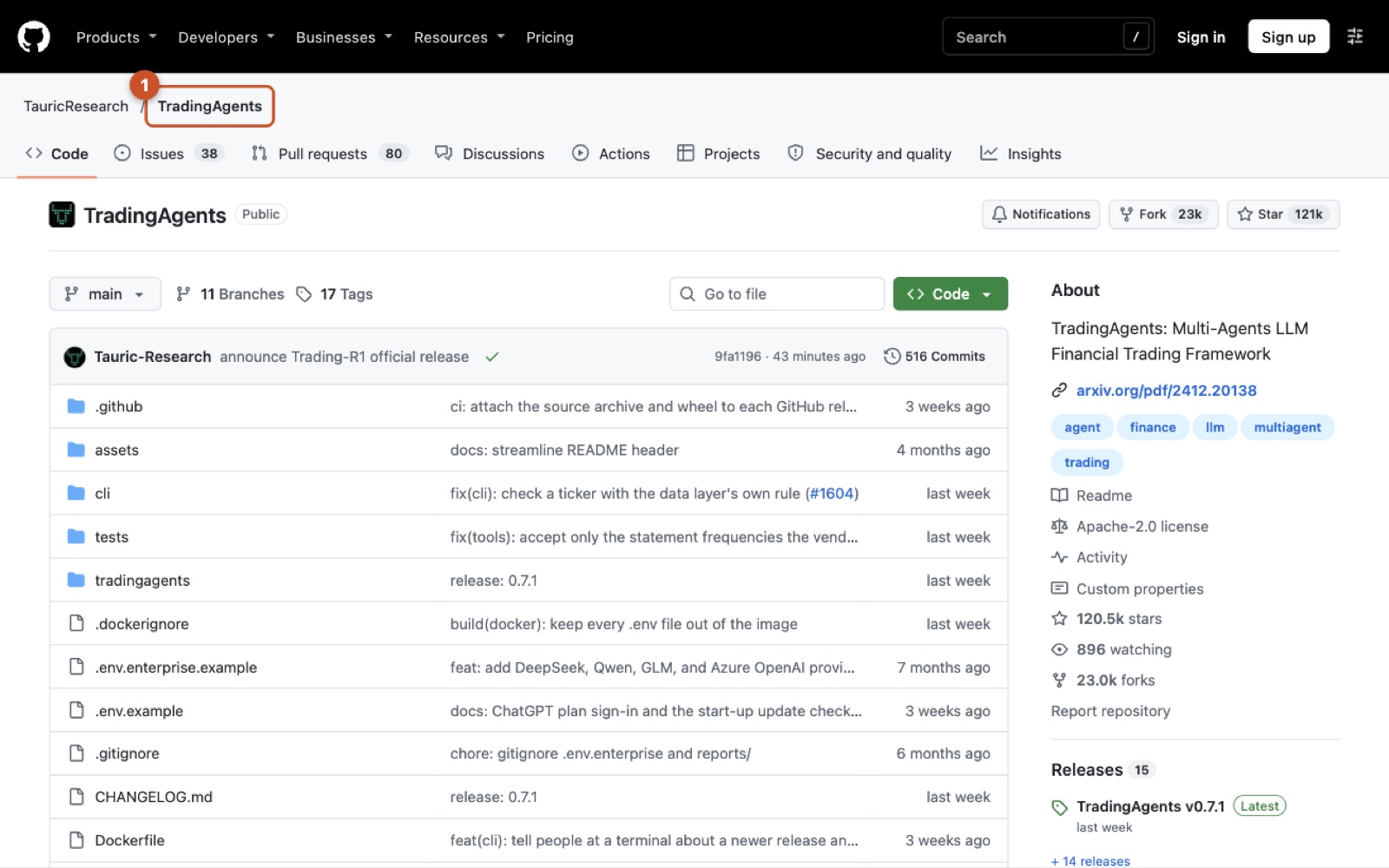
I evaluate TradingAgents v0.7.1 as a remarkable simulation of an investment committee that belongs strictly in your qualitative research layer, never anywhere near your live order routing. TauricResearch has built a compelling multi-agent framework that captures how an institutional desk deliberates: specialized analysts surface fundamental, sentiment, and technical data, feeding adversarial Bull and Bear researchers who argue counter-theses before passing their synthesis to risk controllers and portfolio managers. That workflow mirrors how investment committees actually debate edge cases.
However, treating these agents as autonomous execution engines is an operational trap. In my view, you should adopt TradingAgents strictly as an asynchronous qualitative ideation engine that prepares pre-market thesis memos for discretionary review or downstream quantitative screening. The framework’s multi-turn deliberation across five or more roles takes minutes per ticker, consumes substantial token budgets, and settles backtests naively on market close prices without accounting for execution slippage, bid-ask spreads, or borrow rates. Worse, relying on an LLM "risk management" agent to act as your capital governor invites disaster; probabilistic agents cannot substitute for hard, deterministic pre-trade boundaries encoded in immutable software. Use it to stress-test your narrative hypotheses against structured counter-arguments, but keep execution completely detached.
What TradingAgents Actually Is: An Institutional Committee Simulator
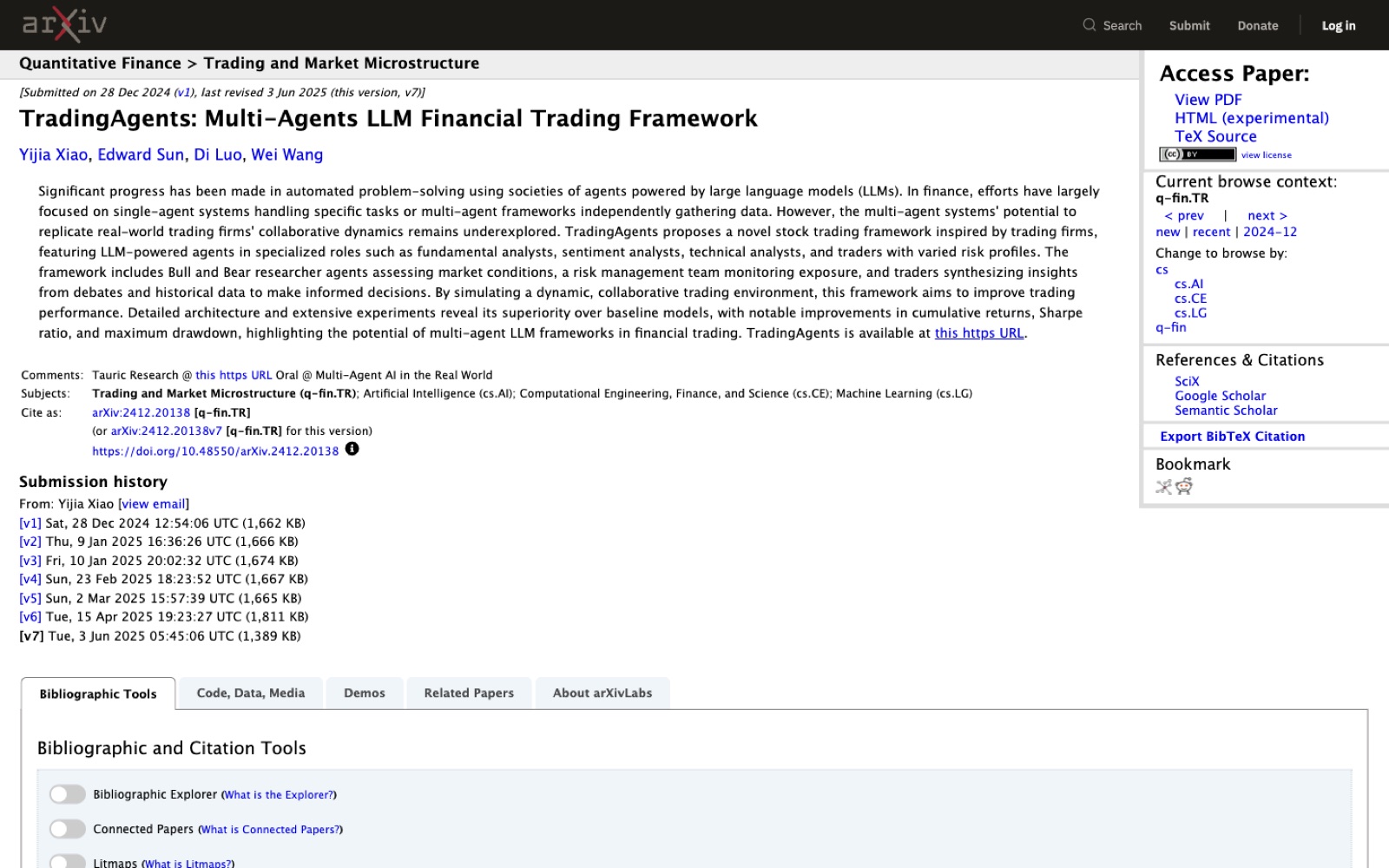
TradingAgents moves beyond the naive "prompt-an-LLM-for-stock-picks" pattern and avoids the rigid tabular limitations of classical machine learning engines. Documented by TauricResearch in arXiv 2412.20138, the framework models an institutional trading desk using structured, adversarial role-playing. Instead of asking a single frontier model to assess an equity, the architecture enforces checks and balances across distinct operational tiers.
The workflow begins in the analyst tier. Since v0.5.2, specialized analyst agents execute in parallel to extract fundamentals, technical indicators, and news sentiment from disparate data streams, including financial disclosures and web queries. This parallel extraction dramatically compresses data-gathering latency. Once compiled, this intelligence flows into an adversarial research tier: dedicated Bull and Bear researchers consume the identical dataset and actively formulate conflicting investment theses.
flowchart TD
    subgraph Parallel Analysts ["Parallel Analyst Tier (v0.5.2)"]
        A1["Fundamental Analyst"]
        A2["Technical Analyst"]
        A3["Sentiment Analyst"]
    end

    subgraph Adversarial Debate ["Adversarial Research Tier"]
        BULL["Bull Researcher"]
        BEAR["Bear Researcher"]
    end

    subgraph Executive Decision ["Executive & Risk Tier"]
        TRADER["Trader / PM Synthesis"]
        RISK["Risk Management Team"]
    end

    INPUT["Market Data & SEC Filings"] --> A1 & A2 & A3
    A1 & A2 & A3 --> BULL & BEAR
    BULL <-->|"Structured Counter-Theses"| BEAR
    BULL & BEAR --> TRADER
    TRADER <-->|"Exposure & Sizing Debate"| RISK
    RISK --> REPORT["Consolidated HTML Report"]
This internal cognitive friction directly addresses model sycophancy, where an LLM blindly validates whatever bias was embedded in the initial query. The competing briefs are handed up to a Trader agent, who synthesizes a coherent trade proposal. Before finalization, that proposal enters a multi-turn debate with a Risk Management agent that inspects sizing and factor exposure.
To make this computationally feasible, v0.6.0 introduced tiered model heterogeneity. Trading desks cannot afford frontier reasoning tokens across every routine data-ingestion step, so the framework decouples model providers across tiers, keeping bulk analysis fast while reserving deep reasoning models for final consensus.
The Architecture Scorecard: Evaluating TradingAgents on Quant Fundamentals
To evaluate whether TradingAgents can handle institutional-grade quantitative workflows, I scored its architecture across five core operational dimensions grounded directly in its release history and commit trajectory.
| Operational Dimension | Score | Production Assessment & Ground Truth |
|---|---|---|
| Lookahead Bias Safeguards | Fair | Patches in v0.5.2 and v0.7.1 explicitly corrected lookahead flaws where backtests ingested SEC filings published after the run date. While point-in-time filing boundaries are now enforced, unstructured search fallbacks introduced in v0.6.0 remain fragile to retrospective post-facto articles. |
| Execution Realism | Poor | The settlement engine settles naively against market closes per v0.7.0 and v0.7.1 (even when accounting for market holidays). It fails to model market impact, order-book depth, bid-ask spreads, borrow fees for short positions, or real-world execution slippage. |
| Compute & Latency Efficiency | Poor | Even with parallel analysts (v0.5.2), multi-turn debates between Bull/Bear researchers and risk controllers require minutes and thousands of tokens per ticker. It is economically unviable for high-volume universe screening across hundreds of assets daily. |
| Qualitative Ingestion | Excellent | The framework excels at parsing narrative 10-K/10-Q disclosures, earnings reports, and macroeconomic releases that traditional tabular engines like Qlib or deep RL systems completely ignore. |
| Auditability | Excellent | Every run produces complete, human-readable debate transcripts and consolidated single-page HTML audit reports that record specific parameter flags, ticker targets, and agent deliberation histories. |
The scorecard reveals the structural divide in TradingAgents: its qualitative ingestion and auditability are world-class, but its execution mechanics remain theoretical. In backtesting, naive closing price settlement generates paper profits that quickly vanish when exposed to real-world friction. Furthermore, while the maintainers took significant steps in v0.5.2 and v0.7.1 to restrict disclosure dates to point-in-time timestamps, fallback mechanisms that scrape search engines risk pulling recap commentary published after market open. If you adopt this framework, treat its output as unstructured alpha research rather than a turnkey portfolio allocator. Pair its qualitative thesis generation with a hardened execution engine that enforces deterministic risk controls.
Where the Framework Wins: Eliminating Sycophancy Through Adversarial Debate
The primary vulnerability of applying language models to market analysis is sycophancy. Standard single-agent prompts and generic orchestration frameworks like CrewAI or AutoGen exhibit an overwhelming tendency toward confirmation bias: if an incoming earnings headline is mildly positive, the agent constructs an exclusively bullish narrative, ignoring structural balance-sheet decay. In contrast, TradingAgents succeeds by institutionalizing cognitive dissonance into its core graph architecture.
Rather than routing data through a unified prompt chain, the framework forces an explicit dialectical confrontation. Analyst outputs from fundamental, sentiment, and technical streams feed directly into dedicated Bull and Bear researcher personas. The Bear researcher is not an unconstrained summarizer; its explicit mandate is to attack the bull case, search for liquidity deterioration, probe margin compression, and present downside vulnerabilities. By forcing competing agents to debate opposing theses before any portfolio manager synthesis occurs, TradingAgents physically loads both sides of the evidentiary distribution into the context window.
quadrantChart
    title Financial AI System Positioning
    x-axis Low Qualitative Narrative Ingestion --> High Qualitative Narrative Ingestion
    y-axis Low Market Microstructure Realism --> High Market Microstructure Realism
    quadrant-1 Theoretical Ideal
    quadrant-2 Pure Quant and RL
    quadrant-3 Generic MAS Wrappers
    quadrant-4 Institutional Deliberation
    TradingAgents: [0.85, 0.25]
    Trading-R1: [0.88, 0.28]
    FinRobot: [0.55, 0.22]
    Microsoft Qlib: [0.15, 0.85]
    FinRL: [0.20, 0.82]
    Generic MAS Wrappers: [0.25, 0.18]
This structural tension separates TradingAgents from functional workflow engines like FinRobot, which prioritize automated report generation and discounted cash flow modeling without adversarial verification. TauricResearch has taken this cognitive tension further with their early-access companion reasoning model, Trading-R1 (v0.1.0), which trains reasoning trajectories directly on multi-turn counter-argument synthesis rather than relying solely on runtime prompt choreography.
In my evaluation, this debate layer delivers genuine utility for discretionary research teams. Instead of using models to blindly score sentiment, the multi-agent debate acts as an automated devil’s advocate that stress-tests narrative assumptions against historical disclosures. It turns the model from a gullible momentum tracker into a structured skepticism engine. For teams evaluating agentic workflows, pairing this debate structure with Offline Trajectory Scoring Replaces the Prompt Engineering Treadmill provides an auditable paper trail of every thesis and counter-thesis before capital allocation.
What It Costs You: Settlement Blindspots, Scraping Drift, and Lookahead Leakage
Despite the elegance of its debate layer, TradingAgents carries critical operational blindspots that make deploying it as an autonomous execution engine hazardous. The maintainers have committed continuous patches to its backtesting harness, but the underlying mechanics still suffer from idealized assumptions about how markets clear.
The most dangerous assumption lies in settlement. Changes across v0.7.0 and v0.7.1 shifted scoring between the first close post-decision and final closes accounting for market holidays. However, marking simulated trades strictly to closing prices ignores market microstructure: bid-ask spreads, order-book liquidity constraints, execution slippage, and overnight gap risk. In live trading, an investment committee consensus formed during after-hours disclosures faces substantial pricing dislocations at the following morning’s open. Calculating strategy returns on frictionless closing settlement produces paper profits that do not survive real execution.
Compounding this is ingestion fragility. In v0.6.0, the maintainers added an emergency fallback to Yahoo search after public news feeds broke. Web search fallbacks are notoriously brittle in financial contexts: search engine indices frequently index retrospective market recaps written hours after price moves occur. If an agent ingests an article explaining why an equity dropped during the trading session, it is no longer conducting predictive analysis; it is rationalizing past price action.
To audit whether your pipeline suffers from lookahead contamination, run deterministic point-in-time CLI evaluations across historical earnings dates using the standalone flags:
export TRADINGAGENTS_LLM_PROVIDER=openai TRADINGAGENTS_QUICK_THINK_LLM=gpt-6-luna TRADINGAGENTS_DEEP_THINK_LLM=gpt-6-sol
export TRADINGAGENTS_OUTPUT_LANGUAGE=English TRADINGAGENTS_MAX_DEBATE_ROUNDS=1 TRADINGAGENTS_MAX_RISK_ROUNDS=1
tradingagents --ticker NVDA --date 2026-09-23 --analysts market,news,fundamentals --save --no-show
Inspect the generated HTML report and verify that disclosures filed after the specified date are completely absent from the analyst context windows.
What Would Change My Mind: Four Production Milestones Before Live Deployment
I find TradingAgents immensely valuable as an offline research assistant, but I would not connect its graph outputs to an active brokerage account without fundamental architectural overhauls.
First, the framework requires external deterministic execution adapters. Instead of assuming frictionless closing price fills, the settlement layer must integrate with institutional order management engines that model realistic slippage distributions, borrow availability for short ideas, and spread costs based on realized order-book depth.
Second, the ingestion architecture must abandon consumer-grade web scrapers and fallback search engines in favor of institutional, point-in-time data feeds. Every document, press release, and financial disclosure must carry immutable UTC exchange timestamps, guaranteeing that historical simulations never ingest subsequent amendments or retrospective commentary.
Third, risk management must be removed from probabilistic prompt loops and relocated into deterministic software. A language model acting as a risk officer can succumb to prompt injection or hallucinated exposure calculations; portfolio VaR boundaries, maximum position sizes, and emergency circuit breakers must exist as hardcoded rules outside the LLM execution graph, functioning as discussed in Code Mode vs Function Calling for Multi-Step Agents.
Finally, TauricResearch needs to publish rigorous, out-of-sample benchmark performance metrics comparing TradingAgents against established quantitative baselines like Microsoft Qlib factor portfolios. Until the framework demonstrates verifiable alpha net of transaction costs, slippage, and compute expenditure, it belongs strictly in the research lab.
Resources
Updated 2026-10-30 by Mehran Mozaffari.
Related posts
30 October 2026
Amnesic Process Resets or Persistent Context for Autonomous Coding Agents
28 October 2026
The Codebase Is an Environment, Not a Context Window
24 October 2026
Recurrent State Kernels Move the Local Inference Bottleneck from Memory to Dispatch
4 October 2026
Turning Production Coding Agents into RL Environments: The Mechanics, Failure Modes, and Economics of Capture Proxies
8 September 2026
diagram-design: What Actually Happens When Your Agent Draws Instead of Compiles
5 September 2026
Ripwire: A Deterministic Call-Graph Primer for Coding Agents