
The Deliberative Architecture on One Page
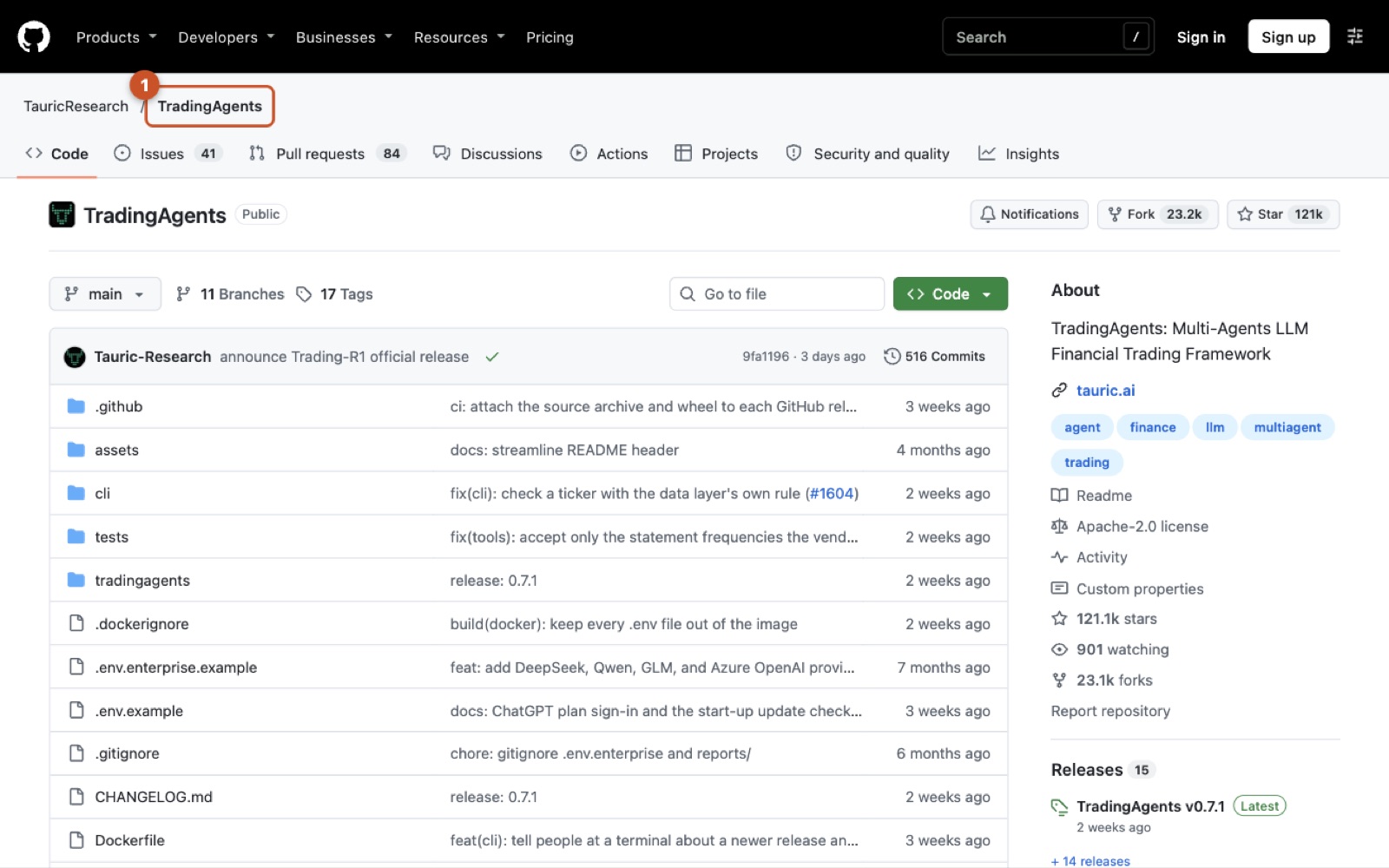
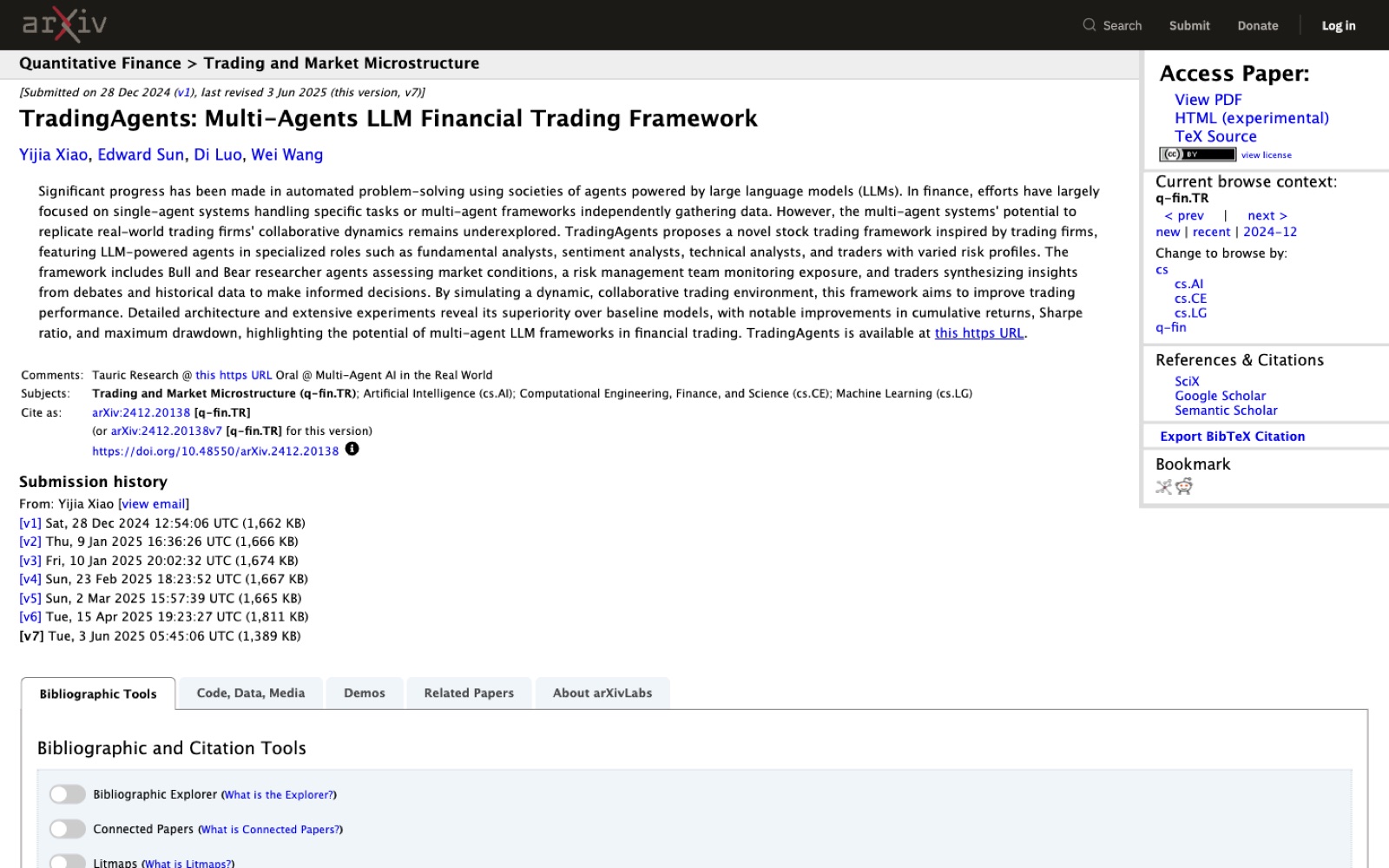
When evaluating algorithmic frameworks, I divide systems into quantitative execution engines and deliberative synthesis engines. Systems like NautilusTrader or Microsoft's Qlib operate directly on structured time series, calculating factor exposures across order books and vectorized data structures. TradingAgents abandons that paradigm entirely. It models market decision-making as an investment committee, replacing deterministic matrix math with dialectical multi-agent role-play.
flowchart TD
    CLI["CLI Input (--ticker, --date)"] --> Feeds["Ingestion Layer"]
    Feeds --> SEC["SEC EDGAR Filings"]
    Feeds --> Yahoo["Yahoo News & Search Fallback"]
    SEC --> Analysts["Parallel Specialist Analysts"]
    Yahoo --> Analysts
    subgraph Specialists["Specialist Evaluation"]
        Analysts --> FA["Fundamental Analyst"]
        Analysts --> TA["Technical Analyst"]
        Analysts --> SA["Sentiment Analyst"]
    end
    FA --> Debate["Dialectical Deliberation Layer"]
    TA --> Debate
    SA --> Debate
    subgraph AdversarialDebate["Adversarial Debate Nodes"]
        Debate --> Bull["Bull Persona Node"]
        Debate --> Bear["Bear Persona Node"]
        Bull <-->|"Critique & Rebuttal"| Bear
    end
    Bull --> Manager["Portfolio Manager Consensus"]
    Bear --> Manager
    Manager --> Execution["Execution Order Generation"]
    Execution --> Settlement["Next-Close Settlement Engine"]
    Settlement --> Report["Single-Page HTML Report"]
The orchestration begins at the CLI, where a run is triggered via --ticker and --date flags. As of v0.5.2, the runtime dispatches parallel specialist analyst agents—fundamental, technical, and sentiment nodes—to gather and evaluate disparate market information simultaneously. Fundamental agents parse raw SEC disclosures, technical agents digest historical price series, and sentiment agents scour news feeds, falling back to scraped Yahoo search results if primary endpoints drop.
Once these specialists formulate their isolated theses, their outputs route into an adversarial deliberation layer. Rather than letting a single LLM summarize the data—which inevitably drifts toward confirmation bias or narrative complacency—the architecture funnels the findings into opposing Bull and Bear debate nodes. These nodes exchange critiques over configured debate rounds, forcing counter-theses against overconfident projections. Finally, a portfolio manager node reviews the debate transcript, establishes consensus, and emits an execution order scored against the next trading session's close.
To prevent token expenditure from compounding out of control, TradingAgents introduced provider-per-model-tier routing in v0.6.0. I configure lower-cost models to handle extraction chores across SEC text, reserving frontier reasoning models for the adversarial debate and portfolio manager consensus steps. Yet this multi-tier delegation comes with an architectural tax. While deterministic frameworks fail loudly with typed stack traces, qualitative agent debates degrade through narrative drift and non-deterministic logic shifts whenever upstream provider behaviors change. As I explored when analyzing Offline Trajectory Scoring Replaces the Prompt Engineering Treadmill, multi-step agent pipelines succeed or fail based on boundary enforcement, and in financial simulation, the most dangerous failure vector is temporal boundary leakage.
Lookahead Bias and Temporal Leakage: The Primary Maintenance Drain
If you examine the TradingAgents changelog across releases v0.5.2 through v0.7.1, a distinct pattern emerges: maintenance is overwhelmingly dominated by patching lookahead bias. In classical quantitative platforms, temporal isolation is enforced at the storage layer through bitemporal databases that index records by both effective event time and system ingestion time. In TradingAgents, temporal constraints are mediated through agent prompts, string dates, and API query parameters, creating an insidious surface for temporal data leakage.
stateDiagram-v2
    [*] --> ValidHistoricalIngestion
    ValidHistoricalIngestion --> UnpaddedDateMutation: String date comparison failure (e.g. 2024-7-5)
    UnpaddedDateMutation --> PostFilingLeakage: Query fetches SEC disclosures past simulation cutoff
    PostFilingLeakage --> HallucinatedAlpha: Agents deliberate on future balance sheet metrics
    HallucinatedAlpha --> InvalidPortfolioSettlement: Position sized and scored on lookahead data
    InvalidPortfolioSettlement --> [*]
The most frequent breakdown occurs in string date formatting (#1488). When language models construct tool arguments without strict zero-padding, they emit strings like 2024-7-5 instead of 2024-07-05. In string-based lexicographical evaluations, unpadded dates fail boundary assertions, causing comparison routines to evaluate 2024-7-5 as greater than 2024-07-01 or inadvertently matching filing records from subsequent quarters.
Even more damaging is the conflation of reporting period end dates with public dissemination timestamps (#1517). Consider an agent simulating an execution on October 15, 2024. A corporate 10-Q filing covers the third fiscal quarter ending September 30, 2024. If the ingestion pipeline queries SEC EDGAR using the period end date without checking the public acceptance timestamp, the agent receives balance sheet figures that were not publicly filed until mid-November. The Bull and Bear agents debate earnings beats that the live market could not possibly know, producing phantom alpha that evaporates the moment the system touches real-time data.
Compounding this are agent-generated inverted date ranges (#1595, #1593), where models request windows where the end timestamp precedes the start timestamp. When ingestion layers handle these malformed inputs by silently defaulting to full-year historical data instead of raising exceptions, post-simulation disclosures flood the context window.
To prevent these temporal leaks in my own ingestion pipelines, I place an immutable point-in-time assertion check between any agent tool output and external data providers:
I parse both the public dissemination timestamp and the execution cutoff through strict ISO-8601 parsing (datetime.fromisoformat), enforcing assert filing_public_timestamp <= simulation_cutoff_timestamp, f"Temporal leak: {filing_public_timestamp} > {simulation_cutoff_timestamp}". If an agent emits an inverted window where query_end_date < query_start_date, the gateway raises an explicit ValueError rather than falling back to an unconstrained query. Without structural enforcement at the gateway, prompt-level instructions cannot guarantee point-in-time integrity.
Calendar Desynchronization and Next-Close Settlement Flaws
Beyond unstructured data ingestion, simulated trading frameworks face an equally fragile hurdle: synchronizing multi-agent execution cycles with real-world market calendars. In early iterations of TradingAgents, backtest scoring suffered from subtle intra-day lookahead (#1548). When a simulated run kicked off mid-session, the analyst agents observed the active day's price trajectory before formulating a thesis, yet the trade settled against that exact same day's close. In versions v0.7.0 and v0.7.1, TauricResearch corrected this by locking evaluation strictly to the first immediate final close following the decision boundary.
While next-close scoring eliminates intra-day price leakage, it exposes the framework to calendar desynchronization across multi-day exchange recesses (#1539). Stock markets do not follow continuous Gregorian time; they pause for weekends and extended holidays like Thanksgiving, Christmas, Golden Week, or the Lunar New Year.
When a backtest executes an order immediately preceding an extended holiday break, naive portfolio state engines expect an exchange settlement record on the consecutive calendar day. When no market close exists for that timestamp, the portfolio manager enters an un-settled limbo state. In earlier builds, pending orders hung indefinitely, leaving open risk positions unpriced and generating NaN equity values that froze downstream portfolio updates.
A third operational vulnerability surfaces during concurrent execution (#1549). To backtest across multiple assets, operators run batch jobs across tickers and historical dates. When multiple agent instances kick off within the same second, they frequently collide over shared SQLite state stores and file locks in the report output directories. Because the CLI serializes run configurations, debate logs, and HTML reports into structured disk paths, uncoordinated concurrent writes produce truncated run artifacts and corrupted portfolio state caches.
To operate TradingAgents reliably in an automated pipeline, calendar awareness and concurrency isolation cannot remain secondary concerns. Settlement mechanics must reference explicit exchange holiday schedules, and run artifacts must be partitioned into isolated execution directories keyed with millisecond-unique identifiers to prevent cache collisions during parallel sweeps.
Scraper Drift and Memory Corruption During Historical Backfills
Relying on public web scraping for production data ingestion is always a ticking clock, but inside an autonomous deliberation loop, it is catastrophic. In v0.6.0, TradingAgents introduced a fallback mechanism that routes sentiment analysts through Yahoo search HTML scraping whenever primary news endpoints reject connections. In a live environment, search engines do not fail with polite schema errors; they fail through dynamic DOM mutations, anti-scraping challenges, and CAPTCHA walls.
When the scraper hits an automated bot challenge, the extraction routine returns an empty payload or strips raw navigation markup into the prompt. The sentiment agent receives an empty context, hallucinates an arbitrary neutral market narrative, and feeds an ungrounded brief into the Bull and Bear nodes. A core premise of multi-agent debate is that dialectical tension cancels out individual persona bias, but debate cannot recover from corrupted ground truth. When both Bull and Bear agents debate an investment thesis using hallucinated headlines or empty sentiment feeds, the resulting consensus does not converge on stable alpha—it produces high-conviction hallucinations backed by multi-turn role-play.
An even more destructive state defect surfaces during historical backfills (#1603). When evaluating multiple historical periods, operators rarely run queries in strict forward-chronological sequence. If you backfill a historical window from June 2024 after previously running an evaluation on September 2024, the framework’s memory persistence engine records reflections based on ingestion order rather than immutable execution timestamps.
The storage layer appends the older June reflection on top of the September state, treating the older market context as the most recent operating experience. When the agent subsequently evaluates October 2024, its reflection buffer retrieves outdated market dynamics from June as if they occurred yesterday. Instead of accumulating progressive wisdom, the agent’s working memory suffers temporal displacement, polluting forward decision trees with stale historical takeaways.
Numeric Truncation, Ticker Normalization, and Multi-Tier Drift
When language models process financial arithmetic, minor serialization oversights introduce devastating distortion. In TradingAgents, standard float-to-string conversions routinely round small numbers to two decimal places (#1567). In large-cap US equities, rounding to pennies is manageable; in foreign exchange pairs, crypto cross-rates, or sub-dollar equities, that truncation strips away the underlying asset movement.
A pip movement in EUR/USD or fractional volatility in a penny stock gets converted into 0.00. The technical analyst agent reads flatline pricing across multiple periods and concludes that volatility has collapsed to zero, triggering defensive cash allocations or halting trend-following strategies entirely. A companion failure appears in financial statement parsers (#1589). To simplify context budgeting, filing ingestion modules often assume balance sheet figures are denominated in millions by default. When parsing small-cap companies with cash reserves or debt obligations under $1,000,000, the parser evaluates the truncated integer as 0. The fundamental analyst reads a balance sheet with zero cash and zero short-term debt, hallucinating severe solvency distress.
These data errors compound when passing assets across disparate brokers and exchanges (#1556, #1604). Asset tickers like crypto pairings (BTCUSDT) or regional equities like Hong Kong listings (700.HK) lack unified formatting across data sources. Without canonical normalization, the data fetcher fails silently or pulls unrelated instruments, feeding incongruous fundamentals into the specialist nodes.
Finally, operators adopting multi-tier model topologies face silent operational breaks across providers. Assigning Azure-hosted endpoints to portfolio managers (#1584) frequently triggers dropped requests unless operators explicitly configure max_tokens, as Azure drops completions on unstated budget caps. Concurrently, using dated Anthropic reasoning snapshots like claude-sonnet-4-20250514 (#1585) causes immediate pipeline crashes when newer reasoning parameters are passed to unsupported legacy APIs. Compounding infrastructure risk, container builds prior to v0.7.1 packaged local .env and .env.enterprise files directly into Docker image layers, creating severe credential leakage vulnerabilities when images were shared across registries.
Production Triage and Point-in-Time Defensive Patterns
When running autonomous agents against financial markets, debugging must be systematic. The table below outlines the five primary operational breakdowns in TradingAgents, along with their immediate indicators and diagnostic steps.
| Failure Mode | First Visible Symptom in Logs / Reports | First Diagnostic Verification Check |
|---|---|---|
| Lookahead Leakage | Unrealistically spotless entry timing on historical earnings announcements | Verify that SEC EDGAR acceptance_datetime strictly precedes simulated run_date |
| Holiday Desync | Run jobs hang indefinitely over holiday intervals or emit NaN balances |
Inspect portfolio state machine logs for un-settled execution orders across market pauses |
| Memory Inversion | Agent outputs cite market conditions from backfilled runs out of chronological sequence | Query reflection database records and compare insertion timestamps against simulation dates |
| Numeric Truncation | Technical analyst logs report 0.00 volatility or cash reserves evaluated as empty |
Inspect serialized prompt text entering technical analyst for truncated decimal precision |
| Provider Drift | Abrupt empty responses from manager nodes or schema validation crashes | Check provider-tier configs for missing max_tokens on Azure or unsupported reasoning flags |
To deploy TradingAgents beyond research sandboxes, teams must construct a defensive perimeter around the core orchestration graph. As I argued when evaluating Code Mode vs Function Calling for Multi-Step Agents, leaving schema adherence and operational boundaries to runtime model compliance is an architectural anti-pattern.
First, air-gap the data ingestion layer behind an immutable bitemporal gateway. Do not permit LLM agents to pass raw string dates directly to SEC EDGAR or price vendors. Every retrieval call must be filtered by a deterministic gateway that enforces two distinct timestamps: the effective event time and the knowledge availability time. If an earnings filing's public acceptance timestamp postdates the simulation boundary, the gateway must drop it regardless of what the agent requested.
Second, wrap all agent tool interactions in strict schema validation layers using Pydantic. Tool responses must validate zero-padded ISO-8601 timestamps, assert that start_date <= end_date, reject non-finite numerical floats (NaN, Inf), and map all symbols to canonical exchange formats before passing payloads to downstream nodes. Finally, eliminate web-scraping fallbacks entirely; replacing volatile HTML extraction with resilient commercial APIs guarantees that sentiment agents deliberate on valid data.
Resources
Updated 2026-11-03 by Mehran Mozaffari.
Related posts
7 November 2026
From Zero to Verifiable Spec-Driven AI Coding in Five Steps
5 November 2026
The Codebase Is an Environment, Not an Autoregressive Window
4 November 2026
How Scenario's 3D OS Turns Blender into Headless Tool Skills Without Context Collapse
3 November 2026
How img2threejs Compiles Reference Images into Three.js Code Without Mesh Files
30 October 2026
Amnesic Process Resets or Persistent Context for Autonomous Coding Agents
30 October 2026
Should You Trade With TradingAgents? Confine It to the Research Sandbox