
The Contenders and the Job: Sandboxed Browser Execution Versus Host Daemons
The operational job here is clear: private, air-gapped code generation and editing where zero bytes of source code or instructions leave the client machine. When developers ask for this, the standard approach has been installing native daemons on the host operating system—running CLI tools or background workers powered by llama.cpp or Apple's MLX. These processes execute as standard OS binaries, holding uninhibited access to local hardware and filesystems.
The alternative architectural fork is running the entire execution loop inside an ordinary web browser tab. A notable implementation of this is Pi running Liquid AI's LFM3-1.7B through custom WebGPU compute shaders, handling 4-bit quantized GGUF weights directly on the client.
This architectural split matters now because Apple Silicon unified memory delivers workstation-grade memory bandwidth directly to client applications, enabling generation speeds exceeding 300 tokens per second entirely locally. But moving execution from a native OS daemon into a browser tab completely redraws your operational boundary. A host daemon can parse repository directory trees, execute test suites, and read Git history unimpeded. The browser runtime, by contrast, lives behind strict web sandboxes: file access requires interactive Origin Private File System (OPFS) or File System Access API handles, runtime execution cannot touch native compilers without separate container layers, and the entire compute context is subject to browser tab life cycles.
I see this as a foundational trade-off between friction and capability. Native daemons demand binary downloads, environment configuration, and explicit system permissions. Sandboxed WebGPU engines achieve immediate zero-install execution by simply visiting an internal URL. Moving the inference runtime into the browser sandbox trades operational system access for frictionless zero-install isolation. Choosing between them is not merely an inference speed question; it dictates where your agent's execution boundaries begin and end, as I explored when looking at system boundaries in An Agent That Edits Its Own Harness Must Not Be Its Own Kernel.
Execution Topology and Hardware Bandwidth Saturation
Hitting generation speeds above 300 tokens per second inside a browser sandbox sounds impossible until you run the physical bandwidth arithmetic. On modern hardware like Apple's M4 Max, the unified memory bus provides between 400 GB/s and 546 GB/s of sustained throughput. During auto-regressive token generation, small-scale models are almost entirely memory-bandwidth bound rather than compute bound. Every generated token requires streaming the model's active weights through the GPU registers once.
When a 1.7-billion parameter model is quantized down to 4 bits (using formats like Q4_0 or Q4_K_M inside a GGUF container), the model weights occupy roughly 1.0 to 1.1 GB of memory. If the model architecture suppresses the traditional memory overhead of self-attention KV caches, each decode step requires moving approximately 1.1 GB across the bus. At 400 GB/s, dividing available bandwidth by memory footprint yields a theoretical physical ceiling:
$$\frac{400\text{ GB/s}}{1.1\text{ GB/token}} \approx 363\text{ tokens/second}$$
Hitting over 300 tokens per second in WebGPU simply means the implementation is approaching the hardware's physical saturation limits. However, the software paths taken to achieve this bandwidth saturation diverge sharply between environments.
sequenceDiagram
    autonumber
    participant App as Browser Agent (Pi)
    participant WGSL as WGSL Compute Shaders
    participant WebGPU as WebGPU Runtime
    participant Metal as Apple Metal API
    participant Mem as Unified Memory (M4 Max)
    participant Host as Native Daemon (MLX / llama.cpp)

    Note over App,Mem: In-Browser WebGPU Pathway
    App->>WGSL: Dispatch custom 4-bit dequant & GEMV shaders
    WGSL->>WebGPU: Bind segmented GGUF storage buffers
    WebGPU->>Metal: Translate WGSL to MSL pipeline states
    Metal->>Mem: Stream 1.1 GB weight slice at ~400-546 GB/s
    Mem-->>App: Emit decoded token via browser memory bus

    Note over Host,Mem: Native Daemon Pathway
    Host->>Metal: Direct MSL command buffer encode
    Metal->>Mem: Direct mmap pointer read of unified memory
    Mem-->>Host: Emit decoded token via OS process memory
In a native host daemon using MLX or llama.cpp, the binary maps the GGUF file directly into OS virtual address space using mmap and issues low-level command buffers directly to Metal. There is virtually zero runtime overhead between the compute definition and the silicon.
In the browser, the runtime cannot simply issue naked pointers to system memory. The engine must read GGUF tensor buffers into WebGPU storage buffers (GPUBuffer), which are strictly constrained by browser allocation limits (often requiring segmented bindings across multiple buffers to overcome default 256 MB or 1 GB limits). The execution engine then relies on hand-crafted WGSL compute shaders tailored for 4-bit dequantization on-the-fly and register-tiling. These WGSL kernels are compiled at runtime into Apple Metal Shading Language (MSL). When written well, memory coalescing allows the GPU to saturate the unified memory bus as cleanly as a native binary.
The 300 tokens per second metric measures the M4 Max memory bus, not the efficiency of web browsers.
Attention Cache Memory Dynamics: Hybrid SSMs Versus Dense Transformers
The reason a 1.7B parameter model can sustain 300+ tokens per second over meaningful sequence lengths comes down to model architecture: specifically, the difference between hybrid state space models and standard dense Transformers.
In a dense auto-regressive Transformer (such as Qwen-2.5-Coder-1.5B or Llama-3.2-1B), generating each new token requires attending across every previously evaluated token. The model must preserve an exact key-value (KV) cache in VRAM. As the context window expands toward 8k, 16k, or 32k tokens, reading the expanding KV cache consumes an escalating fraction of available memory bandwidth. Even if your base model weight read remains static at 1.1 GB, the KV-cache read penalty slows token generation down over sequence length.
Liquid Foundation Models (LFMs) bypass this memory wall by utilizing adaptive linear dynamical systems and recurrent state space mechanisms. Instead of saving every historical token vector into an ever-expanding cache, the model updates a fixed-size hidden state across time. Decoding step memory bandwidth demands remain effectively flat across the sequence.
| Architectural Dimension | Hybrid SSM / LFM3-1.7B | Dense Transformers (e.g., Qwen-2.5-Coder, Llama-3.2) |
|---|---|---|
| Parameter Footprint | 1.0B–3.0B parameters (~0.8–2.2 GB in 4-bit GGUF) | |
| Memory Scaling over Context | Flat/Linear: updates fixed-dimension internal recurrent states | Quadratic/Linear: linearly growing KV cache allocation per layer |
| KV Cache Bandwidth Demands | Minimal constant-size state fetches during decoding | Increases with context length; saturates memory bus at long contexts |
| Reasoning & Tool-Use Limits | Fast inline edits; prone to schema drift and state compression loss | Higher fidelity needle retrieval; stronger multi-step structured planning |
Do not mistake extreme generation velocity for engineering capability. While the research demonstrates phenomenal hardware saturation, there is no evidence that a 1.7B hybrid model functions as an effective autonomous engineer on realistic codebases.
Sub-2B parameter models exhibit severe capability boundaries. They are well suited for localized code autocomplete, generating concise unit test skeletons, or rewriting isolated functions. But when asked to act as autonomous coding agents—reading AST representations, maintaining JSON schema adherence across multi-turn tool loops, and debugging multi-file regressions—they frequently break down. At 1.7B scale, models easily lose track of structured tool call schemas, emitting malformed arguments or entering hallucination loops when patches fail to apply.
Generating 300 tokens per second of broken refactors simply delivers the wrong output faster. High throughput is valuable for developer responsiveness during interactive editing, but treating a 1.7B parameter hybrid SSM as a drop-in replacement for larger frontier models or full-parameter edge models is an architectural mismatch.
Runtime Sandboxing, Workspace I/O, and Host Tool Integration
When an agent writes code, generating tokens is only half the contract; the other half is reading the repository and validating that the changes actually compile and pass tests. The divide between a native host daemon and an in-browser WebGPU runtime determines how that loop operates.
A host daemon running on the OS interfaces directly with your shell. It inspects Git staging, runs linters, and executes build targets (cargo test, pytest, npm test) via native processes. The feedback loop is immediate: the agent generates an edit, the OS executes the test suite, and standard error returns straight to the prompt context.
Inside a web browser tab, the environment is walled off. The agent cannot reach your disk without explicit user authorization via the File System Access API or an Origin Private File System (OPFS) mount. Even after mounting a local folder, navigating deep directories, traversing symlinks, or parsing .git internals frequently hits browser permission prompts or silent I/O throttling.
Worse, the browser cannot run native binaries. To execute code client-side, the runtime must rely on WebAssembly virtual shims such as WebContainers or Pyodide. These sandboxes lack raw POSIX sockets, native C bindings, and background system services. If your project relies on native toolchains, Docker, or external databases, the in-browser agent cannot run your test suite. Bridging this gap with a localhost sidecar daemon resolves tool execution, but it completely defeats the zero-install, purely browser-delivered architectural advantage.
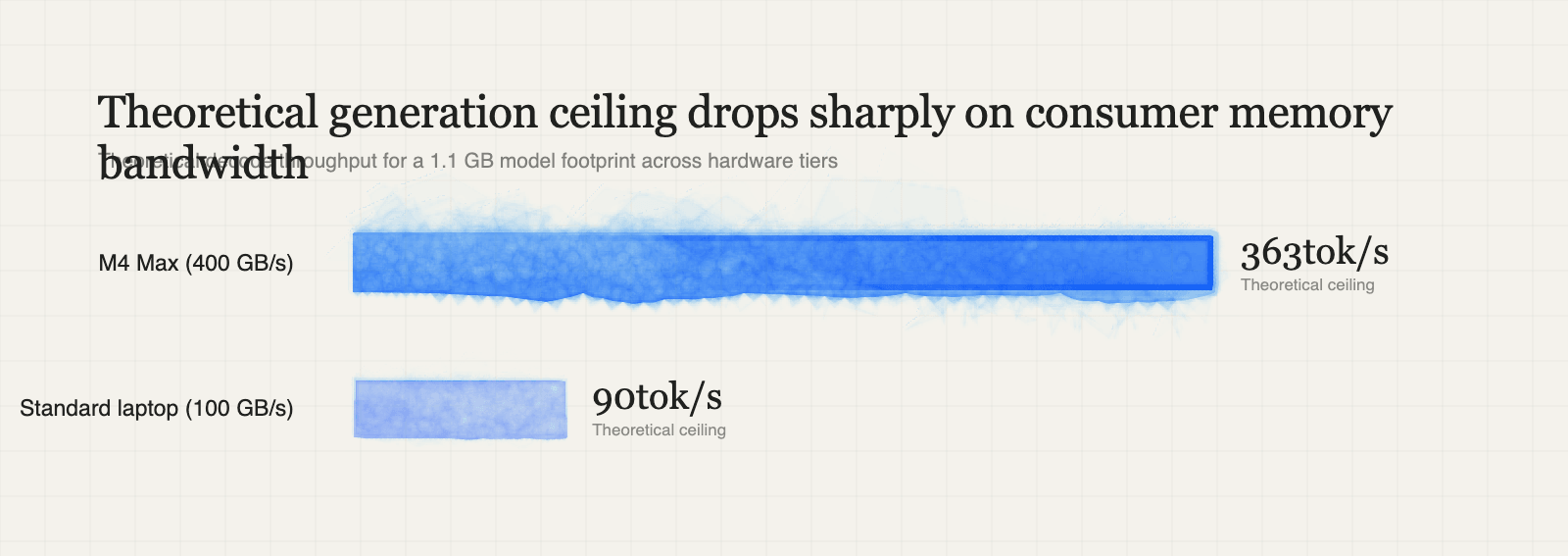
Before committing to this architecture, run a sanity check on your target machines. Auto-regressive decode speed is bounded by memory bandwidth, not compute core count. You can calculate your hardware's theoretical generation ceiling with a simple calculation:
$$\text{Theoretical Ceiling (tok/s)} = \frac{\text{Unified Memory Bandwidth (GB/s)}}{\text{Quantized Model Footprint (GB)}}$$
For a 1.7B parameter model quantized to 4-bit GGUF, the tensor footprint sits at roughly 1.1 GB. On an M4 Max with 400 GB/s of bandwidth, $400 / 1.1$ yields approximately 363 tokens per second, aligning with the 300+ tok/s measurements. But run that same arithmetic on a standard developer laptop with 100 GB/s of unified bandwidth: $100 / 1.1$ yields a hard upper bound of 90 tokens per second, with real-world shader dispatch falling closer to 40 to 60 tok/s. Verifying your hardware's measured bandwidth prevents mistaking flagship Apple Silicon throughput for universal browser performance.
Production Failure Modes and Fleet Heterogeneity
Deploying hand-tuned WebGPU compute kernels across a fragmented fleet of developer machines exposes fragile edge cases that native command-line runners never encounter.
The most jarring failure mode in production is browser context eviction. To conserve energy, operating systems aggressively throttle inactive background windows. When a developer switches tabs to check documentation or leaves their desk, the browser triggers a device lost event (GPUDevice.lost). Because WebGPU treats device loss as unrecoverable, the entire device-allocated tensor graph, recurrent states, and memory allocations are instantly cleared from VRAM. When the developer returns, the agent cannot simply resume; it must reinitialize the pipeline, allocate new GPU buffers, and stream the 1.1 GB GGUF weight payload back into memory from IndexedDB or OPFS cache.
Hardware heterogeneity further degrades kernel reliability. Writing custom WGSL compute shaders optimized for Apple Metal means relying on tight assumptions about 32-wide SIMD workgroups, subgroup operations, and unified register tiling. Porting those identical kernels to Windows or Linux means running against Direct3D12 or Vulkan backends. An AMD GPU with 64-wide execution waves or an Intel integrated GPU with variable subgroup widths will either fail shader validation (GPUValidationError) or incur extreme register spilling, dragging decode speeds down or stalling the UI thread with kernel execution timeouts.
Compounding this is the browser's buffer architecture. WebGPU adapters enforce strict allocation limits via maxStorageBufferBindingSize, which defaults to 256 MB and rarely exceeds 1 GB or 2 GB even when extended. Ingesting a 1.1 GB weight file requires slicing tensors across segmented storage buffers, introducing pipeline complexity and memory alignment overhead.
Finally, client-side privacy creates an operational blind spot. Running an air-gapped browser agent completely severs your telemetry and crash-reporting pipelines. When a custom WGSL dequantization shader crashes on a specific GPU driver, or when the 1.7B model enters an infinite tool-calling loop due to schema drift, no trace reaches your servers unless the developer explicitly exports an error payload. You are shipping low-level graphics code into hostile, heterogeneous runtimes without an error monitor.
Architectural Tradeoff Matrix: Browser WebGPU Versus Native Daemons
Evaluating whether to package an agent inside a browser tab or deploy it as an operating system daemon comes down to structural trade-offs across installation friction, system autonomy, and hardware stability.
quadrantChart
    title Local Coding Runtime Positioning
    x-axis Low Setup Friction Browser --> High Setup Friction Host Setup
    y-axis Constrained Sandboxed I/O --> Unconstrained Native Shell Access
    quadrant-1 Heavy Native Workstations
    quadrant-2 Unreachable Ideal
    quadrant-3 Sandboxed Zero-Install Edges
    quadrant-4 Friction Without Capability
    Pi with LFM3-1.7B WebGPU: [0.15, 0.20]
    WASM llama.cpp on CPU: [0.22, 0.25]
    Aider with Ollama Local: [0.78, 0.88]
    Native MLX Daemon: [0.85, 0.92]
The division between these topologies reflects fundamentally different operating assumptions:
| Dimension | Browser WebGPU (Pi + LFM3-1.7B) | Native Host Daemons (MLX / llama.cpp) |
|---|---|---|
| Setup Friction | Zero install. Visiting an application URL streams weights into IndexedDB or OPFS cache and immediately runs. | Medium to high. Demands downloading local binaries, configuring CLI flags, managing Python environments, and allocating system storage. |
| Data Egress | Absolute privacy. Computation runs completely air-gapped within the browser process memory; zero network egress. | High local privacy. Stays on-device, but process retains unrestricted OS network socket access. |
| Inference Throughput | Extreme (300+ tok/s). Achieves theoretical memory saturation on high-bandwidth unified memory using custom WGSL shaders. | High (100–200 tok/s). Extremely fast on Apple Silicon, but dense Transformers encounter increasing KV-cache latency over long sequences. |
| Agentic Reasoning | Strictly bounded. Sub-2B parameter scale limits complex planning, multi-file refactoring, and high-order logic. | Extensible. Easily swaps between 7B, 14B, and 32B weights capable of repository-level planning and precise tool use. |
| Filesystem Execution | Sandboxed. Confined to Web File System Access API prompts or WebAssembly virtual execution containers. | Native. Direct execution access to shell environments, compilers, test runners, linters, and Git trees. |
| Memory & Context Stability | Volatile. Tab backgrounding or OS power throttling drops the GPUDevice, triggering context loss. |
Persistent. OS daemon processes survive backgrounding and sleep cycles without clearing in-memory weights. |
Choosing between WebGPU and a native daemon means deciding whether installation friction or runtime autonomy is your primary bottleneck.
Deployment Decisions: When to Run in the Browser and When to Run on the Host
When choosing between an in-browser WebGPU runtime and a native host daemon, your decision should hinge strictly on the scope of the code editing task and the operational context of the user.
I reach for the browser stack when building client-facing developer tools where user onboarding friction kills adoption. If you are shipping an interactive code tutorial, a private documentation playground, an internal browser extension, or an embedded syntax transformer, forcing a developer to install Ollama, pull a 5 GB container, and configure a local port is a non-starter. In those environments, the ability to stream a 1.1 GB GGUF weight file into client storage and decode at hundreds of tokens per second delivers a responsive, zero-configuration editing experience.
However, attempting to turn that browser-bound runtime into an autonomous software engineer on complex repositories is an architectural mistake. A 1.7B hybrid model simply cannot sustain the reasoning chains necessary to index dozens of source files, synthesize compiler diagnostics, and navigate recursive build errors. Furthermore, the browser sandbox makes executing native commands like cargo test or npm run build impossible without introducing an external local proxy daemon—which immediately destroys the zero-install elegance of the browser in the first place.
If you choose to run an agent in the browser, you must defensively mitigate the small model's architectural fragility. Never let a 1.7B model generate free-form tool calls. Because small hybrid SSMs suffer from state compression degradation and schema drift over extended sequences, you must enforce structured outputs using WebAssembly-based grammar-masked decoding during token sampling. Constraining the model to emit valid JSON schemas prevents hallucinated brackets and broken tool invocations before the tokens ever reach your execution loop. Couple that with strict context slicing—passing only isolated 20-to-40 line AST fragments rather than whole files—and the browser runtime becomes a fast, reliable utility for focused code generation.
Resources
Updated 2026-10-27 by Mehran Mozaffari.
Related posts
28 October 2026
Wrapping Thirty Coding Agents Inside a Single Container: Inside HarnessRouter's Protocol and Process Boundaries
26 October 2026
How AgentBox Bridges Local Tooling Into Ephemeral Sandboxes Without Host Exposure
24 October 2026
Recurrent State Kernels Move the Local Inference Bottleneck from Memory to Dispatch
24 October 2026
How Openspaces Resumes Headless Remote Coding Agents Using Only Standard UNIX Primitives
14 October 2026
The Agentic Scientist Deconstructed: What Sakana Got Right, Where CLI Orchestration Breaks, and How to Run It in Production
4 October 2026
Turning Production Coding Agents into RL Environments: The Mechanics, Failure Modes, and Economics of Capture Proxies