
The Verdict on Simlock: Adopt for Single-Host Agent Workflows, Wait on Fleet Clusters
Running parallel coding agents on mobile repositories exposes an immediate operational bottleneck: mobile runtimes were never designed for concurrent headless execution. If you dispatch two instances of Claude Code or Cursor on a React Native or native iOS project, both will fight over the default booted simulator, trample each other's application state, or crash when issuing concurrent build commands. Simlock steps directly into this gap as an open-source device orchestrator from Callstack, wrapping native platform CLI tools to turn a developer workstation into an automated local simulator pool.
My position is clear: Simlock is an essential adoption for local multi-agent execution on a single Apple Silicon host, but an immature choice for distributed multi-host fleets. As I explored when looking at Wrapping Thirty Coding Agents Inside a Single Container: Inside HarnessRouter's Protocol and Process Boundaries, managing autonomous agent concurrency requires strict boundary enforcement. Simlock implements that boundary through process-level leases over native runtimes rather than spinning up multi-gigabyte virtual machines. For a developer working on a single machine, this eliminates manual simulator shuffling entirely. However, attempting to scale Simlock across a cluster via its gateway daemon introduces operational friction—specifically unmanaged host port collisions and fragile lease reclamation when agent processes crash—that enterprise CI device grids spent a decade hardening.
How Simlock Replaces Ad-Hoc Scripts with Process Leases
Before Simlock, mobile agent toolkits relied on ad-hoc shell scripts wrapping xcrun simctl for iOS and emulator or adb for Android. That approach breaks under concurrency: two agents inspect xcrun simctl list, see the same available target, attempt to boot it concurrently, and trigger IPC deadlocks inside macOS CoreSimulator services.
Simlock replaces those brittle wrappers with a structured leasing state machine. It consists of three primary components: a local worker daemon that interfaces directly with underlying platform binaries, a lightweight CLI client for agent invocation, and a gateway plane capable of routing requests across machines. When an agent requests an environment, Simlock evaluates the active pool. If an unleased simulator matching the profile exists, it claims it exclusively. If not, it dynamically provisions a fresh instance. If host capacity is saturated, it holds the incoming request in a queue until a running lease concludes.
npm i -g simlock
simlock doctor
simlock lease --platform ios --device "iPhone 16"
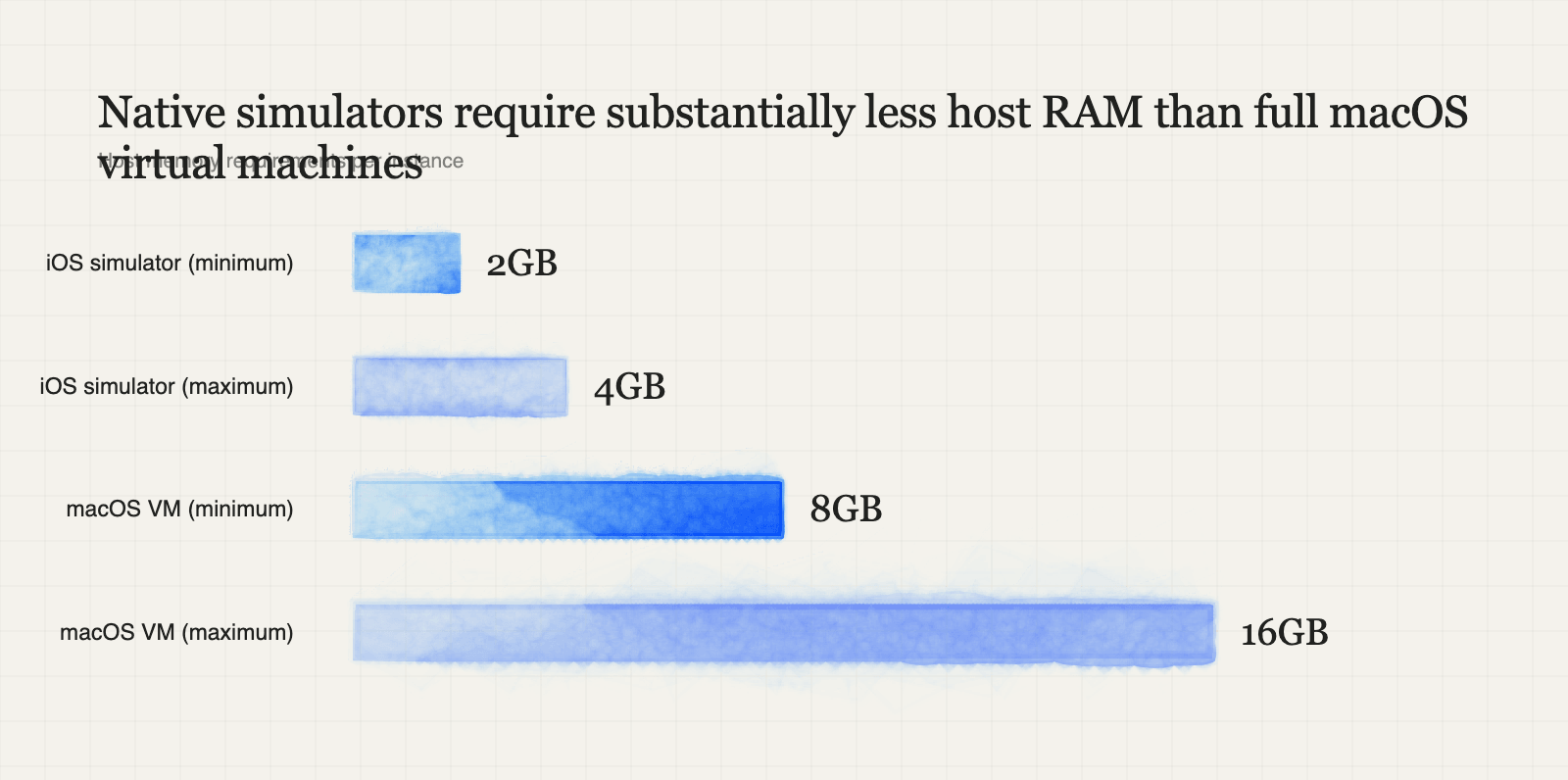
What makes this architecture compelling is multiplexing existing host runtimes without the overhead of full virtualization. An iOS simulator running natively on Apple Silicon consumes roughly 2 GB to 4 GB of host RAM, whereas spinning up a full guest macOS virtual machine demands 8 GB to 16 GB plus a separate OS installation disk image. Simlock enforces a lease lock on the target device UUID, health-checks the booted instance, and passes the device identifier back to the agent. When the agent completes its workflow or disconnects, Simlock tears down or reclaims the instance, preventing abandoned simulator instances from silently starving host memory.
The Mobile Orchestration Scorecard: Comparing Simlock to Clouds, Grids, and Tart
To understand where Simlock fits in an applied AI harness, we must position it against established alternatives: commercial cloud device farms (BrowserStack, Sauce Labs), on-premise device grids (Appium Grid, OpenSTF), and ephemeral Apple Silicon virtual machines (Cirrus Labs' Tart).
Each paradigm optimizes for a different operational profile. Cloud device farms excel at enterprise compatibility testing across hundreds of physical hardware SKUs, but their remote network latency and upload cycles ruin the sub-second iteration speed agents require. Tart provides complete guest OS isolation, guaranteeing zero state contamination, but requires immense memory and disk budgets that cap concurrency on developer machines. On-premise grids provide centralized queues for persistent devices, but demand substantial hardware infrastructure and setup maintenance.
quadrantChart
    title Mobile Runtime Landscape for Coding Agents
    x-axis Low Dev Loop Latency --> High Dev Loop Latency
    y-axis Lightweight Process Overhead --> Heavy Infrastructure Overhead
    quadrant-1 Heavy Enterprise Fleet
    quadrant-2 Ephemeral Sandboxes
    quadrant-3 Local Agent Acceleration
    quadrant-4 Centralized Remote Queues
    Simlock: [0.15, 0.20]
    Tart: [0.22, 0.78]
    BrowserStack: [0.88, 0.85]
    Appium Grid: [0.72, 0.65]
Simlock deliberately sacrifices hypervisor-level isolation to maximize local agent velocity. It operates as developer-loop infrastructure rather than a regression farm, trading absolute isolation for immediate availability on developer hardware.
| Practitioner Criteria | Simlock | Cloud Device Farms (e.g. BrowserStack) | On-Premise Grids (e.g. Appium Grid) | Ephemeral Mac VMs (e.g. Tart) |
|---|---|---|---|---|
| Host Resource Overhead | Minimal; shares host kernel and runs simulators as native processes (~2–4 GB RAM per instance). | Zero local host load; all execution offloaded to remote vendor hardware. | Dedicated host servers required; high local coordination overhead. | High; requires 8–16 GB RAM and 15–30 GB disk space per VM instance. |
| Setup & Configuration Speed | Minutes; installs via npm (npm i -g simlock) and verifies local SDKs with simlock doctor. |
Fast initial setup via API keys, but slow pipeline integration for local agent hooks. | Complex; involves hub-and-node topology, WebDriver protocols, and physical USB routing. | Moderate; requires downloading macOS OCI base images and configuring virtualization framework. |
| Concurrency Isolation | Soft process isolation; simulator files are separated, but host network ports (e.g., Metro 8081) can collide. |
Complete remote tenant isolation per session. | Device-level lock per session; shared test runner infrastructure. | Absolute kernel and filesystem isolation; each VM maintains independent network namespaces. |
| Agent Dev Loop Latency | Sub-second; zero network hop, local socket attachment, and immediate hot-reload support. | High latency (15–60s); involves asset uploading, remote orchestration, and video streaming. | Moderate latency; depends on local network bandwidth and WebDriver commands. | Sub-second execution once booted, but VM initialization takes 10–20 seconds. |
| Crash Recovery | Time-based garbage collection; unhandled agent aborts can leave orphaned locks until timeouts expire. | High; automated session timeouts guarantee teardown on disconnection. | Moderate; hub monitors node timeouts and drops dead client sessions. | Instant; destroying the guest VM process purges all state and releases memory immediately. |
| Multi-Host Fleet Scaling | Supported via Gateway daemon, but immature for multi-tenant enterprise orchestration. | Native; elastic global capacity managed by the vendor. | High; proven clustering protocols designed specifically for multi-machine test labs. | High; easily orchestrated via container engines or CI job schedulers on Mac nodes. |
Where Simlock Wins: Sub-Second Loops and Process Multiplexing
When an agent writes mobile code, fast feedback loops determine whether the task succeeds or deadlocks in context bloat. Running full macOS virtual machines via hypervisor tools like Cirrus Labs' Tart provides pristine guest OS isolation, but it penalizes the agent loop with severe infrastructure weight. Each Tart VM demands 15 to 30 GB of base disk allocation and 8 to 16 GB of dedicated host RAM, alongside hypervisor initialization routines before the agent can even execute its first command.
Simlock takes an architectural stance centered on local developer velocity. By multiplexing runtimes via xcrun simctl and native Android emulators directly on the host kernel, Simlock eliminates virtual disk provisioning. There are no base images to unpack or disk overlays to populate. More importantly, retaining localhost network sockets and direct filesystem access allows Metro hot reload to function immediately without tunneling layers, file-sync daemons, or virtual networking bridges.
When an agent modifies a React Native screen, the local Metro bundler detects the host filesystem update instantly and pushes changes over localhost sockets into the leased simulator. The agent evaluates the rendered outcome in hundreds of milliseconds. In contrast, running that same agent inside an isolated VM forces you into complex file-watching bridges or remote SSH tunnels, degrading an interactive loop into a high-latency batch test cycle. Process-level multiplexing caps memory consumption at roughly 2 to 4 GB per active simulator, allowing an Apple Silicon workstation to run multiple concurrent agent tasks without thrashing host memory.
Where It Breaks: Subprocess Contention, Memory Pressure, and Port Collisions
Calling Simlock a self-managing simulator cloud obscures the fact that it sits atop underlying platform tooling that was never engineered for high-concurrency, headless orchestration. Beneath Simlock's leasing state machine lie xcrun simctl and the Android SDK's adb, both of which encounter severe bottlenecks under rapid parallel execution.
When multiple autonomous agents concurrently hammer the local worker daemon to boot, lease, and erase devices, macOS IPC infrastructure strains. High-frequency commands dispatched to com.apple.CoreSimulator.CoreSimulatorService trigger race conditions and IPC timeouts, stranding the worker daemon. On the Android side, concurrent lifecycle commands frequently provoke sudden daemon restarts, where the host adb server terminates unexpectedly and severs active socket connections across all running emulators on that machine.
Compounding this tooling fragility is physical resource exhaustion. Each booted simulator commands between 2 GB and 4 GB of host RAM. Spawning four parallel agent leases on a 32 GB machine quickly drives macOS into swap thrashing, provoking system memory monitors to drop processes indiscriminately. Furthermore, the architecture provides zero network namespace isolation: Simlock isolates simulator instances while leaving the host networking stack completely shared. Two agents running React Native workflows simultaneously will collide instantly on default Metro bundler port 8081, crashing build runs.
Before deploying Simlock across an agent workflow, benchmark your host's capacity limits. Execute concurrent lease requests from separate terminal processes to identify where your hardware degrades:
simlock lease --platform ios --device "iPhone 16"
Monitor host memory pressure and daemon responsiveness as concurrency increases. If CoreSimulator throws timeouts or memory pressure enters critical ranges, you have hit your machine's physical ceiling.
What Would Change My Mind: Concrete Gates for Enterprise Agent Clusters
I would not deploy Simlock's gateway as a shared team cluster today. For a single engineer operating on a high-spec Mac, the tool solves an immediate concurrency bottleneck; for a distributed team fleet, it shifts the failure domain from developer desktops into an unhardened central daemon.
Three concrete engineering gates must be met before I would consider running Simlock as a shared distributed cluster.
First, Simlock must implement automated ephemeral sanitization on lease release. When an agent concludes its work, recycling an existing simulator without an immediate factory reset or xcrun simctl erase leaves dirty SQLite databases, modified keychain entries, and lingering application state. Allowing a new agent to lease a runtime contaminated by previous runs guarantees non-deterministic test failures.
Second, the gateway needs parent-process heartbeat lease revocation. Coding agents fail unpredictably—hitting token limits, encountering runtime exceptions, or being killed by user aborts. Today, an abruptly terminated agent leaves an orphaned lease holding host RAM until a passive timeout expires. A hardened worker daemon must actively monitor client heartbeats to instantly reclaim abandoned devices.
Finally, Simlock requires native port virtualization or dynamic port mapping passed directly to the agent runtime. Until the gateway orchestrator can dynamically assign dedicated bundler and proxy ports alongside the device UUID, multi-tenant agent execution on a shared host remains brittle.
Resources
Updated 2026-10-29 by Mehran Mozaffari.
Related posts
29 October 2026
How 3D OS Turns a Coding Agent into a Six-Department Animation Studio Without a GUI
28 October 2026
Wrapping Thirty Coding Agents Inside a Single Container: Inside HarnessRouter's Protocol and Process Boundaries
28 October 2026
The Codebase Is an Environment, Not a Context Window
27 October 2026
The Browser Tab Is Becoming the Model Sandbox
27 October 2026
In-Browser WebGPU Agents or Native Daemons for Private Local Coding
26 October 2026
How AgentBox Bridges Local Tooling Into Ephemeral Sandboxes Without Host Exposure