Should You Build Your Enterprise Agent Semantic Layer on NVIDIA Auto Ontology? Not Yet
The Verdict: Treat as an Architectural Reference, Not a Production Foundation
When an agent pulls from revenue_v2_legacy instead of mrr_recognized_usd, the failure is rarely bad SQL syntax—it is a breakdown in semantic grounding. NVIDIA Auto Ontology (NVIDIA/auto-ontology) tackles this exact failure mode. It abandons naive vector search over raw DDL in favor of an automated, graph-based reasoning layer that maps enterprise ontologies and exposes them directly to agent harnesses.
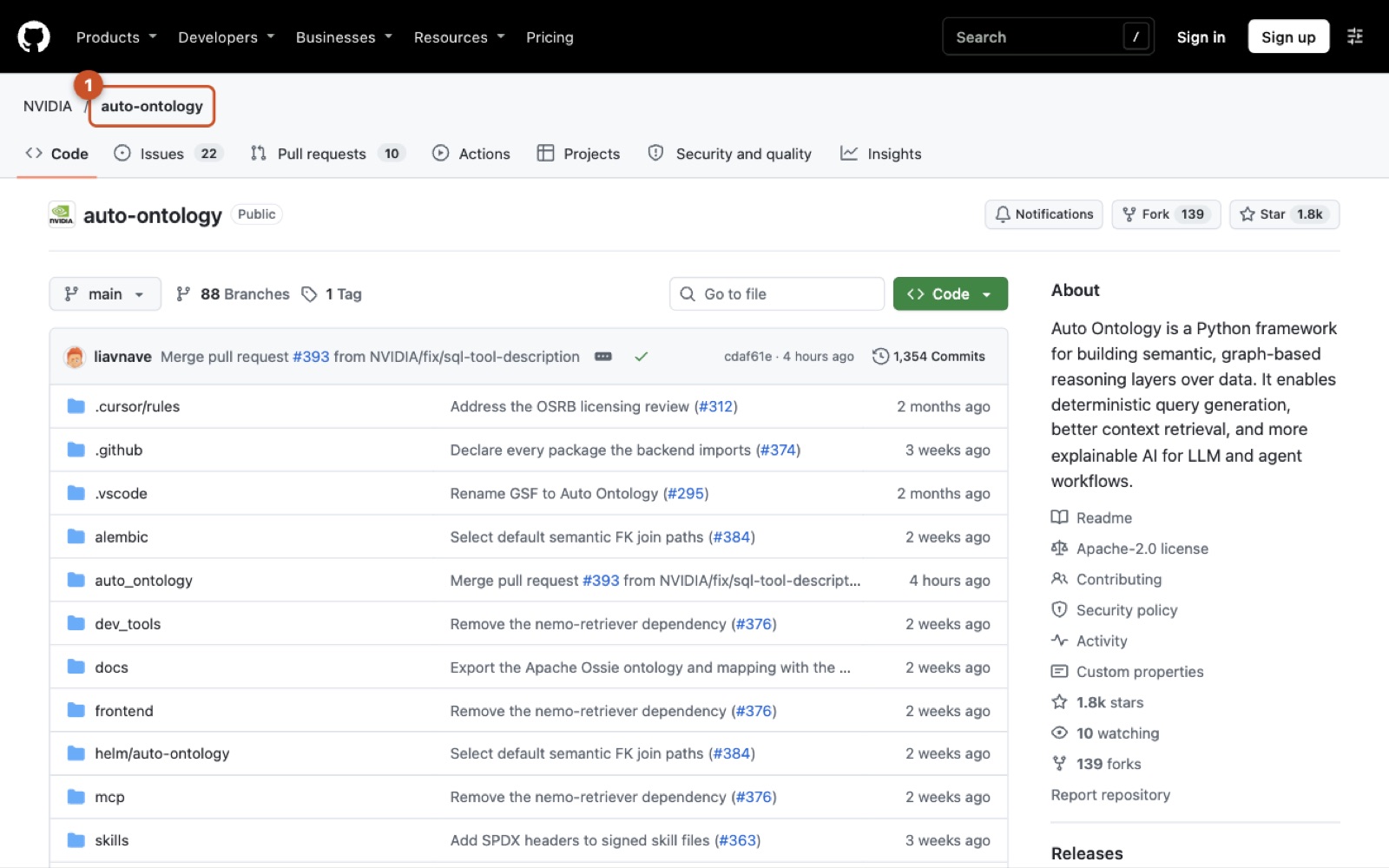
Architecturally, I think NVIDIA nailed the core diagnosis: enterprise agentic data access desperately needs an intermediary that can disambiguate conflicting columns, enforce certified business definitions, and return execution lineage. But when evaluating the code and deployment topology, my verdict is straightforward: treat Auto Ontology as an architectural reference, not as a production foundation.
The software is packaged as an opinionated, monolithic platform rather than a headless middleware library. It couples its FastAPI backend and PostgreSQL catalog to a Next.js 16 web application, integrates tightly with NVIDIA NIM microservices, and carries an explicit upstream notice that it does not accept external contributions. Tying your core data access layer to an Apache-2.0 repository that refuses community pull requests while demanding heavy GPU-backed inference microservices introduces unnecessary operational drag. Study its schemas and its protocol interfaces, but hesitate before deploying its turnkey stack.
The Anatomy: What Auto Ontology Actually Packages Under the Hood
Stripping away the product positioning reveals a multi-tier enterprise application rather than a clean Python package. The foundation is a FastAPI backend responsible for metadata extraction, semantic reconciliation, and query validation. It persists enterprise ontologies, relationship graphs, and catalog definitions in a relational PostgreSQL database managed via Alembic schema migrations.
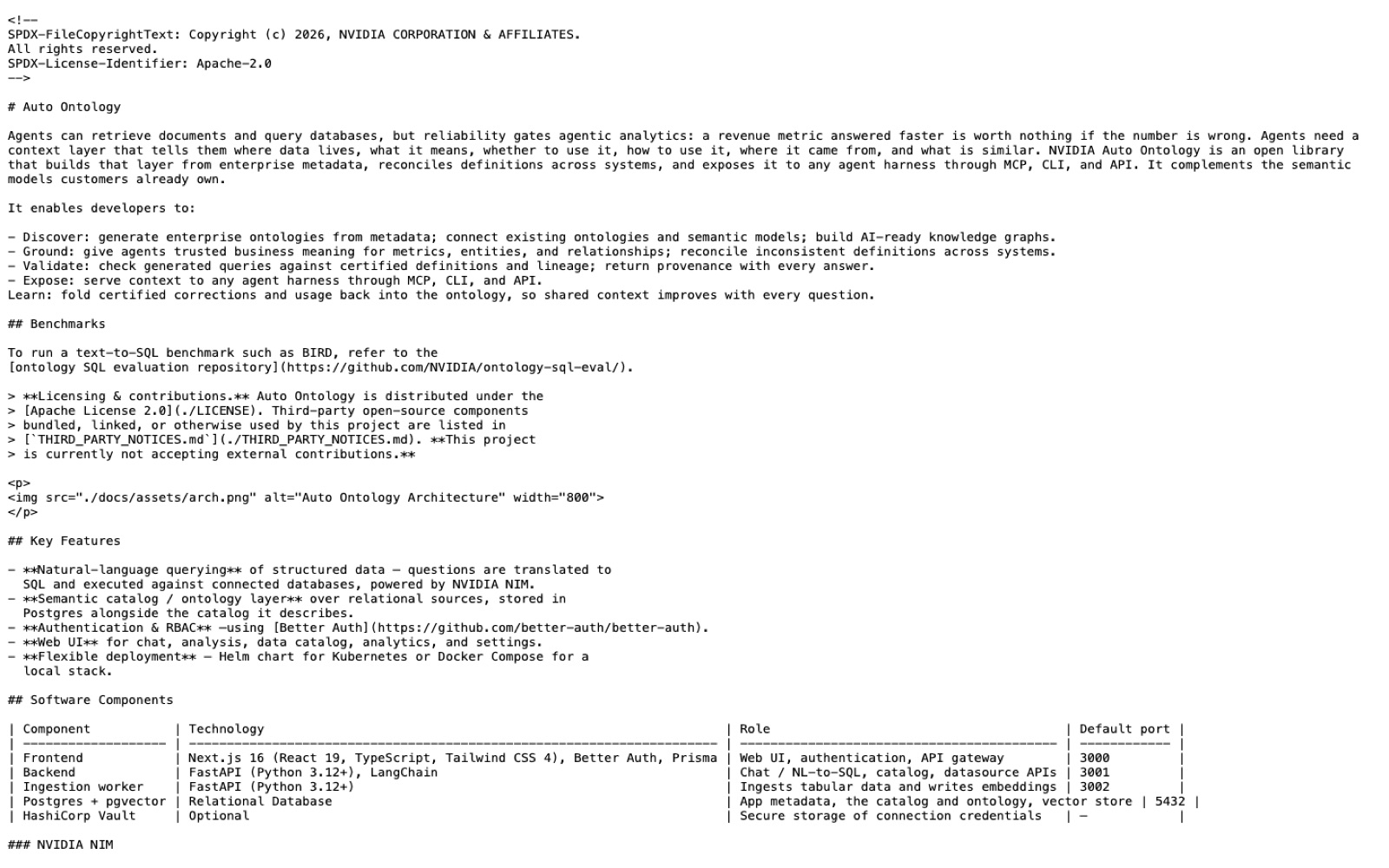
The reasoning component delegates prompt translation to NVIDIA NIM microservices. Instead of asking a general-purpose LLM to guess joins from raw text prompts, Auto Ontology runs specialized models that traverse the knowledge graph to compile validated SQL queries. Accuracy here is benchmarked against the BIRD text-to-SQL suite via a companion harness, NVIDIA/ontology-sql-eval.
Where the system stands out mechanically is how it serves context to the outside world. Rather than forcing agents into custom API contracts, it implements Anthropic's Model Context Protocol (MCP) alongside standard REST endpoints and a CLI. Agent runtimes—whether running inside Claude Desktop, Cursor, or custom multi-agent loops—can query the ontology graph dynamically during tool execution to retrieve certified metric constraints and relational lineage.
Surrounding this core engine is a full web layer: a Next.js 16 frontend built on React 19, Tailwind CSS 4, and Prisma, utilizing Better Auth for session and role-based access control. This UI provides chat interfaces, analytics dashboards, data catalog explorers, and administrative settings. Deployment is orchestrated via Docker Compose or Kubernetes Helm charts. The result is a self-contained analytics environment, but one whose tightly coupled frontend and backend services demand substantial operational commitment.
The Enterprise Grounding Scorecard
When an enterprise data agent fails, it rarely fails on SQL grammar; it fails on semantic ambiguity. Naive vector RAG tools pull table definitions by cosine similarity, which falls apart as schemas scale beyond fifty tables and conflicting column names proliferate. As I argued when analyzing why agent memory was an indexing problem all along, retrieval quality collapses when agents query flat text descriptions without structural constraints. Conversely, declarative semantic layers like dbt MetricFlow and Cube deliver deterministic queries, but they require data engineers to write and maintain extensive YAML models by hand. Palantir AIP demonstrates the gold standard in enterprise object grounding, but locks teams inside a proprietary walled garden.
Auto Ontology occupies the compelling middle: automated graph extraction paired with formal validation. Rather than indexing raw text embeddings, it extracts entities and foreign-key lineage into PostgreSQL, enabling agents to reason over graph structures.
quadrantChart
    title Enterprise Agent Data-Grounding Approaches
    x-axis Manual Overhead --> Automated Extraction
    y-axis Vector Similarity --> Graph Validation & Determinism
    quadrant-1 Automated Graph Grounding
    quadrant-2 Structured Deterministic Modeling
    quadrant-3 Naive Retrieval
    quadrant-4 Automated Heuristics
    Vanna LangChain: [0.75, 0.25]
    dbt Cube: [0.20, 0.85]
    Palantir AIP: [0.45, 0.88]
    NVIDIA Auto Ontology: [0.70, 0.82]
Evaluating the system against production requirements clarifies where the approach excels and where operational friction emerges:
| Criterion | NVIDIA Auto Ontology | Vector RAG (Vanna / LangChain) | Semantic Code (dbt / Cube) | Object Graph (Palantir AIP) |
|---|---|---|---|---|
| Metadata Grounding & Disambiguation | Graph-based reconciliation across conflicting tables; returns query provenance. | Weak; vector similarity matches keywords but confuses identical column names across tables. | Deterministic; explicitly mapped metrics and dimensions eliminate column ambiguity. | Comprehensive; enterprise ontology maps database schemas into real-world business objects. |
| Agent Protocol Ergonomics (MCP) | Native MCP server, REST, and CLI; agents inspect schema context dynamically via tools. | Minimal; usually injected directly into prompt context or via ad-hoc tool functions. | REST/GraphQL APIs; agents query pre-aggregated metric endpoints rather than raw SQL. | Native platform tools; tightly integrated with proprietary agent runtime. |
| Dialect & Execution Fidelity | Uses NIM microservices benchmarked on BIRD; lacks native awareness of multi-engine SQL quirks. | Variable; dependent on base LLM training data and prompt-injected dialect hints. | Absolute; engine-specific SQL compilers (e.g., MetricFlow) compile deterministic SQL. | High; query engine abstracts warehouse execution semantics across supported data sources. |
| Operational Self-Sufficiency | Heavy; requires FastAPI, PostgreSQL, Alembic, Next.js 16, and NVIDIA NIM GPU infrastructure. | Lightweight; simple Python libraries embeddable directly in existing runtimes. | Moderate; requires compilation pipelines, metric servers, and data modeling workflows. | Enterprise-heavy; requires full-platform adoption and managed infrastructure. |
| Ecosystem Openness | Source-available in practice; Apache-2.0 license but upstream explicitly rejects external contributions. | Fully open source; broad community contributions, plugins, and custom adapters. | Open source or open-core with active developer ecosystems and vendor neutrality. | Closed; proprietary commercial platform with vendor lock-in. |
The strongest engineering choice here is native MCP support. Exposing ontology introspection via standard protocol tools allows an agent to request constraints and metrics dynamically during execution without blowing out prompt context. The critical vulnerability lies in execution fidelity and ecosystem governance: without automated schema synchronization or community-driven dialect extensions, adopting teams assume the entire burden of downstream patching.
Where Auto Ontology Wins: MCP-Native Delivery and Relational Graph Lineage
The prevailing industry pattern for agentic text-to-SQL is vector search over DDL: you dump table definitions and column comments into an embedding store, run similarity search against the user prompt, and stuff the top-k schema chunks into the LLM context window. In practice, this falls apart the moment an enterprise database contains multiple columns named revenue, arr, or gross_sales spread across staging, reporting, and ledger tables. Vector similarity cannot distinguish between an accrual-basis accounting column and a raw cash collection field because semantically, their embeddings sit right on top of each other.
NVIDIA Auto Ontology solves this breakdown by replacing loose semantic search with deterministic disambiguation before SQL generation. Instead of forcing an LLM to guess column relationships from raw strings, it maintains a structured knowledge graph and relational catalog in PostgreSQL. Relationships between entities are explicitly defined or extracted alongside foreign-key lineage and metric hierarchies. When an agent needs to calculate quarterly earnings, the system traces the certified path through the relational schema rather than calculating cosine distance across text snippets.
flowchart LR
    Agent["Autonomous Agent Harness"]
    MCP["Model Context Protocol (MCP)"]
    Catalog[("PostgreSQL Catalog & Lineage Graph")]
    NIM["NVIDIA NIM Reasoning Engine"]
    Warehouse[("Enterprise Data Store")]

    Agent <-->|"Dynamic tool inspection"| MCP
    MCP <--> Catalog
    Agent -->|"Validated constraint request"| NIM
    Catalog -.->|"Certified lineage & rules"| NIM
    NIM -->|"Deterministic SQL"| Warehouse
The second win is interface design. By implementing the Model Context Protocol (MCP) alongside REST and CLI interfaces, Auto Ontology eliminates context window bloat. Standard text-to-SQL pipelines force developers to pack extensive table schemas into prompt templates. Under an MCP architecture, the agent treats the ontology as a dynamic tool: it inspects certified terms and relationship constraints only when it needs clarification on a specific metric. This decoupled inspection turns metric resolution into an active runtime check rather than a passive prompting exercise.
The Hidden Tax: Failure Modes, Infrastructure Costs, and the Closed PR Policy
Despite the appeal of automated graph extraction, enterprise deployments reveal severe operational constraints. The most hazardous assumption is believing automated discovery can replace human stewardship. Real-world corporate warehouses are filled with legacy tables, missing primary keys, and cryptically named columns. When extraction runs against uncurated metadata, it does not magically divine business intent; it simply codifies existing structural debt into formal graph nodes.
A second breakdown occurs in execution fidelity and schema drift. Managing ontology definitions in PostgreSQL via Alembic migrations creates a secondary metadata silo. Modern cloud warehouses undergo frequent DDL changes, column deprecations, and upstream ETL modifications. Without an automated synchronization pipeline, the Auto Ontology catalog rapidly drifts from the live database. Furthermore, while the reasoning engine uses NVIDIA NIM microservices benchmarked against the BIRD evaluation suite, standard relational benchmarks do not test the subtle dialect quirks of Snowflake, BigQuery, or Trino. A query that looks syntactically clean can fail on dialect-specific date truncation or generate non-sargable joins that crush warehouse compute budgets.
Finally, the project carries operational and governance friction. Query translation is deeply coupled to NVIDIA NIM microservices, requiring dedicated Tensor Core GPU hardware or egress to hosted inference nodes. Compounding this infrastructure weight is the project's governance model. While published under Apache-2.0, the repository explicitly states that it is not accepting external contributions.
Operating a full stack containing Next.js 16, React 19, Prisma, Better Auth, and FastAPI—while carrying the burden of maintaining a private internal fork indefinitely—is an immense operational tax for a semantic layer.
What Would Change My Mind and How to Test the Claims Yourself
To justify moving from an architectural reference to a core production foundation, NVIDIA would need to hit three concrete milestones:
- Decouple the engine: Separate the semantic graph and MCP server from the monolithic Next.js and Better Auth application into a headless, lightweight Python library that embeds into existing services.
- Open governance: Accept community pull requests to build a vendor-neutral ecosystem of warehouse drivers and dialect translators.
- Provider-agnostic inference: Provide first-class bindings for standard cloud LLM runtimes alongside NVIDIA NIM.
Much like my assessment that teams should steal the chat patterns while leaving the runtime behind, you should extract Auto Ontology's MCP patterns while waiting for its packaging to mature.
If you want to evaluate its claims on your own data, you can run an outside validation check in under an hour:
git clone <repo-url> auto_ontology && cd auto_ontology
cp .env.example .env
# edit .env
docker compose up -d --build
Populate the database with two deliberately ambiguous tables lacking foreign keys—for example, sales_pipeline containing booked_revenue_usd and general_ledger containing recognized_revenue_gaap. Connect an MCP-compatible agent client, configure the API token, and query the catalog:
curl -H "x-api-key: $AUTO_ONTOLOGY_API_TOKEN" https://auto_ontology.example.com/api/terms
If the agent prompts the ontology, isolates the certified lineage path, and explains its column selection through query provenance, the graph engine is doing real work. If it picks an unverified field based on name similarity, you have replicated the classic text-to-SQL failure mode under a heavier infrastructure footprint.
Resources
Updated 2026-11-01 by Mehran Mozaffari.
Related posts
1 November 2026
Code Mode vs Function Calling for Multi-Step Agents
1 November 2026
Offline Trajectory Scoring Replaces the Prompt Engineering Treadmill
31 October 2026
Unreal Engine Skills for Claude Code: How Epic Bypassed the Binary Asset Barrier to Mutate Live Viewports
30 October 2026
Agent Memory Was an Indexing Problem All Along
29 October 2026
How 3D OS Turns a Coding Agent into a Six-Department Animation Studio Without a GUI
29 October 2026
Should You Run OpenDuet in Production? Steal the Chat Patterns, Leave the Runtime