The Manufactured Complexity of Agentic Memory
The AI engineering ecosystem has convinced itself that remembering past work requires building a synthetic subconscious. Over the last two years, teams have piled multi-stage memory extraction pipelines, recursive entity graphs, and continuous vector embedding ingestion on top of their agent stacks. We treated every conversation turn as something that needed to be categorized, summarized by a secondary LLM, projected into a high-dimensional vector space, and periodically consolidated into abstract graph nodes. In practice, this architectural sprawl turns agent memory into an expensive, speculative inference task running continuous background loops.
Platform architectures like Mem0 and Zep exemplify this speculative approach: every concluded interaction triggers background model passes that chew through inference tokens just to structure, chunk, and embed facts before anyone has even asked to recall them. You pay a constant tax in latency, token spend, and extraction hallucination on the off chance that an agent might later need to retrieve a fuzzy concept.
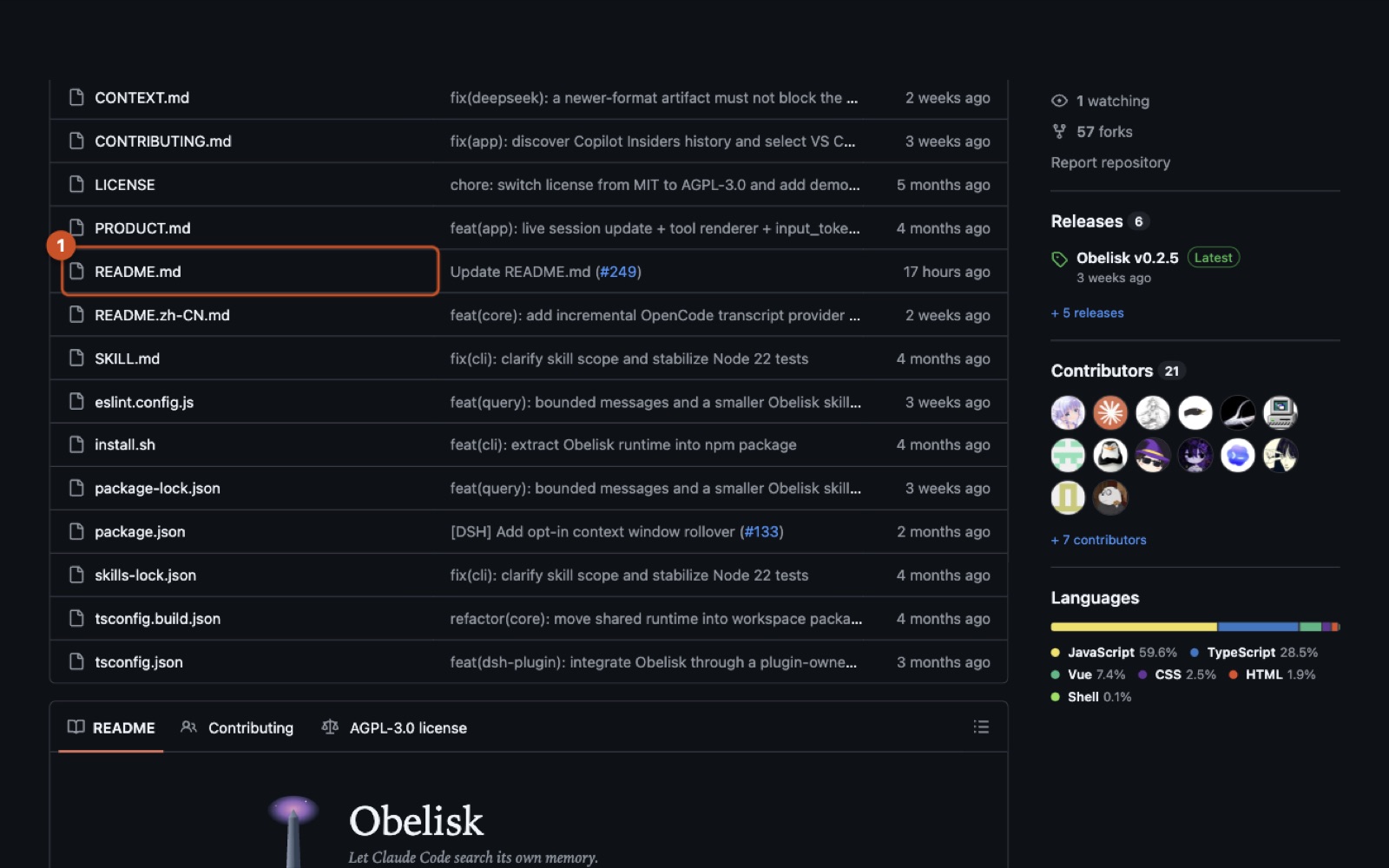
Tools like Obelisk (tommy0103/obelisk) challenge this premise by reducing memory back to deterministic telemetry indexing. Instead of invoking background models to summarize every session, Obelisk monitors local JSONL session files across coding agent harnesses and syncs their raw structural records directly into an on-device SQLite database using Node's native node:sqlite. The ingestion token cost is exactly zero. When I look at what coding agents actually need across multiple sessions—auditing which files were altered during an outage, extracting exact failed shell commands, or inspecting subagent outputs—treating memory as deterministic telemetry indexing solves the problem with none of the semantic distortion introduced by speculative extraction pipelines. As I argued in The Codebase Is an Environment, Not a Context Window, an agent does not need to memorize every past state in its working memory; it needs verifiable mechanisms to inspect the recorded reality of its environment. The fundamental choice for practitioners is whether to keep burning tokens pretending an agent needs an intuitive human subconscious, or to simply hand it a structured index of its own flight recorder.
Why Deterministic SQL Feels Regressive for Non-Deterministic Agents
Engineers instinctively push back against SQL and exact lexical search for agent memory because it feels philosophically mismatched with the probabilistic nature of modern models. We have spent years conditioning ourselves to expect non-deterministic systems to require high-level associative recall. If an agent operates through probabilistic reasoning over natural language, our immediate intuition is that its memory layer should mirror that flexibility through vector cosine similarities and entity relationship traversal. Handing an agent a relational database and telling it to query exact tables feels almost insulting—like running a cutting-edge autonomous system on punch cards.
That skepticism is not entirely unearned, because deterministic retrieval breaks the moment a user's prompt lacks explicit structural or lexical anchors. When a developer asks an agent, "What happened during that weird auth bug last Tuesday?", a pure relational index or lexical query immediately stumbles if the underlying session transcripts only record error logs citing ETIMEDOUT on port 5432 or an update to a session cookie configuration without ever containing the literal word "auth". This semantic gap is precisely why teams rushed toward vector embeddings and entity graphs in the first place: vector spaces excel at bridging loose conceptual intent with disparate phrasing.
Yet in software engineering workflows, the presumption that we always need fuzzy associative matching has led us to sacrifice operational ground truth. When an agent uses vector retrieval to locate past debugging steps, it frequently retrieves structurally similar but functionally irrelevant chunks—returning an unrelated login refactor when the developer needed the exact sequence of shell commands that crashed the staging container. Teams assumed semantic graphs were mandatory because they conflated understanding the user's intent with indexing the underlying data. But an agent equipped with an LLM already possesses the semantic intelligence required to translate a fuzzy intent into concrete, deterministic queries. Instead of forcing the storage layer to be probabilistic, an agent can inspect its own schema, issue targeted structural filters, and reason over raw events directly. The friction we feel using deterministic SQL for agent history isn't a technical limitation of relational databases; it is our own refusal to let the agent act as the query planner over its raw telemetry.
Inside Obelisk's Zero-Token Ingestion and the Limits of What Is Proven
Obelisk executes this deterministic thesis through a lean, local daemon architecture. It configures continuous directory watchers across eleven or more agent harnesses—including Claude Code, OpenAI Codex, GitHub Copilot, Hermes Agent, Kiro, Pi-Agent, DeepSeek Harness, and OpenCode—and pipes raw JSONL transcripts straight into ~/.obelisk/obelisk.sqlite. Because it targets Node.js 22.13 or newer, it runs directly on Node’s built-in node:sqlite engine with zero external runtime npm dependencies, bypassing external database processes entirely. When an agent is invoked via its skill, it writes JavaScript or raw SQL queries (search(), sql()) executed through @obelisk-apps/cli, inspects the resulting JSON payload in milliseconds, and synthesizes the natural language response on the fly.
timeline
    title Evolution of Agent Memory Architectures
    section Early Naive
        Context Appending : Flat buffers and scratchpads blow context limits
    section Generative Synthesis
        Reflection Trees : Recursive LLM summarization loses fine-grained diffs
    section Probabilistic Retrieval
        Vector Stores (Mem0) : Continuous embedding token burn with semantic drift
        Knowledge Graphs (Zep) : Complex entity extraction with high write latency
    section Relational Telemetry
        Raw-Log Indexing (Obelisk) : Zero-token local SQLite ingestion over execution logs
The headline promise of this model is undeniable: you completely eliminate the continuous ingestion tax. However, practitioners must be clear-eyed about the limits of what is currently proven versus what is assumed. The available implementation confirms that zero-token ingestion and deterministic tool execution work cleanly over local directories, but it does not provide empirical benchmark comparisons against vector or graph systems on loosely anchored, semantic queries. If a session log never explicitly mentions the keywords an agent searches for, pure relational and lexical filters will return empty rows where a semantic vector index might have pulled up the right context.
To test whether this tradeoff makes sense in your workflow, you can measure the local retrieval latency directly against the token burn of a cloud memory endpoint. Install the CLI and inspect the version:
npm install --global @obelisk-apps/cli
obelisk --version
Then run a representative execution query across your local transcripts:
/obelisk 上次 auth bug 最后到底改了哪些文件,为什么这么改
Timing that execution exposes the operational reality: you get sub-second local lookups with zero background embedding costs, but you must accept that the agent's ability to recall past work is now bounded by its capacity to construct precise structural queries against its own execution logs.
Software Observability Already Solved This Debate a Decade Ago
The next step in dismantling over-engineered agent memory is recognizing that distributed systems engineering already fought and resolved this exact architectural dispute a decade ago. In the early days of Application Performance Monitoring, vendors attempted to solve observability through proactive metric synthesis. Systems aggressively calculated aggregated error rates, pre-computed service dependency maps, and categorized transaction traces at collection time. When an esoteric production outage struck, engineers discovered that the upfront aggregation had discarded the very high-cardinality metadata needed to diagnose the root cause. The entire discipline subsequently abandoned pre-aggregated metrics in favor of high-cardinality, structured raw event logging, establishing the modern schema-on-read paradigm where raw execution traces are preserved uncorrupted and parsed only when an engineer asks a specific question.
Agent memory is repeating this trajectory beat for beat. Today's memory frameworks attempt speculative metric synthesis: they invoke an LLM on every interaction turn to extract entities, summarize conversational exchanges, and project fragments into vector embeddings. But in software engineering workflows, that upfront synthesis is actively destructive. When an agent summarizes a failed debugging session, it routinely discards the exact shell command, the raw compiler stack trace, the specific exit code, or the subtle path difference in a multi-file git diff. Storing raw event telemetry—the exact tool inputs, unedited shell standard outputs, and atomic file mutations—preserves absolute ground truth.
Agent memory will therefore bifurcate along the exact lines software observability did: operational execution history will be treated as high-cardinality raw telemetry queried on demand, while speculative graph construction will be relegated to high-level summarization tasks. An agent does not need an LLM to pre-chew its flight recorder. When an agent queries its past, schema-on-read querying over uncorrupted execution logs beats lossy upfront synthesis every single time. By preserving the raw JSONL records of past tool invocations in an indexed relational engine, we allow the query planner—which is the agent itself—to decide what matters based on the precise debugging question being asked right now.
Operationalizing Local Relational Memory Across Fragmented Agent Fleets
Bridging the gap between raw telemetry and day-to-day development requires examining how local relational memory actually operates across fragmented agent environments. In modern engineering setups, developers rarely restrict themselves to a single assistant. A typical workflow bounces across Claude Code for terminal tasks, GitHub Copilot for editor completions, and specialized agent test harnesses for background review. As I explored when analyzing multi-harness execution boundaries in Wrapping Thirty Coding Agents Inside a Single Container: Inside HarnessRouter's Protocol and Process Boundaries, unifying these fragmented tools without centralizing sensitive intellectual property requires a shared, local-first telemetry plane.
mindmap
  root((Obelisk Operational Architecture))
    Local Storage Engine
      Local SQLite Database
      Native Node SQLite Module
      Zero External Dependencies
    Multi-Provider Ingestion
      Claude Code Transcripts
      GitHub Copilot Logs
      Hermes Agent Traces
      Pi-Agent Sessions
      Codex Records
    Agent Query Layer
      CLI Tooling
      Obelisk Skill
      JavaScript Script Execution
      Raw SQL Filters
    Human Observability Layer
      Electron Desktop Application
      Weekly Recap Views
      Session History Auditing
      Token And Usage Metrics
Obelisk resolves this fragmentation by establishing a dual-audience architecture. For human operators, the Electron desktop application offers weekly recaps, cross-session audits, and usage metrics, turning dark agent logs into visible engineering telemetry. For the models, the /obelisk skill and CLI interface expose programmatic execution handles, allowing agents to issue millisecond SQL and JavaScript queries directly against ~/.obelisk/obelisk.sqlite.
However, deploying this architecture in production introduces concrete operational hazards that teams must evaluate:
- Log Format Drift: Upstream harnesses iterate rapidly on their internal transcript formats. If an upstream provider refactors how subagent calls, tool responses, or error events serialize into JSONL, Obelisk's ingestion watchers can silently fail or drop records until adapters are patched.
- SQLite Concurrency Bottlenecks: Coding agents generate rapid bursts of tool executions. When continuous directory watchers write simultaneously while an interactive CLI query executes alongside the Electron GUI, write lock contention (
SQLITE_BUSY) will occur unless WAL mode and strict serialization are enforced. - Runtime Constraints: By depending directly on
node:sqliteto eliminate external npm dependencies, the runtime strictly requires Node.js 22.13 or newer. Development machines pinned to LTS Node 18 or 20 will fail immediately. - Copyleft Licensing: Obelisk is licensed under AGPL-3.0. Platform engineering teams evaluating this as a shared component within internal proprietary developer infrastructure must ensure compliance with copyleft distribution boundaries.
When managed carefully, local relational telemetry unifies fragmented agent logs into an auditable data plane, eliminating cloud token waste while grounding agents in their own operational history.
The Boundary Where Structured Logs Fail and Semantic Models Are Required
The final step in evaluating raw-log memory is defining the precise technical boundary where deterministic querying fails and semantic models become unavoidable. Pure relational indexing over SQLite succeeds brilliantly in software engineering environments because the domain provides rigid, unambiguous structural handles: file paths, function identifiers, commit hashes, shell exit codes, and timestamps. When an engineer asks an agent to locate why a migration failed or which subagents participated in an architectural review, the agent can compose deterministic SQL filters that locate the exact rows instantly.
That deterministic advantage dissolves the moment the query target lacks structural or lexical anchors. In open-ended customer support, exploratory research, or high-level organizational knowledge management, user queries rarely reference static artifacts. If a user asks, "What was our general philosophy on retry policies during the platform redesign?", a relational search over session transcripts will return empty sets unless those exact words appear verbatim in the logs. This is where vector embeddings and semantic similarity matching earn their keep: they map disparate conceptual phrasing across continuous dimensional spaces.
My operational verdict for engineering teams is unambiguous: adopt Obelisk or equivalent local SQLite indexing for your coding agent workflows today. It eliminates continuous background vector ingestion costs, preserves absolute execution ground truth, and unifies fragmented developer tools locally without data leakage. But do not treat it as a universal memory panacea: maintain targeted, hybrid vector fallbacks whenever your agents must navigate conceptual shifts that lack concrete lexical anchors.
Resources
Updated 2026-10-30 by Mehran Mozaffari.
Related posts
31 October 2026
Unreal Engine Skills for Claude Code: How Epic Bypassed the Binary Asset Barrier to Mutate Live Viewports
28 October 2026
The Codebase Is an Environment, Not a Context Window
26 October 2026
Should you self-host OpenDuet as your proactive AI coworker? Not yet
24 October 2026
How AutoSwarm Turns Isolated AI CLIs into a Coordinated Swarm Without a Shared Runtime
24 October 2026
Should You Switch Your Agent Harness to Anvaya? Only if Orchestrator Memory Is Your Bottleneck
24 October 2026
Recurrent State Kernels Move the Local Inference Bottleneck from Memory to Dispatch