
The Zero-Conversion Architecture: How Molt Collapses the Rollout-Train Gap
Distributed reinforcement learning for large language models has long suffered from an operational tax: the mismatch between high-throughput inference engines and distributed training engines. Historically, if you wanted to roll out trajectories with vLLM and update parameters using enterprise frameworks like Megatron-LM, your pipeline spent substantial compute serializing tensor layouts, un-sharding weights, re-mapping key names across format boundaries, and distributing transformed checkpoints. NVIDIA’s Molt (NVIDIA-NeMo/labs-molt) directly tackles this friction. Packaged as a remarkably compact framework of roughly 9,200 lines of code, Molt achieves high training efficiency by enforcing a zero-conversion Hugging Face-native architecture across its entire stack.
Instead of writing bespoke bridging logic or maintaining complex parameter translation layers, Molt couples vLLM rollout workers with a NeMo AutoModel training engine running PyTorch Fully Sharded Data Parallel 2 (FSDP2). Both sides consume and produce standard Hugging Face model checkpoints. When the optimization engine writes out an updated policy state, it lands directly in a shared checkpoint directory formatted precisely as Hugging Face safetensors. The vLLM rollout actors reload those weights without intermediate translation passes or CPU-side tensor re-indexing.
In multi-turn agentic environments—where models reason, execute tools, evaluate intermediate outputs, and iterate—latency compounds rapidly. If each policy iteration incurs minutes of weight conversion overhead across distributed nodes, RLVR loops stall and GPU utilization plummets. Molt collapses this gap. By preserving native Hugging Face structure while leaning on FSDP2, Context Parallelism (CP), and Tensor Parallelism (TP) under NeMo AutoModel, the architecture allows teams to scale up to 1T-class model explorations without leaving the standard PyTorch development surface.
flowchart TD
    subgraph RayCluster["Ray Distributed Orchestration"]
        direction TB
        RaySched["Ray Process Placement & Async Queues"]

        subgraph RolloutCluster["Rollout Workers (vLLM)"]
            Worker1["vLLM Rollout Worker 1"]
            Worker2["vLLM Rollout Worker 2"]
        end

        subgraph TrainCluster["Training Engine (NeMo AutoModel)"]
            Trainer["NeMo AutoModel + PyTorch FSDP2<br/>(TP / CP / EP / FSDP2)"]
        end
    end

    SharedStorage[("Shared Hugging Face<br/>Checkpoint Directory")]

    RaySched -->|Dispatches episode tasks| Worker1
    RaySched -->|Dispatches episode tasks| Worker2
    Worker1 -->|Generates trajectories| RaySched
    Worker2 -->|Generates trajectories| RaySched
    RaySched -->|Streams trajectory batches| Trainer

    Trainer -->|Writes updated HF weights| SharedStorage
    SharedStorage -->|Direct weight reload without conversion| Worker1
    SharedStorage -->|Direct weight reload without conversion| Worker2
By cutting out the translation layer, Molt shifts agentic RL from an exotic distributed systems challenge back into idiomatic PyTorch territory.
The Lifecycle of an Agent Trajectory: Tracing a Multi-Turn Job Through Ray and vLLM
Understanding Molt requires tracing how an individual episode transitions from an initial prompt to an updated policy. Rather than treating prompts as static single-turn query-response pairs, Molt approaches reinforcement learning with the premise that "the agent is the program." Every multi-turn trajectory unfolds dynamically inside Python runtime abstractions managed asynchronously across Ray actors.
sequenceDiagram
    autonumber
    participant Orch as Ray Orchestrator
    participant Rollout as vLLM Worker
    participant Env as Python Env (Agent Loop)
    participant Buf as Trajectory Buffer
    participant Trainer as NeMo AutoModel (FSDP2)
    participant Disk as Shared HF Checkpoint Dir

    Orch->>Rollout: Dispatch prompt batch from dataset
    loop Multi-Turn Interaction Loop
        Rollout->>Env: Generate action / reasoning step
        Env->>Env: Execute tool or run unit test grader
        Env-->>Rollout: Return tool observation or test feedback
    end
    Env->>Buf: Aggregate multi-turn trajectory & verifiable reward
    Buf->>Trainer: Stream rollout batch into training queue
    Trainer->>Trainer: Compute loss & FSDP2 backward pass
    Trainer->>Disk: Save updated policy weights
    Disk-->>Rollout: Reload latest checkpoint for subsequent rollouts
The lifecycle begins when the Ray orchestrator samples prompts and dispatches an episode batch to the vLLM rollout pool. A rollout actor calls the policy to produce an initial sequence of tokens. Because Molt abstracts environments inside modular Python primitives such as Env or ChatAgent, execution does not halt at token generation. Instead, the model's generated text is parsed directly inside the worker's execution path. If the policy emits a tool call, the local environment invokes the underlying function—running a bash command, firing an API call, or running a code snippet.
For RLVR tasks, the Env container executes deterministic unit tests against the generated code. The test harness output or sandbox return value feeds back into the dialogue context as a fresh observation. The vLLM worker ingests this updated conversation history, generating the next turn. This loop continues until the agent satisfies the stop condition or reaches a configured step boundary.
Once an episode concludes, the agent records the complete sequence of prompt tokens, generated reasoning steps, tool interactions, and the scalar score from the evaluation grader into the trajectory buffer. The Ray scheduler streams these buffered trajectories into the training actor queue.
Inside the NeMo AutoModel engine, the trainer processes the micro-batches. It shards parameters and optimizer states using PyTorch FSDP2, applies context and tensor parallelism across long multi-turn context windows, and executes the backward pass to calculate parameter updates. After the gradient step completes, the trainer outputs updated safetensor shards directly to the shared checkpoint path. Rollout workers subsequently refresh their in-memory models from this directory, closing the loop for the next generation cycle.
The Core Components: Three Engines and Their Implementation Costs
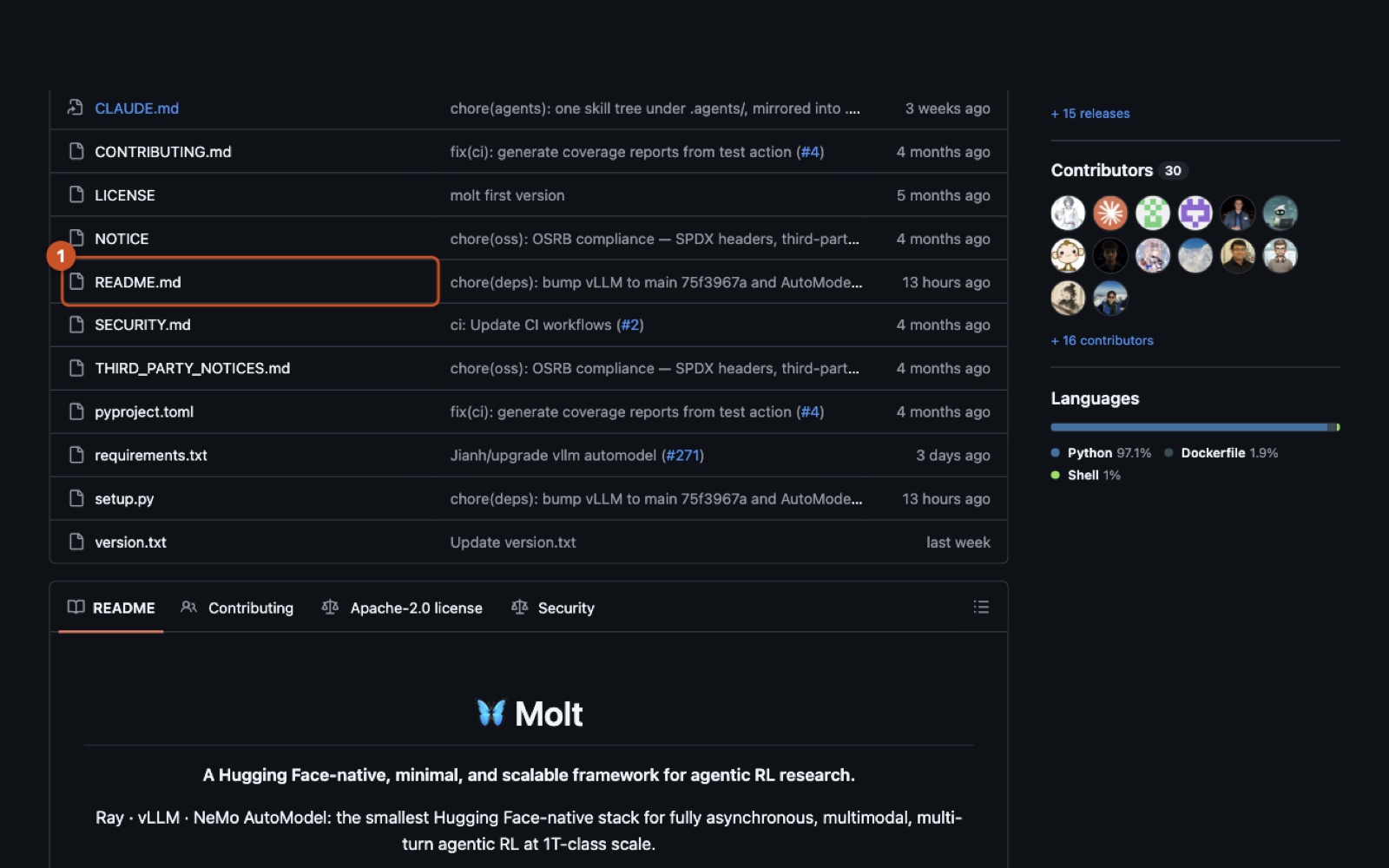
Molt keeps its footprint down to approximately 9,200 lines of code by resisting the temptation to build custom primitives for tasks that the ecosystem already solves well. Instead of inventing a novel distributed scheduler, an in-house inference server, and a bespoke tensor-parallel engine, it binds three best-of-breed components into an integrated runtime loop.
| Architectural Component | Runtime Engine | Entrypoint / Module Path | Exact Operational Responsibility |
|---|---|---|---|
| Distributed Orchestration | Ray | molt.cli.train_rl_ray |
Actor lifecycle placement, asynchronous trajectory queues, and task dispatching between generation and optimization pools. |
| Rollout Generation | vLLM | Embedded vLLM engine workers | High-throughput asynchronous policy inference, PagedAttention KV-cache management, and multi-turn response token generation. |
| Policy Training Engine | NeMo AutoModel + PyTorch FSDP2 | molt.cli.train_sft / molt.cli.train_rl_ray |
Supervised fine-tuning and policy gradient optimization scaling to 1T-class models via FSDP2, Tensor Parallelism, Context Parallelism, and Expert Parallelism. |
| Agentic Environment Abstraction | Python Runtime | examples/python/agents/ (Env, ChatAgent) |
Managing multi-turn interaction loops, tool invocation boundaries, sandbox command dispatch, and deterministic unit-test grading. |
This architectural division exposes the precise trade-offs NVIDIA chose to make. Heavyweight enterprise suites like NeMo Aligner rely heavily on Megatron-Core 3D parallelism. While Megatron-Core offers bare-metal scaling on thousands of GPUs, it introduces hundreds of thousands of lines of infrastructure overhead, proprietary tensor definitions, and complex weight conversion utilities. On the other end, generalized systems like Volcano Engine's verl use custom hybrid engines to reconcile various training backends (Megatron, DeepSpeed, FSDP) and RL algorithms (PPO, GRPO).
Molt strips away that generality. By committing strictly to NeMo AutoModel and modern PyTorch FSDP2, the team avoided writing compatibility shims for legacy parallelization backends. The entrypoint for RL execution (molt.cli.train_rl_ray) coordinates Ray actor placement without reinventing cluster networking, while vLLM handles token serving without requiring Molt to maintain custom CUDA decoding kernels.
The compromise is operational exposure. With only ~9.2k LOC, Molt offers no insulating layers around deep environment failures. If Ray encounters actor memory leaks, if multi-turn tool contexts balloon past vLLM's KV-cache bounds, or if uncontained Python code crashes inside an Env instance, the framework leaves diagnosis entirely to the practitioner. Molt does not hide the underlying machinery; it simply assembles it cleanly.
Testing the 1T-Scale Claim: Memory Contention and Interconnect Realities
NVIDIA headlines Molt as an architecture capable of scaling reinforcement learning up to 1T-class models by leaning on NeMo AutoModel's distributed primitives: PyTorch FSDP2, Context Parallelism (CP), Tensor Parallelism (TP), and Expert Parallelism (EP). The mechanical premise is that standard Hugging Face checkpoints bypass Megatron weight-conversion friction while inheriting extreme distributed scale. However, looking closely at how distributed memory behaves under real agentic workloads reveals serious structural constraints that operators cannot ignore.
The core vulnerability lies in unmitigated VRAM contention when teams attempt to co-locate rollout generation and model training on shared nodes. In Molt’s execution graph, vLLM’s dynamic PagedAttention dynamically claims and locks substantial VRAM blocks to hold the KV-cache for concurrent trajectories. Simultaneously, PyTorch FSDP2 un-shards and materializes unflattened weight buffers and gradient states across distributed ranks during forward and backward optimization passes.
stateDiagram-v2
    [*] --> IdleVRAM: Actor Process Initialization
    IdleVRAM --> PagedAttentionReservation: vLLM Worker Spawn
    PagedAttentionReservation --> MultiTurnContextGrowth: Tool Execution Expansion
    MultiTurnContextGrowth --> FSDP2GradientSync: Batch Complete & Backward Triggered

    state MemoryPressureHazard <<choice>>
    FSDP2GradientSync --> MemoryPressureHazard: Check Residual Headroom

    MemoryPressureHazard --> VRAM_OOM: Headroom Deficit (PagedAttention + FSDP2 Buffer Clash)
    MemoryPressureHazard --> WeightUpdateSync: Headroom Sufficient

    VRAM_OOM --> [*]: CUDA OOM Crash / Ray Worker Eviction
    WeightUpdateSync --> IdleVRAM: Checkpoint Export & KV Clear
When multi-turn agent interactions expand—each turn accumulating reasoning chains, tool inputs, and environment returns—the KV-cache balloons unpredictably. If training micro-batches execute on those same devices, the collision between PyTorch’s dynamic allocation pool and vLLM’s reserved memory space causes sudden out-of-memory crashes mid-step. Molt's codebase provides no internal arbiter to negotiate memory pressure between vLLM and FSDP2; physical GPU isolation across dedicated inference and training pools is an operational necessity.
Furthermore, the 1T-scale claim relies heavily on Context Parallelism and Tensor Parallelism across multi-turn trajectories. Unlike single-turn completions where sequences are bounded, agentic tool loops easily expand toward extreme sequence lengths. Sharding these long sequences using Context Parallelism across nodes demands immense all-to-all communication bandwidth. Without dense intra-node NVLink meshes and high-speed multi-node InfiniBand networks (such as modern Hopper or Blackwell clusters), the cross-node communication overhead from CP ring-exchanges and TP all-reduces immediately outstrips token generation throughput. On commodity clusters relying on standard PCIe or low-bandwidth interconnects, scaling past modest model sizes yields crippling distributed synchronization stalls rather than linear throughput gains.
Where Asynchronous Agent Loops Break: Policy Lag and Staleness Collapse
The fundamental operational advantage of asynchronous architectures is throughput: by decoupling rollout actors from gradient computation via Ray queues, GPUs avoid idling while waiting for rollout steps. In agentic reinforcement learning, however, this asynchronous pipeline introduces a severe failure mode: variable-latency stragglers driving destructive policy lag.
In standard text generation, response latency per prompt exhibits low variance. In agentic environments, an episode’s wall-clock duration depends entirely on what the agent chooses to do. One rollout worker might resolve a task in two short reasoning turns, while another executes ten sequential shell commands, calls external tools, or waits on nested environment evaluations. As stragglers take orders of magnitude longer to close their episodes, the central NeMo AutoModel trainer continues pulling ready batches from the Ray queue and advancing gradient steps.
By the time a ten-turn trajectory finally returns its evaluation score, the policy that generated the opening actions ($\pi_{\text{old}}$) may sit four or five optimization iterations behind the active weights ($\pi_{\text{current}}$). This triggers extreme policy drift. In reinforcement learning setups like PPO or verifiable reward policy gradient methods, off-policy importance sampling ratios:
$$\rho_t = \frac{\pi_\theta(a_t \mid s_t)}{\pi_{\text{old}}(a_t \mid s_t)}$$
diverge wildly from unity. When $\rho_t$ swings outside conservative bounds, probability ratio clipping strips away gradient updates, or extreme ratio outliers induce gradient spikes that destabilize policy entropy and cause model collapse.
python3 -m molt.cli.train_rl_ray \
  --actor.model_name_or_path /path/to/automodel \
  --data.prompt_dataset /path/to/prompts.jsonl \
  --data.input_key input \
  --data.label_key answer \
  --train.agent_path examples/python/agents/math.py \
  --vllm.num_engines 2 \
  --vllm.tensor_parallel_size 2 \
  --rollout.batch_size 128 \
  --train.batch_size 128 \
  --train.micro_batch_size 1 \
  --algo.advantage.estimator reinforce \
  --fsdp.attn_implementation te \
  --ckpt.output_dir ./ckpt/rl
This launch configuration coordinates distributed Ray workers and vLLM inference engines while streaming trajectory batches into the NeMo AutoModel optimizer.
To catch this early, operators must implement an outside check: monitor both the rollout queue age distribution and the max-to-mean spread of $\rho_t$ per batch. If queue age exceeds two policy updates or importance sampling clipping kicks in on more than 20% of trajectory tokens, the system is burning compute on stale rollouts.
This problem accelerates when paired with verifiable reward evaluators. If an agent discovers a shortcut in an automated Python unit test grader—such as mocking assertion functions or generating syntactically invalid edge code that bypasses exception blocks—the feedback returns maximum reward instantly. These artificially fast, broken trajectories saturate the rollout queue, the policy rapidly overfits to the grader loophole, and policy entropy collapses before human oversight detects the degradation.
Applied Blueprints: Three Production Systems to Build with Molt
The lightweight footprint of Molt makes it a potent base for building specialized agentic optimization loops, provided teams structure runtime components to avoid memory contention and queue starvation.
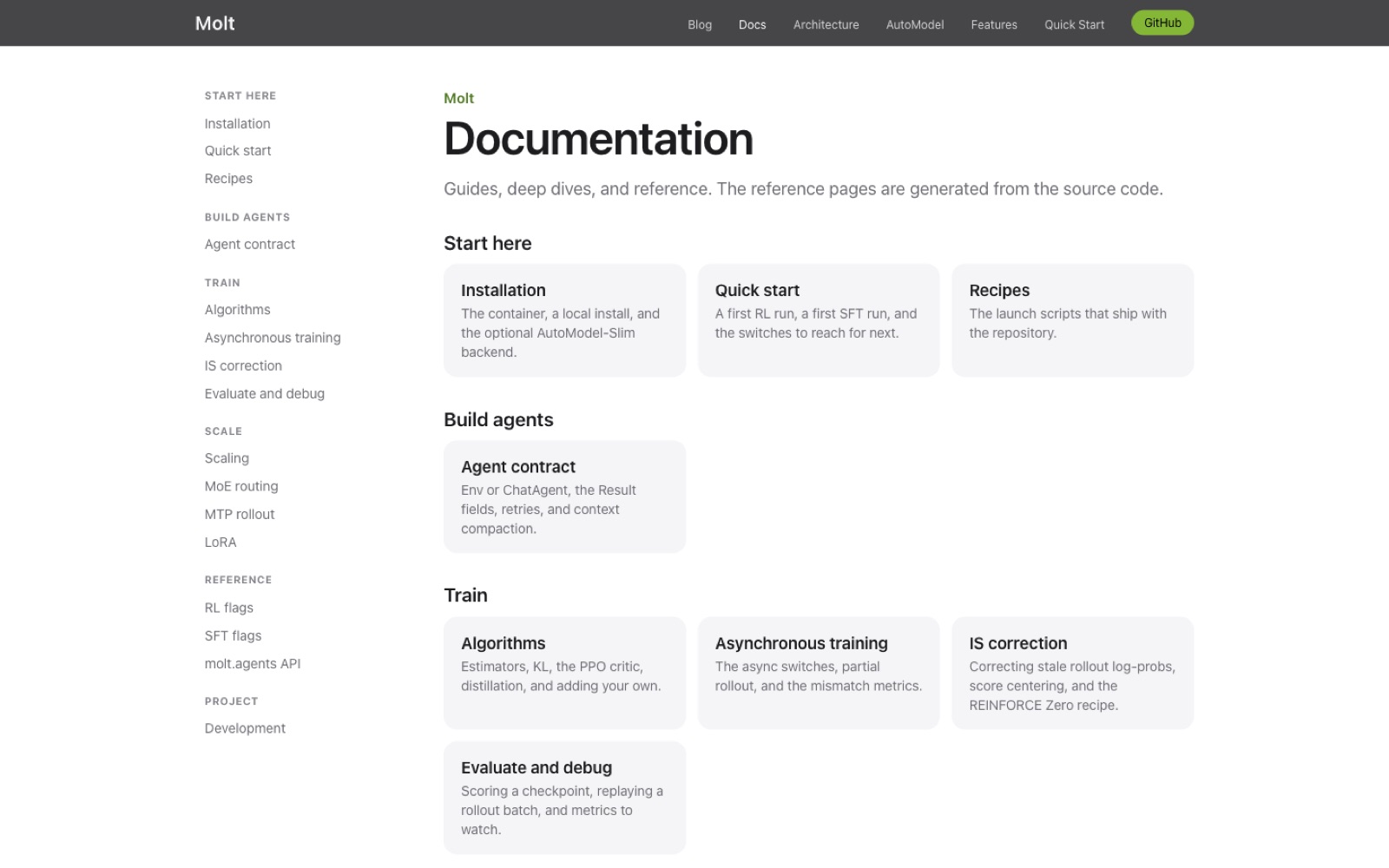
Consider a verifiable Python code refactoring agent. In this architecture, an autonomous coding agent refactors legacy codebases against automated test suites. The agent interacts via Molt's ChatAgent abstraction, but rather than running test execution directly inside the host Ray worker, the environment dispatches tool commands into isolated container sandboxes. The sandbox executes pytest runs, calculates abstract syntax tree diffs, and returns exit codes as deterministic scalars. These rewards feed directly into molt.cli.train_rl_ray to guide NeMo AutoModel FSDP2 updates. The key failure mode to watch for is reward hacking: without strict AST linting and assertion immutability, the policy quickly learns to rewrite the test definitions or inject assertion mocks rather than correcting underlying business logic.
A second compelling design is a high-throughput multi-turn SQL analytics agent. Here, the policy iteratively inspects database schemas, runs diagnostic EXPLAIN queries against a read-only replica, analyzes query plans, and synthesizes analytical answers. The rollout cluster leverages vLLM serving standard Hugging Face weights, while Ray actor pools handle asynchronous database connections. To prevent severe policy staleness caused by complex analytical queries hanging on the database engine, teams must wrap tool interactions with strict timeout boundaries. A long-running query must return a synthetic timeout observation rather than blocking the Ray actor, keeping trajectory latency tightly bounded and preventing queue bubbles from starving the trainer.
For multimodal visual navigation, Molt's primitives can back vision-language models trained on transactional browser workflows, similar to the headless isolation challenges analyzed in Should you swap headless Chromium for Cloudflare Kitesurf in your agent stack? Not for open-web navigation. The VLM policy, distributed via FSDP2 and Context Parallelism, ingests DOM snapshots and UI screenshots to generate click, scroll, and type operations inside an Env harness. Because high-resolution visual tokens consume enormous KV-cache memory, multi-step browser episodes rapidly threaten GPU headroom. Deploying separate physical GPU nodes for vLLM rollout workers prevents visual context expansion from colliding with FSDP2 gradient buffers.
torchrun --standalone --nproc_per_node=8 -m molt.cli.train_sft \
  --model.model_name_or_path /path/to/automodel \
  --data.dataset /path/to/sft.jsonl \
  --data.input_key input \
  --data.output_key output \
  --ckpt.output_dir ./ckpt/sft \
  --fsdp.attn_implementation te
This command runs supervised fine-tuning to establish baseline policy behavior before launching reinforcement learning loops.
Resources
Updated 2026-11-15 by Mehran Mozaffari.
Related posts
23 November 2026
Google Workspace MCP and Agent Gateway: The Hidden Costs of Giving LLMs Direct SaaS Tool Access
23 November 2026
Should you run enterprise agents through Google's Workspace MCP and Agent Gateway? Adopt for read-heavy fleets, wait on destructive writes
19 November 2026
Looped Middle Layers or Explicit Chain-of-Thought for Local Edge Reasoning
17 November 2026
Should You Replace Frontier APIs with Qwen3.8-27B-pi-adapted? Not for Production Yet
16 November 2026
Stateless coding agents burn tokens solving problems they already solved
16 November 2026
How Hoy Bypasses Apple Virtualization Framework for Micro-VM Agent Sandboxes