The Local Reasoning Contenders and the 32GB Edge Bottleneck
When you run local inference on a 32GB Apple Silicon node, you quickly run into a physical wall: unified memory must house the OS, runtime buffers, model weights, and the dynamic Key-Value (KV) cache. If your goal is deep analytical reasoning rather than basic text completion, you face a sharp architectural fork. You can either deploy a standard feed-forward architecture that spends compute across sequence space via explicit chain-of-thought tokens, or you can use internal recurrent depth—looping hidden states through shared middle layers multiple times per generated token.
quadrantChart
    title Local Inference Reasoning Architectures on 32GB Unified Memory
    x-axis Low Memory Footprint --> High Memory Footprint
    y-axis Fast Token Step Latency --> Slow Token Step Latency
    quadrant-1 Memory Bloat and High Latency
    quadrant-2 Low VRAM but High Step Latency
    quadrant-3 Fast and Lean
    quadrant-4 Fast Step but Heavy VRAM
    Standard Linear Feed-Forward blocks: [0.35, 0.25]
    Looped Middle-Layer Recurrence: [0.25, 0.75]
    Explicit Chain-of-Thought Scratchpads: [0.70, 0.40]
    Sparse MoE routing: [0.85, 0.30]
The core head-to-head tension comes down to where you spend your compute budget: inside the token step or across the token sequence. A standard linear model operating with explicit chain-of-thought keeps per-step latency low, but it dumps hundreds of intermediate thinking tokens into the KV cache. That bloats context memory and degrades TTFT over multi-turn agent runs.
In contrast, looping three times through middle blocks compresses that reasoning pass directly into the latent state. You preserve a compact context window and keep static weights small enough to comfortably sit inside a 14B-sized memory boundary. The price you pay is immediate: step-by-step token generation slows down substantially, and the model's inner reasoning path remains a black box. As I detailed when analyzing how CUDA Does Not Own Silicon Speed in Memory-Bound Decode, local hardware constraints force you to decide whether memory bandwidth or sequential latency will be your primary bottleneck. On a 32GB host, that decision dictates whether your local reasoning agent remains responsive or stalls under its own execution weight.
FLOP Density and Arithmetic Intensity Under Unified Memory Constraints
Standard autoregressive decode at batch size 1 is notoriously memory-bandwidth bound. Every token generation step requires the processor to read every parameter weight from unified memory into on-chip cache and registers just to perform a handful of multiply-accumulate operations. For a conventional linear feed-forward network, increasing reasoning depth means increasing total layer count, which forces more gigabytes across the memory bus for every token produced.
sequenceDiagram
    autonumber
    participant In as Token Embedding
    participant Early as Early Layers
    participant Mid as Middle Block Cluster
    participant Late as Late Layers
    participant Out as Output Head

    Note over In,Out: Standard Feed-Forward Execution
    In->>Early: h(0)
    Early->>Mid: h(1)
    Mid->>Late: h(2)
    Late->>Out: h(final)

    Note over In,Out: 3x Recurrent Loop Execution
    In->>Early: h(0)
    Early->>Mid: h(1) [Pass 1]
    Mid->>Mid: h(2) [Pass 2 - Reusing Weights in SRAM]
    Mid->>Mid: h(3) [Pass 3 - Reusing Weights in SRAM]
    Mid->>Late: h(4)
    Late->>Out: h(final)
Weight-tied middle blocks fundamentally invert this profile. By holding the middle block cluster resident in local SRAM and cycling the hidden representation $h^{(k)}$ through those exact same parameters three times, the system executes three arithmetic passes per byte loaded from system memory. This drastically drives up arithmetic intensity.
On Apple Silicon's unified memory architecture, this loop flips inference from being strictly memory-bandwidth bound to compute-core bound. You no longer wait on memory bus saturation to stream giant parameter arrays; instead, you saturate the GPU execution units and Neural Engine running serial matrix multiplications on the recycled layers.
The practical trade-off is stark. While your static VRAM footprint remains identical to an unlooped base model, generation throughput plummets. Because the middle cluster typically represents 60% to 75% of the total parameter stack, running those blocks three times means each token must wait for the sequential execution of five to seven virtual layer equivalents before projecting to the unembedding head. For interactive workflows like local agent tool calls, you are trading away snappy per-token streaming speed to achieve higher FLOP density within the same physical memory space.
KV Cache Footprint and Context Memory Scaling
The primary operational advantage of latent recurrent reasoning over explicit chain-of-thought is supposed to be context conservation: instead of spitting out 1,500 scratchpad tokens that clog your memory buffers, the thinking happens within the hidden dimension. However, self-attention mechanics introduce a severe runtime ambiguity that determines whether this theoretical advantage holds up on edge hardware.
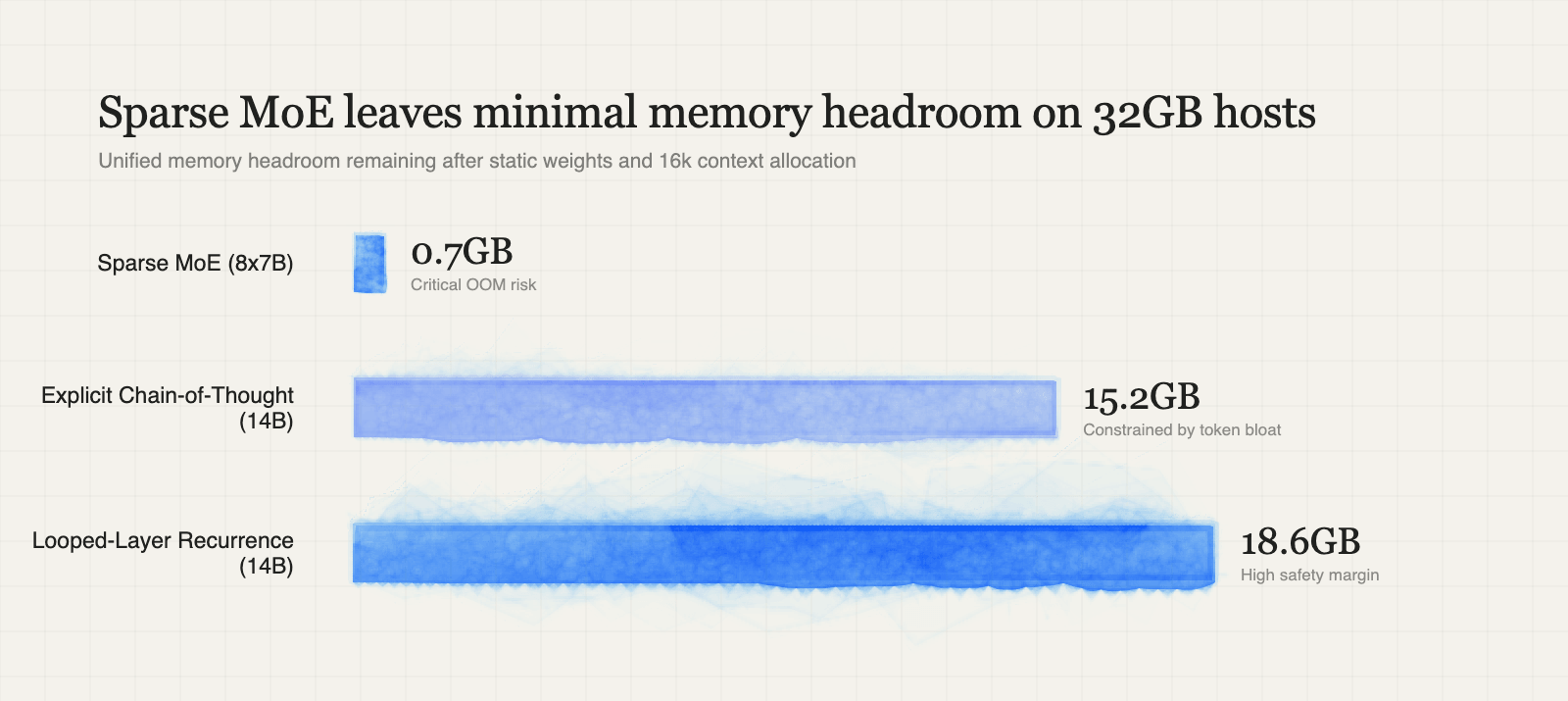
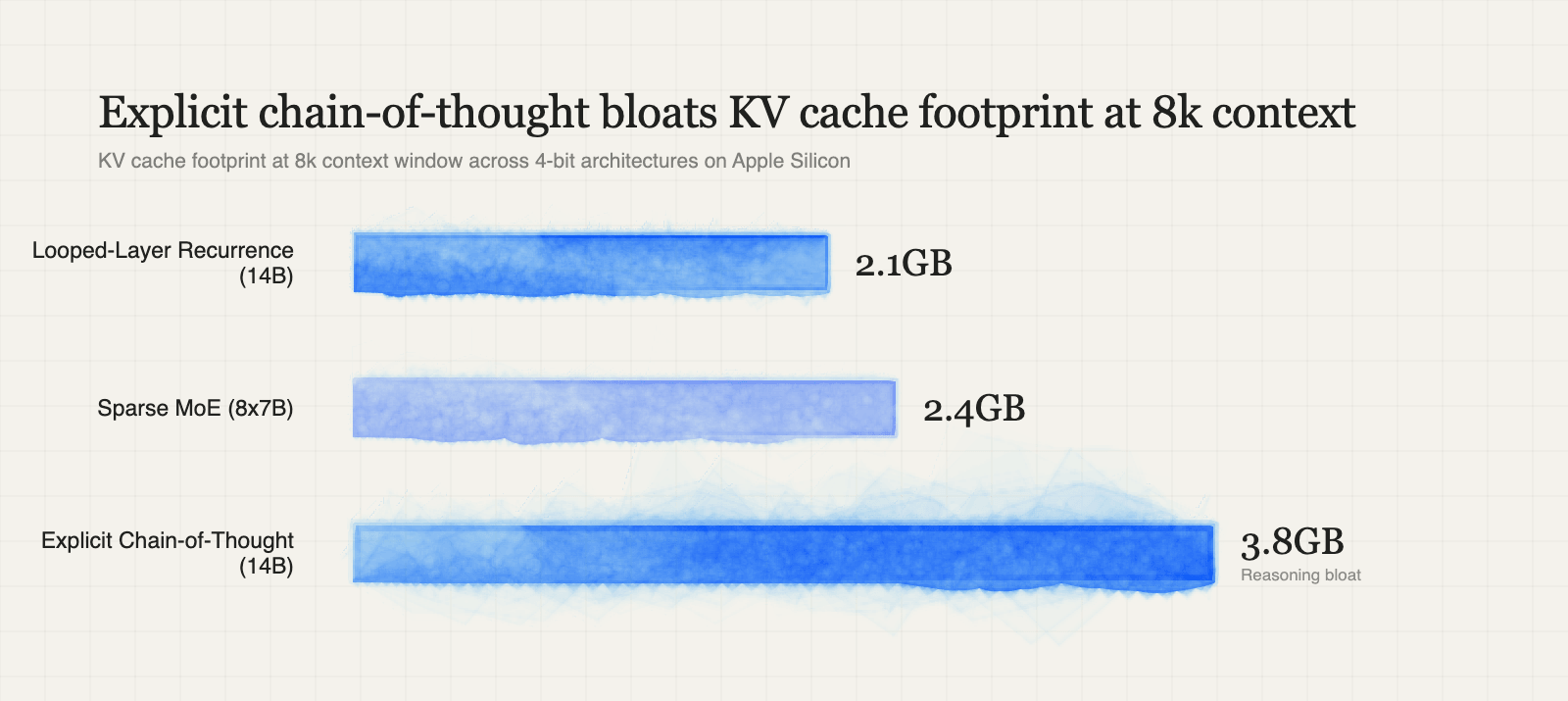
| Architecture Paradigm | Static Weight Memory (4-bit Q4_K_M) | KV Cache at 2k Context | KV Cache at 8k Context | KV Cache at 16k Context | Unified Memory Headroom (32GB Host) |
|---|---|---|---|---|---|
| Looped-Layer Recurrence (14B, 3x Mid Loop) | ~9.2 GB | ~0.5 GB | ~2.1 GB | ~4.2 GB | ~18.6 GB (High safety margin) |
| Explicit Chain-of-Thought (14B Linear Stack) | ~9.2 GB | ~0.5 GB | ~3.8 GB (Reasoning bloat) | ~7.6 GB (Context saturation) | ~15.2 GB (Constrained by token bloat) |
| Sparse MoE (e.g. 8x7B, 2 Active Experts) | ~26.5 GB | ~0.6 GB | ~2.4 GB | ~4.8 GB | ~0.7 GB (Critical OOM risk) |
In an explicit chain-of-thought model, KV cache allocation is strictly linear and tied to token sequence length. Every token appends exactly one Key and Value projection vector per layer. While verbose reasoning traces inflate the token count and chew through memory over extended agent conversations, the runtime behavior is completely predictable and fully supported by standard GGUF memory managers.
Recurrent middle layers break that clean mapping. In self-attention, layer $L_{\text{mid}}$ must compute queries against past tokens. If the inference runtime builds its compute graph by simply unrolling the loop into distinct forward passes without dedicated cache-overwriting logic, it allocates a separate KV slot for Pass 1, Pass 2, and Pass 3. Instead of storing one key-value pair per physical block, you store three for every middle layer in the network.
When that happens, your context memory scaling spikes exponentially relative to physical layer count. At an 8k context window, a poorly managed looped graph can consume more runtime buffer space than a standard feed-forward 32B model, completely erasing the parameter-efficiency advantage that motivated choosing a looped architecture on a 32GB Mac in the first place. Adopting teams must verify that the underlying execution graph enforces strict single-slot KV reuse across iterations before trusting it in long-context local pipelines.
Inspectability, Latent Drift, and Error Compounding Across Loops
The headline promise of looping through middle layers is enticing: you get "deep reasoning" without paying the static parameter toll. In my experience evaluating local models, this assumption breaks down the moment you inspect the actual dynamics of repeated tensor transformations. True depth in a standard feed-forward transformer works because successive, distinct layers specialize in a hierarchy of representations. Early layers handle token syntax and surface structure, intermediate layers resolve compositional grammar and entity bindings, and late layers handle high-level semantic reasoning. Re-applying the exact same weight matrix three times does not magically replicate that hierarchical emergence. It merely subjects the identical representation to an iterative operator.
That iterative reuse introduces severe numerical failure modes. A transformer block functions as a residual step: $x_{l+1} = x_l + F_l(x_l)$. When $F_l$ is parameterized by unique weights at every depth, the network learns subtle orthogonal adjustments without compounding systematic operator biases. In a recurrent middle cluster where $F_{\text{mid}}$ runs cyclically, stability hinges entirely on the spectral properties of that repeated operator. If the transformation's spectral radius drifts above unity, intermediate activations amplify with each cycle, pushing hidden states toward saturation and triggering numerical instability under reduced precision. Conversely, if the operator acts as a contractive mapping, hidden states collapse into a fixed-point attractor. When that happens, fine-grained token variance washes out, leaving the model trapped in repetitive syntax loops or producing degraded token distributions across long prompts.
Beyond numerical drift, the most acute operational cost is the total loss of inspectability. When an explicit chain-of-thought model reasons through a multi-step logic problem, it externalizes its intermediate derivations directly into text. If the model misinterprets a premise, executes an invalid deduction, or drops an operational constraint, I can parse the scratchpad trace, locate the exact token where the logic derailed, and insert an automated guardrail or intervention.
Looped middle layers force all reasoning into latent space. There is no intermediate trace to audit, evaluate, or constrain. If the model arrives at a flawed output after three recurrent passes, you cannot tell whether the initial projection failed, whether an intermediate pass diverged, or whether the final projection collapsed. For production pipelines requiring high-assurance reasoning, latent recurrence trades away verification for context brevity—a dangerous compromise when deterministic accuracy matters more than raw prompt length.
Runtime Graph Execution and Ollama DAG Compatibility
Even if a recurrent architecture maintains numerical stability on paper, running it reliably in local environments like Ollama presents substantial engineering friction. Mainstream local inference runtimes—primarily llama.cpp and its downstream distributions—are architected around static directed acyclic graphs (DAGs). The compute engine assumes a predictable forward pipeline where tensor allocations, layer activations, and buffer lifetimes map onto a linear sequence of layer operations.
Weight-tied recurrence breaks this clean acyclic paradigm. To execute a three-pass loop through middle layers within a GGUF runtime, the engine must either unroll the graph at compilation time or implement a custom cyclic execution scheduler. Unrolling the graph creates phantom nodes that share underlying weight pointers. While this avoids loading redundant parameter bytes into memory, it bloats graph metadata, disrupts memory pool planning, and complicates the Metal backend's ability to schedule unified memory buffers efficiently. If the runtime instead attempts custom cyclic graph routing, it bypasses standard execution pathways, frequently breaking kernel fusions and memory reuse passes.
This architectural divergence incurs a persistent maintenance tax against the broader local AI ecosystem. Standard feed-forward models immediately benefit from upstream optimizations: automatic Metal kernel fusion, optimized FlashAttention passes, and native compatibility with speculative decoding setups where small draft models accelerate decode. A model relying on custom graph looping sits outside this fast lane. Speculative decoding engines struggle because draft-verification algorithms assume a straight-line forward pass across sequential blocks.
Furthermore, local runtimes frequently update quantization kernels, memory-mapping routines, and multi-threaded dispatch logic. Custom execution topologies that rely on non-standard graph execution paths lag behind these mainline performance improvements. Teams attempting to operationalize recurrent middle layers locally will find themselves managing bespoke runtime forks or absorbing unoptimized dispatch overhead, negating much of the theoretical throughput efficiency that local edge inference is supposed to deliver.
Empirical Verification: Profiling Latency, Cache Size, and Coherence
Before letting any weight-tied recurrent model enter an agent pipeline, I subject the runtime to a rigorous three-step profiling gate. Theoretical parameter efficiency means nothing if the underlying engine quietly duplicates cache allocations or degrades into circular token loops under quantization.
First, measure the raw latency tax. Run an A/B benchmark comparing the recurrent candidate against an unlooped, feed-forward 14B baseline under identical context lengths and batch size 1. Capture Time-to-First-Token (TTFT) and inter-token generation speed across both short prompt completions (128 tokens) and long generation targets (1,024 tokens). Expect the recurrent model’s generation throughput to drop by roughly 50% to 65% relative to the standard 14B architecture. If your deployment requires snappy streaming responses or high-frequency agent tool calling, this test confirms whether the arithmetic intensity trade-off remains within your interactive latency budget.
Second, profile context memory scaling to detect runtime KV cache duplication. Execute an automated sweep prompting the model at 1,024, 4,096, and 8,192 input tokens with identical decoding parameters, recording resident set size (RSS) memory at each plateau. Calculate the exact delta in megabytes per thousand context tokens. If the slope matches standard 14B feed-forward KV cache allocations, the runtime properly shares cache state across recurrent iterations. If that slope triples across the middle layers, unrolled computation graphs are duplicating state, turning what seemed like a compact 14B deployment into an out-of-memory hazard on a 32GB host.
Third, benchmark logical coherence across precision formats to isolate quantization noise amplification. Feed a suite of multi-step logical deduction prompts to both an unquantized FP16 build and a standard 4-bit (Q4_K_M) GGUF build. Look specifically for late-sequence degeneration: repetitive syntax loops, collapsed token variance, or sudden attractor states where the model repeats boilerplate phrases. If the FP16 build resolves the deduction cleanly while the 4-bit build collapses into circular reasoning, the recurrent loop is recursively compounding quantization truncation errors, making reduced-precision deployment unsafe for production tasks.
Summary Decision Matrix and When to Pick Each Approach
Deciding between looped-layer recurrence, standard feed-forward models with explicit chain-of-thought, and sparse Mixture of Experts (MoE) on a 32GB edge node requires evaluating strict trade-offs across physical memory, compute latency, and runtime maintainability.
| Operational Dimension | Looped Middle-Layer Recurrence | Explicit Chain-of-Thought Models | Sparse Mixture of Experts (MoE) |
|---|---|---|---|
| Parameter Footprint in 32GB RAM | Low (~9–12 GB in 4-bit; leaves substantial OS and buffer headroom) | Moderate (~9–18 GB depending on base size; fits comfortably) | Critical (~24–28 GB for 8x7B; near hardware capacity limits) |
| Generation Latency | High latency (2x–3x slower per token step due to sequential loops) | Fast per-token decode step (but longer total wall-clock time due to verbose output) | Fast per-token decode (low active FLOP count per step) |
| KV Cache Growth Rate | Flat and compact (latent reasoning preserves short token sequences) | High growth rate (hundreds of reasoning tokens bloat context memory) | Standard linear growth per output token |
| Reasoning Inspectability | Opaque (black-box latent transitions; no intermediate audit trace) | Transparent (full externalized scratchpad tokens for inspection and guardrails) | Transparent if paired with scratchpad prompts; standard token output |
| Runtime / GGUF Ecosystem Compatibility | Low (requires custom cyclic graphs or unrolled DAG hacks in local engines) | Native (standard linear execution path across all mainstream runtimes) | Mature (broadly supported in upstream llama.cpp and Ollama runtimes) |
| Quantization Stability | Fragile (recursive loops amplify 4-bit rounding noise non-linearly) | Robust (standard error distribution across distinct layer weights) | Robust across standard quantization formats (Q4_K_M, Q5_K_M) |
Deploying recurrent weight-tied models makes sense only in specialized, memory-constrained edge environments where saving context space outweighs execution speed. If an embedded system must run continuous, long-horizon analytical tasks without filling its KV cache with thousands of intermediate thinking tokens, latent looping delivers the necessary compute density within a compact memory footprint. You avoid loading 40GB of sparse MoE weights into a unified memory bus that cannot support them, and you keep process memory comfortably below hardware thresholds.
For virtually every other production scenario, standard feed-forward models with explicit chain-of-thought remain the superior engineering choice. The ability to inspect intermediate reasoning tokens, attach automated validation logic, and immediately benefit from upstream optimizations across standard execution graphs outweighs the theoretical compactness of looped recurrence. Until local inference engines offer first-class, hardened execution graphs for cyclic topologies, explicit chain-of-thought remains the production standard for reliable edge reasoning.
Resources
(no official sources were available to link)
Updated 2026-11-19 by Mehran Mozaffari.
Related posts
23 November 2026
Google Workspace MCP and Agent Gateway: The Hidden Costs of Giving LLMs Direct SaaS Tool Access
23 November 2026
Should you run enterprise agents through Google's Workspace MCP and Agent Gateway? Adopt for read-heavy fleets, wait on destructive writes
17 November 2026
Should You Replace Frontier APIs with Qwen3.8-27B-pi-adapted? Not for Production Yet
16 November 2026
Stateless coding agents burn tokens solving problems they already solved
16 November 2026
How Hoy Bypasses Apple Virtualization Framework for Micro-VM Agent Sandboxes
15 November 2026
Inside NVIDIA Molt: How a 9,000-Line Framework Trains Trillion-Parameter Agents Without Weight Conversion