
Stateless Coding Agents Treat Every Issue Like Day One on the Job
The standard execution model for autonomous coding harnesses is structurally amnesic. Every time a harness spins up an agent to resolve a bug or implement a feature, it allocates a pristine, empty context window and hands the model a shell. What follows is an expensive pantomime of basic orientation: the model issues repeated calls to find, grep, ls, and directory walk utilities simply to discover where entry points live, which test runner the repository expects, and which virtual environment holds the active dependencies. On a sprawling codebase, an agent easily burns thousands of prompt tokens before writing a single line of functional code.
Treating execution sessions as disconnected episodes caps operational performance while multiplying runtime spend. In a production repository with hundreds of open tickets, paying the full token tax for exploratory reconnaissance on every ticket is untenable. When a human engineer spends three hours figuring out that a test suite requires an obscure environment variable and a custom runner invocation, they write it down in an internal guide or commit it to working memory; they do not rediscover it from scratch the next morning. By wiping state clean between sessions, current harnesses force models to relive the same orientation failures indefinitely.
The structural fix is clear: decoupling transient execution scratchpads from durable repository knowledge through post-session distillation transforms repetitive exploration into cumulative engineering leverage. Instead of treating an agent’s run as ephemeral terminal noise to be discarded upon exit, an execution trajectory contains high-value operational telemetry. When an agent successfully navigates a build harness, diagnoses a cryptic import clash, or surfaces an undocumented service mock, that knowledge can be captured, normalized, and indexed. Rather than forcing future runs to perform raw discovery, the harness can inject distilled repository conventions directly into initial prompts.
The progression of agent context architectures reveals an escalating struggle to balance token usage against operational awareness:
timeline
    title Evolution of Context Management in Coding Agents
    section Exploration
        Naive Shell Discovery : Agents run raw find and grep commands on every task
    section Reactive Capping
        SWE-agent ACI : Custom viewers restrict terminal outputs to narrow line windows
    section Static Structure
        Aider Repo Maps : AST graphs and PageRank index symbols prior to run
    section Dynamic Tooling
        MemGPT : LLM invokes explicit tools to query and persist memory blocks
    section Distillation
        TokenEconomizer : Offline trajectory parsing seeds targeted execution memory cards
Moving away from brute-force exploration is essential if coding agents are to become cost-effective partners in large repositories.
Why Injecting Historical Memory Feels Counterintuitive to Context Hygiene
Injecting past session logs into an active prompt immediately triggers skepticism from any operator who has wrestled with context hygiene. Modern frontier context windows may span a million tokens, but effective attention remains finite, fragile, and sensitive to prompt clutter. Loading raw interaction traces from previous runs introduces massive token overhead, dilutes attention on the immediate task instructions, and increases the likelihood of hallucinated constraints. If an agent ingests hundreds of lines of historical stack traces from a previous developer's session, it frequently fixates on obsolete errors rather than diagnosing the code right in front of it.
Because of this friction, engineering teams reflexively reach for static alternatives. Approaches like AST-based symbol ranking—used effectively by tools like Aider—compress the physical layout of classes and functions into a lean, predictable structural map without introducing natural-language ambiguity. Alternatively, teams resort to human-authored configuration files like .cursorrules or .windsurfrules, embedding static directives such as "always run pytest with --no-cov" directly into system prompts. Both tactics reflect a preference for deterministic boundaries over letting an LLM write its own persistent field notes.
Yet static code representations leave an operational blind spot: they capture syntax and symbol topology while missing dynamic runtime execution. An Abstract Syntax Tree cannot reveal that running integration tests against a local database requires spinning up a detached container with a non-standard port flag. It cannot warn an agent that a specific module imports an unpinned library requiring a patched environment variable, nor can it document the exact mock setup needed to satisfy a flaky assertion in tests/test_client.py. These runtime traps only surface during live terminal interaction.
Relying on manual rule curation to plug this gap fails because human documentation inevitably falls behind active codebases. Developers rarely update localized rule files every time an internal test harness shifts, and expecting engineers to hand-craft instructions for every subpackage turns tooling into a maintenance burden. What operators need is not uncurated trajectory dumps, but automated extraction of verified operational facts stripped of conversational noise. When captured cleanly, historical execution knowledge bridges the divide between static AST maps and dynamic execution realities, giving subsequent agent runs an unfair operational head start.
Testing the Amortization Math Against Benchmark Trajectories
The mechanical pipeline behind TokenEconomizer centers on converting noisy runtime transcripts into concise, queryable memory units. When an agent session concludes, an extraction pipeline parses the raw execution trajectory. Verbose compiler diagnostics, multi-page directory trees, and unhelpful stack traces are pruned. The cleaned transcript passes through an offline evaluation step that distills the interaction into modular cards: repository topology notes, environment setup commands, and concrete debugging rules of thumb. These cards are stored in a keyed memory layer and selectively injected into subsequent task runs, either as pre-seeded guidance during session initialization or via targeted runtime lookups when an agent hits an execution wall.
mindmap
  root((Episodic Agent Memory))
    Extraction Pipeline
      Trace pruning of noisy shell output
      Recipe distillation for test and build runs
      Error taxonomy and failure caveats
    Storage Layer
      Keyed memory cards by file and module
      Commit hash tags for cache tracking
      Vector index for semantic fallback
    Retrieval Paths
      Initial context seeding before prompt boot
      Just in time debugging tool calls
Proponents claim this workflow cuts preliminary token consumption by 30 to 60 percent on repeated repository workloads. While that metric looks impressive on paper, it demands scrutiny. As I noted when exploring whether to drop TokenEconomizer into your coding agent harness, moving tokens from the foreground interaction loop into background distillation jobs does not automatically yield net efficiency.
If an engineering team processes dozens of discrete tasks across the same monolithic repository, the secondary distillation compute amortizes quickly. Spending 4,000 tokens in an offline extraction step to save 10,000 tokens across five subsequent task attempts produces a clear net win. But if your workflow routes single, isolated bug fixes across hundreds of disparate open-source repositories, the amortization math completely falls apart. The system burns significant secondary tokens extracting and embedding lessons that will never be queried again.
Furthermore, these distilled operational insights remain fundamentally tied to the repository where they were produced. Discovering how to mock a specific authentication service in an internal web framework does not translate to a different codebase with its own custom mocking patterns. Token reduction claims only hold true when task density on a specific codebase is high enough to offset background distillation overhead. Without high task concentration on a stable codebase, an organization simply shifts its token bill from the live execution harness to the post-processing pipeline without capturing genuine savings.
The Compiler Cache Law: Why Agent Memory Mirrors Bazel Action Graphs
Every build engineer eventually learns the hard way that a cache without hermetic invalidation is simply a corruption engine waiting for an excuse. Systems like ccache and Bazel's action cache derive their entire reliability from deterministic action keys: if a compiler flag shifts, an environmental header changes, or a transitive dependency updates, the action graph invalidates that node immediately. When build systems violate this rule, developers spend hours chasing ghost symbols and irreproducible linker failures caused by stale artifacts lingering on disk.
Episodic memory for coding agents faces this exact reality. When an agent framework distills an operational lesson—such as "run tests via pytest -m 'not integration' --custom-flag"—and stores it as an untracked text fragment, it is creating an unversioned build artifact. Software repositories are living trees: dependencies bump, configuration files migrate from setup scripts to modern pyproject definitions, and test fixtures are refactored. If memory cards are treated as permanent truths rather than short-lived, invalidatable cache artifacts keyed to lockfiles and commit trees, the system degrades rapidly.
flowchart TD
    A["Lockfile or Config Shift"] --> B{"Action Graph Key Match?"}
    B -- "Digest Matches" --> C["Inject Cached Environment Recipe"]
    B -- "Digest Mismatch" --> D["Evict Stale Memory Card"]
    D --> E["Run Fresh Discovery Pass"]
    C --> F["Execute Verified Test Runner"]
The failure mode is far more punitive than starting from scratch. When an agent enters an unfamiliar repository with an empty context window, it approaches the shell with baseline skepticism, checking file presence and command availability step by step. But when an agent receives high-confidence historical memory reflecting a state from forty commits ago, it accepts those instructions as canonical ground truth. When the outdated invocation crashes, the model assumes the immediate codebase is broken rather than its own injected instructions. An agent operating on stale memory burns far more prompt tokens fighting obsolete instructions than it would have spent exploring from an empty context.
Treating agent memory as an invalidatable action graph demands pinning every distilled card to concrete repository digests: package manager lockfiles, container hashes, and exact directory paths. The moment a dependency tree changes, any associated setup recipe must be purged instantly.
Calculating Net Token ROI and Running the Outside Verification Test
Evaluating whether episodic memory makes economic sense comes down to a straightforward trade-off between live discovery spend and offline extraction overhead. To achieve a positive return on investment, the tokens saved during active exploration must comfortably outpace the secondary inference costs required to parse, distill, and index every trajectory.
We can express this relationship directly:
$$\text{Net Savings} = N \cdot (\Delta T_{\text{explore}}) - (T_{\text{distill}} + T_{\text{retrieve}})$$
Where $N$ represents task density—the number of discrete tasks executed against that specific repository state—$\Delta T_{\text{explore}}$ is the reduction in prompt tokens during the initial discovery phase, $T_{\text{distill}}$ is the total token spend of the offline extraction pipeline, and $T_{\text{retrieve}}$ is the token payload added to incoming task prompts. If an offline extraction pass consumes 4,500 tokens to distill an execution trajectory, and injecting that memory saves 1,500 exploratory tokens per run, your break-even threshold is four subsequent tasks on that exact repository revision. Below that volume, the system operates at a net token deficit.
You can verify this dynamic in your own terminal without adopting an unvetted framework:
- Select a repository unfamiliar to your harness and dispatch three consecutive, distinct bug-fix tasks without any memory layer.
- In your session telemetry, isolate every shell command issued before the model opens its first target edit file. Sum the prompt and completion tokens consumed by these discovery calls (
find,cat Makefile,grep, and failed test invocations). - At the end of the third run, manually extract the single verified command sequence required to activate the environment and execute unit tests into a minimal JSON payload:
{"repo": "name", "test_cmd": "pytest -k unit", "env_vars": {"DEBUG": "1"}}. - Inject that exact payload into the system prompt of a fourth task and measure the drop in initial discovery commands.
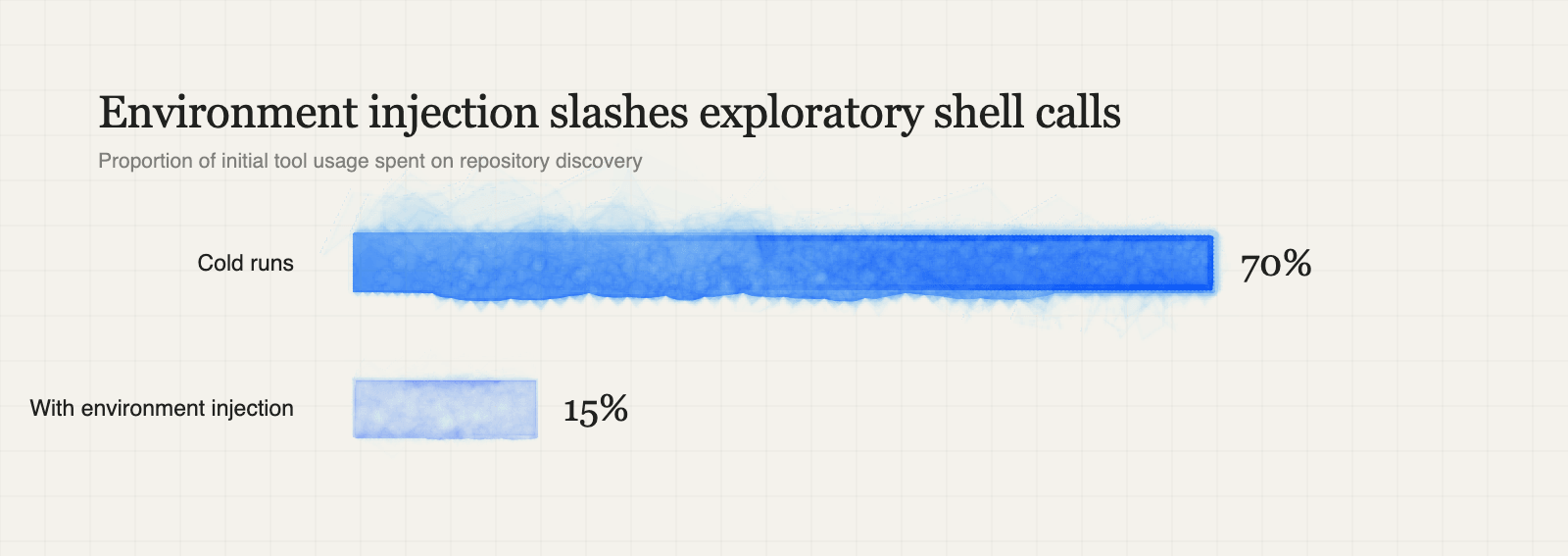
In my evaluations, healthy runs exhibit a distinct command ratio. On cold runs, exploratory shell calls frequently make up over 70 percent of initial tool usage. With precise environment injection, that exploratory footprint should plummet below 15 percent, shifting model compute directly into implementation edits. If initial tool calls remain heavily exploratory despite memory injection, the retrieval payload is failing to provide actionable leverage.
The Operational Boundary Between Memory Poisoning and Clean Eviction
Deploying persistent trajectory memory in production introduces three severe operational hazards that can degrade harness reliability if left unmanaged.
The first is ghost knowledge: an agent recalls a specific build workaround from an earlier sprint and stubbornly attempts to run legacy setup scripts that were deleted during an infrastructure refactor. The second is memory poisoning: an agent encounters a flaky test suite, resolves it through an unprincipled shortcut—such as passing --override-ini or deleting an assertion—and the post-session summarizer canonizes that dirty workaround as standard operating procedure for future runs. The third is semantic misdirection: a vector database retrieves a debugging card for a generic ConnectionRefusedError from an integration test module and injects it while the agent is attempting to resolve an unrelated unit test in a database client, pulling the model into irrelevant architectural assumptions.
flowchart LR
    subgraph Ingestion
        A["Agent Trajectory"] --> B{"Zero-Exit CI Verification"}
        B -- "Failed" --> C["Drop Run"]
        B -- "Passed" --> D["Secret Scrubber Engine"]
        D --> E["Key by Commit & Path Hash"]
    end
    subgraph Storage
        E --> F[("Hermetic Memory Store")]
    end
    subgraph Retrieval
        G["New Task Initialized"] --> H{"Exact Path Key Match?"}
        H -- "Yes" --> I["Inject High-Priority Card"]
        H -- "No" --> J["Scoped Semantic Search"]
        J --> K["Inject Fallback Guidance"]
    end
To prevent these hazards, an engineering harness must enforce strict operational boundaries:
- Gate distillation strictly behind verified zero-exit runs. Never distill lessons from a run that produced a partial patch, skipped linters, or failed downstream regression suites. If the harness cannot guarantee that the terminal state was clean, the trajectory must be discarded.
- Scrub terminal outputs before persistence. Execution transcripts routinely capture secrets, session tokens, and sensitive internal endpoints exposed in environment dumps or error traces. Automated regex and entropy-based scrubbers must sanitize traces before they touch an embedding model or vector store.
- Route memory via exact structural keys before semantic fallback. Vector similarity across natural language descriptions is far too imprecise for software engineering. Retrieval must match exact file paths, submodule boundaries, and lockfile digests first, reserving semantic similarity strictly for localized debugging advice.
My verdict for practitioners is straightforward: do not deploy unconstrained natural-language memory loops to production repositories today. Until harnesses treat memory cards as strictly invalidatable cache artifacts tied to deterministic commit trees, the risk of context pollution and poisoned workarounds outweighs the efficiency gains. For teams managing high-density tasks on stable monolithic repositories, build a simple, hash-keyed configuration layer that records verified execution recipes deterministically. For general-purpose bug fixing across varied codebases, continue relying on static repository maps and well-maintained developer rule files while the tooling for hermetic trajectory distillation matures.
Resources
(no official sources were available to link)
Updated 2026-11-16 by Mehran Mozaffari.
Related posts
23 November 2026
Google Workspace MCP and Agent Gateway: The Hidden Costs of Giving LLMs Direct SaaS Tool Access
23 November 2026
Should you run enterprise agents through Google's Workspace MCP and Agent Gateway? Adopt for read-heavy fleets, wait on destructive writes
19 November 2026
Looped Middle Layers or Explicit Chain-of-Thought for Local Edge Reasoning
17 November 2026
Should You Replace Frontier APIs with Qwen3.8-27B-pi-adapted? Not for Production Yet
16 November 2026
How Hoy Bypasses Apple Virtualization Framework for Micro-VM Agent Sandboxes
15 November 2026
Inside NVIDIA Molt: How a 9,000-Line Framework Trains Trillion-Parameter Agents Without Weight Conversion