
The Verdict: Hold Off on Inkling 2 Mini for Local Workstation Workloads
I have run enough local model evaluations to recognize when architectural ingenuity collides head-on with consumer hardware physics. Inkling 2 Mini from Thinking Machines packages a 26B total parameter pool into an appealing ~20 GB weight footprint—achieved through an aggressive ~6-bit average packing—and routes down to just 3.4B active parameters per forward pass. On top of that sparse foundation, it layers recurrent parameter looping to execute an effective 5.4B compute depth for harder programmatic reasoning. On paper, it sounds like the developer workstation holy grail: the expansive syntactic repertoire of a 27B-class model paired with the raw inference speed of a lightweight 3B–5B model.
The core tension here lies in the persistent mismatch between token compute reduction and memory bus realities. Slashing active parameters to 3.4B dramatically lowers arithmetic compute demands, which saves battery life and avoids thermal throttling on modern laptops. However, autoregressive token generation remains fundamentally memory-bandwidth bound. On unified-memory workstations, fetching sparse expert slices out of a 20 GB footprint across a shared system bus means your generation throughput will bottleneck on memory bus transfers rather than compute FLOPs. Throw in uncompressed KV caches eating up the remaining slice of unified RAM, and the practical headroom on consumer machines vanishes rapidly.
Architectural Scorecard: Where the Sparsity and Recurrence Mechanics Deliver
To evaluate how Inkling 2 Mini actually handles day-to-day engineering tasks, we have to look past the top-line parameter claims and examine how sparse routing and recurrent depth behave across real workstation runtimes. As I explored in CUDA Does Not Own Silicon Speed in Memory-Bound Decode, low arithmetic overhead does not rescue an edge engine when memory traffic stalls the pipeline.
| Criterion | Architecture Assessment | Mechanical Root Cause |
|---|---|---|
| Parameter Capacity vs In-Memory Footprint | Exceptional (~20 GB for 26B) | Sub-8-bit block quantization packs a full 26B parameter pool into unified memory, preserving wide syntactic breadth across languages without demanding a 50 GB+ FP16 footprint. |
| Compute Efficiency Per Forward Pass | High (3.4B active / 5.4B looped) | Fine-grained top-$k$ gating restricts per-token arithmetic to 3.4B parameters, while selective recurrent layer passes dynamically inject depth up to 5.4B effective compute. |
| Edge Memory Bus Saturation | Poor on Unified Architectures | Despite low active FLOPs, routing disparate tokens across a 26B parameter matrix forces constant expert fetching across system memory, hitting bandwidth limits on 150–200 GB/s buses. |
| Context Window Headroom | Severely Constrained | The 20 GB baseline leaves less than 4 GB of headroom on standard 24 GB hardware; long-context prompts (32k+) create immediate memory allocation failures unless aggressive KV quantization is applied. |
| Runtime Kernel Compatibility | Fragmented Out of the Box | Recurrent parameter looping combined with fine-grained routing lacks native fused execution kernels in standard engines like vLLM or llama.cpp, forcing unoptimized execution paths. |
The technical compromise is clear. Inkling 2 Mini decouples storage footprint from forward-pass compute by trading dynamic memory reads for FLOP reduction via recurrent depth. If your inference runtime does not support fused execution of the recurrent layers, or if the router weights were uniformly quantized alongside the feed-forward experts, routing drift will degrade delicate code syntax.
Where It Wins: High-Capacity Reasoning Inside a Low-FLOP Envelope
Despite the architectural friction, Inkling 2 Mini occupies a distinct sweet spot on the deployment frontier. If you look at standard dense architectures like Qwen2.5-Coder-32B, Codestral 22B, or even Qwen3.8-27B-pi-adapted, they force an all-or-nothing trade-off. Running a 27B-to-32B dense model on an edge machine burns heavy arithmetic compute on every single token, regardless of whether it is emitting a trivial closing parenthesis or synthesizing an intricate recursive algorithm. On a laptop running on battery, sustained generation with those models quickly spins up fans and induces thermal throttling.
Inkling 2 Mini attacks that specific inefficiency. By gating execution to a 3.4B active core, it keeps energy draw and heat generation remarkably low. Yet, unlike a compact 7B or 14B dense model that has to compress all its world knowledge into a tiny parameter space, Inkling 2 Mini retains a 26B parameter reservoir. That expansive capacity enables it to retain niche syntactic patterns, polyglot framework bindings, and complex structural grammar that 7B models routinely hallucinate.
quadrantChart
    title Local Coding Model Deployment Space
    x-axis Low Memory Footprint --> High Memory Footprint
    y-axis Low Compute Intensity --> High Compute Intensity
    quadrant-1 Heavyweight Compute & High RAM
    quadrant-2 Edge Inefficient
    quadrant-3 Lightweight & Highly Portable
    quadrant-4 Low Compute with High Capacity
    Compact Dense 7B-14B: [0.25, 0.35]
    DeepSeek-Coder-V2 Lite 16B: [0.45, 0.15]
    Codestral 22B: [0.65, 0.70]
    Qwen2.5-Coder-32B: [0.85, 0.90]
    Inkling 2 Mini: [0.80, 0.25]
When an algorithmic edge case demands deeper reasoning, the architecture traverses its recurrent loop up to 5.4B effective compute. This gives the model an iterative reasoning buffer without adding a single megabyte to its physical VRAM footprint. For a developer working on a high-spec 32GB or 64GB unified-memory machine doing isolated module synthesis, Inkling 2 Mini delivers the semantic range of a 27B-class model at the thermal cost of a 4B engine. It points directly toward the future of edge agent design, even if the current deployment stack needs time to catch up.
What It Costs You: Memory Bandwidth Bottlenecks, KV Cache Bloat, and the Looping Trap
The operational math on edge devices quickly punctures the marketing narrative. Packing 26B parameters into ~20 GB gives the illusion of portability because it technically loads on a 24GB RTX 4090 or a 32GB unified-memory MacBook. But loading weights is only the baseline cost. In real developer workflows, context length dictates utility. If you inject a 32k context window to ingest an entire API surface or dependency tree, an uncompressed 16-bit Key-Value cache demands an extra 4 GB to 10 GB of VRAM. On a 24GB GPU or a 32GB laptop already hosting OS desktop overhead, that allocation tips you directly into immediate CUDA out-of-memory crashes or aggressive unified-memory swap thrashing that slows token generation to an unusable crawl.
Even with context constrained, autoregressive decode runs into memory bandwidth limits. An Apple M-series unified chip delivers roughly 150 to 200 GB/s of bandwidth. Because Mixture-of-Experts routing continually swaps active expert weights across tokens, the memory bus must fetch fragmented parameter slices throughout the forward pass. You end up waiting on memory bus transfers rather than arithmetic execution, which erodes the speed advantage of having only 3.4B active parameters.
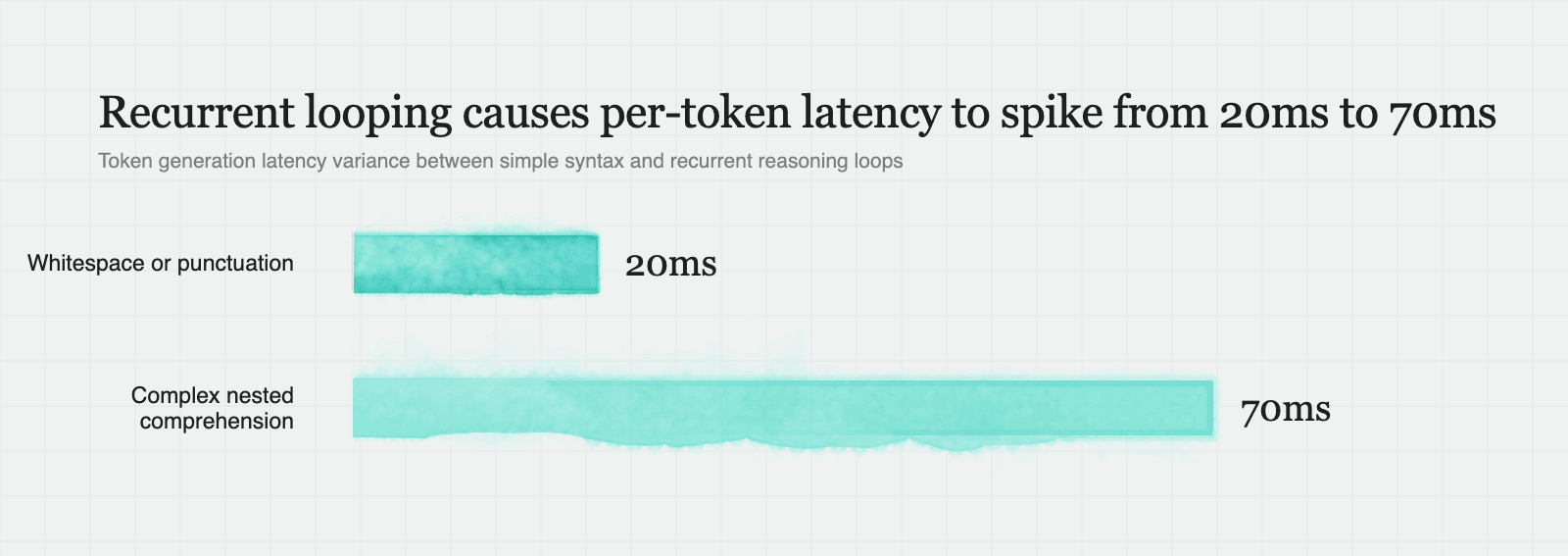
The recurrent looping mechanism introduces an even more disruptive runtime failure mode: latency jitter. Executing an effective 5.4B looped compute profile means running intermediate activations through iterative reasoning layers. When loop depth is token-dependent or varies across code complexity, per-token latency fluctuates wildly. Simple whitespace or punctuation emits in 20 milliseconds, but an intricate nested comprehension triggers maximum loop depth and spikes token latency to 70 milliseconds. That dynamic latency variance completely shatters the strict SLA requirements needed for inline editor autocomplete. Furthermore, un-normalized recurrent looping amplifies latent noise, turning minor syntax divergences into catastrophic degeneration loops.
Stress-Testing the Headline Coding Claims: What Would Change My Mind
Headline claims like "Ahead in 10 of 13 in coding vs Qwen3.8-27B" sound impressive in a press release, but they almost certainly reflect synthetic unit-test benchmarks evaluated in isolation. Passing standalone algorithmic prompts tells me very little about whether a model can perform multi-file repo refactoring, maintain AST-level consistency across large edits, or handle continuous Fill-in-the-Middle autocomplete without drifting off-track. As observed in Stateless coding agents burn tokens solving problems they already solved, isolated generation benchmarks consistently mask catastrophic failures in long-context consistency and state retention.
Before I trust this architecture in an everyday engineering environment, I would subject it to an outside, reproducible stress test. First, I would measure token generation throughput across expanding context sizes—specifically stepping from 2k up to 32k tokens—to chart the exact point where memory bus overhead and KV allocations stall streaming output on consumer hardware. Second, I would run real-world repository diff tasks across polyglot projects, running an automated tree-sitter AST validation pass over every generated patch to quantify syntax breakage and routing-induced delimiter corruption under real-world domain shifts.
To flip my verdict from a hold to an active recommendation, Thinking Machines or the open-source community must deliver three concrete mechanical proofs. First, upstream inference runtimes must ship native fused kernels for the recurrent looping blocks, eliminating the unoptimized kernel launch overhead that currently penalizes throughput. Second, the runtime stack must support calibrated FP8 or 4-bit KV caching out of the box, ensuring that a full 32k context fits cleanly within 24GB of physical memory alongside the 20 GB weight allocation. Finally, I need to see verifiable multi-turn AST refactoring benchmarks demonstrating that the 26B sparse routing pool maintains structural coherence across real codebases without dropping tokens under expert starvation. Until those conditions are met, Inkling 2 Mini remains a fascinating architectural blueprint rather than a reliable workstation driver.
Resources
(no official sources were available to link)
Updated 2026-11-19 by Mehran Mozaffari.
Related posts
23 November 2026
Google Workspace MCP and Agent Gateway: The Hidden Costs of Giving LLMs Direct SaaS Tool Access
23 November 2026
Should you run enterprise agents through Google's Workspace MCP and Agent Gateway? Adopt for read-heavy fleets, wait on destructive writes
20 November 2026
CUDA Does Not Own Silicon Speed in Memory-Bound Decode
19 November 2026
Looped Middle Layers or Explicit Chain-of-Thought for Local Edge Reasoning
17 November 2026
Should You Replace Frontier APIs with Qwen3.8-27B-pi-adapted? Not for Production Yet
16 November 2026
Stateless coding agents burn tokens solving problems they already solved