
The Real Problem: Balancing Medical Ontology Storage Against On-Premise Infrastructure
Deploying clinical intelligence inside hospital firewalls forces an immediate, unyielding conflict between knowledge retention and infrastructure reality. Patient health information cannot casually traverse public networks to proprietary APIs like Google Med-Gemini without navigating complex Business Associate Agreements, regulatory scrutiny, and corporate governance boundaries. That push toward self-hosted, open-weight deployments usually leads engineering teams toward dense clinical workhorses like Meditron-70B. Yet dense models face a fundamental ceiling: medical knowledge is long-tailed, deeply hierarchical, and unforgiving of capacity limits. Cramming multi-system pharmacology, rare syndromic presentations, and granular ontology trees into a 70B parameter budget invariably produces representation saturation or catastrophic forgetting across edge clinical pathways.
LingSante-3.1-flash attacks this trade-off from an aggressive architectural posture: an open-weight sparse Mixture-of-Experts (MoE) coupling a 560B total parameter parameter reservoir with an active execution path of only 25B parameters per token. I previously analyzed this sparse routing pattern when examining How Ling-3.2-air Runs a 124B Parameter Brain on a 5.5B Compute Budget, but scaling that split to 560B in clinical workflows shifts the operational stakes entirely.
In theory, executing 25B active parameters delivers the per-token arithmetic throughput and responsiveness of a mid-sized model—hence the "flash" label. In practice, arithmetic throughput claims mean nothing if cluster memory overhead and distributed routing collapse production economics. A clinical AI system does not live on paper FLOP counts; it lives across physical silicon. When you move from a dense 70B model that fits across a single four-GPU node to a 560B weight footprint requiring multi-node partitioning, the operational equation ceases to be about FLOPs and becomes an unforgiving problem of memory capacity and interconnect physics.
quadrantChart
    title Clinical Foundation Models: Parameter Footprint vs Specialization
    x-axis General Capability --> Domain Specialized
    y-axis Low VRAM Footprint --> High VRAM Footprint
    quadrant-1 High-Memory Specialized
    quadrant-2 High-Memory General
    quadrant-3 Low-Memory General
    quadrant-4 Low-Memory Specialized
    BioMistral-7B: [0.82, 0.15]
    Meditron-70B: [0.78, 0.42]
    DeepSeek-V3: [0.22, 0.88]
    LingSante-3.1-flash: [0.85, 0.82]
Choosing LingSante-3.1-flash over a dense open-weight backbone is not an automatic upgrade; it is an explicit architectural trade. You are betting that your clinical workload genuinely requires half a trillion parameters of medical ontology storage, and that your team can absorb the severe distributed cluster tax required to keep those dormant weights resident in high-bandwidth memory.
Serving Topologies: The 560B VRAM Footprint vs 25B Arithmetic Compute
The primary operational trap of LingSante-3.1-flash lies in confusing arithmetic compute footprint with memory residency. Because the forward pass only computes against 25B active parameters, an operator might mistakenly budget compute nodes as if serving a standard 30B dense model. That assumption shatters the moment you attempt to stage weights into physical GPU memory.
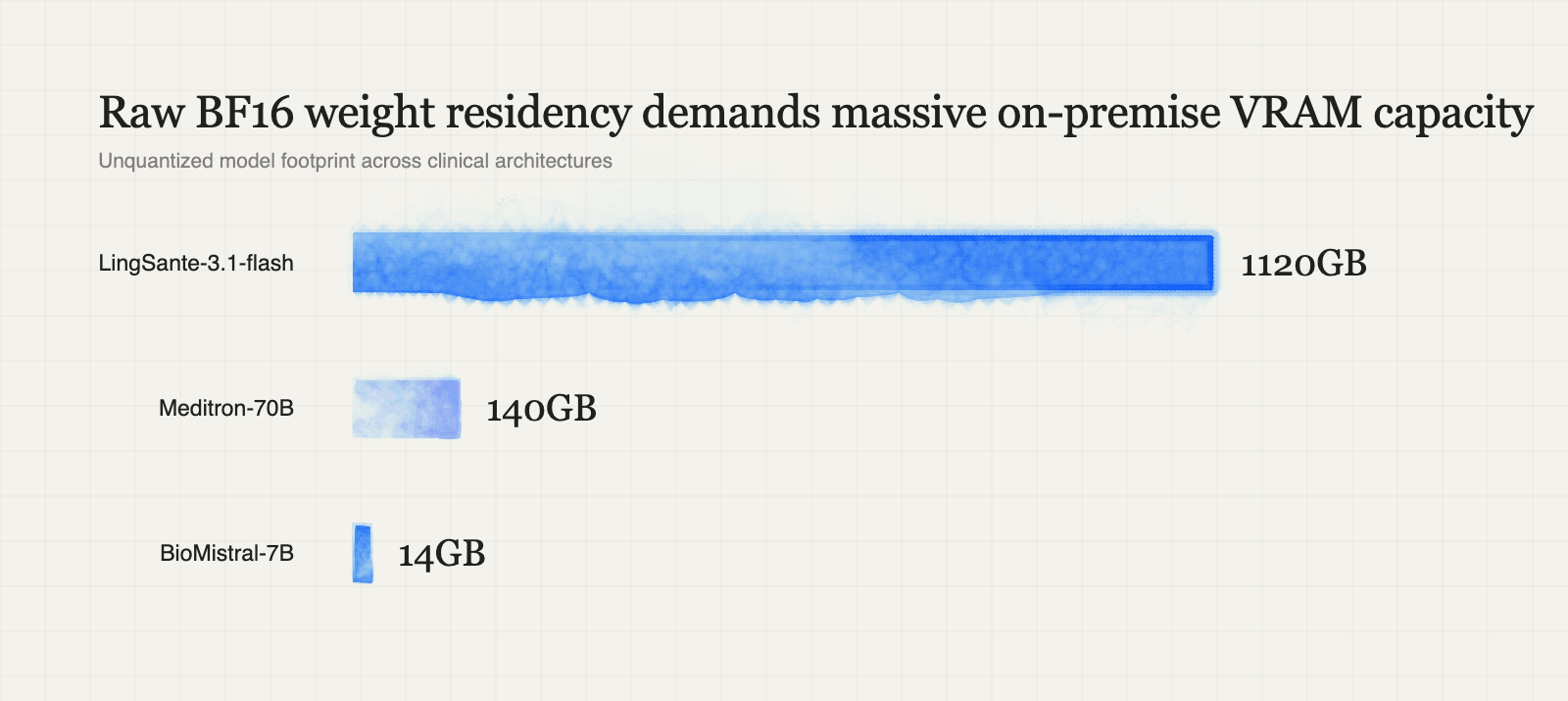
At 16-bit precision (BF16), storing 560 billion parameters requires approximately 1.12 TB of high-bandwidth memory before factoring in the runtime overhead of key-value caches, communication buffers, and dynamic routing allocations. Staging this model unquantized demands at least 1.4 TB to 1.6 TB of addressable VRAM. Even when applying aggressive post-training quantization, physical limits remain stubborn. FP8 quantization cuts the weight footprint to roughly 560 GB, while an INT4 checkpoint requires around 280 GB. On paper, an INT4 checkpoint fits into an eight-way 80 GB GPU node (640 GB total gross VRAM). In production, an FP8 checkpoint leaves virtually no headroom on an 8x80GB node for concurrent context windows, while INT4 quantization risks eroding routing logit stability across delicate differential diagnostics.
sequenceDiagram
    autonumber
    participant Client
    participant Meditron as Meditron-70B Node<br/>(4-8 GPUs Local TP)
    participant Gate as LingSante Router<br/>(Top-k Gate)
    participant Cluster as Distributed MoE Nodes<br/>(Expert Parallelism)

    Note over Client,Meditron: Dense Execution: Local NVLink Only
    Client->>Meditron: Ingest Clinical Encounter Note
    Meditron->>Meditron: Local Tensor Parallel MatMul (All-Reduce on NVLink)
    Meditron-->>Client: Return Generation

    Note over Client,Cluster: Sparse MoE: Cross-Node Interconnect Dependent
    Client->>Gate: Ingest Clinical Encounter Note
    Gate->>Gate: Evaluate Routing Logits (Top-k Selection)
    Gate->>Cluster: All-to-All Dispatch (Cross-Node InfiniBand / RoCEv2)
    Cluster->>Cluster: Execute 25B Active Parameters on Assigned Experts
    Cluster->>Gate: All-to-All Reduce-Scatter Collection
    Gate-->>Client: Return Generation ("Flash" Latency or Network Stalled)
Furthermore, serving a 560B MoE model requires Expert Parallelism (EP), distributing different experts across separate physical accelerators and nodes. At every MoE routing layer, the engine executes an All-to-All collective communication step: tokens are dynamically packed and dispatched across the cluster fabric to the specific GPUs hosting the selected experts, computed, and gathered back via reduce-scatter operations.
| Dimension | LingSante-3.1-flash | Meditron-70B | BioMistral-7B |
|---|---|---|---|
| Active Parameters (Compute) | ~25B parameters | 70B parameters | 7B parameters |
| Total Memory Parameters | 560B parameters | 70B parameters | 7B parameters |
| Raw VRAM (BF16) | ~1,120 GB (1.12 TB) | ~140 GB | ~14 GB |
| Raw VRAM (INT4 Quantized) | ~280 GB | ~35 GB | ~4 GB |
| Minimum Production Topology | 16x 80GB GPUs or 8x 142GB/192GB | 2x to 4x 80GB GPUs (Single Node) | 1x 24GB GPU (Edge / Single Node) |
| Interconnect Dependency | Mandatory 800 Gb/s InfiniBand / RoCEv2 | Local NVLink / PCIe (Single Node) | Single GPU / Local Bus |
| Serving Framework Complexity | High (Multi-node EP, vLLM / SGLang) | Low (Standard Tensor Parallelism) | Minimal (Standard HuggingFace / vLLM) |
If your physical nodes lack high-bandwidth interconnect fabrics like 800 Gb/s InfiniBand or low-latency RoCEv2, cross-node network latency completely dwarfs the compute savings of only activating 25B parameters. The system collapses into an I/O wait state, leaving expensive tensor cores stalled while tokens crawl across standard data center Ethernet.
Expert Routing Dynamics: When Clinical Skew Degrades MoE Latency
Standard sparse MoE architectures rely on an implicit mathematical ideal: load-balancing loss functions during pre-training that encourage tokens to distribute relatively uniformly across all available experts. In clinical operations, that mathematical assumption breaks against the reality of structured medical language. Specialized clinical encounters are not uniform distributions of general text; they are dense, concentrated semantic domains.
When processing an intensive oncology pathology summary or a complex polypharmacy regimen, the router does not distribute tokens evenly across the entire 560B parameter space. Specialized clinical vocabulary repeatedly activates the same narrow subset of domain-specialized experts—those holding representations for chemotherapeutic interactions, histological staging, and diagnostic thresholds. While the router sends a torrent of tokens toward the GPUs hosting those specific experts, the remaining GPUs in the cluster sit idle, waiting for the active nodes to finish their forward passes.
This expert hotspotting creates severe compute bubbles across the distributed cluster. In an Expert Parallel topology, a forward pass cannot complete until the slowest expert finishes processing its assigned token bucket. The straggler effect transforms your high-throughput system into a sequential queue bottlenecked by whichever GPU holds the oncology or pharmacology weights.
Attempting to smooth out this imbalance by batching heterogeneous patient records across different medical specialties introduces an opposing operational hazard. As you scale batch sizes across disparate encounters—pairing a cardiology follow-up with a psychiatric evaluation and an orthopedic intake—the aggregate batch touches nearly every expert across the 560B structure in every forward pass. When every expert is triggered simultaneously, the sparse routing mechanism loses its cache locality and degenerates into dense memory thrashing. Instead of enjoying the low-latency memory bandwidth of a 25B parameter model, your memory bus reads across the entire 560B parameter estate, causing overall token generation speeds to plummet. Managing an ultra-large medical MoE in production requires treating token routing not as an abstract algorithmic detail, but as a dynamic queue-management challenge that directly dictates real-world clinical response times.
Testing the Headline Claim: Does 560B MoE Scale Prevent Clinical Hallucination?
The core narrative surrounding massive scale in domain models is that sheer parameter volume solves factual hallucination. The intuition feels reasonable on the surface: dedicate 560 billion parameters to an ontology, and the system should retain enough granular biomedical associations to avoid the factual collapses that plague 7B or 70B models. However, the available research material presents no empirical validation, verified benchmark scores on clinical safety evaluations like MedQA or PubMedQA, or standardized diagnostic accuracy figures to substantiate that expectation. From an applied systems perspective, assuming that parameter scale guarantees clinical precision is an active hazard.
Scale shifts the nature of clinical failure rather than eliminating it. In smaller dense architectures, a model that lacks knowledge often breaks down in obvious, detectable ways: it stumbles over syntax, generates non-sequiturs, or produces garbled clinical vocabulary. A 560B model operates under an entirely different failure mode. With vast parameter real estate dedicated to biomedical literature, the model masters clinical cadence, terminology, and tone with complete fluency. When it hallucinates, it does not sound confused; it sounds like an attending physician delivering an authoritative consult note.
Applying a failure-mode and effects analysis across clinical workflows highlights three acute risk vectors where this deceptive fluency creates direct operational danger:
- Pharmacotherapy and Drug Combinations: When synthesizing treatment regimens for multi-morbidity presentations, the model can effortlessly weave together complex chemotherapeutic regimens while hallucinating a dosage threshold or dropping a lethal drug-drug interaction. Because the generated rationale quotes accurate mechanism-of-action terminology, human reviewers suffer verification fatigue and overlook the contraindicated pairing.
- Dynamic Laboratory Evaluation: Interpreting borderline pathology reports alongside shifting metabolic panels requires rigorous numerical grounding. Sparse gating across distinct reasoning paths can introduce subtle numerical confabulations—interpreting an elevated serum creatinine as baseline stability or miscalculating an anion gap while presenting an internally consistent diagnostic justification.
- Jurisdictional Guideline Divergence: Foundation training on localized clinical corpora introduces silent protocol mismatches. An oncology model aligned with Chinese national clinical standards or regional hospital formularies will reference diagnostic tiers, drug naming conventions, or surgical indications that diverge sharply from FDA, NCCN, or NICE pathways. The resulting output appears syntactically rigorous yet remains clinically unviable within a different regulatory framework.
Parameter scale provides an immense storage locker for medical terminology, but fluent clinical phrasing must never be treated as an indicator of factual diagnostic reliability. In clinical infrastructure, high parameter capacity raises the bar on how deceptive an error can be.
Production Guardrails and an Empirical Verification Test for Adopting Teams
Building a safe clinical decision-support pipeline around LingSante-3.1-flash requires treating parametric memory as an untrusted draft engine rather than a source of truth. Under no circumstances should an operational healthcare platform allow an MoE backbone to generate raw pharmacotherapy dosages, fluid titration schedules, or drug interaction clearances directly from internal weights. Free-form token generation across sparse experts is probabilistic; clinical safety requires determinism.
The production runtime must enforce tool-calling boundaries that intercept every clinical entity. When the model proposes a therapeutic intervention, execution must pause behind an external validation seam. The proposed regimen is extracted and validated against authoritative registries like RxNorm, Lexicomp, or UpToDate via deterministic database calls before any text reaches the clinician. The language model handles context synthesis and semantic drafting; deterministic APIs handle clinical verification.
Before committing multi-node hardware to LingSante-3.1-flash, an engineering team must execute a rigorous outside check in an isolated test environment. Do not evaluate the cluster using synthetic general prompts or toy batching. Build a benchmarking suite in vLLM or SGLang configured with your target Expert Parallelism topology (ep_size), and profile performance using a synthetic test harness:
First, construct a workload of long-context clinical encounter notes containing heterogeneous medical vocabulary—spanning intensive polypharmacy, histological staging, and longitudinal lab tables.
Second, profile static VRAM consumption across your nodes to verify that your chosen quantization (such as FP8 or INT4) leaves sufficient headroom for dynamic key-value cache expansion across your maximum target context window (such as 16k or 32k tokens) without triggering out-of-memory crashes.
Third, execute an empirical load sweep measuring p95 and p99 generation latency across escalating concurrency levels, moving systematically from batch size 1 to batch size 32.
Watch the latency curve closely. If p99 latency spikes discontinuously at moderate batch sizes, your cluster is encountering expert hotspotting: the routing gate is funneling dense clinical vocabulary into a narrow set of nodes while the remaining GPUs idle. Furthermore, monitor your inter-node network throughput across InfiniBand or RoCEv2 interfaces during the prefill phase. If network transmission saturates while GPU compute utilization stalls, your operational topology is network-bound. Identifying these bottlenecks through an empirical test harness prevents deploying half a trillion parameters onto infrastructure that cannot sustain their distributed overhead.
The Architectural Decision Matrix: Comparing Clinical LLM Paradigms
Selecting an architectural foundation for hospital workflows requires balancing computational physics against regulatory boundaries. Every paradigm trades off between memory footprint, deployment friction, and domain coverage.
A proprietary clinical frontier model like Google Med-Gemini delivers state-of-the-art diagnostic synthesis and multi-modal integration out of the box, but shipping protected health information outside an enterprise firewall introduces acute governance barriers. Dense open-weight clinical adaptations like BioMistral-7B solve data sovereignty by running on a single workstation or edge appliance, yet an 8-billion parameter ceiling cannot retain long-tail medical ontologies, orphan disease pathways, or granular drug interactions without severe capacity saturation. Meditron-70B strikes an accessible middle ground: it fits cleanly onto standard enterprise multi-GPU nodes using local NVLink interconnects, delivering reliable parametric recall without distributed networking overhead.
LingSante-3.1-flash changes the calculus for organizations with enterprise-grade compute clusters. By decoupling parameter storage from active compute, it packs half a trillion parameters of medical representations into on-premise infrastructure while preserving the per-token arithmetic latency of a 25B model. However, that architectural bargain shifts the operational penalty directly onto memory capacity and network interconnects.
| Dimension | LingSante-3.1-flash | Meditron-70B | BioMistral-7B | Google Med-Gemini |
|---|---|---|---|---|
| Architectural Footprint | Sparse MoE (560B total / 25B active) | Dense (70B parameters) | Dense (~7B parameters) | Proprietary frontier foundation system |
| On-Premise Feasibility | Multi-node enterprise cluster (16x 80GB or 8x 142GB+) | Single-node standard server (2x to 4x 80GB GPUs) | Single GPU / workstation (1x 16GB–24GB GPU) | Infeasible (Closed public API only) |
| Knowledge Retention | Exceptional (Massive parameter reservoir for rare diseases) | Moderate (Solid core clinical terminology; saturates on edge ontologies) | Constrained (Requires heavy RAG augmentation; low rare-disease retention) | Frontier (Exhaustive multi-modal knowledge across global literature) |
| Batch Latency Determinism | Volatile (Hotspotting and cross-node All-to-All overhead degrade tails) | Predictable (Uniform matrix multiplication without routing jitter) | High (Fast, constant latency across small hardware profiles) | Provider-managed (Subject to external API network variance) |
| Compliance & Data Sovereignty | Absolute (Full on-premise weight custody behind firewall) | Absolute (Self-hosted within local security perimeter) | Absolute (Runs locally, air-gapped if required) | Constrained (Requires strict BAA and data transit approvals) |
| Deployment Barrier | Extreme (Demands InfiniBand/RoCEv2 fabrics and MoE runtime tuning) | Low (Standard tensor parallelism across commercial nodes) | Minimal (Standard HuggingFace or single-engine deployment) | Minimal (API key integration, zero local compute management) |
Which Clinical Model to Pick for Your Healthcare Infrastructure
Operational success in applied clinical AI depends on matching model architecture to your physical infrastructure budget and clinical risk surface. Deploying an ultra-large sparse MoE when your physical infrastructure cannot support cross-node communication turns high-end silicon into an expensive network wait state. Conversely, forcing a compact dense model to memorize rare syndromic presentations without external retrieval inevitably triggers dangerous factual gaps.
I map this deployment boundary along three practical operational questions: Do you possess dedicated high-speed inter-node fabrics? Is your patient data legally barred from leaving your physical perimeter? And does your clinical workload demand deep parametric retention of long-tail medical ontologies that cannot be solved via external retrieval?
When your compute cluster features 800 Gb/s InfiniBand or RoCEv2 fabrics capable of sustaining the high-frequency All-to-All token dispatches inherent in Expert Parallelism, LingSante-3.1-flash unlocks unmatched representation density. For large research hospitals synthesizing complex oncology consults or pharmaceutical research teams mining biochemical pathways, its 560-billion-parameter capacity provides the long-tail domain storage that dense architectures lack, while keeping per-token execution latency responsive.
If your physical deployment lives within a standard hospital server room powered by an isolated four- or eight-way GPU chassis, a dense 70B backbone remains the engineering standard. You trade away the vast ontology cache of half a trillion parameters, but you gain absolute latency determinism, uniform memory access, and freedom from expert hotspotting. Pair Meditron-70B with deterministic retrieval over institutional formularies and clinical guidelines, and you achieve a reliable, cost-efficient clinical copilot that respects your hardware constraints.
Finally, for edge applications like bedside tablet transcription or clinic intake summarization, deploy dense 7B or 8B models like BioMistral. Keep your core clinical triage on lightweight nodes, reserve dense 70B backbones for primary inpatient workflows, and treat 560B MoE clusters as specialized regional compute hubs rather than everyday endpoints.
Resources
(no official sources were available to link)
Updated 2026-11-21 by Mehran Mozaffari.
Related posts
23 November 2026
Google Workspace MCP and Agent Gateway: The Hidden Costs of Giving LLMs Direct SaaS Tool Access
23 November 2026
Should you run enterprise agents through Google's Workspace MCP and Agent Gateway? Adopt for read-heavy fleets, wait on destructive writes
22 November 2026
How Ling-3.2-air Runs a 124B Parameter Brain on a 5.5B Compute Budget
22 November 2026
Should you move local agent workflows to OpenCode 2.4.0 automations? Wait for sandboxing and state durability
22 November 2026
One Sandboxed Runtime Replaces Two Thousand Tool Definitions
22 November 2026
Should You Deploy Shirudo for Agentic Runtime Defense? Wait for Pre-Compiled Templates