
The 22:1 Sparsity Bet: Enterprise Reasoning at 6B FLOPs
Every enterprise document automation pipeline eventually runs into the same operational wall: choosing between the unit economics of dense open models and the recurring API spend of frontier closed systems. When you point a dense model like Qwen2.5-VL 72B at thousands of multi-page invoices, multi-column balance sheets, or ERP navigation trajectories, every single output token triggers 72 billion parameters worth of matrix multiplications. Conversely, leaning on proprietary endpoints like Claude 3.5 Sonnet or Gemini Flash hands you pristine extraction accuracy, but it exposes sensitive corporate ledgers to external network perimeters and subjects high-volume workloads to unpredictable operational bills.
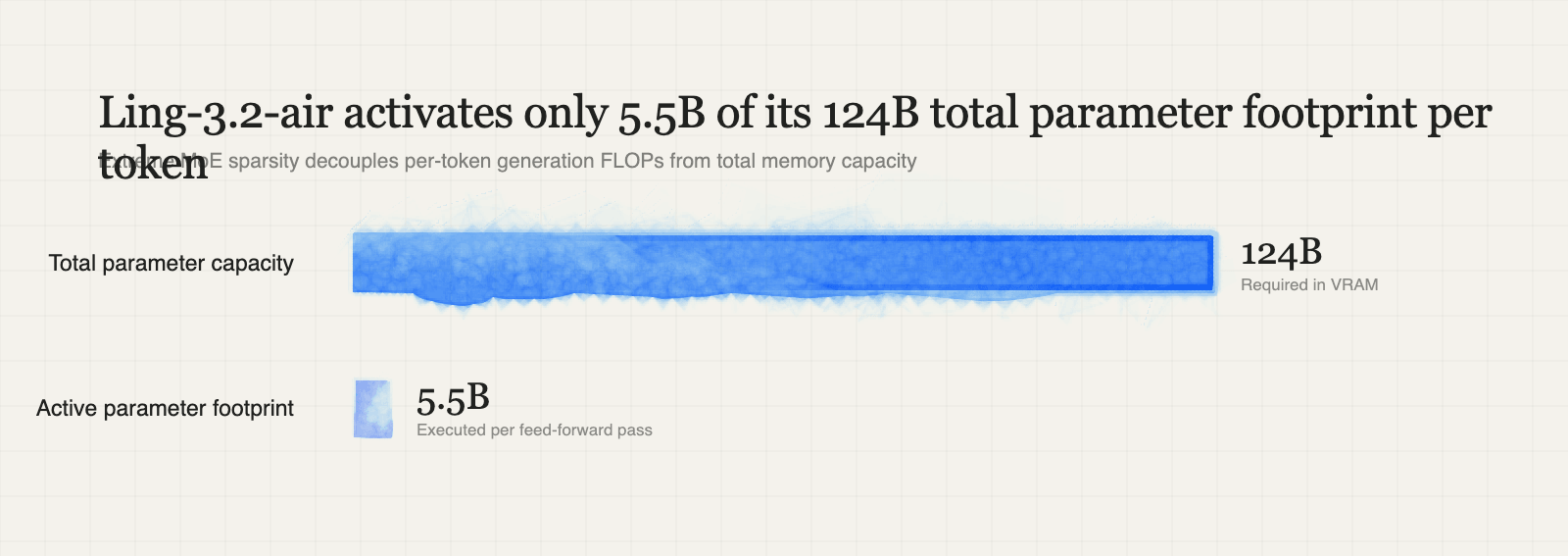
Ling-3.2-air stakes out a radical alternative by running an extreme-sparsity mixture-of-experts (MoE) backbone: 124B total parameters, but only 5.5B active parameters per token pass. It borrows its native multimodal foundation directly from Ling-3.0-flash-VL, aiming to deliver high-capacity document grounding without the compute penalty of monolithic weights.
In practice, this means generation FLOPs mirror a compact 6B-class dense model. Auto-regressively decoding structured JSON extractions or navigation commands proceeds at high token velocities. Yet this efficiency introduces an unavoidable systems trade-off that teams frequently misunderstand: you compute at 5.5B scale, but you provision hardware for 124B.
Those 124 billion weights must reside permanently in GPU memory. A high-sparsity router cannot afford PCIe bus roundtrips mid-generation. Serving Ling-3.2-air in unquantized 16-bit precision demands roughly 250 GB of VRAM—a four-way 80GB GPU cluster. Even when quantizing weights down to FP8 (requiring around 130 to 140 GB of VRAM) or aggressive INT4/AWQ profiles, you still need dual 80GB enterprise cards like H100s or L40S units to hold the weights and retain sufficient KV cache headroom. If your architecture team expects to drop this onto a commodity 24GB workstation card, they will face immediate out-of-memory crashes. Ling-3.2-air is not an edge model; it is an enterprise throughput workhorse engineered to slash inference latency and operational power budgets on dedicated data-center hardware.
Tracing a Multi-Page Invoice from Raw Pixels to Tool Invocation
The conventional approach to multimodal document processing couples a frozen vision transformer (ViT) to an off-the-shelf language model through a linear adapter or cross-attention bridge. That decoupling is precisely where complex document parsing breaks down. In legacy pipelines, spatial coordinates get compressed through bottleneck layers, stripping out the sub-pixel precision needed to correlate line-item prices with tabular headers. Ling-3.2-air avoids this by ingesting visual patches directly into an interleaved, native multimodal backbone.
To see how this works in an actual pipeline, trace a high-resolution, multi-page invoice containing nested tax schedules and dynamic layout tables as it transitions from raw raster inputs into an executable ERP action.
sequenceDiagram
    autonumber
    participant Client as Client Pipeline
    participant Tiler as Dynamic Patch Decomposer
    participant Backbone as Interleaved Transformer Backbone
    participant Router as Top-k MoE Router
    participant Experts as Routed Experts (5.5B Active)
    participant Decoder as Coordinate & JSON Head

    Client->>Tiler: Send raw high-DPI document image
    Tiler->>Tiler: Calculate aspect ratio & slice 2D patches
    Tiler->>Backbone: Stream interleaved visual patch tokens
    Client->>Backbone: Stream extraction prompt text tokens
    loop For Each Transformer Layer
        Backbone->>Router: Pass token representations
        Router->>Router: Evaluate gating logits across 124B pool
        Router->>Experts: Dispatch tokens to top-k selected experts
        Experts-->>Backbone: Return processed feed-forward activations
    end
    Backbone->>Decoder: Project unified spatial-semantic states
    Decoder->>Client: Emit JSON schema with exact click coordinates and fields
The process begins at the dynamic 2D patch decomposer. Rather than naively downsampling a 300 DPI scan into a generic square—which inevitably blurs fine decimal points and dense borders—the decomposer evaluates the native aspect ratio and chops the page into a grid of high-fidelity spatial tiles.
These visual tokens pass straight into the interleaved transformer backbone alongside the prompt’s textual instructions. Because visual and textual tokens share early self-attention layers, cross-modal grounding happens immediately. The model does not first "read" OCR text and then guess where it sat on the page; layout geometry and typography are processed concurrently.
As tokens propagate through each layer, the fine-grained gating router assesses each token's activation state. For an invoice token representing a numerical currency cell, the router evaluates gating logits across the 124B parameter pool, dynamically dispatching that token to the top-$k$ specialized experts—such as numerical tabular or spatial layout specialists—activating only 5.5B parameters for that feed-forward cycle. The resulting hidden states pass to the coordinate regression and generation head, which decodes the final response: a rigorously structured JSON payload complete with verified pixel coordinates ready for downstream database ingestion or automated desktop UI entry.
The Three Core Subsystems: Tiling, Routing, and Coordinate Grounding
Operating Ling-3.2-air reliably in enterprise environments requires understanding how its three foundational subsystems interact: the dynamic resolution patch decomposer, the fine-grained sparse router, and the interleaved spatial coordinate grounding head. Each subsystem introduces a distinct operational bottleneck when processing dense enterprise artifacts.
flowchart TD
    subgraph S1["Subsystem 1: Dynamic Patch Decomposer"]
        A["Raw Document Image"] --> B{"Aspect Ratio & DPI Check"}
        B -->|Oversized / Multi-Page| C["2D Spatial Tiling & Grid Splitting"]
        B -->|Standard Layout| D["Direct Patch Encoding"]
        C --> E["Visual Token Sequence"]
        D --> E
    end

    subgraph S2["Subsystem 2: Fine-Grained Sparse Router"]
        E --> F["Interleaved Transformer Layers"]
        G["Text Prompt Tokens"] --> F
        F --> H["Gating Network Logits"]
        H --> I{"Top-k Expert Selection"}
        I -->|Static Allocation| J["Shared Base Experts"]
        I -->|Dynamic Routing| K["Routed Specialized Experts (5.5B Active)"]
        J --> L["Layer Activation Aggregation"]
        K --> L
    end

    subgraph S3["Subsystem 3: Coordinate Grounding Head"]
        L --> M["Unified Multimodal Latents"]
        M --> N["Autoregressive Text Decoder"]
        M --> O["Spatial Coordinate Regression Head"]
        N --> P["Structured JSON Schema Output"]
        O --> Q["Normalized Bounding Boxes & Action Coordinates"]
        P --> R["Final Tool Call Payload"]
        Q --> R
    end
The patch decomposer manages input fidelity. It splits non-standard document geometries into digestible 2D tiles, avoiding the loss of fine characters in multi-column tables. However, processing a ten-page regulatory filing can easily generate tens of thousands of visual tokens. This volume places severe pressure on the KV cache during the prefill stage, risking out-of-memory exceptions before output generation even starts. Furthermore, if a critical data point—such as an IBAN number or an ERP check-box—falls directly across a patch boundary, local feature fragmentation can lead to truncated extraction strings.
The sparse router balances the computational load across the 124B parameter space. Using top-$k$ selection alongside shared static experts, it ensures common linguistic constructs pass through dedicated baseline pathways while specialized mathematical, code, or tabular features divert to isolated expert modules. The engineering risk here stems from expert queue capacities in serving engines like vLLM or SGLang. Under heavy concurrent batching, tokens routing heavily to a specific subset of document experts can cause queue overflows, resulting in dropped tokens or skipped layers that silently corrupt extraction accuracy.
| Core Subsystem | Functional Responsibility | Memory & Compute Profile | High-Load Failure Mode |
|---|---|---|---|
| Dynamic Patch Decomposer | Evaluates aspect ratios; slices high-DPI pages into 2D spatial patches; preserves typography. | High KV-cache prefill footprint; lightweight front-end compute overhead. | Visual token explosion across multi-page scans; text fragmentation across tile boundary seams. |
| Fine-Grained MoE Router | Computes gating logits; assigns tokens to top-$k$ routed experts and shared static experts. | Extremely low active compute (5.5B FLOPs); high memory-bandwidth utilization. | Expert queue saturation under concurrent traffic; routing oscillation on non-standard GUI canvases. |
| Native Interleaved Backbone | Joint self-attention over visual patches and textual instructions; preserves structural geometry. | Requires 130–250 GB VRAM to hold 124B parameter weights across GPUs. | Attentional drift across extended contexts; shallow deductive reasoning under complex nested logic. |
| Coordinate Grounding Decoder | Regresses normalized (x, y) bounding boxes and outputs structured action schemas. |
Low compute footprint; execution bounded by autoregressive token generation. | Coordinate drift on high-resolution screens; syntax degradation under heavy context saturation. |
The coordinate grounding decoder maps latent representations back to physical screen or page geometry. Because visual tokens remain interleaved throughout the backbone, attention heads preserve precise spatial relationships. This spatial grounding enables direct execution on benchmarks like AutomationBench-A, driving workflows such as clicking interactive ERP elements or drawing bounding boxes around disputed ledger entries.
When teams fail to protect these routing and encoding layers during quantization, the router's assignment probabilities wobble across sequential turns. A button coordinate that should resolve cleanly to [412, 85] drifts into adjacent margins, completely derailing automated workflows. Maintaining numerical precision across these critical gating components is non-negotiable for reliable deployment.
Stress-Testing the AutomationBench-A Claim: Where 5.5B Active Capacity Fractures
Marketing benchmarks like AutomationBench-A paint a clean picture of autonomous desktop navigation, but evaluating Ling-3.2-air against production workloads quickly exposes the structural boundaries of an extreme-sparsity architecture. The fundamental tension sits right in the arithmetic: while 124B total parameters afford broad cross-domain vocabulary and layout memory, the active capacity per token pass remains constrained to 5.5B FLOPs.
In practice, that 5.5B parameter compute envelope functions well for immediate perceptual mapping, but it regularly degrades during open-ended, multi-step problem solving. When an agent must cross-reference multi-tiered tax schedules across split tables or balance reconciliation sheets, generation often shifts from analytical deduction to shallow associative pattern-matching. What the research confirms is competent single-turn grounding and structured action mapping; what the material does not demonstrate is trajectory stability over extended agentic runs exceeding ten or fifteen interactive steps.
Under real operating conditions, this architectural split manifests across three concrete points of breakdown.
First is dynamic patch boundary truncation. High-resolution document scans decomposed into 2D spatial tiles inevitably split tabular content across seams. When a critical numerical string—such as a ten-digit account number or an entry with subtle decimal placement—straddles the boundary between two adjacent visual patches, the local patch encoder fails to build unified contextual representations. The model then emits truncated digits or hallucinates missing decimals.
Second is UI state tracking and "lazy verification." During desktop browser automation, modals appear, form inputs trigger client-side validation warnings, and loading spinners delay field rendering. A 5.5B active parameter forward pass frequently relies on text-generation history rather than performing a rigorous perceptual re-grounding of the newly updated screenshot. The model generates a form submission click because the prior text plan anticipated it, completely bypassing an active error tooltip displayed prominently in red pixels on screen.
Third is routing congestion under concurrent batching. When an inference engine manages heavy document streams, tokens disproportionately demand the same specialized financial or layout experts. If the serving runtime enforces fixed expert capacity factors to constrain latency, the router drops overflowing tokens or skips feed-forward passes entirely.
The core failure mode I'd watch for in any workflow automation setup is this silent degradation. A dense model degrading under load slows down; an extreme-sparsity MoE model configured with standard capacity limits simply drops tokens and emits structurally coherent nonsense.
The Production Footprint: Serving Economics, Quantization, and Memory Bandwidth
Deploying Ling-3.2-air forces an immediate confrontation with memory bandwidth economics. Because active execution requires only 5.5B parameters, arithmetic compute during autoregressive generation is remarkably cheap. However, token generation speed during single-stream inference is strictly bound by memory bandwidth: for every generated token, the system must stream weights across high-bandwidth memory (HBM).
If you deploy Ling-3.2-air in uncompressed FP16/BF16, storing 124B parameters consumes roughly 250 GB of VRAM. That necessitates an operational footprint of four 80GB enterprise GPUs (such as NVIDIA H100s or A100s). The operational cost of a four-GPU node just to serve 5.5B effective FLOPs is an impossible economic sell for most mid-tier extraction tasks.
Compressing the model down to FP8 shifts the entire operational equation. At FP8 weight precision, the model fits into 130 to 140 GB of VRAM, making deployment feasible on a dual 80GB GPU cluster with sufficient overhead remaining for dynamic PagedAttention KV caches. Quantizing further to 4-bit profiles (AWQ/GPTQ) allows weights to squeeze into approximately 70 to 80 GB, theoretically fitting on a single 80GB GPU. However, aggressive 4-bit compression degrades the gating logits and coordinate regression heads, producing severe routing oscillation and spatial coordinate jitter.
Before moving Ling-3.2-air to production, teams should execute a local routing stability validation test: pass a deterministic set of 50 multi-column invoice crops through the model across ten sequential runs at your target quantization level. Log the assigned expert IDs for each token across every layer. If the top-$k$ expert assignments fluctuate by more than 3% across identical visual inputs, your quantization scheme has compromised the router’s precision, and you must restore the gating networks and visual patch encoders to FP16 or BF16.
Production Blueprints: Targeted Deployments for Ling-3.2-air
Building successfully with Ling-3.2-air requires anchoring deployments to workflows where the 124B parametric storage shines and the 5.5B generation speed cuts latency, while strictly constraining the execution horizon to prevent multi-step drift.
A primary architecture to deploy is a High-Throughput Air-Gapped Financial Ledger Extraction pipeline. Enterprise teams can process multi-page balance sheets and high-DPI scanned financial filings by standing up dual 80GB H100 instances running vLLM with FP8-quantized weights. An upstream image-slicing module assesses layout aspect ratios, feeding spatial tiles into the dynamic patch decomposer. To prevent schema hallucination and syntax drift, wrap decoding in a grammar-constrained engine like Outlines to enforce typed JSON outputs. The key failure mode to guard against here is tile boundary splitting across critical figures and router queue saturation; teams must implement non-token-dropping inference flags and heuristic layout pre-cropping to prevent decimal values from landing directly on patch seams.
For organizations restricted from cloud APIs, an Air-Gapped Desktop Robotic Process Automation (RPA) Executor offers a local automation agent within virtual machine perimeters. This setup executes multi-step form entry across legacy client applications by pairing Ling-3.2-air's native coordinate grounding head with an external DOM and accessibility-tree hybrid validator. Rather than granting the model unrestricted visual control, the system constrains output coordinates to active bounding boxes detected by the local accessibility layer. When navigating non-standard enterprise interfaces, watch out for routing oscillation and lazy verification where the model attempts confirmation clicks without re-grounding against rendered modal dialogs. Pairing this execution with the patterns discussed in One Sandboxed Runtime Replaces Two Thousand Tool Definitions provides an isolated runtime boundary that verifies every OS action before dispatch.
Finally, field operations can leverage a Complex Technical Schematic and CAD Diagram Question-Answering engine. By deploying Ling-3.2-air alongside a prefix-cached KV layer, technicians can query dense wiring schematics and multi-page engineering manuals interactively. A sparse top-$k$ expert router retrieves complex structural symbols, while an upstream vector retrieval pre-filter selects only the relevant diagram sheets. This prevents visual token explosion from flooding the context window, avoiding out-of-memory prefill faults while preserving crisp spatial grounding across intricate engineering blueprints.
Resources
(no official sources were available to link)
Updated 2026-11-22 by Mehran Mozaffari.
Related posts
23 November 2026
Google Workspace MCP and Agent Gateway: The Hidden Costs of Giving LLMs Direct SaaS Tool Access
23 November 2026
Should you run enterprise agents through Google's Workspace MCP and Agent Gateway? Adopt for read-heavy fleets, wait on destructive writes
22 November 2026
Should you move local agent workflows to OpenCode 2.4.0 automations? Wait for sandboxing and state durability
22 November 2026
One Sandboxed Runtime Replaces Two Thousand Tool Definitions
22 November 2026
Should You Deploy Shirudo for Agentic Runtime Defense? Wait for Pre-Compiled Templates
21 November 2026
LingSante-3.1-flash or Meditron-70B: Sizing Open-Weight Medical Models for On-Premise Healthcare Stacks