
The 1:1 Endpoint Mapping Model Has Hit an Architectural Wall
Exposing enterprise-scale API catalogs by mapping each REST endpoint to an individual Model Context Protocol (MCP) tool schema has reached an insurmountable architectural ceiling. When teams began standardizing on MCP, the instinct was straightforward: take an OpenAPI specification, generate a declarative JSON schema for every route, and register them as distinct model tools. For twenty or thirty focused endpoints, this approach works cleanly. But when applied to comprehensive enterprise platforms like Cloudflare—spanning over 2,500 endpoints—the naive 1:1 mapping breaks down entirely.
The failure is both mathematical and cognitive. Registering 2,500 endpoints declaratively requires loading tens of thousands of tokens of boilerplate schema definitions—{"type": "object", "properties": {...}}—into the context window on every turn before reasoning even starts. Beyond raw token exhaustion, saturating the model's attention layer with hundreds of competing parameter trees induces severe tool-selection degradation. The model routinely hallucinates path parameters, confuses adjacent endpoints, or drops required request headers simply because the attention distribution over the prompt space becomes excessively diffused.
timeline
    title Evolution of Agent Tool Calling Architectures
    section Declarative Era
        2023 : Single-function JSON calling
        2024 : Massive MCP schema registration bottlenecks
    section Dynamic Era
        Late 2024 : Dynamic vector-indexed Tool RAG
        2025 : Edge V8 isolate execution via Code Mode
The industry's initial workaround was dynamic Tool RAG: indexing tool schemas in a vector store and injecting only the top matches. In practice, semantic retrieval over fine-grained infrastructure endpoints is notoriously fragile; it frequently fails on subtle operational differences and cannot handle compound actions spanning multiple APIs without multi-turn round trips. Moving toward Code Mode is not an abandonment of standardized integration protocols, but the inevitable transition to code-as-an-action: collapsing thousands of declarative schemas into a single sandboxed execution interface that lets the model programmatically interact with an API surface.
Why Handing an Agent Raw Code Feels Like an Operational Step Backward
Handing an agent the ability to write and execute raw code against critical infrastructure triggers immediate, understandable resistance from production engineering teams. For years, we treated declarative JSON schemas as our primary safety boundary. A structured schema enforces strict type coercion, regex parameter validation, enum boundaries, and pre-execution authorization checks deterministically before any payload ever touches the network. If an agent emits a malformed string where an integer is expected, the orchestrator catches it locally and rejects the call with zero infrastructure impact.
Replacing that guardrail with freeform JavaScript looks, on the surface, like an operational regression. It reintroduces the exact failure modes we tried to engineer out of agent loops: syntax errors, unhandled promise rejections, silent type conversions, missing await statements, and unhandled runtime exceptions. A script modifying a DNS record, adding a firewall ruleset, and purging edge caches in a single generated block lacks native transactionality; if the third line throws an exception, the system is left in a dirty, partially mutated state without a clean rollback mechanism.
Yet our reflexive insistence on treating models as rigid remote procedure call (RPC) invokers blinded us to their native strengths. Large language models are not deterministic JSON parsers; they are fundamentally probabilistic code-generation engines trained extensively on expressive programming languages. Forcing an LLM to navigate a combinatorial explosion of rigid declarative schemas discards its greatest competency: understanding language semantics, programmatic control flow, and interface contracts. When properly sandboxed, code generation allows the model to handle branching, looping, and data transformation natively, rather than stumbling through artificial, multi-turn JSON handshakes.
How Edge Isolates Compress 2,500 Endpoints into 1,000 Tokens
Edge V8 isolates resolve the context window bottleneck by leveraging programming language expressiveness over declarative schema verbosity. Instead of registering thousands of individual JSON tools, Cloudflare’s Code Mode provides a sandboxed execution runtime—such as a Cloudflare Worker—accompanied by compact TypeScript type definitions or lightweight SDK method stubs. A single TypeScript interface signature conveys deep structural information—parameter types, optional fields, union variants, and return shapes—in a fraction of the token budget consumed by equivalent JSON Schema specifications.
mindmap
  root((High-Surface API Architectures))
    Declarative Schemas
      Native MCP
      Direct JSON Schemas
    Retrieval Systems
      Tool Search RAG
      Vector Indexed Stubs
    Gateway Proxies
      Generic HTTP Metatools
      Dynamic OpenAPI Callers
    Container Sandboxes
      E2B Environments
      Modal microVMs
    Edge Isolates
      Cloudflare Workers Code Mode
      V8 Isolate Sandboxes
Beyond prompt compression, the runtime isolate functions as a server-side data filter. In traditional tool-calling setups, listing records across hundreds of zones dumps massive raw JSON payloads straight back into the conversation context, quickly exhausting token budgets and polluting working memory. With an edge isolate, the agent writes programmatic array transformations—filtering, mapping, and paginating data—directly inside the runtime, returning only the specific synthesized string or distilled array required for the next operational step.
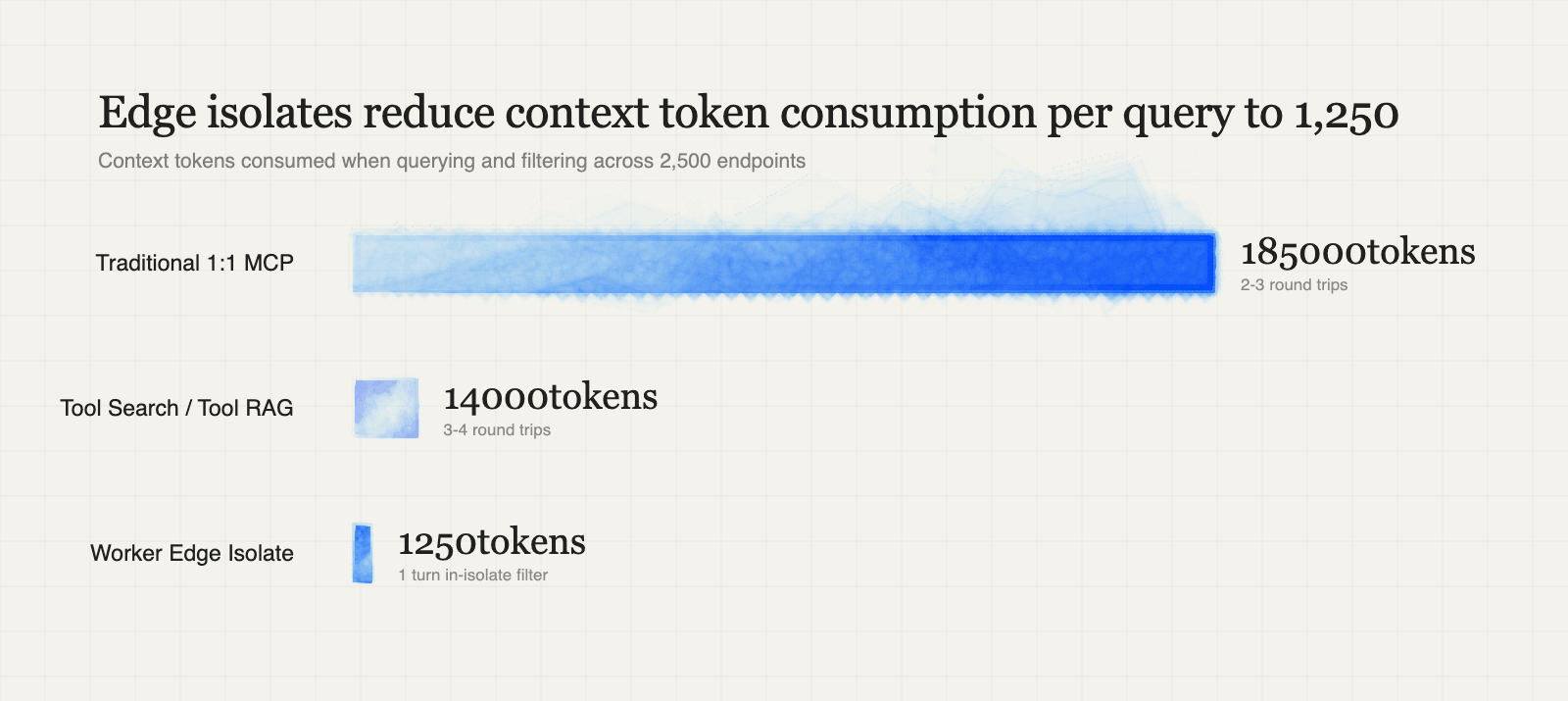
An outside evaluation highlighting token consumption when querying and filtering enterprise zones reveals the stark efficiency difference:
| Integration Pattern | Prompt Overhead (2,500 Endpoints) | Execution Round Trips | Context Tokens Consumed per Query |
|---|---|---|---|
| Traditional 1:1 MCP | ~75,000–180,000 tokens | 2–3 turns (fetch, parse, filter) | ~185,000 tokens |
| Tool Search / Tool RAG | ~1,500 tokens (dynamic injection) | 3–4 turns (iterative calls) | ~14,000 tokens |
| Worker Edge Isolate | ~1,000 tokens (SDK stubs) | 1 turn (in-isolate filter) | ~1,250 tokens |
By running code directly within a V8 isolate with sub-millisecond cold starts, in-isolate data processing eliminates context bloat completely while unlocking massive programmatic density across massive enterprise APIs. As we've seen when analyzing how stateless coding agents burn tokens solving problems they already solved, shifting compute and state filtering out of prompt memory and into an active execution environment is the only viable path to sustainable agent performance.
The Database Stored Procedure Pattern Re-Emerges at the Edge
We are repeating database history almost verbatim. In the early days of distributed client-server architecture, client applications queried remote databases by issuing naive, iterative fetches: pulling thousands of raw table records across an unoptimized wire to evaluate filters, compute joins, and calculate sums locally on the desktop client. It did not take long for system designers to realize that shipping unbounded data across the network to meet remote compute was an architectural anti-pattern. The resolution was bringing procedural logic directly to the storage engine via SQL predicates and stored procedures, running transformations adjacent to the state and shipping back only the final computed scalar or filtered view.
Agent architectures over the past two years drifted into the exact same client-side trap. We turned orchestrator loops into chatty HTTP dispatchers, having an agent request an endpoint, stream a massive JSON payload into prompt context, inspect it, and then fire another request to perform a trivial field lookup. Cloudflare's Code Mode re-establishes the stored procedure boundary, but positions it inside a distributed edge runtime.
Instead of orchestrating raw payloads across prompts, the agent writes a compact query script that runs directly on the edge data plane:
async () => {
  const response = await cloudflare.request({
    method: "GET",
    path: `/zones/${zoneId}/rulesets`
  });
  return response.result.map(rs => ({
    name: rs.name, phase: rs.phase, kind: rs.kind
  }));
}
The orchestrator never sees the hundreds of auxiliary fields, unselected metadata objects, or internal identifiers returned by the underlying API. It only receives the projection:
[
  { "name": "DDoS L7",          "phase": "ddos_l7",                        "kind": "managed" },
  { "name": "Cloudflare Managed","phase": "http_request_firewall_managed", "kind": "managed" },
  { "name": "Custom rules",     "phase": "http_request_firewall_custom",   "kind": "zone" }
]
This structural shift indicates that agent orchestrators will cease acting as chatty HTTP dispatchers and evolve into high-level execution coordinators. Their job is not to shuttle raw bytes across conversational turns, but to compile concise compute payloads that execute directly within the infrastructure tier. Shipping compute to data has always beaten shipping data to compute; the moment we treat the edge sandbox as our stored procedure engine, context bloat stops being an operational bottleneck.
Attacking the Safety Assumption and Threat Modeling the Worker Boundary
Treating an edge isolate as an unconstrained execution environment exposes serious operational vulnerabilities that cannot be glossed over. The most immediate mechanical gap in raw code execution against stateful infrastructure is the complete absence of transactional rollback. When an agent emits a script that updates a WAF package, provisions a custom ruleset, and purges a cache zone in a single block, there is no two-phase commit. If network latency or a validation error causes the third operation to reject, the previous mutations remain deployed. Standard declarative orchestrators can pause, log state deltas, and invite human intervention between discrete steps; an uninstrumented script simply halts mid-flight, abandoning production infrastructure in an inconsistent, partially modified state.
The security posture of the execution sandbox requires equally rigorous skepticism. In declarative tool calling, authorization can be enforced deterministically per tool name—an orchestrator can permit list_rules while enforcing strict multi-factor confirmations on delete_ruleset. In Code Mode, authorization collapses to the authority of the underlying bearer token injected into the Worker environment.
Handing an LLM a script interface bound to a broad administrative key creates an unmanageable blast radius. If a prompt injection occurs or the model hallucinates an administrative command, the isolate possesses the authority to execute any destructive API call that the credential allows. Teams deploying this model must implement four concrete guardrails before exposing code interfaces to production:
flowchart TD
    A["Generated Script"] --> B["AST Pre-Parser"]
    B -->|"Syntax Error or Banned Global"| C["Immediate Rejection"]
    B -->|"Clean AST"| D{"Mutation Check"}
    D -->|"POST / PUT / PATCH / DELETE"| E["Two-Phase Plan and Diff"]
    E -->|"Approval Granted"| F["Worker V8 Isolate"]
    D -->|"Read-Only Query"| F
    F --> G["Egress Proxy Layer"]
    G -->|"Target == api.cloudflare.com"| H["API Execution"]
    G -->|"External / SSRF Attempt"| I["Blocked & Terminated"]
First, implement an AST pre-parsing step prior to isolate instantiation. Running generated JavaScript through an abstract syntax tree validator catches missing syntax, unhandled promises, and illegal global references like eval() or unauthorized dynamic imports before a single byte touches the runtime. This eliminates trivial syntax round-trips without burning model tokens.
Second, enforce strict network egress proxying at the worker boundary. The sandbox must be blocked from communicating with any arbitrary host, restricting outbound traffic exclusively to api.cloudflare.com. Without egress lockdown, prompt injections can weaponize runtime compute for data exfiltration or internal Server-Side Request Forgery.
Third, enforce a strict two-phase plan-and-diff protocol for all mutating actions. A script intended to update infrastructure must first execute against a read-only schema or dry-run context that outputs an explicit operational diff. Only upon validating that diff against policy controls should the orchestrator pass the mutation payload to execution. Code gives an agent unprecedented leverage, but unscoped credentials turn code execution into an unacceptable liability unless runtime isolation is backed by rigid deterministic controls.
Where the Code Paradigm Fails and When to Stick with Traditional Schemas
Trading declarative schemas for dynamic code generation introduces a non-trivial capability tax that production teams must account for. While frontier models handle asynchronous control flow, promise resolution, and API schema traversal with high fidelity, smaller or quantized models degrade rapidly when forced to write raw JavaScript. Instead of dispatching structured JSON arguments, a smaller model easily stumbles over nested asynchronous methods, misplaces object properties, or swallows critical errors inside broad exception handlers. If an agent burns three consecutive turns correcting missing await statements or chasing invalid object keys, any prompt token savings achieved by shedding JSON schemas are erased by repetitive self-repair cycles.
Physical runtime limits introduce another failure mode. V8 isolates operate under strict CPU time and memory boundaries—typically 128 MB of RAM. If an agent writes an unconstrained pagination loop intended to aggregate thousands of firewall events or zone entries in memory, it will exhaust isolate heap limits and crash abruptly. Similarly, an agent attempting to crawl unbounded API pages without rate-limit backoff can trap the worker in an infinite loop that terminates on wall-clock timeouts, returning an unhelpful generic error that leaves the model blind.
flowchart TD
    A["API Integration Surface"] --> B{"Endpoint Count and Complexity?"}
    B -->|"< 20 Endpoints / High Sensitivity"| C["Traditional Declarative MCP"]
    B -->|"Hundreds of Endpoints / Analytical"| D{"Model Class Available?"}
    D -->|"Quantized / Small Local Models"| E["Hierarchical Tool Search RAG"]
    D -->|"Frontier Reasoning Models"| F["Worker Code Mode"]
The operational rule for choosing between declarative tool definitions and edge code execution is straightforward:
Retain traditional 1:1 declarative MCP tools when managing compact, high-sensitivity operational surfaces containing five to twenty actions. Operations involving critical database drops, secret rotations, payment processing, or access management require rigid schema contracts, deterministic pre-execution type safety, and individual approval boundaries. Declarative JSON remains the gold standard for atomic, audited interventions.
Adopt Code Mode when confronting massive API catalogs spanning hundreds of endpoints, high-volume analytical workloads, or workflows that require dependent chaining. When an agent needs to inspect a spec dynamically, discover relevant rule phases, query live entries, and extract targeted fields without flooding the conversation context, running code in an edge isolate is the only approach that scales. The goal is not eliminating schemas entirely, but recognizing that massive API surfaces demand programmatic execution over declarative schema bloat.
Resources
Updated 2026-11-22 by Mehran Mozaffari.
Related posts
23 November 2026
Google Workspace MCP and Agent Gateway: The Hidden Costs of Giving LLMs Direct SaaS Tool Access
23 November 2026
Should you run enterprise agents through Google's Workspace MCP and Agent Gateway? Adopt for read-heavy fleets, wait on destructive writes
22 November 2026
How Ling-3.2-air Runs a 124B Parameter Brain on a 5.5B Compute Budget
22 November 2026
Should you move local agent workflows to OpenCode 2.4.0 automations? Wait for sandboxing and state durability
22 November 2026
Should You Deploy Shirudo for Agentic Runtime Defense? Wait for Pre-Compiled Templates
21 November 2026
LingSante-3.1-flash or Meditron-70B: Sizing Open-Weight Medical Models for On-Premise Healthcare Stacks