Chapter
11
Choosing Your Agent
Claude Code, Cursor, Copilot, OpenCode, Codex, Gemini CLI, and Antigravity compared
There is no single best agent for Open Design; there is the right agent for your constraints, and this chapter routes you to it.
11.1 The Comparison Criteria
Before ranking anything, state what you are ranking on. That is the first discipline in any honest agent comparison, and it is especially important here because the agent-CLI market is genuinely volatile. What is accurate on September 1, 2026 may not be accurate by the end of the month. Route, don't rank is the mental model for this chapter: not "which agent is best," but "which agent fits your constraints."
The criteria used across every row in this chapter are:
- Type: Proprietary hosted, open-source, or IDE-integrated. Determines lock-in surface and governance posture.
- MCP support: Whether the CLI connects to Open Design via the Model Context Protocol (MCP) and how the config is structured.
- Pricing and license: Monthly cost or license type. Proprietary tiers vs Apache-2.0 or MIT.
- Model access: Which underlying models the agent can route to, because model capability directly affects artifact quality.
- Design fit: Where the agent's specific features map onto Open Design workflows --- visual editing, local inference, CI/CD, or team governance.
- Staleness risk: How fast the facts in each row age, and what event triggers a re-check.
OpenDesign-side facts in this chapter --- CLI counts, model pickers, Harness setup, plan pricing --- come from a live audit of OpenDesign 0.21.1 on September 1, 2026. Third-party agent claims are sourced from official documentation and were last verified in mid-2026. Re-verify against primary sources before committing a team to one agent. Every cell in the comparison tables carries a staleness signal. Section 11.6 gives you a structured recheck list.
One more framing note: every agent covered here connects to Open Design over MCP as of September 2026, and the field has widened well past these seven --- OpenDesign 0.21.1 auto-detects 26+ coding-agent CLIs. That means any of them can drive Open Design through od mcp install. The question is not whether they connect; it is which trade-offs you can live with once they do.
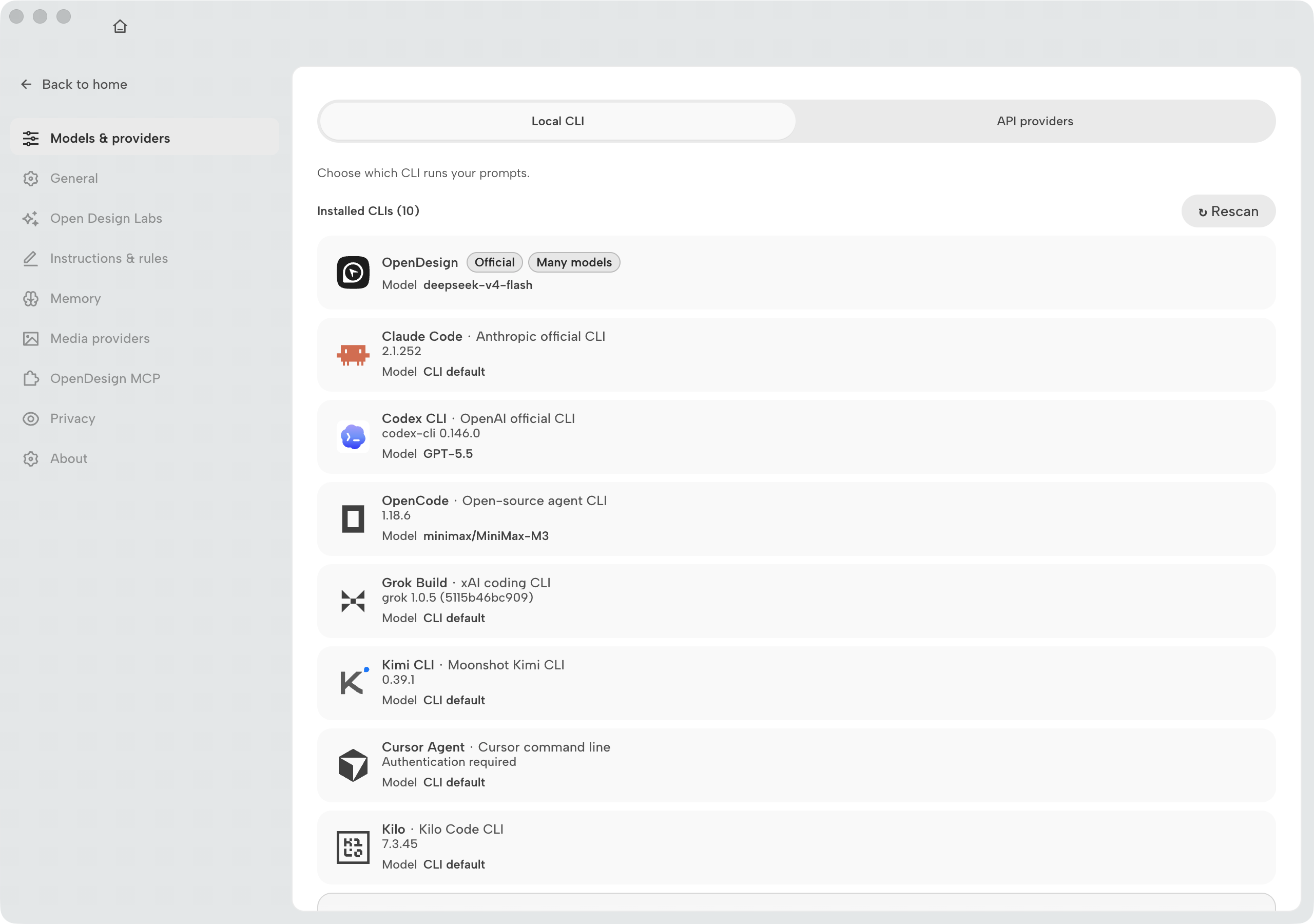
In the desktop app, agent selection is not buried in a config file. The home composer's model picker and Settings → Workspace settings → Models & providers expose the same detected-CLI roster: Local CLI routes through whichever binary you pick; API providers route through whichever key you configure. The 0.21.1 Settings page on my machine lists Installed CLIs (10) --- OpenDesign built-in (deepseek-v4-flash), Claude Code 2.1.252, Codex CLI 0.146.0 (GPT-5.5), OpenCode 1.18.6, Grok Build 1.0.5, Kimi CLI 0.39.1, Cursor Agent (auth required), Kilo 7.3.45, Antigravity 1.1.22, and DeepSeek Reasonix v1.21.3 --- plus Available CLIs (16) more behind a Rescan button. A well-provisioned machine commonly runs ten at once; the product total is 26+ auto-detected CLIs. And since 0.21.0, discovery self-repairs past stale PATH shims, so a binary you installed yesterday shows up without hand-editing your shell profile. The grid still does not update until you ask it to --- Rescan after installing a new CLI.
11.2 The Proprietary Agents
Four of the seven headline agents are proprietary: Claude Code (Anthropic), Cursor (Anysphere), GitHub Copilot CLI (GitHub/Microsoft), and Google Antigravity. All four are rolling releases with subscription pricing, hosted inference, and single-vendor model access. The trade-off is capability ceiling versus lock-in surface.
Claude Code
Claude Code is Anthropic's terminal agent, built on the Claude model family. It ships two consumer tiers: Pro at $20/month giving Sonnet 4.6 access, and Max at $100–200/month giving Opus access (list prices as of mid-2026; re-verify before purchase). The reference machine for this chapter runs Claude Code 2.1.252. Claude Code added persistent artifact storage in March 2026 and a hosted visual design tool (Claude Design) in April 2026. Claude Design generates visual prototypes, pitch decks, and UI mockups from a Claude Code session --- making it the most native integration between an agent CLI and a hosted design surface of any tool in this comparison.
The trade-off is total vendor lock-in. Authentication is OAuth-only through Anthropic. If Anthropic changes pricing or sunsets a model tier, Claude Code users have no fallback. Third-party OAuth access is also a dependency: OpenCode's Claude subscription login stopped working in January 2026 (see 11.3), and a break of that kind is not something a third-party agent can control. For a team using Open Design, this means your agent and your design cloud are both Anthropic-dependent.
Cursor
Cursor is an IDE-first proprietary agent from Anysphere. Version 3.7, released June 5, 2026, introduced Design Mode: visual UI editing in the browser with voice input, multi-select, and canvas-level operations. Pricing is Free (Hobby), Pro at $20/month, and Ultra at $200/month (mid-2026 list). MCP support is available at Pro tier and above.
Cursor's Design Mode is its meaningful differentiator in this comparison. Where other CLIs operate in a terminal, Cursor lets a design engineer point at an element in the browser, describe the change verbally, and have the agent execute it visually. For artifact iteration workflows in Open Design, this changes the interaction model from prompt-driven to gesture-driven. One September 2026 data point softens the "IDE or nothing" framing: OpenDesign 0.21.1's CLI scanner detects a Cursor Agent binary on PATH (flagged "auth required" in the Settings roster). Treat headless/CI support as plausible but unverified --- confirm it against Anysphere's docs before wiring a pipeline to it.
GitHub Copilot CLI
GitHub Copilot CLI is Microsoft's agent, built into the GitHub ecosystem. As of June 1, 2026, it moved from flat subscription pricing to usage-based billing, meaning costs are determined by the number of agent requests rather than a fixed monthly fee. A free plan remains available with limited agent credits. MCP support is confirmed via the built-in GitHub MCP server and /mcp add for external servers including Open Design.
Copilot's strongest fit is the GitHub-native team: pull request integration, code review agents, and GitHub Actions hooks come out of the box. For design workflows in Open Design, the integration gives you a path from generated artifact to PR and deployment without leaving the GitHub surface. The risk is billing opacity: usage-based models make it hard to predict monthly costs for design-heavy sessions that generate large artifacts repeatedly.
Antigravity
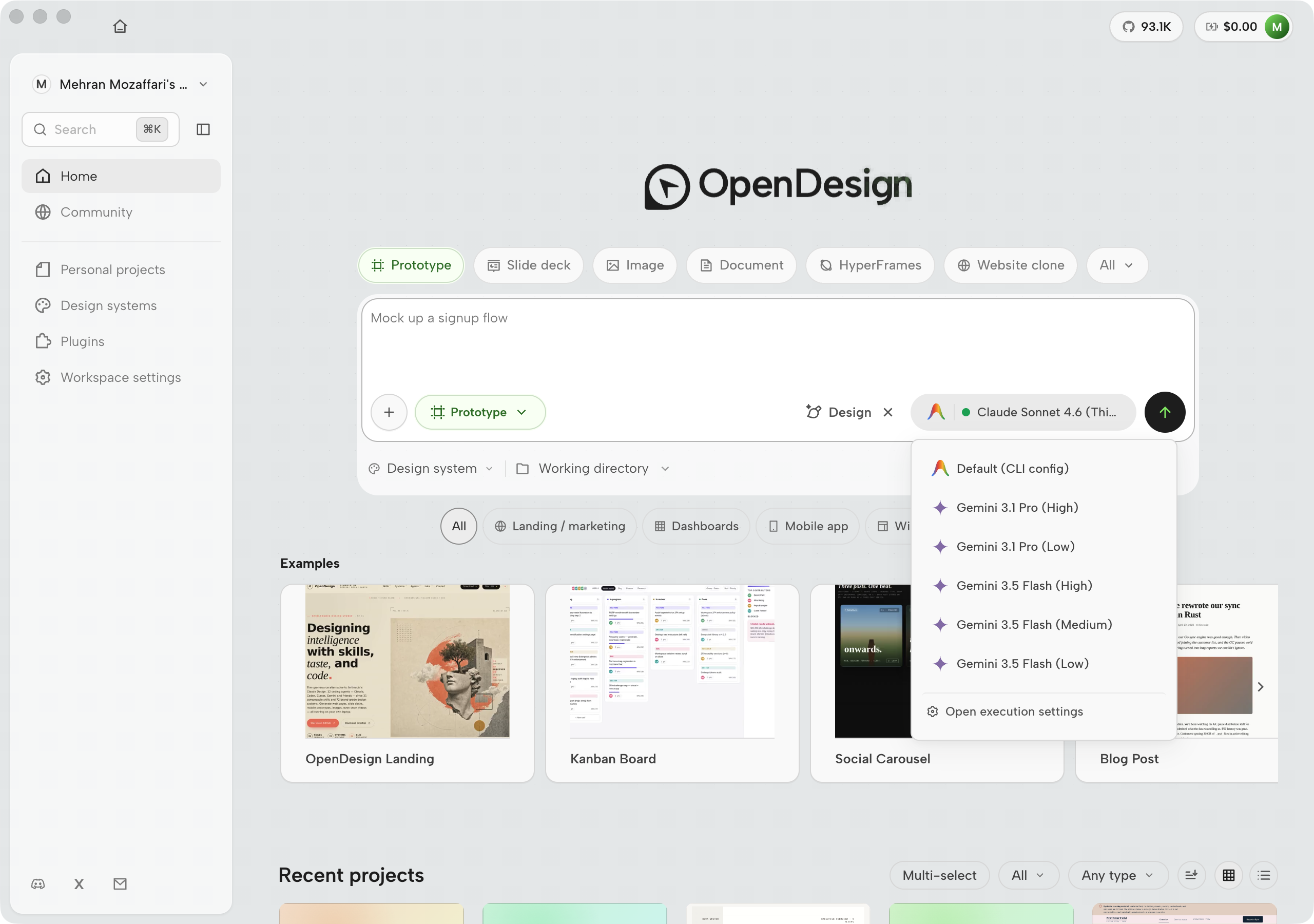
Antigravity is Google's successor to Gemini CLI, launched at Google I/O in May 2026 and positioned for free, Pro, and Ultra Google accounts as Gemini CLI wound down. The reference machine runs Antigravity 1.1.22, and since OpenDesign 0.20.1 it has been the model-picker showcase: Antigravity's per-agent picker exposes Default (CLI config), Gemini 3.1 Pro High/Low, Gemini 3.5 Flash High/Medium/Low, Claude Sonnet 4.6 (Thinking), Claude Opus 4.6 (Thinking), and GPT-OSS 120B --- one agent, three vendors' models. That is the multi-agent orchestration pitch made concrete.
Antigravity's own pricing has been in transition from preview to general availability throughout 2026; exact Pro and Ultra tier costs were still not confirmed from an official primary source at the September 2026 re-check. Use Antigravity if your team is Google Cloud-native or wants Gemini-family models inside Open Design's picker. Treat its pricing as unverified until Google posts a stable pricing page.
Model pickers are per-agent --- and entitlement-aware
A quiet but consequential 0.20.1 change: the model picker is now scoped per agent and entitlement-aware. In OpenDesign 0.21.1 the Home picker's label reads like Antigravity · Claude Sonnet 4.6 (Thinking) --- agent first, model second --- and opening it lists only the models that agent can actually reach, with an "Open execution settings" escape hatch. Two rules govern the list. First, "unlimited" badges appear only on models your plan actually entitles you to, and a zero wallet balance no longer hides plan-included unlimited models (a 0.20.1 honesty fix). Second, since 0.21.1 you do not need an OpenDesign Cloud account at all to use any of this: pick a local CLI or bring your own key from Home and start --- Cloud is optional, and signing out preserves your local provider keys, URLs, model choices, and media defaults.
When you do want the Cloud lane, the plan ladder as of September 1, 2026 runs: Free (no account needed; local CLI or BYOK; 1 concurrent task, 5 runs/day), Plus at $20/month, Pro at $100/month, Max at $200/month, legacy Go (sold out to new purchasers as of 0.21.0), and seat-based Team. Chapter 14 puts the full quota and fine-print table against the procurement decision; the routing point here is simpler --- the model you get is a function of agent choice times plan entitlement, and the picker now tells you both honestly.
| Agent | Vendor | Version (September 2026) | MCP | Pricing | Design fit |
|---|---|---|---|---|---|
| Claude Code | Anthropic | Rolling | Yes | Pro $20/mo; Max $100–200/mo | Hosted design integration (Claude Design, Artifacts); highest capability ceiling; full Anthropic lock-in |
| Cursor | Anysphere | v3.7 (June 5, 2026); Cursor Agent binary detected by OpenDesign (auth required) | Yes (Pro+) | Free; Pro $20/mo; Ultra $200/mo | Visual Design Mode for gesture-driven UI editing; IDE-integrated; headless/CI support unverified |
| GitHub Copilot CLI | GitHub / Microsoft | Rolling | Yes | Usage-based from June 1, 2026; free tier available | Best for GitHub-native teams; PR and Actions integration; billing opacity risk |
| Antigravity | 1.1.22 (on the 0.21.1 reference machine) | Yes | Google account tiers; not confirmed from a primary source — re-verify on Google's pricing page | Google Cloud native; Gemini CLI successor; per-agent picker exposes Gemini 3.1/3.5, Claude Sonnet/Opus 4.6 Thinking, GPT-OSS 120B; pricing unconfirmed |
Claude Code is the clearest win on capability and the clearest loss on vendor independence. The Claude Design integration genuinely changes what a design session looks like --- but if Anthropic raises Max pricing or restructures OAuth tomorrow, you are stranded. I run Claude Code daily, but I also keep a second agent configured precisely because of that exposure. Route, don't rank: Claude Code wins for capability, but it is not safe as a sole agent.
11.3 The Open-Source Agents
Three of the seven headline agents are open source: OpenCode (MIT), Codex CLI (Apache-2.0), and Gemini CLI (Apache-2.0, sunset completed June 18, 2026). Open-source agents give you license portability, community maintenance, and the option to self-host or fork. The trade-off is that community-maintained tools depend on that community staying active, and as OpenCode's Claude OAuth login outage in January 2026 demonstrated, integrations that depend on another company's authentication endpoint can break at any time, for reasons outside the community's control.
OpenCode
OpenCode is the direct open-source alternative to Claude Code, maintained by the anomalyco organization since a rebrand and repo migration in early 2026. The reference machine runs OpenCode 1.18.6 under an MIT license, and OpenDesign has grown friendlier to it over time --- 0.20.1 handed hand-off off to an OpenCode community plugin. The project carried approximately 162,000 GitHub stars as of June 10, 2026 (per the repository page on that date; star counts change daily). OpenCode supports MCP fully, including local and remote server configuration.
In January 2026, OpenCode's Claude subscription OAuth login stopped working, as documented in OpenCode's GitHub issue tracker (issue #18827) and in community blog reports. Neither Anthropic nor OpenCode has published an official statement confirming the cause; this book reports only the observed effect and does not attribute the cause or intent to either party. OpenCode's community responded by migrating to approximately 75+ alternative model providers (as of June 10, 2026), including Ollama for fully local inference. As of June 2026, OpenCode is the only agent in this comparison that is designed to support local model inference out of the box — making it well-suited for teams with local-inference requirements. It is also the strongest vendor-independence hedge: MIT license, multi-provider, self-hostable. Evaluate whether any specific compliance or privacy requirement is actually satisfied by consulting qualified security or legal counsel.
The cost is configuration overhead. Where Claude Code ships one model and one billing relationship, OpenCode requires you to select and configure a provider. The Zen and Black plans (OpenCode's hosted tiers) have not published stable pricing at research time.
Codex CLI
Codex CLI is OpenAI's lightweight terminal agent. The reference machine runs 0.146.0 routed to GPT-5.5; it ships under Apache-2.0, and the schema-handling improvements that landed in 0.139.0 (June 2026) carried forward. Codex is minimal by design: it runs in the terminal, executes coding tasks, and routes through OpenAI model APIs. There is no IDE and no hosted design surface of its own.
What changed in August 2026 is the direction of the integration. OpenDesign 0.17.0 shipped an @open-design plugin that runs inside Codex Desktop and Codex CLI: you confirm a visual brief in Codex, pick OpenDesign Cloud or a local runtime, and receive a Preview or Studio result --- with pre-flight model checks before the run starts. OpenDesign becomes a creative engine callable from Codex, and a Codex Design collection of 50 skills ships alongside it. For OpenAI-native teams this is now the lowest-friction route in: the agent you already run can drive OpenDesign without a second app in the foreground. The remaining limitation is unchanged --- Codex follows OpenAI model availability and pricing, which is itself a concentration risk, just with OpenAI instead of Anthropic.
Gemini CLI
Gemini CLI v0.46.0 is an Apache-2.0 terminal agent from Google with MCP support. Its sunset is no longer hypothetical: Google's May 19, 2026 announcement took effect on June 18, 2026, when service stopped for free, Pro, and Ultra accounts. Enterprise license holders were unaffected and may continue. The repo's long-term archive status is worth checking if you still depend on it.
If your team is somehow still running Gemini CLI for design work, migrate to Antigravity --- the successor Google explicitly positioned for this transition, and the agent whose model picker OpenDesign 0.21.1 showcases. The migration path is documented in the official Google Developers Blog announcement.
| Agent | License | Version (September 2026) | MCP | Local model support | Lock-in risk |
|---|---|---|---|---|---|
| OpenCode | MIT | 1.18.6 (0.21.1 reference machine; MiniMax-M3 config) | Yes | Yes (Ollama and 75+ providers) | Low; multi-provider, self-hostable; Claude OAuth login stopped working Jan 2026 (per community reporting); Handoff community plugin since 0.20.1 |
| Codex CLI | Apache-2.0 | 0.146.0 (GPT-5.5; 0.21.1 reference machine) | Yes (schema improvements since v0.139.0) | No (OpenAI API required) | Medium; OpenAI API dependency; auditable codebase; @open-design plugin turns it into an OpenDesign client (0.17.0) |
| Gemini CLI | Apache-2.0 | v0.46.0 (final; sunset completed June 18, 2026) | Yes | No | Sunset took effect June 18, 2026 (free/Pro/Ultra); migrate to Antigravity |
11.4 MCP Support Across Agents
Every agent in this comparison connects to Open Design over MCP as of September 2026, and the connection has become more self-serve on both ends. MCP is the open standard — originally at the 2025-11-25 spec, with a 2026-07-28 revision in release-candidate — that makes Open Design agent-agnostic. Chapter 10 covers the MCP server in depth; this section focuses on the per-agent configuration differences that matter when you run od mcp install.
MCP support is confirmed, but the configuration format differs significantly across agents. Cursor requires a GUI step in addition to the config file. GitHub Copilot adds a built-in GitHub MCP server that is always present and uses /mcp add for custom servers. OpenCode's config lives in ~/.config/opencode/config.json and supports both local stdio and remote SSE transports. Codex CLI's schema-handling fix (0.139.0) removed tool-discovery failures that pre-0.139.0 builds suffered, and the 0.146.0 build carries it forward.
OpenDesign's own side of the wire has grown helpers too. The Settings → OpenDesign MCP page prints a ready-made per-CLI setup command --- for Claude Code it is claude mcp add-json --scope user open-design '{…}', with the daemon payload paths and OD_DATA_DIR/OD_SIDECAR_IPC_PATH variables filled in --- followed by the reminder "Keep OpenDesign running. Restart your coding agent after setup." Newer one-liners cover surfaces beyond coding CLIs: od mcp install claude-desktop (0.19.1) wires the Claude Desktop app. And since 0.21.0, agent discovery self-repairs past stale PATH shims, so a CLI that moved or upgraded still gets found at Rescan.
| Agent | MCP confirmed | Config format | Open Design install command | Notable friction |
|---|---|---|---|---|
| Claude Code | Yes | JSON (project or global scope) | od mcp install claude-code |
None; tightest integration, official support |
| Cursor | Yes (Pro+) | JSON + GUI step in Settings | od mcp install cursor |
GUI step required; free-tier users excluded |
| GitHub Copilot CLI | Yes | /mcp add CLI command |
od mcp install copilot |
Built-in GitHub MCP server always active; may require scoping |
| Antigravity | Yes | Config file (JSON) | od mcp install antigravity |
Detected as 1.1.22 by 0.21.1; per-agent model picker is entitlement-aware |
| OpenCode | Yes | JSON (~/.config/opencode/config.json) |
od mcp install opencode |
Both local stdio and remote SSE supported; verify provider config first |
| Codex CLI | Yes (schema fix since v0.139.0) | Config file (JSON) | od mcp install codex |
Schema validation issues in pre-0.139.0 versions; upgrade before connecting. Or skip MCP entirely and use the @open-design plugin inside Codex (0.17.0) |
| Gemini CLI | Yes | Config file (JSON) | od mcp install gemini |
Sunset completed June 18, 2026 — migrate to Antigravity |
The practical implication: all of these agents reach Open Design, but some require more setup effort than others. For a new team, Claude Code and OpenCode have the smoothest documented paths. Cursor's GUI step is a one-time friction. Codex CLI's schema improvements removed a common failure mode, and its 0.17.0-era OpenDesign plugin removes even the MCP step for OpenAI-native teams. Wherever you connect from, the Settings → OpenDesign MCP page in 0.21.1 prints the exact command for your agent.
MCP config formats are not portable across agents. A config you wrote for Claude Code does not transfer to OpenCode or Cursor without editing. Keep per-agent config files separate and under version control. When you add a new agent to your Open Design setup, run od mcp install <agent> rather than copying a config file from another agent's directory.
11.5 The Routing Table
Route, don't rank. The agents in this chapter are not ordered from best to worst; they are routed by constraint. The table below maps each common constraint to the agent that fits it best, with a one-line reason. Read down the "Your constraint" column until you find yours, then follow the recommendation across.
| Your constraint | Recommended agent | Why |
|---|---|---|
| Maximum capability and hosted design surface (Claude Design, Artifacts) | Claude Code (Max tier) | Opus 4.7 access and Claude Design integration are unmatched; accept full Anthropic lock-in |
| Visual editing by pointing and drawing in the browser | Cursor (Pro or Ultra) | Design Mode (v3.7) is the only gesture-driven visual editing surface among these agents |
| Already in GitHub; want PR and Actions integration | GitHub Copilot CLI | Built-in GitHub MCP, PR-level agent access, free entry tier; watch usage-based billing |
| Google Cloud stack or Gemini model requirement | Antigravity | Official Gemini CLI successor; per-agent picker exposes Gemini 3.1/3.5 plus cross-vendor thinking models; confirm pricing before committing |
| Deepest budget lane for volume generation | OpenDesign built-in (deepseek-v4-flash) or DeepSeek Harness | Built into OpenDesign itself; DeepSeek V4 Flash carries an unlimited badge on paid plans inside the app; Free tier needs no account at all (0.21.1) |
| OpenAI-native team that lives in Codex | Codex CLI + @open-design plugin |
OpenDesign becomes a creative engine callable from Codex Desktop/CLI with pre-flight model checks (0.17.0); no separate MCP wiring step |
| Vendor independence or local model inference (local-inference posture) | OpenCode | MIT license, approximately 75+ providers (as of June 2026), Ollama for fully local inference; survives any single vendor's pricing or sunset. Whether local inference satisfies a specific compliance or privacy requirement depends on your environment — verify with qualified counsel or a security review. |
| OpenAI API native; prefer lightweight terminal tool with open license | Codex CLI | Apache-2.0, minimal footprint, OpenAI model routing; no IDE dependency |
| Already running Gemini CLI | Antigravity (the sunset completed June 18, 2026) | Gemini CLI stopped for free/Pro/Ultra accounts on June 18; Antigravity is the official migration path |
A few routing notes that do not fit cleanly in the table:
Budget-first teams now have three real rungs. The floor is OpenDesign's own Free tier: since 0.21.1 it requires no account at all --- pick a local CLI or BYOK and work within 1 concurrent task and 5 runs a day. Above that, GitHub Copilot's free tier and OpenCode's multi-provider flexibility cover light agent-driven sessions. And inside the app on any paid plan, DeepSeek V4 Flash carries an unlimited badge, which makes it the volume lane for variation-heavy work. None of these is as capable as Claude Max or Cursor Ultra at the ceiling, but all of them connect fully.
Teams with local-inference requirements --- where keeping design artifacts and model inference on local infrastructure is a priority --- have one real option in this comparison: OpenCode plus Ollama. Local-first Open Design already controls where your files live; adding OpenCode with Ollama keeps the inference local as well. Nothing else in this comparison is designed to offer that combination. Whether a specific governance or compliance policy is actually satisfied by this architecture depends on your context; consult qualified counsel or a security review for hard requirements.
Teams who want to run Open Design in a CI/CD pipeline without a human in the loop need a headless CLI. Cursor is the uncertain case: historically IDE-only, though OpenDesign's 0.21.1 scanner detects a Cursor Agent binary (auth required) --- verify headless behavior before relying on it. Claude Code, Codex CLI, and OpenCode all support headless execution. GitHub Copilot's usage-based billing model makes it harder to bound pipeline costs.
For a team adopting Open Design today, pair at least two agents: one proprietary for raw capability and one open-source for vendor-independence. Claude Code plus OpenCode is the combination I actually run. Claude Code handles the high-quality iterations where model capability matters; OpenCode is configured and ready to take over if Anthropic's OAuth, pricing, or model availability changes. Agent-agnosticism is only meaningful if you exercise it. Running two agents keeps that escape hatch open. The downside is real: it doubles setup work and config maintenance. A small team might reasonably pick one and accept the risk. But for any team treating Open Design as a production workflow, the two-agent hedge pays for itself the first time a vendor changes terms.
| Agent | License | Lock-in risk | Local model support |
|---|---|---|---|
| Claude Code | Proprietary | High — single vendor (Anthropic) | No |
| Cursor | Proprietary | High — single vendor (Anysphere); IDE dependency | No |
| GitHub Copilot CLI | Proprietary | High — GitHub/Microsoft ecosystem; usage billing | No |
| Antigravity | Proprietary | High — Google ecosystem; pricing unconfirmed | No |
| OpenCode | MIT | Low — multi-provider, forkable | Yes (Ollama) |
| Codex CLI | Apache-2.0 | Medium — OpenAI API dependency; auditable codebase | No |
| Gemini CLI | Apache-2.0 | Transitional — sunset completed June 18, 2026 | No |
11.6 Staleness and What to Recheck
This is the chapter in this book that ages fastest. Agent-CLI pricing, versions, and feature sets churn monthly. The mental model of route, don't rank assumes a stable set of constraints; if the agents themselves change, the routes change too. This section is a structured watch-list: what to recheck, what event triggers the recheck, and where to look.
The four highest-risk claims in this chapter, as of September 1, 2026:
- Antigravity pricing. Antigravity moved from preview to general availability during 2026, and 0.21.1 detects it at version 1.1.22 with a fully populated model picker --- but exact Pro and Ultra tier pricing has still not been confirmed from an official primary source. This affects the routing table for Google Cloud teams.
- GitHub Copilot usage-based billing. Effective June 1, 2026. Per-request credit costs for agent-heavy sessions (such as iterating on Open Design artifacts) remain undetailed from a primary source. The routing table treats Copilot as "watch billing" until exact rates are confirmed.
- OpenCode model tiers. OpenCode's Zen and Black hosted plans have not published stable pricing. OpenCode is routed as the vendor-independence choice; this recommendation is stable regardless of tier pricing, but the cost-comparison row may need updating.
- OpenDesign Cloud campaign pricing. The "unlimited" model badges are entitlement-gated and apply only inside the app (not MCP, CLI, or API traffic), DeepSeek unlimited campaigns are time-boxed and repeatedly extended, and legacy Go is sold out. Any cost math built on an unlimited badge needs a re-check against the live pricing page before it reaches a budget.
| Agent | What is changing | Recheck trigger | Where to check |
|---|---|---|---|
| Gemini CLI | Sunset completed June 18, 2026 for free/Pro/Ultra | Only if you still depend on it: archive status and fork activity | Google Developers Blog and github.com/google-gemini/gemini-cli for archive status |
| Antigravity | Pricing from preview to GA; model picker contents per plan | First official Antigravity pricing page goes live | Google I/O 2026 materials and official Antigravity documentation |
| GitHub Copilot CLI | Usage-based billing effective June 1, 2026; credit costs per agent request | Any GitHub Copilot pricing announcement | github.com/features/copilot/plans and GitHub billing settings |
| OpenCode | Zen/Black plan pricing; model provider list (75+ as of June 2026) | Official pricing announcement on opencode.ai | opencode.ai/docs and github.com/anomalyco/opencode releases |
| Claude Code | Max tier pricing ($100–200/mo); Claude Design feature set | Any Anthropic pricing or Claude Design announcement | claude.com/pricing and anthropic.com/news |
| OpenDesign Cloud plans | Free/Plus/Pro/Max quotas, DeepSeek campaign windows, Go availability | Any OpenDesign release note touching pricing or entitlements | open-design.ai/pricing and the in-app model picker badges |
Beyond the table, there is a structural pattern worth naming. The proprietary agents (Claude Code, Cursor, Copilot, Antigravity) have all made significant changes to their pricing model or feature set between January and August 2026. Claude Code gained Artifacts persistent storage and Claude Design. Cursor shipped Design Mode. Copilot moved to usage-based billing. Antigravity launched as a new product and became OpenDesign's per-agent picker showcase. And OpenDesign itself now moves the market: twelve releases in five weeks (mid-July through August 2026) added Codex integration, a Team Workspace, subscription image generation, the DeepSeek Harness, and a no-login Free tier.
The open-source agents have a different kind of volatility. The loss of OpenCode's Claude OAuth login in January 2026 was an external event, not a roadmap decision by the OpenCode team. Gemini CLI's sunset was a product decision from Google. The Apache-2.0 source continues to exist post-sunset, so community forks are possible --- but the community must step in for that to be real.
Do not treat any agent ranking in this chapter as durable. The agent-CLI market is in active consolidation and competition. Re-verify pricing, version, and MCP support against each vendor's primary documentation before committing a team to one agent or publishing internal guidance that names specific tiers or prices. The OpenDesign-side claims in this chapter are accurate as of 0.21.1, verified September 1, 2026; the third-party claims were last checked against vendor sources in mid-2026 and are not guaranteed accurate 60 days later.