
The Shift from Batch Rendering to 40 FPS Diffusion Streams
For the past two years, running generative video in production has meant babysitting asynchronous worker queues. You POST an image and a prompt to an API gateway, push a task to Celery or Redis, and force the client to poll a job endpoint for forty-five seconds while an offline cluster evaluates twenty-five denoising steps on a batch diffusion transformer before writing an MP4 container to object storage. That operational pattern works fine for creative toolkits and asynchronous content pipelines, but it collapses the instant you attempt to build conversational interfaces or responsive digital environments. The moment you require interactive latency—keeping total round-trip latency under 300 milliseconds—the traditional batch-and-poll architecture becomes dead on arrival.
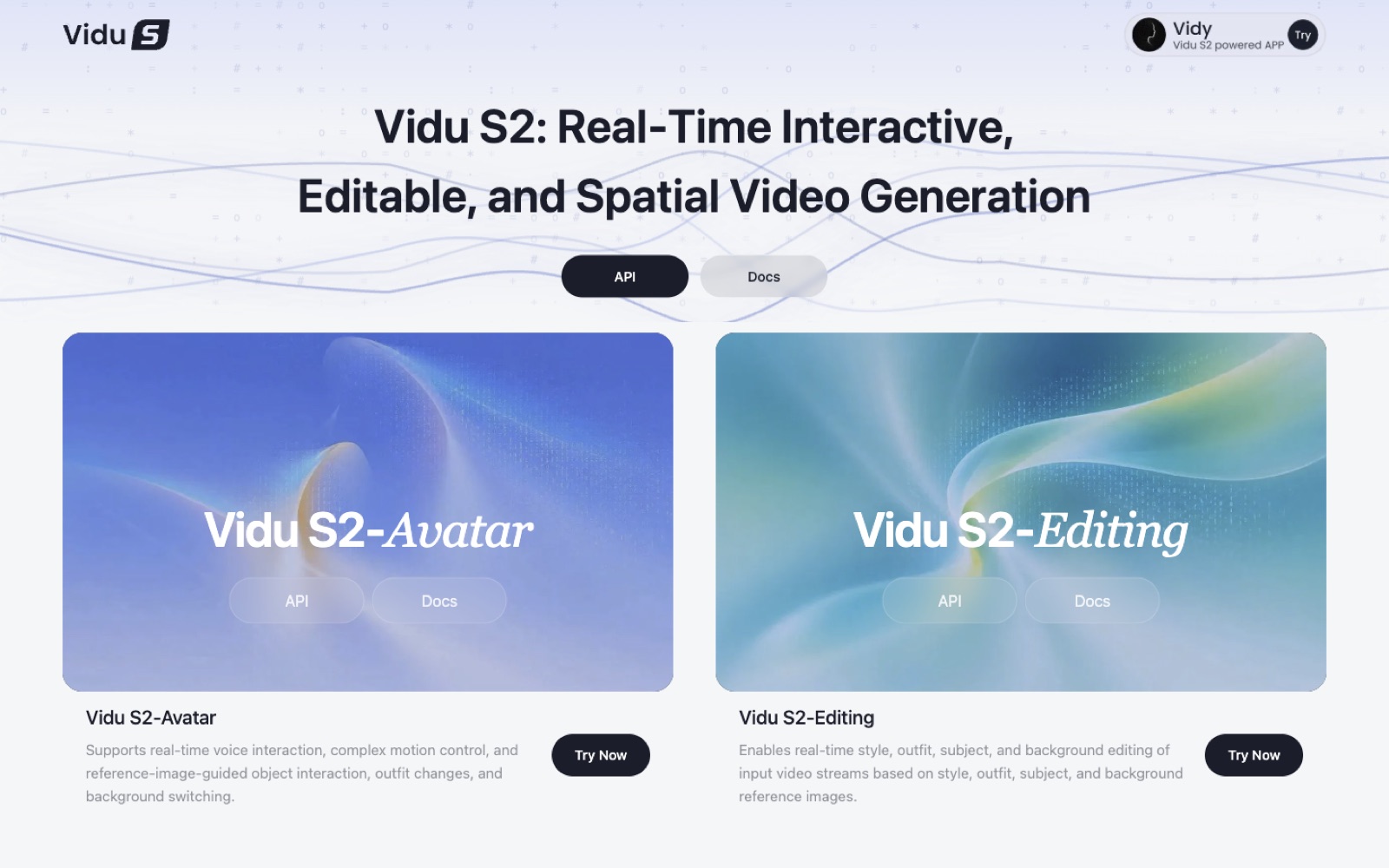
Vidu S2 replaces that asynchronous queue pattern with an uninterrupted, low-latency WebRTC pipeline that delivers 720p video at sustained rates between 25 and 42 FPS. Operating at this cadence fundamentally rewrites the engineering economics of generative diffusion. Instead of pooling compute across sporadic, queue-based jobs where GPUs achieve high batch-size throughput, streaming diffusion requires dedicated, non-preemptible inference hardware pegged to each active peer connection. You cannot oversubscribe your accelerator tier when dropped frames instantly collapse the client's WebRTC jitter buffer.
Achieving 40 FPS means the entire pipeline—receiving an audio chunk, updating cross-attention context, executing distilled diffusion denoising, decoding latents to RGB pixels, and pushing them into a hardware H.264/AV1 encoder—must complete within a rigid 25-millisecond budget per frame. Shengshu Technology and Tsinghua achieve this via distilled few-step DiT checkpoints mated with proprietary TurboDiffusion runtimes, but the infrastructure tradeoff is severe. In a standard enterprise deployment, an NVIDIA H100 that once processed hundreds of asynchronous clips an hour across queued batch jobs can now realistically anchor only one or two concurrent real-time WebRTC sessions.
From an infrastructure perspective, this shifts generative video from an elastic compute problem into a stateful session management problem. Egress bandwidth becomes a dominant line item: streaming high-bitrate 720p streams requires continuous outbound pipes of 8 to 15 Mbps per user session. Session negotiation over WebRTC requires globally distributed TURN and STUN relays positioned close to the edge to prevent network transmission jitter from eating into the model's microscopic compute budget. You are no longer managing worker nodes pulling static jobs from a broker; you are managing a fleet of stateful, real-time media servers where a single dropped packet or inference stall manifests immediately on the user's glass as stutter, frozen geometry, or visual degradation.
Inside the Mechanics: Self-Replay Forcing and In-Flight Conditioning
The core breakthrough powering both Vidu S2-Avatar and S2-Editing is continuous sequence persistence: the model preserves its autoregressive Key-Value (KV) cache across frame boundaries rather than re-evaluating context from scratch on every step. This architectural choice makes in-flight conditioning possible. In earlier stream-to-stream implementations, injecting a new conditioning prompt or reference image required clearing the temporal attention cache, causing a jarring visual pop or several frames of geometric instability. Vidu S2 sidesteps this by maintaining active spatio-temporal KV buffers while projecting new visual conditioning tokens directly into active cross-attention layers.
When you pass a reference image—such as a garment swap, a prop, or a new background—the vision encoder projects these features into conditioning tokens that slot dynamically into the transformer's cross-attention mechanisms. For stream-to-stream video modifications in S2-Editing, the network pairs this injection with dense spatio-temporal feature tracking to decouple the actor's underlying motion vectors from their surface texture tokens. I have analyzed similar dense tracking mechanisms when reviewing Dense 3D Tracking Across Thousand-Frame Horizons: An Operator's Breakdown of TrackEverything, and the operational hurdle is always preserving structural identity under rapid motion. When an actor gestures aggressively, attention weights risk bleeding background textures into foreground limbs. Vidu S2 mitigates this by anchoring motion trajectories while modulating surface latents.
sequenceDiagram
    autonumber
    participant Client as WebRTC Client<br/>(Mic / Webcam / DataChannel)
    participant Gateway as Media Gateway &<br/>TURN Server
    participant Engine as DiT Inference Engine<br/>(Active KV Cache)
    participant Encoder as Hardware Video Encoder<br/>(H.264 / AV1)

    Client->>Gateway: Send continuous audio stream & frame packets
    Client->>Gateway: Push dynamic reference image tokens via DataChannel
    Gateway->>Engine: Forward audio frames & tokenized image conditioning
    activate Engine
    Note over Engine: Inject tokens into active cross-attention layers
    Note over Engine: Apply Self-Replay Forcing (re-noise historical latents)
    Note over Engine: Execute low-step DiT denoising pass (25-42 FPS)
    Engine->>Encoder: Dispatch uncompressed 720p tensor buffer
    deactivate Engine
    activate Encoder
    Encoder->>Gateway: Egress hardware-encoded RTP video stream
    deactivate Encoder
    Gateway->>Client: Deliver low-latency WebRTC media stream
    Note over Client: Ingest into jitter buffer & render to glass (<300ms round-trip)
The greatest hazard in autoregressive diffusion streaming is error compounding. In open-loop autoregressive generation, minor latent artifacts introduced in frame $N$ get recycled into the temporal cache as ground truth for frame $N+1$, leading to rapid semantic drift where faces melt, eyes distort, and anatomical geometry dissolves within dozens of frames.
To break this feedback loop, Vidu S2 employs Self-Replay Forcing. Instead of blindly conditioning on the raw, unadulterated output of previous frames, the architecture injects controlled perturbations by partially re-noising historical latent trajectories during inference. This re-noising forces the model's denoising path to continually snap back toward the persistent identity priors established by the source anchor image and speech conditioning. By re-anchoring temporal representations against the source reference frame, the model achieves stability across extended sessions without freezing the avatar into a static, repetitive loop.
The Spatial Reality Check: 3DoF Stereo Streams vs. True 6DoF Radiance Fields
Vidu S2's positioning highlights real-time interactive spatial video generation for VR, but as operators, we have to look past the marketing vernacular and examine the underlying spatial geometry. What the system actually produces is a synchronized dual-view stereoscopic video stream—a left-eye and a right-eye perspective transmitted over WebRTC. That architecture delivers 3 Degrees of Freedom (3DoF) rotational stereoscopy, not genuine 6 Degrees of Freedom (6DoF) spatial presence.
In a genuine 6DoF environment, an avatar or scene possesses explicit volumetric geometry. You can translate your head forward, tilt laterally, or step sideways, and the rendering engine computes correct motion parallax, occlusion boundaries, and disocclusion fills from your exact viewpoint. Vidu S2 does not output an underlying geometric mesh, signed distance field, or neural radiance field; it streams pixels projected onto a virtual stereoscopic plane. If a user wearing an XR headset translates their head through space, the perspective does not update to reveal what is hidden behind the avatar's shoulder. The user is effectively sitting inside a dual-camera 3D projection booth.
This distinction introduces severe perceptual failure modes that do not exist in standard 2D streaming. When you generate two video streams using generative diffusion models, you are vulnerable to binocular rivalry. In human vision, our visual cortex fuses the left and right ocular views into a unified perceptual volume. If high-frequency generative details—such as strand-level hair synthesis, eye glints, specular highlights on a leather jacket, or edge noise around moving fingers—hallucinate with slight discrepancies between the two views, the brain cannot fuse the images. The result is immediate ocular strain, visual shimmering, and nausea within minutes of immersion. Maintaining strict cross-view generative consistency across two parallel 40 FPS diffusion passes in real time requires tight cross-view attention coupling, which heavily penalizes throughput.
This points directly to the compute penalty of diffusion-based spatial streaming. Generating stereoscopic streams requires roughly double the tensor operations of a monocular feed. In contrast, 3D Gaussian Splatting and neural rig approaches (such as Meta Codec Avatars) separate the generation or capture of geometry from the render step: a compact neural representation or rig deformation is transmitted or evaluated once, and the client headset renders the twin viewpoints locally at 90+ FPS with zero binocular rivalry and zero stereo transport overhead. Relying on remote dual-stream diffusion to render spatial VR trades away geometric robustness, client-side efficiency, and perceptual comfort in exchange for open-ended generative flexibility.
The Four Architectural Paradigms of Live Visual Synthesis
When evaluating low-latency visual generation, engineering teams often conflate distinct design paradigms under the generic label of "real-time AI video." In practice, the field has bifurcated into four architectural archetypes, each resolving the tension between inference compute, temporal consistency, and spatial embodiment differently.
quadrantChart
    title Live Visual Synthesis Paradigms
    x-axis Planar / Pseudo-Stereo --> True 6DoF Parallax
    y-axis Constrained Talking Head --> Unconstrained Agency & Injection
    quadrant-1 Generative Spatial Worlds
    quadrant-2 Unconstrained Generative Diffusion
    quadrant-3 Deterministic 2D Talking Heads
    quadrant-4 Geometric Radiance Fields
    Vidu S2: [0.28, 0.82]
    HeyGen and Tavus: [0.15, 0.22]
    Meta Codec Avatars: [0.88, 0.35]
    Decart Oasis: [0.35, 0.70]
At the commodity end sit neural 2D warping pipelines like HeyGen and Tavus. Rather than generating every frame from scratch, these systems take a pre-recorded base video and run lightweight, localized inpainting across facial landmarks or mouth blendshapes driven by incoming speech audio. Because they modify only a tiny fraction of the pixel canvas while leaving the torso, hair, and background untouched, their server-side compute footprint is trivial. They deliver sub-150ms round trips, zero temporal drift over hours, and rock-solid identity lock. But they are completely pinned to talking-head portraits; you cannot ask them to execute gross motor movement, turn around, or dynamically equip a newly generated jacket.
At the spatial extreme sit hybrid 3D Gaussian radiance fields and neural rigs, exemplified by Meta Codec Avatars and runtime 3DGS pipelines. These decouple dynamic facial expression tracking from rendering. The neural rig deformation or Gaussian state evaluates upstream, while the local client headset renders the actual stereoscopic viewpoints natively at 90+ FPS with mathematical parallax. They eliminate binocular rivalry completely. However, they demand explicit pre-capture priors and lack runtime generative agency: they cannot synthesize novel objects or modify clothing on the fly.
Autoregressive world models like Decart's Oasis treat environmental simulation as next-token prediction conditioned on keyboard and mouse vectors. While they allow interactive navigation within simulated worlds, their semantic drift compounds across multi-minute horizons, and conversational audio-to-face grounding remains essentially non-viable.
| Paradigm | Representatives | Rendering Mechanism | Latency & Framerate | Motion Agency | Spatial Stereoscopy | Compute Economics |
|---|---|---|---|---|---|---|
| Streamable Diffusion / DiT | Vidu S2 | Full-frame few-step distilled DiT denoising with active KV caching | ~100–300ms, 25–42 FPS (720p) | Unconstrained gross motor actions, live visual asset injection | Pseudo-stereo (dual-stream 3DoF) | Dedicated GPU instance per concurrent active stream |
| 2D Landmark Warping Rigs | HeyGen, Tavus | Blendshape audio warping and localized facial patch inpainting | <150ms, 30–60 FPS (1080p) | Constrained talking-head portraits | Monocular 2D only | High concurrency per GPU (~10–30 streams) |
| 3D Gaussian Splats / Neural Rigs | Meta Codec Avatars | Neural volumetric state tracking with local rasterization | Native headset rate, 90+ FPS | Rigid capture-bound facial and head articulation | True 6DoF stereoscopic parallax | Low server compute; relies on client XR GPU |
| Autoregressive World Models | Decart Oasis | Next-frame latent diffusion conditioned on continuous action tokens | ~150–250ms, 20–30 FPS (480p–720p) | Interactive environmental navigation | Monocular 2D (exploratory depth projection) | Dedicated accelerator per interactive session |
Vidu S2 sits squarely in the streamable diffusion transformer camp. By committing to full-frame pixel denoising on every step, it sacrifices the micro-dollar efficiency of landmark inpainting and the rigorous 6DoF parallax of radiance fields. What it gains in return is unconstrained generative agency: true runtime asset hallucination, on-the-fly garment swapping, and gross motor choreography without pre-scanned 3D rigs.
Latency, Jitter Buffers, and the WebRTC Transport Bottleneck
Moving a diffusion transformer into a live WebRTC loop exposes harsh networking realities that batch video architectures never encounter. In standard cloud media playback, a video player maintains a generous jitter buffer—often three to ten seconds of pre-buffered media. If a transit hop drops a packet or introduces a burst of latency, the client quietly requests retransmission via TCP or selective RTP resend while draining its buffer. The viewer perceives nothing.
In conversational and interactive applications, your end-to-end interactive budget is capped at roughly 300 milliseconds before conversations feel unnatural or VR interactions induce disconnect. When the server-side diffusion pipeline consumes 20 to 25 milliseconds per frame just on compute, your client-side WebRTC jitter buffer must be tuned down to razor-thin tolerances—typically between 30 and 60 milliseconds.
[Audio Ingest] ──► [Few-Step DiT Denoise] ──► [NVENC Encode] ──► [RTP Egress] ──► [Edge Transit] ──► [Client Jitter Buffer] ──► [Glass]
   ~10-20ms              ~25ms                   ~5ms                 ~10ms             ~30-80ms             ~30-50ms             ~110-190ms
                                                                                                    ▲
                                                                                       [Packet Drop Here Causes
                                                                                        Temporal Freeze / Desync]
At that threshold, packet loss becomes catastrophic. If a network node drops packets from an incoming audio chunk or egress RTP video frame, the client cannot stall without violating the real-time contract. In traditional video streaming, a missing packet causes an instant macroblock glitch until the next keyframe arrives. In continuous autoregressive streaming diffusion, the server pipeline lacks traditional discrete I-frames; each frame's generation is conditioned on the temporal KV cache of preceding latents. If transport interruptions force the media gateway to drop frames or desynchronize, the client experiences abrupt motion freezes, frame interpolation tearing, or sudden geometric pops when the feed catches back up.
Bandwidth escalation compounds these transmission vulnerabilities, particularly when attempting spatial feeds. Delivering a clean, hardware-encoded 720p monocular stream at 30 to 42 FPS via H.264 or AV1 requires an uninterrupted outbound pipe of 6 to 12 Mbps. The moment you push dual-eye stereoscopic feeds for spatial headsets, that requirement jumps to 12 to 25+ Mbps per connected user. Across standard residential Wi-Fi or congested 5GHz channels on standalone XR headsets, maintaining that sustained downstream throughput without micro-burst jitter is notoriously brittle.
Geography exacerbates this profile. Vidu’s infrastructure endpoints are split between mainland China (api.vidu.cn) and global regions (api.vidu.com). If an application's signaling or media gateway is misrouted—such as a European or North American client establishing a peer connection that routes through an Asian edge node before hitting inference workers—the physical speed-of-light transit penalty instantly adds 150 to 220 milliseconds of base round-trip time. That network penalty alone exhausts the entire conversational latency budget before the diffusion model even runs its first denoising step. Reliable deployment demands terminating WebRTC peer sessions at localized edge TURN servers, keeping the transport hop below 30 milliseconds so the GPU cluster has room to breathe.
The Dedicated Compute Wall: Unit Economics and GPU Fleet Sizing
Operating streaming diffusion in production forces a collision with infrastructure economics that offline batch processing never encountered. In batch video pipelines, GPUs operate at peak economic efficiency: tasks queue up in Redis, worker pools batch sequences together to maximize tensor core occupancy, and an H100 can churn through hundreds of short video generations per hour. That amortization yields unit costs measured in pennies per clip.
Real-time streaming at 25 to 42 FPS shatters that model. Because the entire pipeline must return a denoised frame within a rigid 25-millisecond window to prevent client jitter buffer starvation, you cannot aggregate concurrent streams into batched inference passes. An enterprise accelerator like an NVIDIA H100 or A100 must be dedicated exclusively to one or two active WebRTC connections. At current cloud pricing of $3.00 to $4.00 per GPU hour, powering a single user session costs between $1.50 and $2.00 per hour in compute alone—excluding outbound bandwidth and edge transit. Compared to 2D landmark warping engines like HeyGen or Tavus, which can host dozens of concurrent streams on a single GPU by modifying only mouth patches, full-frame streaming diffusion is orders of magnitude more expensive.
Batch Queue Model:
[Job Queue] ──► [Batched Worker (Batch Size 8-16)] ──► Max Tensor Saturation (~$0.02/clip)

Streaming Diffusion Model:
[Active WebRTC Session] ──► [Dedicated H100 (Unbatched, <25ms/frame)] ──► Locked Occupancy (~$2.00/user-hr)
Handshake cold starts compound these baseline expenses. Establishing an interactive session requires WebRTC SDP negotiation, ICE candidate verification, pushing reference condition tensors, and warming the spatio-temporal KV cache. This handshake takes several seconds. Because interactive users will not tolerate a multi-second freeze upon connection, you must maintain a warm pool of pre-allocated GPU workers running idle inference loops. Every idle worker in that standby fleet burns capital while producing zero user value. During off-peak periods, the standby capacity needed to absorb traffic surges can easily double your effective cost per active session.
To keep these economics viable, production deployments require strict architectural governance. First, implement aggressive voice-activity detection (VAD) coupled with client-side heartbeat timeouts. If user audio ceases for fifteen seconds or the browser window loses focus, immediately tear down the peer connection and return the GPU allocation to the warm pool rather than financing an abandoned session. Second, enforce strict rate-limiting on conditioning injection. Allowing users to trigger back-to-back reference image swaps thrashes cross-attention projections and forces sudden compute spikes. Clamping dynamic conditioning updates to a mandatory two-second interval ensures the temporal cache settles while protecting the inference worker from frame drops that degrade the active stream.
Architectural Blueprints for Live Generative Pipelines
Building reliable products on top of real-time generative video requires balancing open-ended model flexibility with deterministic client-side safeguards. Unlike skeletal pipelines where deformation is bounded by an underlying rig—a workflow I detailed in From Static Mesh to Walking Character: A Technical Operator's Manual for the 3D Vibe Coding Pipeline—a streaming diffusion model must infer every articulation directly in pixel space. Operators must architect around that fundamental variability.
For teams building an Interactive Virtual E-Commerce Dressing Room with Monocular Fallback, Vidu S2-Editing offers a viable path for letting shoppers swap garments and inspect fabric drape under natural body movement. The recommended topology connects browser-based WebRTC video capture to an intermediate FastAPI gateway that coordinates SDP negotiation with Vidu S2 endpoints, persists garment reference embeddings in a Redis session cache, and paints the returning video stream onto a client-side WebGL canvas. The primary mechanical trap here is latent texture bleeding: rapidly swapping garments causes colors and patterns from the preceding outfit to contaminate newly injected latents across subsequent frames. Enforcing a strict two-second debounce interval on asset injection gives the spatio-temporal KV cache time to stabilize. To guard against network volatility, the client WebGL canvas should continuously measure frame jitter; if transit delays exceed 15 milliseconds, the client should execute a graceful fallback to a high-resolution static render until transport conditions recover.
When developing a Dual-Stream Conversational Avatar for Spatial Headsets, the architectural challenge shifts from throughput to perceptual safety. This pattern integrates a headset WebRTC client (built in Unity or WebXR) with an orchestration layer that ingests user microphone input through a local voice-activity and transcription service, routes conversational tokens through an LLM dialogue engine, and streams the synthesized speech audio into Vidu S2-Avatar. The engine then renders synchronized stereoscopic left and right video streams directly onto a curved virtual projection mesh in the user's field of view. The critical failure mode is binocular rivalry and inter-eye illumination desynchronization. If the dual diffusion passes hallucinate slight discrepancies in specular highlights or facial contours, the visual cortex cannot fuse the images, resulting in rapid visual fatigue. Production systems must run real-time perceptual disparity checks on the client: the moment inter-eye pixel disparity drifts beyond comfort thresholds, the headset should smoothly project the twin streams into a floating 2D cinema plane, neutralizing nausea while preserving conversational continuity.
Finally, for broadcast workflows, a Low-Latency Live Stream Style and Presenter Transformer provides a blueprint for converting an incoming presenter camera feed into a stylized digital persona with real-time background substitution. This pipeline routes an OBS or browser video feed through an edge TURN relay into Vidu S2-Editing, pairing prompt-driven dynamic background references with dense motion vector tracking before pushing the composite feed to downstream distribution networks. The primary operational hurdle is severe silhouette tearing and limb dislocation, which occurs when a presenter makes rapid hand gestures across their face under uneven studio lighting. Mitigating this failure mode requires an upstream preprocessing worker that executes lighting normalization and edge sharpening on the incoming camera feed before passing tensors to the diffusion model, ensuring the spatio-temporal attention layers cleanly isolate the presenter's silhouette from dynamic background tokens.
Resources
Updated 2026-09-14 by Mehran Mozaffari.
Related posts
26 October 2026
AudioLift and the Illusion of Rigless 3D Avatars
29 October 2026
How Qwen3.5-4B-3D-Coder Generates Interactive 3D Scenes Without Loading a Single Mesh
29 October 2026
How 3D OS Turns a Coding Agent into a Six-Department Animation Studio Without a GUI
5 October 2026
Deconstructing Pi: Architecture, Context Compaction, and Codemode Mechanics in an Extensible Agent Harness
24 September 2026
Dense 3D Tracking Across Thousand-Frame Horizons: An Operator's Breakdown of TrackEverything
22 September 2026
Inside xvr: Cracking Sub-Second 2D/3D Surgical Registration with Patient-Specific Foundation Models