
The Horizon Ceiling in Dense Visual Tracking
In computer vision pipelines, point tracking has historically hit an unforgiving ceiling. Every time I have evaluated point-tracking architectures for dynamic reconstruction or scene understanding, I have had to accept an unsatisfactory compromise: pick sparse point tracking across long temporal horizons, or pick dense per-pixel tracking across short video bursts.
The root cause lies in how standard 2D tracking models formulate the problem. Frameworks like TAPIR and CoTracker construct track-token representations and iterative 2D correlation volumes across time. When tracking a grid of query tokens, this scales well enough to stretch over hundreds of frames. But the moment you attempt dense, all-surface coverage where every pixel must be accounted for across 1,000+ frames, you hit a memory wall. 4D correlation volumes and spatial-temporal cross-attention layers scale directly with video length and pixel counts: $\mathcal{O}(T \times H \times W)$. On an enterprise GPU, tracking hundreds of thousands of independent point trajectories causes Out-Of-Memory (OOM) faults within seconds.
To dodge this, prior 3D lifting methods like SpatialTracker or pairwise geometric alignment systems like MonST3R restrict optimization to tight temporal windows—typically 16 to 64 frames. Alternatively, practitioners stitch together fragmented sub-clips using heuristic post-processing, which inevitably drifts, jitters, or fails completely under severe occlusions. Continuous optimization approaches like Dynamic 3D Gaussian Splatting bypass discrete tracking, but they require lengthy per-scene offline fitting rather than offering zero-shot forward inference.
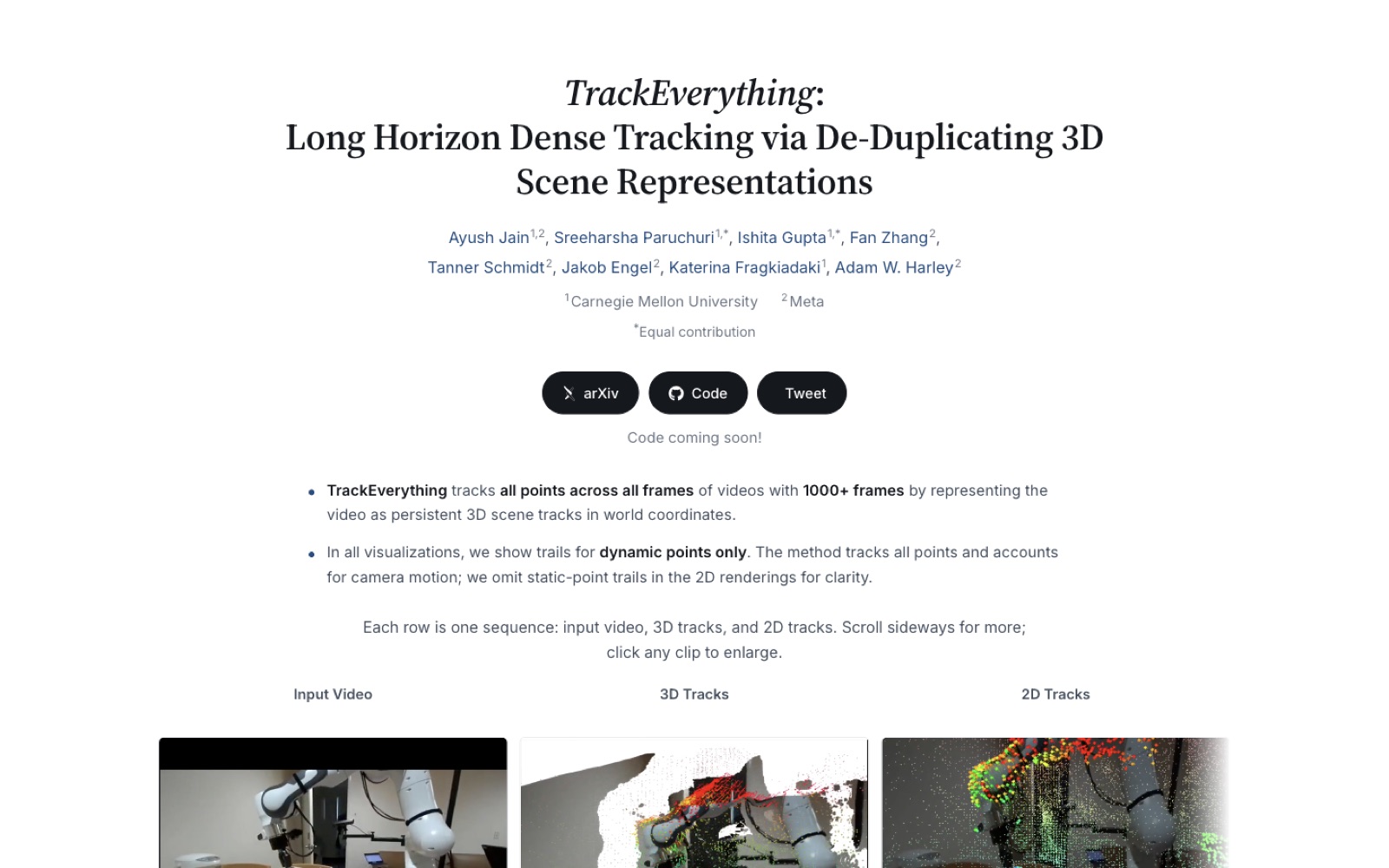
TrackEverything (introduced by Jain et al. from CMU and Meta; arXiv:2609.30222) breaks this impasse by fundamentally reframing the computational model. Long-horizon dense tracking does not need to be a video frame problem where every frame re-computes features for the same physical points over and over again. Instead, TrackEverything treats tracking as a physical scene deduplication problem: computation should scale with the unique 3D physical surface geometry of the world, not with the arbitrary frame rate or runtime duration of the camera stream.
Lifting Tracking to Persistent 3D World Coordinates
The decisive conceptual shift in TrackEverything is moving representations out of transient 2D image coordinates $(u, v)$ and anchoring them directly in metric 3D world coordinates $(X, Y, Z)$. In a standard 2D tracker, a point is merely an image-space trajectory. When an actor walks behind a pillar, a 2D model must either declare the point invisible or rely on learned visual priors to hallucinate where that pixel patch drifted behind the occluder. Once the occlusion lasts dozens of frames, those visual guesses degrade, often requiring messy re-initialization logic when the surface reappears.
By projecting 2D visual features into 3D world space using estimated camera extrinsics and monocular metric depth priors, TrackEverything gives surface points physical permanence. When a physical point on a desk or a moving actor's shoulder is observed, it enters the global scene cloud. If the camera pans away or a foreground object steps in front of it, the point does not vanish or float in 2D ambiguity. It remains anchored to its 3D world coordinate. When the camera swings back or the occluding object clears, the tracker already holds the spatial anchor in place. There is no track identity re-initialization or drift-prone correspondence re-matching.
| Tracking Paradigm | Coordinate Representation | Asymptotic Scaling | Occlusion Survival | Motion Redundancy |
|---|---|---|---|---|
| 2D Pixel Space (CoTracker, TAPIR) |
Image plane $(u, v)$ with visibility flags | $\mathcal{O}(T \times N_{\text{points}})$ memory; scales directly with frame count | Purely visual inference; loses track under sustained occlusions | Re-extracts and matches features for static pixels every frame |
| Hybrid Lifted Depth (SpatialTracker, MonST3R) |
2D track tokens + lifted monocular depth | Quadratic memory in temporal cross-attention over time | Fragmented across sub-clips; weak global coordinate memory | Evaluates spatial-temporal attention uniformly across all points |
| Persistent Metric 3D (TrackEverything) |
Persistent metric world coordinates $(X, Y, Z)$ | $\mathcal{O}(\text{Unique Surface Geometry})$; bounded by scene bounds | Metric persistence; points remain pinned at 3D world positions | Static points bypass trajectory decoding; dynamic points refined selectively |
This representation converts an intractable $\mathcal{O}(T \times H \times W)$ scaling curve into an $\mathcal{O}(\text{Unique Surface Geometry})$ bound. If a camera records a static room for 5,000 frames, a conventional tracker processes billions of pixel instances over time. In TrackEverything, once the room's physical surfaces are instantiated in 3D, new frames yield zero new physical surfaces. They simply project back into the existing point cloud, allowing the model to process sequences exceeding 1,000 frames within an operational footprint under 40 GB of VRAM.
Voxelization and Sliding-Window Boundary Fusion
Moving to persistent 3D world space solves track permanence, but it creates a secondary hazard: if every video frame continuously casts new 3D points into the world, the global point cloud will explode linearly with sequence duration. TrackEverything prevents this point bloat through an explicit sliding-window boundary fusion mechanism based on spatial voxelization.
The model ingests long video streams through overlapping temporal sliding windows. As points are lifted into 3D, multiple frames within that window observe the exact same physical patch from slightly differing perspective angles. At the boundary of each sliding window, TrackEverything runs a 3D spatial voxelization pass across the active point cloud. Points that converge within the same metric voxel cell are identified as redundant observations of the same physical surface.
stateDiagram-v2
    [*] --> InitialObservation: 2D Pixel Detected
    InitialObservation --> MetricProjection: Lift via Depth & Camera Pose
    MetricProjection --> ActiveWindowTrack: Local 3D WAFT Tracking

    state ActiveWindowTrack {
        [*] --> EndpointEvaluation
        EndpointEvaluation --> TrajectoryDecoding
    }

    ActiveWindowTrack --> VoxelFusion: Window Boundary Reached
    VoxelFusion --> PersistentAnchor: Mean-Pooling Deduplication

    PersistentAnchor --> PersistentAnchor: Continues in Frustum
    PersistentAnchor --> OccludedState: Line-of-Sight Blocked
    OccludedState --> PersistentAnchor: Surface Re-emerges

    PersistentAnchor --> FrustumCulled: Exits Camera Frustum
    FrustumCulled --> PersistentAnchor: Viewpoint Re-enters Scene
Rather than discarding duplicate observations or letting them accumulate unchecked, the model merges points occupying the same voxel cell using spatial mean-pooling. Feature descriptors and coordinate estimates within each voxel are fused into a single canonical surface anchor. This preserves high-frequency surface geometry while collapsing redundant collinear samples into a clean, bounded representation.
The lifecycle of any given surface point moves through distinct stages. A 2D pixel observation is lifted into 3D via camera extrinsics and monocular depth, entering the window's active feature set. Local correspondences are updated via 3D Windowed Attention / Flow Sampling (3D WAFT). Once the window completes, the point passes into voxelization, fusing with existing 3D surface anchors. When line-of-sight is broken by foreground objects, the point switches into an occluded state—retaining its metric position without consuming trajectory refinement compute. If camera motion causes points to drift entirely out of the active field of view, they transition to a persistent out-of-frustum cache, ready to be reactivated when the camera re-enters that physical region. Deduplication at the window boundaries keeps memory consumption strictly proportional to physical scene complexity rather than video runtime.
Decoupling Compute: Endpoints Before Trajectories
In virtually any long-form video sequence, the vast majority of visible surface mass is static background: walls, floors, pavement, stationary furniture, and distant scenery. In standard dense tracking architectures, treating every pixel uniformly means you waste massive compute cycles re-estimating trajectories for points that never moved relative to the world. TrackEverything avoids this computational trap by factoring motion into a two-stage pipeline: endpoints first, trajectories second.
flowchart TD
    A["Sliding-Window Feature Tokens"] --> B["EndPoint Refiner"]
    B --> C["Predict Window-Terminal 3D Positions"]
    C --> D{"Motion Classification"}

    D -- "Static Surface" --> E["Bypass Trajectory Refiner"]
    E --> F["Apply Rigid Camera Extrinsics<br/>T_w2c(t)"]
    F --> G["Full-Window Dense Trajectories"]

    D -- "Dynamic Surface" --> H["Dense Trajectory Refiner"]
    H --> I["Sub-Window Deformation Decoding"]
    I --> G
Rather than iteratively decoding intermediate trajectory states across every frame for all active points, the sliding window first routes tokens into the EndPoint Refiner. This module solves a coarser boundary problem: where does each 3D point end up at the final frame of the temporal window, and is its displacement explained entirely by camera ego-motion?
This prediction yields a sharp classification split between static and dynamic surface points. When a point is classified as static, it bypasses the dense Trajectory Refiner entirely. Because its coordinates remain pinned in metric world space $(X, Y, Z)$, generating its intermediate 2D trajectories across intermediate frames requires no transformer self-attention or recurrent updates. It is a closed-form geometric projection governed strictly by the camera extrinsics matrix $T_{w \to c}^{(t)}$ and calibrated intrinsics. Only the points identified as genuinely dynamic—an actor's limbs, an overtaking vehicle, a shifting tool—are passed to the dense Trajectory Refiner to solve for non-rigid deformation and non-camera motion. This compute allocation keeps the dense tracking cost proportional to the dynamic action in the scene rather than total screen resolution.
The engineering risk in this pipeline lies in the classification boundary. If an object moves slowly or creeps at sub-pixel velocities over the window duration—such as a vehicle slowly inching forward at an intersection or an actor shifting weight subtly—its endpoint residual can register below the dynamic activation threshold. The moment that happens, the model tags it as static, locks it to rigid camera extrinsics, and skips intermediate trajectory refinement. The point freezes against the background world coordinates until a subsequent window registers a displacement large enough to flip the classification state, producing noticeable visual tearing and track snapping.
3D WAFT: Replacing 4D Correlation Volumes with Local Spatial Sampling
The core computational bottleneck of modern 2D dense trackers and optical flow networks (such as RAFT) has always been the all-pairs 4D correlation volume. Calculating visual similarity between every query token and every target pixel across spatial dimensions $H \times W$ demands immense GPU memory and bandwidth, scaling quadratically with image resolution. TrackEverything discards 4D correlation volumes by introducing 3D Windowed Attention / Flow Sampling (3D WAFT), shifting correspondence matching directly into metric Euclidean space.
Because points already occupy an explicit 3D scene cloud with associated metric depth and calibrated camera views, the search space for correspondences is physically bounded. In physical reality, a point observed on a solid surface cannot teleport arbitrarily across the world within a 16-frame window. Instead of computing dense 2D feature cross-correlations over the full image plane, 3D WAFT directly samples feature embeddings within a localized 3D spatial neighborhood around each point's estimated position in the world point cloud.
This design enforces true physical locality. Cross-attention is restricted to local metric radii in 3D, keeping attention matrices compact and drastically reducing memory consumption while eliminating visual correspondence hallucinations from distant, visually similar distractors (such as identical floor tiles or repetitive wallpaper patterns). Compute scales with local geometric point density rather than screen-space pixel area squared.
However, moving from global 2D correlation volumes to localized 3D sampling introduces a distinct vulnerability: sensitivity to rapid displacement. If an object undergoes high-velocity motion—such as a swinging bat, a fast-moving hand, or an abrupt vehicle turn—the physical point can travel completely outside the bounded 3D sampling radius before the window endpoints are reconciled. The same breakdown occurs during high-velocity camera jerks or sudden rotational jitter, where upstream pose latency misplaces the sampling sphere. In a traditional 4D correlation volume, global matching can occasionally recover distant correspondences across large image displacements. Under 3D WAFT, once a point breaches its local metric sampling neighborhood, the attention mechanism has no candidates to pull from, resulting in permanent correspondence loss and track termination.
Failure Modes: Pose Drift, Sub-Voxel Jitter, and Geometric Merging
When deploying TrackEverything in production, its core architectural advantage—anchoring computation in persistent 3D world space—becomes its sharpest failure point. The model assumes an accurate, globally consistent metric coordinate frame. In real-world video, where camera poses and depth maps must be estimated on the fly via Visual Odometry (VO), Structure-from-Motion (SfM), or monocular depth models, this assumption breaks down under edge cases.
Upstream Pose/Depth Drift
         │
         ▼
Warped World Coordinates (X', Y', Z')
         │
         ▼
Voxel Grid Misalignment (Points miss target voxel)
         │
         ▼
Voxel Fusion Fails (Duplicate surfaces persist)
         │
         ▼
Point Cloud Multiplies ──► Memory Wall (< 40 GB Exceeded)
The most severe failure mode is upstream pose drift. If camera tracking suffers rotational drift during rapid pans, aggressive rolling-shutter distortion, or featureless segments (such as blank walls), the metric coordinates assigned to incoming points warp relative to the existing scene cloud. Under normal conditions, returning to a previously viewed area merges newly observed points into existing voxel anchors. But when pose estimation drifts by even a few centimeters, returning observations miss their corresponding voxel cells. Spatial deduplication fails completely: the model instantiates a duplicate set of 3D points for surfaces that already exist in memory. Over hundreds of frames of walking through an environment, the scene cloud multiplies in density, defeating the $\mathcal{O}(\text{Unique Surface Geometry})$ memory bound and triggering an out-of-memory crash.
A related geometric failure occurs at the voxel boundary itself. The uniform voxel grid requires choosing a fixed spatial resolution. If this metric threshold is set too coarse, thin or layered structures suffer irreversible geometric over-merging. Fine structures like wire fences, foliage, hair strands, and delicate clothing folds collapse together: points belonging to the foreground fence and the background wall get mean-pooled into an unphysical, floating composite anchor.
Conversely, for subtle non-rigid motions—a dynamic domain I explored when analyzing B3D: Distilling Biomechanics from Foundation Models — A Deep Dive into Architecture, Tradeoffs, and Production Realities—sub-voxel deformation creates severe tracking artifacts. When an elastic surface deforms at amplitudes smaller than the metric voxel cell width across window boundaries, mean-pooling averages out the motion, treating fine mechanical flexing or skin deformation as spatial noise and flattening high-frequency kinematic nuance. Finally, intermittent movers that pause across a window boundary risk being falsely flagged as static, locking them to rigid camera extrinsics and causing jarring trajectory snap-backs the moment dynamic movement resumes.
The Production Reality: GPU Budgets, Latency, and Pipeline Integration
Operating within under 40 GB of VRAM is a genuine technical achievement for tracking dense surfaces over 1,000+ frames, but we should be clear about what that means in an infrastructure budget. It firmly tethers the architecture to enterprise silicon—specifically NVIDIA A100 (40GB/80GB) or H100 clusters. If you attempt to serve this on consumer hardware like an RTX 4090 with 24 GB of VRAM, you will hit immediate out-of-memory exceptions unless you severely subsample query density or downscale input resolutions.
Furthermore, the sliding-window architecture is fundamentally non-causal. Because TrackEverything establishes window-terminal endpoints first and interpolates trajectories retroactively across intermediate frames, you inherit an unavoidable window-length latency. For closed-loop robotics demanding sub-30ms reaction loops, this makes in-the-loop tracking an immediate non-starter. In practice, you must decouple your pipeline: run TrackEverything as an asynchronous background worker that ingests buffered video clips, while an upstream high-rate state estimator handles low-latency control.
Deploying this system robustly requires treating the upstream geometry as fragile. I would never feed unverified monocular depth into this pipeline; it requires pairing with modern metric depth models like Depth Anything V2 or UniDepth, reinforced by visual-inertial odometry. Additionally, in open-world wandering environments where a camera explores continuously, memory scales with physical area explored. Without an active spatial eviction layer, running along several city blocks will exhaust GPU memory regardless of sequence duration.
| Failure Mode / Operational Challenge | Production Mitigation Strategy | Implementation Mechanism |
|---|---|---|
| Upstream Pose Drift | Dual-stream geometric verification | Couple visual odometry with metric foundation depth (e.g., UniDepth / DROID-SLAM); reject window updates when bundle adjustment reprojection residuals exceed metric tolerance. |
| Out-of-Frustum Point Accumulation | Frustum culling and spatial LRU eviction | Implement a spatial garbage collection worker that unloads out-of-frustum 3D point clusters once camera distance exceeds sensor range, caching them to host RAM. |
| Sub-Voxel Motion Loss | Multi-resolution octree voxelization | Replace fixed uniform metric voxel grids with an adaptive octree that retains finer spatial thresholds around high-gradient dynamic boundaries and dynamic foreground masks. |
| Static Classification False Freezing | Confidence thresholding with 2D track fallback | Compute motion classification entropy in the EndPoint Refiner; route ambiguous points (e.g., creeping velocity) through a lightweight 2D tracker like CoTracker before locking them to rigid extrinsics. |
| Pre-Release CUDA Kernel Packaging | Isolated containerized build harnesses | Containerize custom 3D WAFT sampling kernels with pinned PyTorch/CUDA compiler matrix images (e.g., CUDA 12.4, PyTorch 2.4) to isolate non-standard scatter/gather dependencies. |
Applied Blueprints: Downstream Systems to Build Today
For teams working in dynamic neural rendering and 3D asset generation—a space closely tied to modern pipeline automation that I explored in From Static Mesh to Walking Character: A Technical Operator's Manual for the 3D Vibe Coding Pipeline—dense 1,000-frame tracks unlock a Persistent Dynamic 4D Gaussian Splatting Initialization pipeline. Instead of fragmenting extended video captures into temporally disconnected 30-frame chunks, practitioners can ingest long sequences to initialize and anchor dynamic Gaussian primitives across the full capture horizon. In this architecture, TrackEverything extracts dense 3D trajectories, Depth Anything V2 establishes the initial metric scale, DROID-SLAM provides global camera pose constraints, and a Deformable 3DGS optimizer binds its Gaussian centroids directly to the persistent track anchors. The critical failure boundary to monitor is voxel mean-pooling along delicate foreground edges: if fine hair or clothing margins are collapsed into composite 3D anchors, the initialized Gaussians will cluster unnaturally, resulting in smeared, blurred rendering artifacts across dynamic motion phases.
In physical automation, the same geometric persistence enables a Long-Horizon Robotic Manipulation State Tracker that maintains workpiece state through complex assembly tasks. Operating as an asynchronous background service ingesting multi-view RGB feeds, TrackEverything monitors dense tool and workpiece surface points through severe occlusions caused by robotic grippers and human hands. While a local Extended Kalman Filter (EKF) provides high-rate kinematic state prediction for the robot controller, the tracking worker periodically feeds verified 3D surface coordinates back to correct drift, utilizing an out-of-frustum point cache to retain workpiece identities when parts are temporarily moved outside the camera view. The primary operational trap is sub-voxel motion suppression: when an assembly component undergoes slow micro-adjustments or flexible bending, the EndPoint Refiner risks classifying those subtle deformations as static scene mass, freezing workpiece coordinates until displacement crosses the dynamic activation threshold.
Finally, perception infrastructure teams can deploy an Autonomous Fleet Dynamic Obstacle Ground-Truthing Pipeline to automate offline dataset annotation from fleet drive logs. By coupling forward camera video with metric visual-inertial odometry for ego-motion compensation, the system extracts continuous 3D trajectories of moving pedestrians, cyclists, and crossing vehicles without manual point annotation. A dynamic segmentation layer isolates actor trajectories by comparing tracking residuals against the static world boundary. The critical constraint in this setup is open-world spatial accumulation: as vehicles navigate kilometers of new roadways, unmanaged 3D point creation will rapidly break the 40 GB VRAM ceiling. The ground-truthing harness must enforce aggressive spatial frustum culling, evicting trailing point clouds from active memory once the vehicle moves beyond the active sensor horizon.
Resources
Updated 2026-09-24 by Mehran Mozaffari.
Related posts
29 October 2026
How Qwen3.5-4B-3D-Coder Generates Interactive 3D Scenes Without Loading a Single Mesh
29 October 2026
How 3D OS Turns a Coding Agent into a Six-Department Animation Studio Without a GUI
26 October 2026
AudioLift and the Illusion of Rigless 3D Avatars
5 October 2026
Deconstructing Pi: Architecture, Context Compaction, and Codemode Mechanics in an Extensible Agent Harness
22 September 2026
Inside xvr: Cracking Sub-Second 2D/3D Surgical Registration with Patient-Specific Foundation Models
17 September 2026
Beyond Visual 3D: How Graph Functionalization and Hardware Snapping Fix Broken Kinematics in Simulation