
The 4B Procedural Bet: Replacing Heavy Asset Pipelines with Executable JavaScript
When evaluating 3D generation for browser-based applications, the industry default has tilted toward massive, asset-centric pipelines: multi-view diffusion models, Gaussian splatting, and feed-forward reconstruction networks that synthesize multi-megabyte binary meshes. Those systems excel at organic sculpting—rendering a photorealistic creature, bust, or weathered terrain with dense geometry. But the moment you drop those assets into an interactive web application, the operational burden shifts to bandwidth, texture streaming, and rigid scene state. You get a static blob of geometry without lighting rigs, interactive camera paths, DOM bindings, or event loops. If you want reactivity, you still have to write the harness by hand.
At the other extreme sit frontier foundation models like Claude 3.5 Sonnet or GPT-4o. They can synthesize interactive Three.js scenes on demand, but they carry a high per-generation token cost, variable network latency, and an irritating habit of inventing external URLs for binary .gltf assets that fail over CORS or 404 altogether.
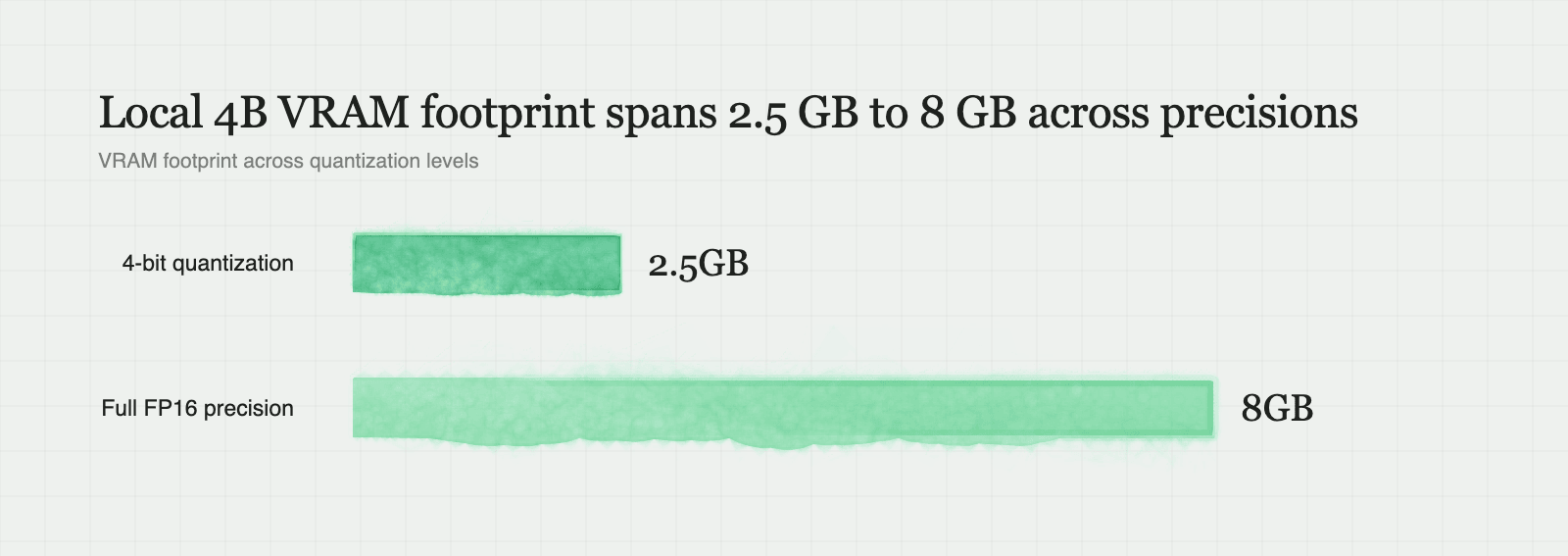
A dedicated 4-billion-parameter code specialist alters this calculus by framing 3D generation purely as programmatic scene orchestration. Rather than synthesizing binary geometry arrays or relying on cloud inference, a 4B dense transformer can run locally within a 2.5 GB to 8 GB VRAM footprint (under 4-bit quantization or full FP16 precision) and output self-contained WebGL scaffolding. Instead of fetching external textures or models across a network, the model builds scenes procedurally: assembling primitive hierarchies with THREE.Group, instancing geometries, and setting up native animation loops and camera handlers in plain JavaScript.
I see this architectural bet as a deliberate trade of organic complexity for runtime autonomy. If your product requires digital humans or scanned physical inventory, a code-synthesis model will disappoint you; asking a 4B model to generate an intricate sports car yields a crude agglomeration of boxes and cylinders. But if you need responsive, parameter-driven viewports—interactive charts, technical exploders, product configurators, or dynamic interface backdrops—generating code directly inside the browser run-loop eliminates asset pipelines entirely. Similar to the orchestration patterns I explored when looking at How 3D OS Turns a Coding Agent into a Six-Department Animation Studio Without a GUI, treating code as the primary artifact turns the browser into a deterministic compiler rather than a passive asset viewer.
Tracing Prompt to Canvas: The End-to-End Execution Pipeline
Turning an ambiguous natural language prompt into an interactive 3D canvas requires an uncompromising execution harness. Because a 4B model has limited parameter capacity compared to frontier systems, streaming unverified JavaScript tokens directly into an end-user DOM is a recipe for broken scenes, security vulnerabilities, and memory leaks. The pipeline must treat the generated program as untrusted bytecode that requires static verification, headless runtime testing, and an automated repair loop before reaching client presentation.
sequenceDiagram
    autonumber
    actor User
    participant Engine as 4B Inference Engine
    participant AST as AST Linter & Security Guard
    participant Headless as Headless WebGL Harness
    participant Client as Sandboxed Client Iframe

    User->>Engine: Prompt ("Interactive planetary orbit with raycasting")
    Engine->>AST: Stream generated JavaScript code
    alt AST Syntax or Security Violation
        AST-->>Engine: Reject: Forbidden globals or malformed tokens
        Engine->>AST: Re-stream repaired syntax
    end
    AST->>Headless: Dispatch sanitized script
    Note over Headless: Spin up Puppeteer with software WebGL
    Headless->>Headless: Mount script, check frame render & shader status
    alt WebGL Error or Blank Frame Detected
        Headless-->>Engine: Error payload (stack trace, missing disposal, blank canvas)
        Engine->>Headless: Corrective generation pass
    end
    Headless->>Client: Send verified code payload
    Client->>Client: Render scene in restricted iframe (allow-scripts)
    Client-->>User: Present interactive Three.js viewport
The flow begins when a prompt enters the local 4B inference engine, running on a continuous batching backend such as vLLM or an edge runner. The model synthesizes an ES-module Three.js snippet, setting up a camera, renderer, scene graph, and event handlers. Instead of passing these tokens to the client, the stream routes immediately into a static AST parser built on Acorn or Babel.
This stage serves a double duty: security isolation and dependency enforcement. The AST validator strips out illegal browser APIs like fetch, localStorage, window.parent, or dynamic eval calls, ensuring the script cannot attempt cross-origin data extraction. Simultaneously, it inspects import statements to ensure the code references only supported, pinned Three.js distribution builds rather than hallucinated external CDNs.
Once the code passes static inspection, the pipeline spins up a headless browser instance via Puppeteer configured with software-rasterized WebGL flags (--use-gl=angle). The headless harness injects the script into a virtual canvas, monitoring the browser console for runtime exceptions, shader compilation failures, and WebGL warnings. Crucially, the harness reads the frame buffer after a designated tick window to verify that depth testing passed and the canvas is not simply outputting a clear-color blank frame.
If a runtime exception occurs—such as a misplaced matrix multiplication or an unlinked uniform in a custom shader—the harness captures the exact stack trace and routes it back into the 4B model as a targeted repair pass. Because the context remains warm, the model corrects the syntax or coordinate reference within a single fast corrective turn. Only after the headless environment verifies zero console faults and confirms pixel rasterization does the payload travel to the client, where it mounts inside an uncredentialed <iframe> sandboxed with restrictive permissions.
The Three Structural Pillars: Scene Graphs, Shaders, and Memory Boundaries
Making 4B-driven WebGL generation robust in production requires understanding how the model manages three foundational architectural pillars: hierarchical scene graphs, custom shaders, and strict GPU resource lifecycles.
First, spatial reasoning in a 4B parameter model is inherently fragile. Without the deep attention capacity of larger architectures, small models easily lose track of relative coordinate frames if forced to manage arbitrary free-floating meshes. To generate cohesive scenes, the model relies on hierarchical grouping via THREE.Group. By nesting procedural primitives (BoxGeometry, CylinderGeometry, ExtrudeGeometry) inside parent coordinate nodes, local transformations remain bounded. A robotic arm or an orbital system retains its geometric integrity because translations and rotations propagate down the hierarchy, preventing floating geometry and inverted normals.
Second, because the model cannot rely on external bitmap textures or pre-baked normal maps without risking network failures, visual complexity is driven by procedural GLSL shaders. The model synthesizes fragment shaders that compute surface noise, gradients, and fresnel effects mathematically within standard materials or custom ShaderMaterial passes. Fine-tuning on WebGL patterns allows the 4B model to write deterministic mathematical surfaces directly into GPU vertex and fragment pipelines, bypassing image decoders entirely.
Third, and most critical for production stability, is the memory boundary. Standard web development relies on JavaScript's garbage collector, but the browser garbage collector has no direct control over memory allocated on the graphics card. Every mesh created in Three.js allocates GPU resources that persist until explicitly unlinked.
When users iteratively modify a scene through subsequent prompts, a naive code generator simply removes the mesh from the scene graph via scene.remove(mesh) and instantiates a new one. In WebGL, this leaves the underlying Vertex Buffer Objects and shader programs orphaned in VRAM. Without an explicit teardown harness, the client will inevitably trigger a context loss crash.
The structural difference between a specialist 4B model and a generalist frontier LLM lies in training alignment. While generalist models optimize purely for lexical fluency, a domain-specialized code model trained with execution feedback learns to couple creation logic with lifecycle cleanup, hoisting transient vector instantiations out of requestAnimationFrame loops to prevent garbage collection pauses.
| Runtime Component | Execution Environment | Primary Responsibilities | Operational Failure Boundaries |
|---|---|---|---|
| Inference Engine | Local GPU / Edge Node (vLLM / FP16) | Synthesize Three.js code, procedural primitives, and event loops | Context exhaustion, coordinate hallucinations, geometry clipping |
| AST Validator | Server-side Node.js / Edge Worker | Enforce import pinning, strip forbidden globals, lint syntax | Malformed AST trees, undetected dynamic property lookups |
| Headless Render Harness | Containerized Puppeteer / WebGL | Execute canvas mount, verify draw calls, detect shader faults | Software-rasterizer timeouts, headless WebGL context crashes |
| Sandboxed Viewer | Client Browser <iframe> |
Render interactive viewport, handle pointer/raycast events | Cross-origin frame violations, DOM layout dimension mismatches |
| GPU Lifecycle Janitor | Client-side Three.js Runtime | Track VBOs, invoke .dispose() on geometries and materials |
Unfreed texture allocations, unhandled webglcontextlost events |
Stress-Testing Spatial Reasoning: Where 4B Geometry Breaks Down
The pitch for a 4B parameter specialized 3D code model promises autonomous generation of interactive WebGL viewports on edge hardware, but pushing past trivial demos exposes severe geometric boundaries. While the architecture reliably outputs flat primitive arrangements—a grid of cubes, a pedestal holding a sphere, or a parameterized cylinder array—it exhibits catastrophic spatial drift the moment a prompt demands multi-tiered hierarchical transformations or bespoke topological continuity. A 4B dense transformer simply lacks the internal parametric capacity to maintain an accurate three-dimensional mental coordinate space across complex matrix stacks.
In practice, conducting a Failure Mode and Effects Analysis across typical generation tasks surfaces three primary structural breakdowns:
First, nested scene graph transformations accumulate compound positioning errors. When assembling multi-part mechanisms that require nesting multiple THREE.Group instances, the model regularly loses track of relative coordinate offsets. Rotations and translations applied at the child level fail to compensate for parent coordinate pivots, causing discrete components to clip through each other or float detached from their structural anchors.
Second, custom procedural geometry triggers normal inversions and culling defects. When directed away from stock Three.js primitives and asked to construct indexed surfaces using THREE.BufferGeometry, the model routinely miscalculates vertex winding orders. Back-face culling instantly renders entire surfaces invisible from the intended camera angle, or worse, flips normal vectors inward so that standard PBR lighting passes produce pitch-black artifacts across the mesh.
Third, interaction logic collapses due to spatial coordinate space mismatches during mouse picking.
To establish an outside check against these failure modes, I rely on a automated verification harness driven by a ten-prompt Puppeteer suite. The harness tests the model across ten escalating spatial scenarios—ranging from a single illuminated prism to a six-part articulable mechanical linkage. For every generated scene, the headless runner computes the axis-aligned bounding boxes of all rendered meshes to calculate spatial overlap ratios, flagging unintended geometric intersections. Concurrently, the test reads the WebGL draw buffer across multiple camera orbits to measure the blank-canvas pixel ratio. If more than eighty percent of pixels remain clear color or bounding boxes exhibit intersection volumes above nominal joint tolerances, the generation run is immediately failed and routed to corrective prompting.
Hardening the WebGL Runtime: Context Loss, Render Throttling, and Script Sandboxing
Executing raw JavaScript synthesized by a local model directly inside a user's browser introduces runtime hazards that standard software boundaries fail to catch. WebGL does not run in a forgiving sandbox; it operates directly against system graphics drivers via an imperative C-style state machine. If an application deploys generated Three.js code without strict wrapping, it faces immediate operational vulnerabilities: driver context crashes, runaway GPU battery drain, and client-side code injection.
stateDiagram-v2
    [*] --> InitialAllocation
    InitialAllocation --> GPU_VBO_Upload: Compile Shaders & Buffer Data
    GPU_VBO_Upload --> ActiveRenderLoop: Initialize requestAnimationFrame
    ActiveRenderLoop --> ContextLostEvent: Unbounded Allocations / VRAM Exhaustion
    ContextLostEvent --> CleanDisposal: Trigger webglcontextrestored handler
    ActiveRenderLoop --> CleanDisposal: User Navigation / Teardown Call
    CleanDisposal --> [*]: Release Geometries & Materials
Beyond catastrophic context loss, the most pervasive runtime issue is the ubiquitous unbounded requestAnimationFrame loop. The model defaults to generating continuous rendering cycles that run at maximum display refresh rates regardless of whether the scene geometry has changed. On laptop and mobile hardware, this causes immediate thermal throttling and battery drain. Hardening the runtime requires stripping the model's generated loop and injecting an on-demand rendering controller that invalidates the viewport only when orbit controls detect camera displacement, an animation tween is active, or a user interaction event triggers a raycast update.
Simultaneously, the execution environment must protect against script injection. Because the model outputs raw executable code, allowing unvalidated scripts into the host DOM risks cross-site scripting vulnerabilities. The host application must isolate code execution inside an <iframe> configured strictly with sandbox="allow-scripts", explicitly omitting allow-same-origin to block access to host cookies, session tokens, and local storage. Before mounting, an AST sanitization step inspects the code tree to reject references to external network primitives, dynamic module evaluation, or attempts to reach window.parent.
Production Blueprints: Integrating 4B Three.js Generation into Applied Stacks
Deploying a 4B Three.js generator into production demands architectures that leverage edge execution while establishing uncompromising boundaries around geometry validity and runtime efficiency. Rather than treating the model as an all-purpose 3D creator, production topologies succeed by assigning it specific orchestration responsibilities within controlled environments.
For desktop engineering applications, builders can implement a Local-First Procedural CAD & Assembly Visualizer. This architecture packages a quantized 4B weights file running locally through Ollama or llama.cpp directly inside an Electron container, bypassing external API calls entirely. When an operator inputs a natural language prompt specifying a mechanical fixture, the engine synthesizes procedural Three.js primitives joined by constructive solid geometry boolean libraries. A client-side AST filter verifies the syntax before passing the assembly to an OrbitControls inspection viewport. When adopting this pattern, teams must watch for hierarchy transformation drift across nested machine parts and inverted face normals on custom CSG boolean geometries, enforcing automated bounding-box clearance checks before presenting the assembly to the operator.
In enterprise web platforms, teams can construct a Dynamic In-Browser Data Landscape Generator that acts as a real-time analytics copilot. Here, an edge-hosted vLLM inference server receives multi-dimensional query payloads and generates Three.js scripts that map complex metrics into spatial coordinate planes, procedural terrain heightmaps, and relational scatter plots. The generated code runs inside an uncredentialed, sandboxed iframe receiving JSON records via cross-document messaging. The primary failure mode to guard against is the sudden memory spike caused by uninstanced geometry allocations when rendering datasets exceeding 10,000 entities; the system harness must enforce THREE.InstancedMesh usage patterns to ensure rendering overhead remains confined to a single draw call.
Finally, consumer applications can implement an Interactive 3D Web UI Scene Coordinator to author dynamic landing page viewports that respond to mouse paths and page scroll progress. A fine-tuned 4B model synthesizes hero-section scene graphs featuring procedural canvas textures and ambient lighting setups. Every candidate script passes through a headless Puppeteer validation harness with pixel-readback checks to confirm valid geometry rasterization before staging. Production teams rolling out this pattern must guard against battery drain and mobile GPU throttling from continuous render loops that fail to pause when the canvas leaves the active viewport, mandating an Intersection Observer wrapper that unbinds the render pass whenever the element scrolls out of view.
Resources
(no official sources were available to link)
Updated 2026-10-29 by Mehran Mozaffari.
Related posts
29 October 2026
How 3D OS Turns a Coding Agent into a Six-Department Animation Studio Without a GUI
26 October 2026
AudioLift and the Illusion of Rigless 3D Avatars
5 October 2026
Deconstructing Pi: Architecture, Context Compaction, and Codemode Mechanics in an Extensible Agent Harness
24 September 2026
Dense 3D Tracking Across Thousand-Frame Horizons: An Operator's Breakdown of TrackEverything
22 September 2026
Inside xvr: Cracking Sub-Second 2D/3D Surgical Registration with Patient-Specific Foundation Models
17 September 2026
Beyond Visual 3D: How Graph Functionalization and Hardware Snapping Fix Broken Kinematics in Simulation