
The Multi-Speaker Coordination Problem in Sub-Second Voice
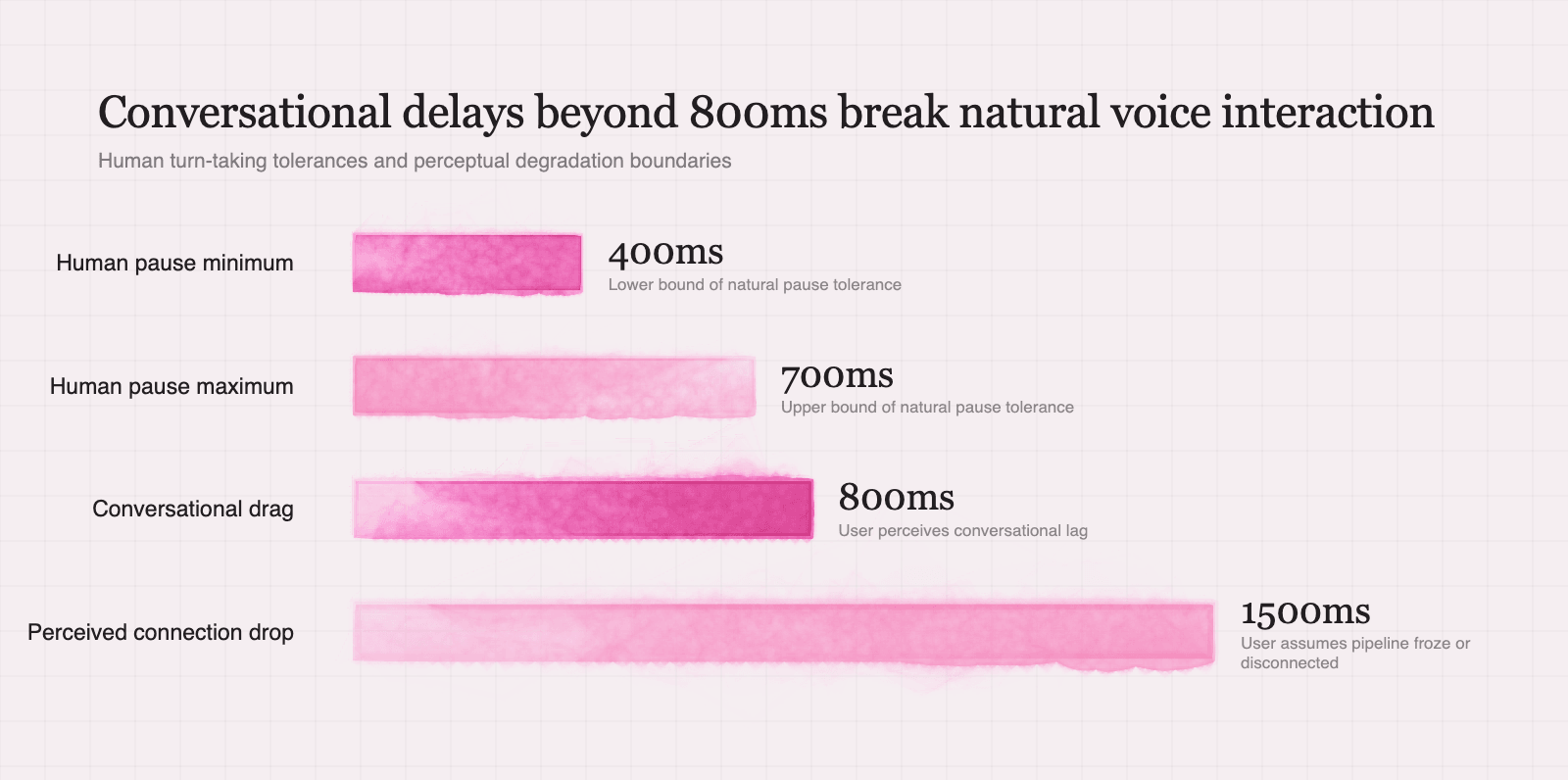
In standard 1:1 voice architectures, conversational turn-taking is essentially a binary state machine: either the human speaks or the model speaks. Voice Activity Detection (VAD) coupled with end-of-speech silence thresholds (typically 250ms to 500ms) governs when the pipeline shifts into synthesis. The timing constraints here are unforgiving. Human conversation operates on an inter-turn pause tolerance between 400ms and 700ms. If an agent takes longer than 800ms to begin responding, the user perceives conversational drag; push past 1500ms, and they assume the connection dropped or the pipeline froze.
When you transition from a single voice agent to an $N+1$ multi-character room—such as six distinct autonomous personas interacting with a human participant—that clean binary state collapses into an $N+1$ floor arbitration bottleneck. Who holds conversational rights? Who yields? Who interjects?
If you approach this using standard text-first multi-agent orchestration paradigms—the way frameworks like AutoGen, CrewAI, or centralized LLM director agents handle group conversation—you hit a wall of latency arithmetic. A typical director LLM must ingest the latest transcript chunk, run attention across the conversational history, deliberate on speaker relevance, and emit a structured tool call or name token indicating who should take the floor. That deliberation loop alone incurs 1200ms to 2000ms over modern frontier inference endpoints. Add upstream Speech-to-Text (STT) finalization (200ms to 400ms), network transit, and downstream Time-to-First-Byte (TTFB) for Text-to-Speech (TTS) synthesis (150ms to 300ms), and the round-trip turn handoff blows out to 1800ms–3200ms. In speech, three seconds of silence is an eternity of dead air. The cadence feels less like fluid room banter and more like a stilted satellite uplink.
sequenceDiagram
    autonumber
    actor User as Human Speaker
    participant STT as Streaming STT
    participant Arb as LLM Director Deliberation
    participant Agent as Selected Character Worker
    participant TTS as Voice Synthesis Engine

    rect rgb(240, 240, 240)
    note over User, TTS: Typical Human Turn Transition: 400ms - 700ms Pause
    end

    User->>STT: "What do you all think about that strategy?"
    STT-->>Arb: Finalized Transcript (300ms)

    rect rgb(255, 230, 230)
    note over Arb: Dead Air / Deliberation Bottleneck (1200ms - 2000ms)
    Arb->>Arb: Evaluate 6 persona prompts & context history
    Arb->>Agent: Assign floor ownership token
    end

    Agent->>Agent: Character LLM Prompt Generation (400ms TTFT)
    Agent->>TTS: Stream first audio tokens
    TTS-->>User: Synthesized audio stream (1800ms - 3200ms total latency)
The In-Process Runtime: Chaining Six PipelineWorkers on an AsyncQueueBus
Solving multi-speaker coordination without blowing the latency budget requires reconsidering process topology. The conventional instinct in real-time media infrastructure—one I previously explored when analyzing Engineering Voice Agents Beyond the Webhook: A Deep Dive into LiveKit Agents and WebRTC Media Infrastructure—is to treat each agent as an independent room participant. In that distributed model, each character runs as a separate container or process, establishing its own WebRTC peer connection, negotiating media tracks via a Selective Forwarding Unit (SFU), and subscribing to remote audio.
While distributed isolation simplifies process sandboxing, it carries punishing operational and latency overhead when scaled to six concurrent characters. Each participant container duplicates audio encoding, network serialization, and independent STT pipelines. More critically, state coordination across distributed containers requires network-bound pub/sub or data-channel messaging, turning floor arbitration into a distributed systems problem where micro-delays create race conditions on who starts streaming audio first.
The architecture built by Jon Taylor takes the opposite tack: compressing all six character workers into a single asynchronous Python runtime built on Daily's Pipecat framework. Pipecat's core abstraction is a bidirectional, frame-based processing pipeline. Streams of raw audio frames, transcription frames, and control messages flow sequentially through chained frame processors (BaseWorker / PipelineWorker).
Instead of isolating workers across network boundaries, this design connects six concurrent PipelineWorker instances using an in-memory AsyncQueueBus. Every worker operates as a lightweight async task within the same event loop. When incoming audio from the human user hits the transport layer—whether over WebRTC or bridged via telephony like SIP—a single shared STT processor transcribes the stream once and broadcasts TextFrame events across the internal queue bus to all six workers simultaneously.
Because workers share the runtime heap, memory serialization and network transit drop to zero. Each worker maintains its own isolated LLM persona prompt, conversational state, and TTS streaming client configuration (such as distinct voice identities from Cartesia or ElevenLabs). Output audio frames from whichever worker holds floor ownership flow back into a shared pipeline mixer, multiplexing the selected stream down to the transport sink.
The operational tradeoff of this single-process model is acute Python event loop discipline. Running six concurrent streaming pipelines means handling audio chunking, JSON decoding, and network I/O across a dozen simultaneous WebSockets within one process. Any blocking CPU work—such as audio resampling or regex filtering executed directly on the main thread—risks freezing the asyncio loop for 20ms or more. In real-time audio, a 20ms stall empties the outbound jitter buffer, causing audible clicks and packet loss concealment. But if compute-heavy tasks are properly isolated or offloaded to C-extensions, the in-process queue bus achieves coordination speeds that distributed architectures simply cannot match.
Tiered Gating Mechanics: Replacing LLM Deliberation with Jev's Sub-100ms Adjudication
The central unlock that makes this in-process multi-worker architecture viable is the decoupling of conversational reflexes from token generation. Human conversation does not wait for a full semantic thesis before deciding to speak; people register turn transitions, pauses, and rhetorical questions almost reflexively, claiming the floor within a couple hundred milliseconds and generating their precise words on the fly.
In Jon Taylor's pipeline, that reflexive "System 1" layer is handled by Jev, an ultra-fast classification model built by TypeSafe AI, rather than a frontier LLM. While deep inference engines like Claude 3.5 Sonnet or local Llama instances serve as the "System 2" generation engines for each character worker, Jev sits directly on the incoming transcript stream to arbitrate turn-taking in under 100 milliseconds.
When a transcript chunk or pause boundary arrives over the AsyncQueueBus, Jev evaluates the conversational state against the persona profiles. Instead of prompting an LLM to generate reasoned conversational delegation, Jev performs rapid structured classification: Did the user address a specific character? Was a question left open? Does Character A have relevant context to interject?
Because Jev completes classification in tens of milliseconds, floor ownership can be adjudicated almost instantaneously. If Jev assigns floor ownership to Character 2, the pipeline issues an immediate ownership grant to that specific worker, while dispatching yield commands to the other five. Character 2 then initiates its LLM streaming call and subsequent TTS synthesis without contending with peer collisions.
Crucially, this tiered approach prevents runaway inference costs. If all six workers queried a frontier model on every human pause to evaluate whether to speak, API token usage and latency would multiply sixfold. By gating generation behind a sub-100ms classifier, only the winning worker invokes its heavy generation engine. Furthermore, if the user resumes speaking while an agent is mid-utterance, the bus immediately broadcasts an atomic interruption event, clearing the active worker's pipeline buffer and reverting all workers back to listening mode before expensive tokens accumulate.
stateDiagram-v2
    [*] --> Listening

    Listening --> Contending : User speech pause or turn completion
    Contending --> Speaking : Jev grants floor ownership (<100ms)
    Contending --> Yielding : Jev routes turn to peer worker

    Speaking --> Listening : User barge-in / Cancel frame emitted
    Speaking --> Yielding : Utterance completed

    Yielding --> Listening : Floor cleared / Bus state reset
Architectural Tradeoffs: Single-Process Pipecat Workers vs. Distributed Rooms and Native Audio Models
When architecting multi-voice environments, you face a trilemma between turn latency, persona autonomy, and operational complexity. The in-process Pipecat and Jev design occupies a deliberate sweet spot, but understanding its boundaries requires comparing it with three contrasting production paradigms.
| Orchestration Paradigm | Turn Handoff Latency | Persona Autonomy & State Isolation | Infrastructure Footprint | Primary Failure Mode |
|---|---|---|---|---|
| In-Process Multi-Worker (Pipecat + Jev) | Low (400ms–800ms) | High (isolated prompts, private tools, distinct TTS profiles) | Minimal (single process, shared STT, shared media pipeline) | Local asyncio event loop starvation; classifier routing misfires |
| Distributed Room Participants (LiveKit) | Moderate (800ms–1500ms) | Complete (fully sandboxed containers/processes) | Heavy (N WebRTC peers, redundant STT instances, SFU routing) | Distributed state race conditions; network-induced dead air |
| Hierarchical Central Director (Vocode / LangGraph) | High (1500ms–3500ms) | Moderate (orchestrator coordinates sub-agents via tools) | Moderate (centralized coordinator plus worker pools) | Sequential LLM deliberation latency stalls conversation |
| Native Audio Foundation Models (OpenAI Realtime / Gemini Live) | Ultra-Low (300ms–600ms) | Low (single unified context window, simulated multi-voice tags) | Minimal (managed cloud duplex WebSocket) | Context bleed between personas; inability to maintain private tool stores |
The distributed multi-participant approach treats every character as an independent peer joining a WebRTC Selective Forwarding Unit (SFU). This guarantees process sandboxing: an unhandled exception or memory leak in Character 4 cannot kill the room. However, this isolation comes at severe infrastructural expense. Running six autonomous containers per room means paying for six independent WebRTC peer connections, six redundant audio decode/encode pipelines, and distributed coordination across an external pub/sub fabric. The resulting network serialization invariably pushes turn-taking latency past the 800ms threshold of natural speech.
At the opposite extreme, native speech-to-speech foundation models achieve unrivaled conversational velocity by collapsing transcription, inference, and synthesis into an end-to-end neural path. But they stumble on genuine multi-agent autonomy. Simulating multiple personas inside a single foundation model prompt forces all characters to share one context window. You cannot grant Character A a private vector database while preventing Character B from observing those retrieved chunks without leaky prompt-gymnastics.
The hierarchical central director model—popular in text-first architectures—fails in production voice because of sequential tool calling. Running an orchestrator LLM to deliberate on room context before delegating the floor introduces insurmountable latency overhead.
By running six PipelineWorker instances inside a single Pipecat process, you eliminate inter-process network hops and retain full persona heterogeneity. Each worker can couple a distinct inference backend with custom retrieval stores and unique TTS profiles—such as streaming Cartesia voices for snappy banter or ElevenLabs for expressive delivery. The price you pay is operational density: instead of offloading concurrency to Kubernetes or an SFU, your application runtime must manage audio frame synchronization, lock contention, and event loop hygiene directly in memory.
Runtime Failure Modes: Python Event Loop Starvation, Audio Underruns, and Mixer Collisions
Packing six real-time streaming agents into a single Python process exposes brittle runtime failure modes that do not exist in traditional 1:1 voice pipelines. In real-time audio, timing budgets are absolute. If your pipeline commits to 20ms audio frames, delivering a frame at 23ms is functionally indistinguishable from a total connection drop.
flowchart TD
    subgraph Ingest ["Shared Ingest"]
        InAudio["Raw 48kHz Mic PCM"] --> STT["Shared Streaming STT"]
        STT -->|"TextFrame Broadcast"| Bus["AsyncQueueBus"]
    end

    subgraph Arbitration ["Reflexive Floor Arbitration"]
        Bus --> Jev["Jev Classifier Gate"]
        Jev -->|"Routing Race Window"| Lock{"Floor Mutex"}
    end

    subgraph WorkerTier ["Concurrent PipelineWorkers"]
        Lock -->|"Token Granted"| W1["Worker 1 (LLM + TTS)"]
        Lock -->|"Token Granted (Collision)"| W2["Worker 2 (LLM + TTS)"]
        W1 --> Block1["Local Resampling / Regex Parsing"]
        Block1 -.->|"Blocks Event Loop >20ms"| LoopFreeze["Asyncio Loop Starvation"]
    end

    subgraph Egress ["Outbound Transport"]
        W1 --> Mix["Shared Audio Frame Mixer"]
        W2 --> Mix
        Mix -->|"Uncoordinated Superposition"| OutBuffer["Jitter Buffer"]
        LoopFreeze -.->|"Empty Buffer"| Underrun["Audio Buffer Underrun (Clicks / PLC Drops)"]
        OutBuffer --> Sink["WebRTC / SIP Downstream"]
    end

    classDef danger fill:#fee2e2,stroke:#ef4444,stroke-width:2px;
    class LoopFreeze,Underrun,Mix danger;
The most frequent source of audio degradation is asyncio event loop starvation. While external network requests to inference and synthesis APIs use non-blocking WebSockets, local frame manipulation runs on the application thread. In a six-worker topology, minor synchronous operations rapidly aggregate. If Worker 1 performs dynamic sample rate conversion—such as downsampling 48kHz WebRTC audio to 8kHz mono PCM for a SIP telephony bridge—or executes heavy regular expression chunking across streaming token buffers, it monopolizes the main thread for 10ms to 30ms.
Because all six workers share a single Python runtime, any main-thread CPU spike halts the entire pipeline. The outbound jitter buffer empties within milliseconds, forcing downstream WebRTC clients into Packet Loss Concealment (PLC) and producing robotic distortion, crackles, and stutter. To survive production, all audio transcoding, PCM downmixing, and text sanitization must be strictly isolated to native C-extensions or delegated to a background thread pool.
The second critical failure point is the classification race window. Jev operates on rapid transcript updates. If the human pauses mid-sentence, Jev evaluates the partial transcript across all worker profiles. If the decision boundaries between two characters overlap—for instance, when a general question could apply equally to two technical personas—both workers may register an activation response within the same scheduling cycle.
Without an atomic, non-blocking floor mutex, both workers initiate generation simultaneously. As their TTS streams stream frames into the shared pipeline mixer, uncoordinated downmixing occurs. The client receives two voices superimposed on the same audio channel, creating perceptual cacophony. If both workers subsequently detect the collision and attempt to yield at once, the system enters a "stutter-start" loop: simultaneous speech followed by dead air, repeated until one worker forcibly drops its pipeline state.
A robust implementation requires a leasing floor manager. When Jev triggers a handoff, the winning worker must acquire an exclusive, time-bounded ownership token before emitting synthesis chunks, while the bus broadcasts suppression frames to drain in-flight buffers across all idle peers.
Telephony and Egress Realities: Managing Twelve WebSockets and Downmixed Mono Audio
Moving an ensemble voice architecture from a local prototype to a production cluster reveals an aggressive connection multiplier at the transport boundary. In a traditional 1:1 voice setup, an agent typically manages two persistent streams: one inbound STT connection and one outbound TTS connection, with the LLM invoked over either HTTP streaming or an async WebSocket. When six PipelineWorker instances share a single session, the math scales drastically.
Even with a consolidated STT ingest where inbound human audio is transcribed once and broadcast internally, each of the six workers must maintain independent egress paths. If every character persona runs an isolated generation loop paired with a low-latency voice synthesis provider like Cartesia or ElevenLabs, a single conversation session sustains between 12 and 18 concurrent duplex WebSockets. Scale that to a modest deployment of 100 concurrent user sessions, and your orchestrator pool is suddenly juggling 1,200 to 1,800 active, bidirectional real-time audio and text sockets. File descriptor limits, TLS handshake churn, and TCP keep-alive management become immediate operational concerns. A network blip or socket drop on Worker 4 cannot be allowed to throw an unhandled exception that tears down the shared AsyncQueueBus for the entire room.
Individual Room Ingress & Egress Sockets (6 Workers):
Ingress:   [Shared Mic Stream] ──> 1x Inbound STT WebSocket
Workers:   6x Streaming LLM Sockets + 6x Duplex TTS Sockets
Total:     13 to 19 Active Persistent WebSockets per Conversation Session
The acoustic problem becomes even more acute when terminating these sessions onto traditional telephone networks via SIP or RTP trunks (using providers like Twilio or Telnyx). Over WebRTC, a client can theoretically receive multi-channel audio tracks, allowing the client-side audio engine to position distinct character voices across a stereo soundstage. Telephony strips away that spatial crutch entirely. SIP trunking forces downstream audio into an 8kHz G.711 mono channel (or 16kHz with G.722 wideband).
When six autonomous voices are downmixed into a flat, single-channel mono stream, cognitive clarity degrades rapidly. If two agents speak with similar pitch contours or timbral profiles, the human ear struggles to separate them without visual cues or spatial separation. Furthermore, any gain accumulation during rapid speaker handoffs or brief vocal collisions clips the narrow dynamic range of telephony codecs, introducing harsh digital distortion. Operating multi-agent ensembles over telephone lines requires continuous dynamic gain ducking at the pipeline mixer: the moment an outbound audio frame from the designated speaker enters the transport sink, the mixer must aggressively attenuate the gain floor of all other pipeline buffers down to absolute silence.
Production Patterns and Architectural Safeguards for Autonomous Voice Ensembles
Hardenng an in-process ensemble voice pipeline requires four defensive mechanisms: leased floor tokens, thread-isolated audio dispatch, atomic cancellation broadcasts, and strict synthetic loopback filtration.
First, conversational ownership must be protected by a leased mutex token rather than open queue competition. When Jev’s classifier selects a worker, that worker must acquire a time-bounded floor lease from a central in-process coordinator before emitting TTS synthesis chunks. If the worker's LLM generation stalls, the lease automatically expires after a configurable ceiling (such as 3500ms), preventing a deadlocked worker from muting the room.
Second, the core asyncio event loop must do nothing except route lightweight frames. Heavy operations—such as resampling 48kHz audio to 8kHz PCM, applying dynamic range compression, or running regex sanitization over streaming LLM tokens—must run inside dedicated C-extensions or background worker threads. Freezing the event loop for even 20ms starves the outbound RTP buffer and introduces immediate audio clicks.
Third, user interruptions require atomic pipeline flushes. When upstream VAD detects human speech while an agent holds the floor, the system must immediately broadcast a high-priority CancelFrame across the AsyncQueueBus. This frame instructs the active worker to drop its current LLM generation task, tells the TTS client to sever its current synthesis buffer, and clears the transport mixer’s pending queue within single-digit milliseconds.
Finally, you must implement synthetic audio loopback filtration. In a shared room, the STT engine can easily ingest an agent's synthesized voice from an acoustic echo and interpret it as incoming human speech. Every synthetic audio frame flowing into the outbound mixer must be stamped with a session-level generation ID and filtered out of the STT pipeline, preventing agents from conversing with their own echoes in hallucinated conversational spirals.
flowchart LR
    HumanVAD["Human VAD Trigger"] -->|"Interrupt Detected"| Bus["AsyncQueueBus"]
    Bus -->|"Broadcast CancelFrame"| TokenMgr["Leased Floor Manager"]
    Bus -->|"Broadcast CancelFrame"| W1["Worker 1 (Active)"]
    Bus -->|"Broadcast CancelFrame"| Mixer["Shared Audio Mixer"]

    TokenMgr -->|"Revoke Lease"| Lock[("Floor Mutex")]
    W1 -->|"Abort LLM & Sever TTS"| Drop["Flush In-Flight Buffers"]
    Mixer -->|"Drop Outbound Frames"| Clear["Clear Jitter Buffer"]
These safeguards unlock compelling production patterns for multi-voice environments. For instance, teams can build an Interactive Multi-Specialist Technical Panel, where three distinct specialist agents—a database architect, a security auditor, and an infrastructure lead—autonomously debate engineering trade-offs with a human engineer over Daily WebRTC. By pairing Pipecat workers with distinct Cartesia voice profiles and adjudicating turns through Jev, the panel feels like an authentic technical design review. The core failure mode to guard against here is circular agreement: without tight negative constraints in their persona prompts, autonomous specialists easily spend hundreds of tokens politely agreeing with one another instead of pushing the debate forward.
Similarly, developers can deploy a Multi-Character Roleplay Simulation on SIP Telephony, creating realistic conflict resolution training where two AI characters with opposing goals negotiate with a human trainee over a standard telephone call. Routing this through a SIP trunk with Deepgram STT demands aggressive dynamic audio ducking on the mono mixer to prevent severe vocal overlap distortion on the narrow 8kHz channel.
Another high-leverage application is an Autonomous Executive Briefing with Dedicated Fact-Checker, where a primary presenter worker streams continuous project status updates while an autonomous background auditor monitors the transcript. The auditor runs a heavy retrieval model and uses Jev to interrupt the presenter only when factual discrepancies occur. Here, the critical engineering constraint is interruption latency: if the cancellation broadcast and auditor interjection take longer than 600ms, the fact-checker ends up correcting a slide or statement long after the presenter has moved on.
Resources
(no official sources were available to link)
Updated 2026-10-03 by Mehran Mozaffari.
Related posts
25 October 2026
Why Ming-3.0-tts Couples a Tiny Language Model to Diffusion for 44.1 kHz Speech
15 October 2026
Beyond Silence Timers: Dissecting TYGER and the Mechanics of Full-Duplex Voice Turn-Taking
3 October 2026
Engineering Voice Agents Beyond the Webhook: A Deep Dive into LiveKit Agents and WebRTC Media Infrastructure
22 September 2026
Gemini 3.8 Flash TTS: A Practitioner's Deep Dive into the Prompt-Directed Voice Engine
22 September 2026
Audio8 ASR Infinite: What It Actually Takes to Listen Forever
12 September 2026
Reverse-Engineering the Local TTS Evaluation Stack: What 'Just Run It on Colab' Actually Buys You