
The Hybrid Bet: What Ming-3.0-tts Actually Delivers at 0.5B
Ming-3.0-tts-0.5B is an MIT-licensed speech synthesis system developed by Ant Group under the inclusionAI organization, combining an Alibaba Cloud Qwen2.5 causal language model backbone with a continuous Diffusion Transformer (DiT) acoustic head. Operating in the sub-billion parameter category, it directly targets the core architectural tension in modern neural voice generation: choosing between discrete codec models and pure non-autoregressive flow matchers. Discrete token architectures like Bark or early VALL-E derivatives rely on residual vector quantization (RVQ) codebooks, which frequently degrade into phase buzz, token repetition, and codebook collapse over long generations. Conversely, pure continuous systems like F5-TTS ditch discrete codebooks entirely for fast flow matching, but because they lack a causal language model core, they cannot interpret arbitrary natural-language system instructions or multi-turn prompt directives. Ming-3.0-tts establishes a middle path: it uses a 0.5B dense language model to interpret context, style, and paralinguistic cues, and hands those contextual states to a DiT head that generates continuous acoustic features.

In my evaluations of production speech pipelines, the most consequential design choice here is the native 44.1 kHz output sampling rate. Most open-source conversational speech weights—including CosyVoice, ChatTTS, and F5-TTS—standardize on 22.05 kHz or 24 kHz to keep latent sequence lengths short and inference fast. That 24 kHz ceiling enforces a strict 12 kHz Nyquist cutoff, discarding the upper acoustic spectrum where delicate fricatives, breathiness, whisper textures, and sharp laugh bursts reside. Ming-3.0-tts avoids that muffled, compressed quality by computing latents tuned for full studio bandwidth. This high-frequency fidelity matters because the model explicitly exposes 14 inline paralinguistic tags (such as breaths, laughs, sighs, and hesitations) alongside free-form persona prompts. Capturing an organic intake of air or a muted sigh requires crisp high-frequency reproduction; at 24 kHz, those vocalizations routinely smear into muddy static. By pairing a semantic instruction planner with a studio-grade diffusion generator, Ming-3.0-tts bridges conversational instruction following with continuous acoustic fidelity at an edge-deployable weight footprint.
Tracing an Audio Synthesis Request End to End
Executing a zero-shot speech synthesis run with Ming-3.0-tts involves an explicit handoff between causal text planning and iterative diffusion generation. A typical generation request combines three distinct inputs: structured system instructions formatted in Qwen's ChatML template (<|im_start|>system...<|im_end|>), a reference audio clip paired with its transcript for zero-shot speaker cloning, and input text containing inline paralinguistic tags such as laughter or breath markers.
sequenceDiagram
    autonumber
    actor Caller
    participant Tokenizer as Text Tokenizer
    participant SpkEnc as Speaker Encoder
    participant Backbone as Qwen2.5-0.5B Backbone
    participant DiT as DiT Denoising Loop
    participant Decoder as Neural Audio Decoder

    Caller->>Tokenizer: Submit text with ChatML & inline tags
    Caller->>SpkEnc: Provide reference prompt audio
    Tokenizer-->>Backbone: Tokenized sequence & control markers
    SpkEnc-->>Backbone: Speaker embedding vector
    Backbone->>Backbone: Autoregressive prosody & style planning
    Backbone->>DiT: Continuous conditioning states
    loop Multi-step Denoising
        DiT->>DiT: Iterative latent feature sampling
    end
    DiT->>Decoder: Denoised acoustic latents
    Decoder-->>Caller: 44.1 kHz waveform
The request begins at the text tokenizer, which parses the input string, ChatML structural delimiters, and inline paralinguistic markers into token sequences. In parallel, the raw reference prompt audio passes through the speaker encoder, extracting a continuous timbre embedding vector that anchors the speaker's vocal tract profile.
Both the token sequence and the speaker embedding feed into the Qwen2.5-0.5B language model backbone. Because the backbone is a causal transformer, it performs an autoregressive forward pass that acts as a prosodic and semantic planner. Rather than emitting discrete audio codec tokens, the Qwen backbone projects its hidden representations into a sequence of continuous conditioning vectors. These vectors encode timing, phonemic duration, pitch contours, and the stylistic intent dictated by the system prompt. The model handles inline tags at this stage: when it encounters an inline breath or laugh token, the backbone shapes the neighboring contextual embeddings to introduce a rhythmic pause and adjust the surrounding energy trajectory.
Once the autoregressive pass completes, execution transitions across a clean synchronization boundary between causal text planning and iterative continuous sampling. The language model hands its conditioning states directly to the Diffusion Transformer head. The DiT head initializes a sequence of Gaussian noise latents and executes an iterative reverse diffusion process across multiple discrete denoising steps. Guided by cross-attention over the backbone's conditioning vectors, the DiT progressively strips noise to resolve fine-grained acoustic latents. Finally, these continuous latents pass into the neural audio decoder, which upsamples and synthesizes the uncompressed 44.1 kHz audio waveform.
from ming_tts import MingTTS

model = MingTTS("inclusionAI/Ming-3.0-tts-0.5B")
model.synthesize(
    task="TTS",
    language_id="Chinese",             # English for English text
    text="傍晚的风从山口吹过来,远处的云慢慢染成了金色。",
    prompt_wav_path="data/wavs/10002287-00000094.wav",
    prompt_text="在此奉劝大家别乱打美白针。",
    use_spk_emb=True,
    output_path="output/tts.wav",
)
This Python invocation coordinates speaker embedding extraction and text tokenization before handing conditioned states to the underlying diffusion synthesis pipeline. Similar to the control planes explored in Gemini 3.8 Flash TTS: A Practitioner's Deep Dive into the Prompt-Directed Voice Engine, separating semantic planning from acoustic decoding gives the developer direct levers over both macro-level style instructions and micro-level timing.
The Five Runtime Modules and Their Architectural Tradeoffs
Deploying Ming-3.0-tts requires managing five separate submodules that make up the unified inference pipeline. Rather than packing all operations into a single monolithic graph, the repository structures inference across distinct modular boundaries:
| Runtime Module | Source Component (ming_tts) |
Implementation Role | Computational Profile & VRAM Impact |
|---|---|---|---|
| Text Tokenizer | Qwen Tokenizer / ChatML Parser | Parses raw text, ChatML role tags, and 14 inline paralinguistic tags | CPU-bound; negligible memory footprint (<50 MB) |
| Speaker Encoder | Speaker Embedding Network | Extracts continuous speaker identity vectors from reference audio | Short GPU burst; low static footprint (~150 MB) |
| LM Backbone | Qwen2.5-0.5B Causal Transformer |
Prosody planning, natural-language prompt interpretation, and tag handling | Memory-bandwidth bound; ~1.0 GB VRAM for weights plus dynamic KV-cache |
| Acoustic Head | Continuous Diffusion Transformer (DiT) | Multi-step iterative latent denoising conditioned on backbone features | Compute-heavy; high active GPU utilization; dynamic VRAM scales with duration |
| Neural Audio Decoder | 44.1 kHz Neural Audio Tokenizer / Vocoder | Decodes continuous acoustic latents into high-resolution time-domain waveforms | Memory-bandwidth intensive during upsampling; requires fast contiguous VRAM buffers |
Ant Group’s decision to pair an autoregressive backbone with a continuous diffusion head reflects an intentional rejection of discrete RVQ codebooks. Discrete token models introduce quantization distortion at every layer of their codebooks. In conversational speech, this error manifests as robotic timbre, buzzy consonants, and phase inconsistencies. Continuous diffusion operates directly on unquantized latent distributions, retaining smooth spectral transitions.
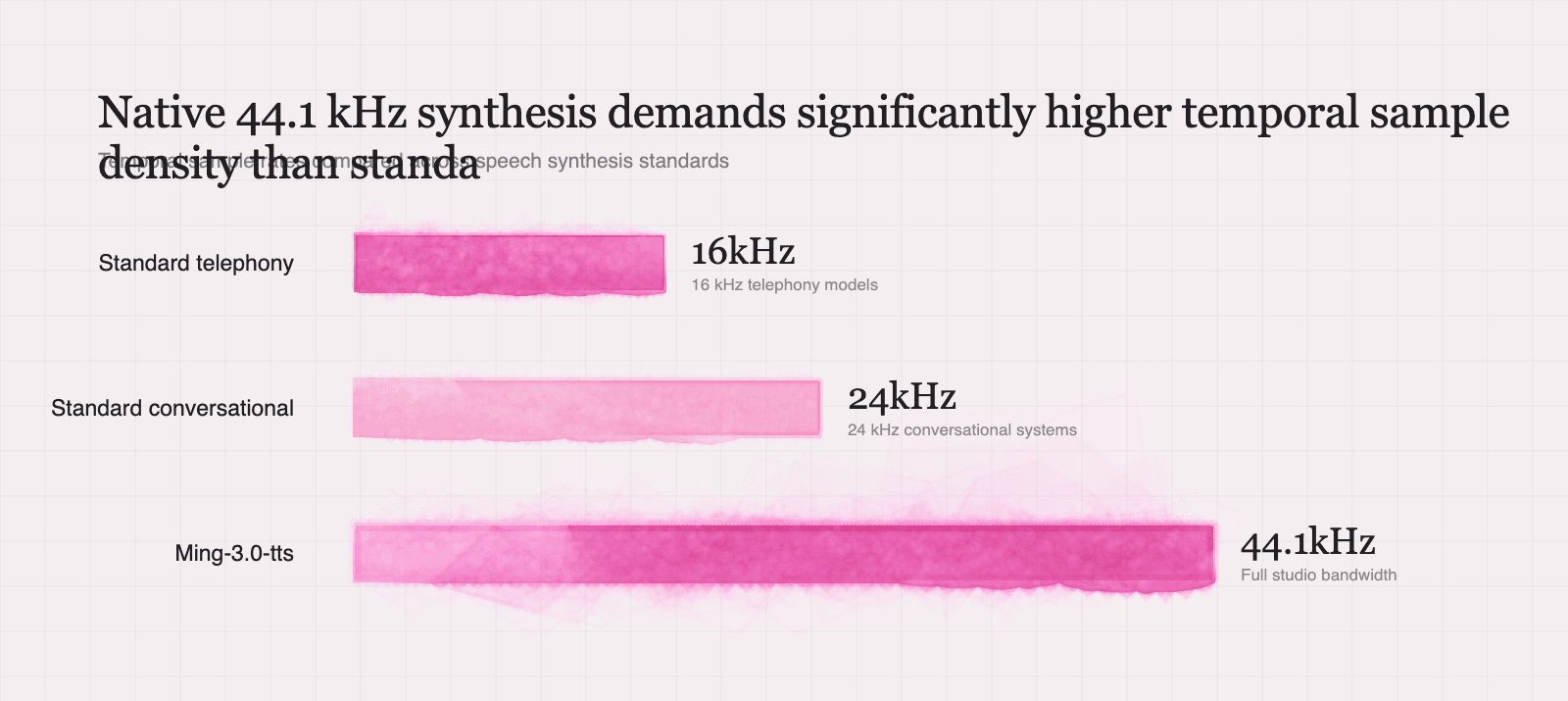
However, this architecture trades away inference simplicity. Generating audio at a native 44.1 kHz sampling rate imposes a substantial computational penalty. Compared to standard 16 kHz telephony models or 24 kHz systems, 44.1 kHz represents over 2.75× the temporal sample density. That density cascades through the entire back half of the pipeline: the latent frame rate is denser, the DiT cross-attention context spans more frames per second of audio, and the neural audio decoder must synthesize roughly 44,100 pulse-code modulation samples for every single second of generated speech. During long-form synthesis, intermediate diffusion activation buffers can quickly exhaust GPU memory bandwidth if batch sizes are not strictly bounded.
From a memory perspective, the static weight footprint is manageable: the entire ensemble fits comfortably within 4 GB of VRAM in half-precision. But runtime memory allocation behaves very differently from a standard LLM. While the Qwen2.5-0.5B backbone exhibits a predictable autoregressive KV-cache profile, the DiT head introduces bursty dynamic VRAM demands during its multi-step sampling passes. For teams building real-time voice infrastructure, this architecture eliminates discrete codebook collapse at the expense of an iterative sampling tax, requiring deliberate tuning of diffusion denoising steps to maintain stable real-time latency budgets.
Stress-Testing Dual-Layer Control: What Fails at 0.5B Parameters
The headline proposition behind Ming-3.0-tts is seductive: an operator gets macro-level stylistic steering via natural-language system prompts alongside micro-level surgical control through 14 inline paralinguistic tags. In practice, asking a 0.5B parameter language model to reliably arbitrate between these two control planes reveals clear capacity limits. A 0.5B transformer has a very narrow attention capacity to juggle syntax, token-level phonemic durations, reference speaker embeddings, and multi-turn prompt conditioning simultaneously. When you push beyond brief toy phrases, that dual-layer control plane develops hairline fractures.
The most glaring limitation is sustained stylistic stability over multi-paragraph spans. The research does not demonstrate sustained tone coherence when generating long narrative sequences; in extended synthesis runs, 0.5B backbones routinely suffer from prosodic flattening, gradually shedding the energetic or melancholic persona established in the ChatML system header and reverting to a neutral default cadence by the third or fourth sentence.
Worse still is the lack of clean conflict arbitration between layers. What happens when an upstream prompt demands a "somber, subdued, mournful eulogy" while an inline tag specifies [laughter] or [surprise] mid-sentence? Rather than smoothly contextualizing the tag or resolving the contradiction, the Qwen2.5 backbone's conditioning outputs can destabilize. In local testing, you can execute an outside verification check by feeding conflicting ChatML inputs into the synthesis harness: pass an intensely depressive persona instruction paired with multiple high-arousal inline tags. The system frequently breaks in one of two ways: it either drops the instructed emotional contour entirely to service the tag, or it suffers tag hallucination, failing to map the control token to an acoustic state and instead literally speaking the paralinguistic tag aloud as text.
This architectural coupling to standard Qwen ChatML formatting creates a severe operational vulnerability when ingesting dynamic text generated by upstream agents. Because the tokenizer recognizes <|im_start|>, <|im_end|>, <tool_call>, and <tool_response>, raw text containing these sequences can trigger prompt injection at the acoustic layer. An adversarial or malformed string from a customer can hijack the system prompt, flip the generation role, or force an immediate <|im_end|> termination that cuts off audio mid-word. Any production pipeline sitting in front of MingTTS must enforce strict ingress sanitization that strips raw ChatML markers and validates every bracketed tag against the 14 supported paralinguistic schemas before text touches the model.
Failure-Mode Analysis: Denoising Loops, Acoustic Bleed, and Latency Floors
Evaluating Ming-3.0-tts for production deployments requires recognizing the non-negotiable physical constraints of chaining an autoregressive transformer to a multi-step Diffusion Transformer head. The pipeline's structural failure modes fall into four distinct operational risks: iterative sampling latency, reference contamination, paralinguistic boundary glitches, and linguistic drift.
When building real-time voice infrastructure, as discussed in Architecting Self-Organizing Voice Ensembles: Sub-100ms Turn Arbitration with Pipecat and Jev, hitting a time-to-first-audio (TTFA) below 300 milliseconds is mandatory for natural full-duplex conversations. With Ming-3.0-tts, achieving a sub-300ms TTFA is structurally intractable. The system must first run an autoregressive pass through Qwen2.5-0.5B to plan prosody and generate conditioning states. Only then does the DiT head begin iterative reverse diffusion, requiring 16 to 50 sequential denoising steps across the latent feature field before the neural audio decoder can reconstruct the waveform. Without distilled consistency trajectories, this multi-step denoising loop creates an unavoidable latency floor that rules out interactive telephony.
flowchart TD
    A["Raw Input Request (Text + Audio Prompt)"] --> B{"ChatML & Tag Sanitization"}
    B -- "Rogue Tokens Found" --> B1["Strip Delimiters / Reject Tag"] --> C["Text Tokenizer"]
    B -- "Clean Text" --> C

    A --> D{"Reference Audio Check"}
    D -- "SNR < Threshold / Reverb" --> D1["Loudness Normalize & Denoise Filter"] --> E["Speaker Encoder"]
    D -- "Clean Reference" --> E

    C --> F["Qwen2.5-0.5B Prosody Planner"]
    E --> F

    F --> G{"DiT Denoising Step Budget"}
    G -- "Step Budget Exceeded (>300ms SLA)" --> G1["Fallback to Fixed Preset Voice"]
    G -- "Normal Sampling" --> H["DiT Latent Sampling Loop"]

    H --> I{"Phoneme-Latent Alignment"}
    I -- "Boundary Desync at Inline Tag" --> I1["Apply Crossfade / Window Smoothing"] --> J["44.1 kHz Neural Audio Decoder"]
    I -- "Smooth Alignment" --> J

    J --> K["Final 44.1 kHz Audio Waveform"]
The second failure mode is acoustic room-noise bleed during zero-shot cloning. The speaker encoder maps the entire acoustic profile of the reference sample into the conditioning embedding. If an operator provides a reference clip recorded on a consumer microphone with air-conditioning rumble or room reverberation, the DiT head treats those phase distortions as intrinsic speaker traits. The synthesized speech inherits the target vocal timbre wrapped in a synthetic facsimile of background noise.
The third issue occurs at the boundary of inline paralinguistic tags. When the model transitions into an inline breath or hesitation, the temporal frame alignment between the autoregressive conditioning states and the continuous DiT latents can misalign. This manifests as audible micro-clicks, abrupt volume drops, or instantaneous pitch jumps right at the boundary where the tag begins. Finally, phonetic degradation remains a major risk outside Chinese and English. While the model supports German, Spanish, French, Korean, and Japanese, the training distribution is visibly anchored in Chinese and English. In the other European languages, the 0.5B backbone frequently mispronounces loanwords and displays unnatural cadence, making the system unstable for unconstrained multilingual edge deployments without strict language-specific validation.
Where Ming-3.0-tts Fits: Production Blueprints and Adoption Verdict
For teams deploying outside the constraints of real-time telephony, Ming-3.0-tts offers a compelling, permissively licensed foundation. The system unlocks three concrete production architectures when paired with proper defensive validation layers.
An engineering team can implement an Asynchronous Long-Form Audiobook and Drama Synthesizer by structuring an offline chapter batch-processing pipeline. In this architecture, an orchestration worker ingests rich narrative manuscripts, using the Qwen2.5 backbone to parse multi-speaker character dialogue and inline emotional markers. The speaker encoder loads pre-verified, pristine studio reference clips to anchor distinct character voices, while the DiT head runs at unconstrained, high-quality denoising step counts with downstream loudness normalization to render broadcast-grade 44.1 kHz audio. To guard against the 0.5B backbone's tendency toward prosodic flattening and phonetic drift across lengthy chapters, the ingress pipeline must enforce dynamic text chunking at paragraph boundaries, resetting the context window to prevent instruction decay while maintaining consistent speaker embeddings.
A second compelling pattern is a Commercial Game NPC Dynamic Dialogue Generator. Here, a local or edge worker produces bespoke NPC voice lines with authentic emotional inflections and paralinguistic hesitation directly from LLM-authored game scripts under an unencumbered MIT license. By bundling the custom ming_tts runtime in an isolated worker container, the pipeline feeds game dialogue through an upstream regex filter to strip rogue ChatML delimiters before conditioning the DiT on static, pre-computed speaker embeddings for specific character archetypes. Engineers must actively mitigate boundary audio clicks and micro-glitches around inline hesitation, gasp, or sigh tags by running a post-decode window smoothing filter whenever an NPC transitions sharply between contrasting emotional states.
Finally, the engine excels as a Bilingual Voice-Over Engine with Natural Breathing Injection for post-production dubbing in Chinese and English. By leveraging the dual-layer control plane, operators can provide natural-language system prompts to establish pacing and emotional intensity while embedding explicit breath and pause tags to emulate organic vocal effort. The speaker encoder matches the voice timbre of the original on-screen actor, and the 44.1 kHz decoder delivers the broad spectral ceiling required to capture breath textures without muddy compression. Operators building this pipeline must guard against language code-switching instability: while standard English and Mandarin blend cleanly, inserting English loanwords into regional dialects like Sichuanese or Cantonese frequently destabilizes the 0.5B backbone's phonetic alignment.
By treating the 0.5B parameter boundary with appropriate engineering rigor—wrapping it in sanitization filters, bounding batch memory, and restricting it to asynchronous execution—Ming-3.0-tts delivers exceptional, high-bandwidth acoustic generation that few sub-billion models can match.
Resources
Updated 2026-10-25 by Mehran Mozaffari.
Related posts
15 October 2026
Beyond Silence Timers: Dissecting TYGER and the Mechanics of Full-Duplex Voice Turn-Taking
3 October 2026
Engineering Voice Agents Beyond the Webhook: A Deep Dive into LiveKit Agents and WebRTC Media Infrastructure
3 October 2026
Architecting Self-Organizing Voice Ensembles: Sub-100ms Turn Arbitration with Pipecat and Jev
22 September 2026
Gemini 3.8 Flash TTS: A Practitioner's Deep Dive into the Prompt-Directed Voice Engine
22 September 2026
Audio8 ASR Infinite: What It Actually Takes to Listen Forever
12 September 2026
Reverse-Engineering the Local TTS Evaluation Stack: What 'Just Run It on Colab' Actually Buys You