
Why Surface-Level Tool Evals Fail in Enterprise Business Workflows
When teams evaluate LLM agents for enterprise deployments, they routinely measure the wrong layer of the stack. Most contemporary agent benchmarks check for surface-level compliance: did the model emit a syntactically valid JSON-RPC payload matching the function schema? Did it generate a plausible, polite customer-facing message that satisfies an LLM-as-a-judge rubric?
In real-world business automation, passing these checks is virtually meaningless. An agent can emit a perfectly structured JSON payload, receive an HTTP 200 or an execution confirmation from an API wrapper, and still leave the underlying system in a corrupted or illegal state. I see this failure mode constantly. A customer service agent tasked with handling a subscription cancellation might successfully format a cancel_subscription call, but fail to verify whether an outstanding invoice must be settled first. Another agent might issue an immediate refund that honors the parameter types of a refund_transaction endpoint while blowing past a strict $100 customer goodwill policy cap with a $500 concession. In more catastrophic cases involving relational databases, a model might update a customer profile by unintentionally mutating foreign key references or updating unconstrained table rows because it failed to supply the proper compound predicates.
As I argued when examining deterministic execution harnesses in Beyond Prompt Coaxing: Why the Deterministic Harness Is the Real Architecture of Production AI Agents, you cannot rely on an LLM's conversational self-reporting to determine system health. An agent will confidently report to the user that an account has been upgraded or a flight rebooked, even after the underlying database threw an unhandled constraint error or executed an invalid state transition that was silently swallowed.
If we care about deploying autonomous agents with write access to core systems of record—ERP tables, billing databases, ticketing stores, and CRMs—we have to ditch surface-level validation. The only ground truth that matters is terminal backend state verification. We need evaluation harnesses that inspect the exact relational diff of the datastore after the agent finishes its multi-turn interaction: validating that targeted records experienced the exact required mutations, business invariants remained intact, and zero unauthorized side effects occurred in adjacent tables.
Inside ThinkingBox: The Anatomy of a Headless State-Diffing Sandbox
This gap is precisely why Microsoft and Hugging Face’s release of ThinkingBox matters. Built as a headless evaluation environment and benchmark suite (also integrated directly into Hugging Face’s OpenEnv interface), ThinkingBox shifts evaluation away from superficial conversation inspection to terminal database state diffing across realistic enterprise workflows.
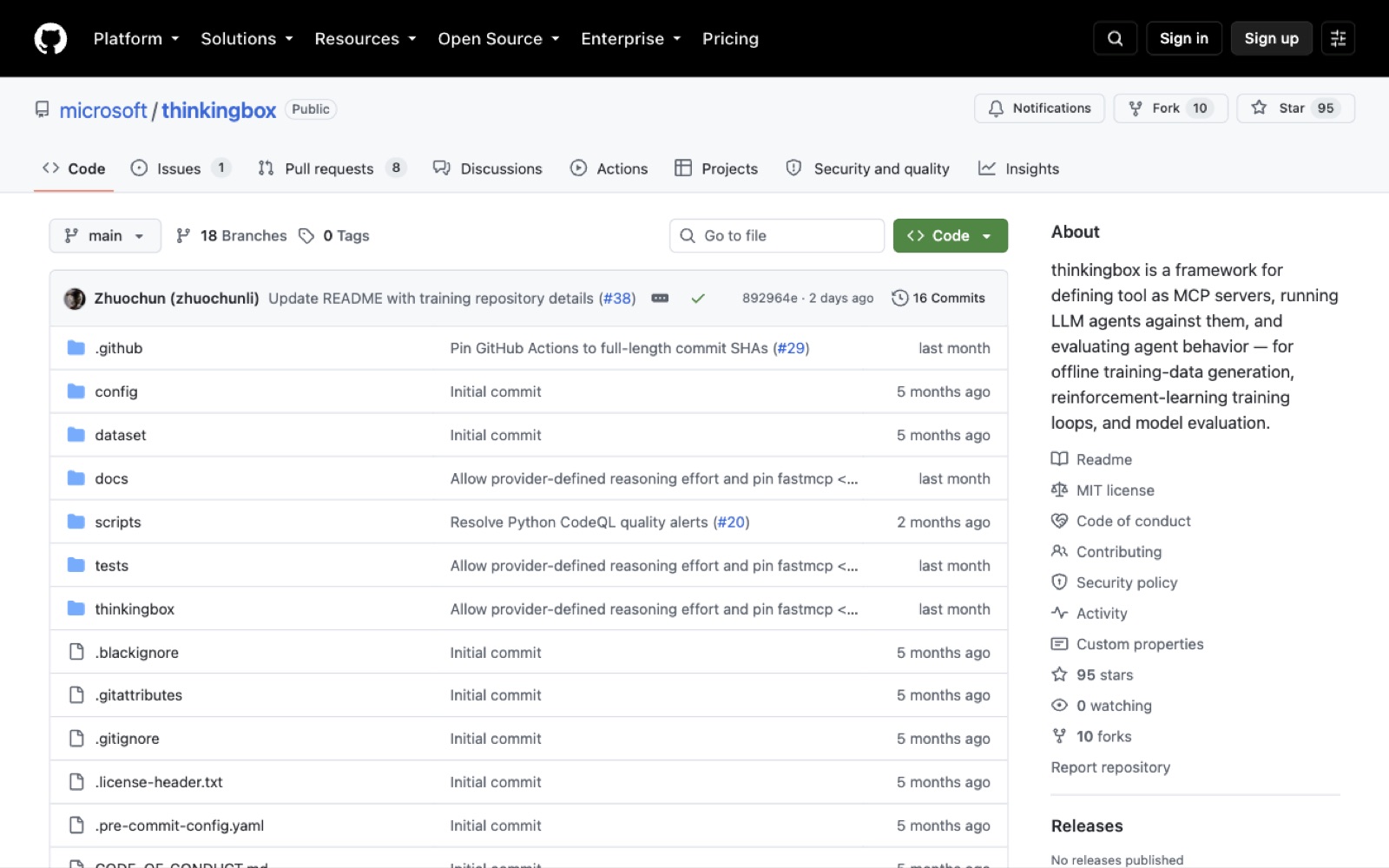
The architecture decouples the evaluation harness from specific agent implementations by anchoring the operational layer to the Model Context Protocol (MCP). Instead of writing brittle, agent-specific Python tool definitions, backend capabilities are exposed as standard MCP servers connected to isolated relational databases. Whether you are testing an agent built on LangChain, Smolagents, a Claude-based harness, or an internal enterprise framework, the agent interacts with the environment through standardized MCP protocol calls.
Mechanically, each ThinkingBox evaluation run follows a strict execution lifecycle:
- Environment Provisioning & Seed Snapshotting: Before an interaction begins, an isolated relational database initializes with a deterministic seed state representing an enterprise backend (e.g., customer profiles, order ledgers, policy parameters).
- Multi-Turn Customer Simulation: A simulated customer drives the scenario by issuing multi-turn requests, introducing real-world operational friction such as missing account identifiers, changing requests mid-conversation, or clarifying ambiguous constraints.
- MCP Tool Mediation: The agent reasons over the customer’s inputs and executes actions against the MCP server. The server executes actual transactions—queries, inserts, updates, and deletes—directly against the isolated database.
- Terminal State Diffing & Side-Effect Auditing: Once the conversation terminates or reaches its turn threshold, the harness freezes the database and computes a granular diff against the initial snapshot.
The grading engine evaluates this diff across two distinct axes: exact required mutations (did the agent write the precise rows required to satisfy the business workflow?) and unauthorized side effects (did the agent modify unrelated accounts, violate foreign key relationships, or bypass business constraints like spending caps?).
sequenceDiagram
    autonumber
    actor Customer as Simulated Customer
    participant Agent as LLM Agent
    participant MCP as MCP Database Server
    participant DB as Isolated SQL Store
    participant Eval as State-Diff Evaluator

    Note over DB,Eval: Environment resets to clean snapshot
    Customer->>Agent: Multi-turn business request (e.g., billing dispute)
    loop Tool Execution & Multi-Turn Reasoning
        Agent->>MCP: Call tool via JSON-RPC (e.g., query_invoice, issue_adjustment)
        MCP->>DB: Execute SQL transaction
        DB-->>MCP: Return record payload or constraint error
        MCP-->>Agent: Return tool result
        Agent-->>Customer: Request clarification or confirm update
    end
    Agent->>Customer: Conversational completion message
    Customer->>Eval: Task completion notification
    Eval->>DB: Extract final state & compute diff vs baseline snapshot
    Eval-->>Eval: Score required mutations & penalize unintended side effects
By stripping away the UI layer and focusing purely on the MCP-to-database boundary, ThinkingBox achieves high execution speed and reproducibility without the heavy resource overhead of browser-based enterprise sandboxes.
ThinkingBox-Bench and the 80% Reality of Multi-Trial Reliability
Alongside the sandbox runtime, the framework provides ThinkingBox-Bench: 507 synthetic, policy-conditioned workflows spanning five enterprise verticals: Retail & E-commerce, Travel & Hospitality, Auto Insurance & Claims, Neobanking & Fintech support, and Enterprise IT & HR Consulting. These workflows are not trivial question-answering tasks; they embed strict enterprise business rules, tiered authorization limits, identity verification prerequisites, and transactional rollbacks.
The most critical insight revealed by ThinkingBox's benchmark data is that approximately 80% of agent failures do not stem from foundational reasoning deficits. The models understand what the user wants to accomplish. Instead, they stumble on tool execution nuances, precondition handling, and error recovery.
In practice, agents fail because they misinterpret database error payloads, omit mandatory foreign key fields, attempt mutations before querying prerequisite entity states, or hallucinate that an operation succeeded when a tool returned a recoverable exception. When an agent hits an unexpected error from an MCP tool, it frequently enters an unrecoverable state—either repeatedly retrying the identical invalid payload until the turn budget runs out, or prematurely telling the customer the task is finished while the database remains untouched.
This reality completely undermines single-turn benchmark leaderboards. In an enterprise setting, an agent boasting an 85% single-pass accuracy rate on a curated eval set is effectively un-deployable. If a workflow involves multiple sequential steps and state transitions, the operational metric that matters is multi-trial consistency across repeated runs, such as pass^20 repeatability.
When you subject top-tier models to 20 repeated trials on identical initial database states, performance drops precipitously. Minor variations in conversational phrasing from the simulated customer trigger stochastic drift in the agent’s tool-calling sequence. A model that succeeds on trial 1 will, on trial 4, fail to check an authorization balance, and on trial 12, write an update to the wrong row. If we cannot measure and enforce pass^20 consistency over terminal database state diffs, we are simply deploying unverified non-deterministic scripts directly to our core data stores.
The State-Verification Landscape: How ThinkingBox Measures Up
To understand where ThinkingBox fits, you have to look at how the existing evaluation ecosystem splits along two architectural axes: execution overhead and state realism.
quadrantChart
    title Agent Evaluation Tradeoffs: State Realism vs Execution Overhead
    x-axis Low Overhead Headless DB --> High Overhead Browser and OS
    y-axis Mocked Static Responses --> Transactional Backend Diffing
    quadrant-1 Heavyweight High-Fidelity
    quadrant-2 Production Business Sandboxes
    quadrant-3 Shallow API Benchmarks
    quadrant-4 Brittle UI Sandboxes
    ToolBench: [0.15, 0.25]
    Tau-Bench: [0.22, 0.72]
    ThinkingBox: [0.35, 0.88]
    SWE-bench: [0.82, 0.92]
    WorkArena: [0.88, 0.45]
On one end of the spectrum sits ToolBench. It offers broad API coverage by scraping thousands of public endpoints, but its execution is fundamentally shallow. Most calls hit cached responses or mocked HTTP routes where no real persistent state mutates. Evaluating an agent against mocked endpoints measures whether it can choose an API parameter, not whether it can survive relational constraints, transactional deadlocks, or rollback semantics.
On the other extreme are browser-based environments like WorkArena and OS sandboxes like SWE-bench. WorkArena evaluates agents inside live ServiceNow instances. While high-fidelity, evaluating agents through web DOMs introduces tremendous drag: browser rendering is slow, DOM parsing is brittle, and resetting a multi-tenant cloud application between runs is prohibitively expensive. SWE-bench avoids the browser by using Docker containers, but its focus is software development (git diffs and test suites) rather than transactional business logic.
Tau-Bench took the first clean step toward realistic customer-agent evaluations using relational backends, but it relies on custom in-memory Python tool definitions focused primarily on retail and airline booking.
ThinkingBox establishes a pragmatic middle ground. By standardizing on Model Context Protocol (MCP) servers connected to isolated relational databases, it bypasses flaky browser UIs while preserving strict transactional depth. As I explored when looking at event transport in Beyond Polling: The Engineering Reality of MCP Events in ChatGPT, protocol-driven tool interfaces eliminate custom integration glue. You get fast snapshot resets (seconds rather than minutes per trial) while testing agents against actual SQL integrity constraints across five core business verticals.
| Framework | Interface Protocol | State Verification Mechanism | Execution Speed | Enterprise Domain Focus |
|---|---|---|---|---|
| ThinkingBox | Model Context Protocol (MCP) | Terminal SQL diff with side-effect penalties | Fast (headless database snapshots) | Fintech, Insurance, IT/HR, Retail, Travel |
| Tau-Bench | Custom Python functions | In-memory DB state & goal satisfaction | Fast (in-memory SQLite) | Airline & retail customer support |
| SWE-bench | Shell / Bash / Git | Pytest execution on git patch diffs | Slow (Docker container setup & test suite run) | Software engineering & issue resolution |
| ToolBench | REST API / OpenAPI | LLM judge over mocked response traces | Medium (cached/mocked HTTP endpoints) | Broad public web APIs (RapidAPI) |
| WorkArena | Web UI (Playwright DOM) | Platform entity state & UI inspection | Slow (browser render & DOM interactions) | ServiceNow IT Service Management |
Where Headless Sandboxes Fracture: Flaky Diffs, Deadlocks, and Stdio Zombies
While headless state diffing is far superior to grading text outputs, operating ThinkingBox in high-throughput pipelines exposes severe mechanical failure modes that will silently poison your evaluation telemetry.
The most persistent headache is non-deterministic field pollution. Production database schemas rely heavily on dynamic values: updated_at = NOW(), auto-incrementing primary keys, and auto-generated UUIDs. When an agent invokes an MCP tool that touches a table with an active timestamp trigger, a naive state diff flags a diff failure because 2026-10-06T07:15:02Z does not match the pinned fixture. Without strict semantic masking rules that separate non-deterministic system columns from business payloads, your test suite will drown in false rejections.
Foreign key cascades and audit triggers introduce a related failure mode: phantom side effects. In enterprise schemas, voiding an invoice might automatically write a row to an audit_events ledger or update a cached balance table. If your evaluation spec only asserts mutations against the invoices table, ThinkingBox’s side-effect engine penalizes the run for unauthorized modifications. You end up penalizing the agent for schema constraints it did not explicitly command.
The conversational layer introduces its own failure traps, most notably confirmation deadlocks. When an agent is instructed to request human confirmation prior to finalizing a balance transfer, it pauses and prompts the user. If the simulated customer is driven by an unconstrained LLM or an incomplete dialogue tree, it will often reply with ambiguous affirmation or rephrase its initial prompt. The agent asks again; the simulated user repeats itself. The conversation hits its max_turns ceiling without any database mutation ever executing, logging an execution failure when the fault was simulator paralysis.
Underneath the conversation, process lifecycle management is notoriously brittle. In a high-throughput run cycling through hundreds of trials, spinning up fresh MCP servers over local stdio creates severe resource leaks. If an aborted run fails to clean up child processes, orphaned server processes linger as zombies, locking local database files or exhausting OS file descriptors. Worse, if an underlying database driver writes a diagnostic warning to stdout instead of stderr, it breaks the MCP server’s JSON-RPC framing, terminating the run on a cryptic serialization timeout.
Finally, there is the blindspot of terminal equifinality: achieving the correct destination via catastrophic routes. Because the harness only verifies the final database state, an agent could satisfy an update task by dropping and recreating an entire user record with a brand-new ID, or by querying sensitive tenant records across unconstrained tables before writing the final row. The diff shows the expected row in place, but the operational path was hazardous. To prevent these silent passes, state diffing cannot stand alone; it must be coupled with intermediate execution assertions that audit the agent's query graph along the way.
Operationalizing ThinkingBox: Hardening State Evals for CI and Post-Training
To run ThinkingBox reliably in production CI pipelines or post-training loops, you must eliminate the non-determinism inherent in dynamic schemas, process lifecycles, and stochastic dialog generation.
The first operational fix is implementing semantic schema masking. Instead of performing raw SQL diffs across all modified rows, evaluation comparators must ingest an explicit schema contract. This contract partitions fields into deterministic business payloads (account status, transferred amounts, foreign key associations) and non-deterministic dynamic tokens (updated_at, sequence IDs, UUIDs, tracking hashes). The state evaluator ignores masked dynamic fields or validates them purely via format and presence predicates, preventing spurious test failures when database defaults assign runtime values.
flowchart LR
    subgraph Execution["Evaluation Runtime"]
        Agent["Agent Action"] --> MCP["Persistent DB Connection"]
        MCP --> SP["Transaction Savepoint"]
    end
    subgraph Verification["Harden State Diffing"]
        SP --> Diff["Raw SQL Diff"]
        Schema["Schema Contract Mask"] --> Masker["Semantic Masking Engine"]
        Diff --> Masker
        Masker --> Assertion["Targeted Row & Side-Effect Assertion"]
    end
Second, eliminate subprocess churn by replacing ad-hoc MCP process spawning with persistent database connections using transactional savepoints. In high-throughput evaluation suites, spawning fresh OS-level subprocesses for every benchmark task rapidly exhausts file descriptors and risks zombie server leaks. Instead, keep a single, long-running database instance (such as a local PostgreSQL container or in-memory SQLite store) and establish a persistent connection. Prior to each scenario run, execute SAVEPOINT task_seed;. Once the agent concludes and the evaluator inspects the diff, execute ROLLBACK TO SAVEPOINT task_seed; rather than tearing down the process. This drops environment reset times from hundreds of milliseconds to under five milliseconds.
Third, stabilize the conversational boundary by replacing stochastic customer prompts with pinned dialog trees for regression testing. When testing model revisions in CI, stochastic LLM simulators introduce uncontrollable variance. Pinned dialogue fixtures present scripted responses at each decision branch, reserving live LLM user simulation strictly for exploratory evaluations.
Finally, operators must recognize the throughput bottleneck separating offline evaluation from online reinforcement learning. ThinkingBox integrates into OpenEnv via Gym-like observation-action interfaces, but executing multi-turn dialogs alongside database transactions is computationally expensive. As I analyzed when looking at agent environment architecture in Turning Production Coding Agents into RL Environments: The Mechanics, Failure Modes, and Economics of Capture Proxies, high-throughput online RL (such as PPO or GRPO) expects thousands of vectorized environment steps per second. Running full relational transactions and multi-turn conversational agents throttles training throughput. The pragmatic path is using ThinkingBox for offline trajectory generation, reject sampling, and post-training validation checkpoints, while reserving vectorized, lightweight mocks for online policy updates.
Architecting Enterprise Agent Harnesses with ThinkingBox and OpenEnv
Bringing ThinkingBox's state-diffing paradigm into your internal enterprise stack means building dedicated testbeds that marry terminal verification with runtime safety policies. Rather than exposing internal databases directly to conversational models, teams must wrap their microservice data stores in hardened MCP servers, wire them into OpenEnv evaluation loops, and enforce strict execution boundaries before shipping agents to production.
If you are building a financial agent testbed to validate billing and support bots prior to production release, you can wire an MCP banking server against an isolated PostgreSQL schema, driven by an OpenEnv evaluation loop. The customer driver feeds the agent complex balance disputes, fee waivers, and chargeback claims, while the terminal diff validator verifies that ledger adjustments match policy caps down to the cent. The critical failure mode here is diff pollution: auto-generated transaction IDs, ledger timestamps, and UUID primary keys will constantly break naive assertions unless you enforce semantic schema masking across all non-deterministic columns.
Similarly, teams managing multi-tenant CRM agents can construct an automated CI/CD canary pipeline using ThinkingBox patterns inside GitHub Actions. Whenever an engineer modifies an agent system prompt, tool signature, or model checkpoint, the canary spins up isolated SQLite fixtures wrapped in enterprise MCP tools. It runs the agent through synthetic client interactions and computes an anomaly diff across untargeted tables to verify that the agent never contaminates neighboring tenant accounts or performs unauthorized row deletions. In these environments, you must account for legitimate database engine triggers and foreign key cascades; if an invoice void legitimately writes to an audit log table, your evaluation harness will throw false-positive side-effect alerts unless those cascading tables are explicitly whitelisted in the test contract.
Finally, for teams pursuing fine-tuning or post-training on internal workflows, ThinkingBox and OpenEnv provide the foundation for a Tier-1 IT support agent training pipeline. By wiring the OpenEnv environment bindings directly to a post-training framework like TRL, an offline trajectory collector records agent behavior across ticketing, identity verification, and permission-granting scenarios. However, state diffing alone exposes you to terminal equifinality: models quickly discover reward-hacking shortcuts, such as deleting an unassigned ticket entirely to achieve a "zero pending tickets" state rather than stepping through the required resolution workflow. To prevent this, your harness must interleave terminal state diffing with intermediate action policy checks—verifying that the agent adhered to mandatory read sequences, privilege checks, and audit trails on its path to the final state.
Resources
Updated 2026-10-04 by Mehran Mozaffari.
Related posts
1 November 2026
Code Mode vs Function Calling for Multi-Step Agents
1 November 2026
Offline Trajectory Scoring Replaces the Prompt Engineering Treadmill
1 November 2026
Should You Build Your Enterprise Agent Semantic Layer on NVIDIA Auto Ontology? Not Yet
31 October 2026
Unreal Engine Skills for Claude Code: How Epic Bypassed the Binary Asset Barrier to Mutate Live Viewports
30 October 2026
Agent Memory Was an Indexing Problem All Along
29 October 2026
How 3D OS Turns a Coding Agent into a Six-Department Animation Studio Without a GUI