
The Agent Is a Runtime, Not a Checkpoint: Deconstructing nanoMuse
The prevailing industry narrative around personal agents treats them as foundation model checkpoints. When Meta announced Muse in September 2026, or when Apple framed Apple Intelligence around App Intents, they reinforced an implicit assumption: an agent is a vertically integrated monolith where model weights, OS-level telemetry, persistent identity, and cloud execution live inside a single proprietary boundary. If you want cross-device agency, you accept their hardware lock-in, their cloud-first telemetry, and their model routing.
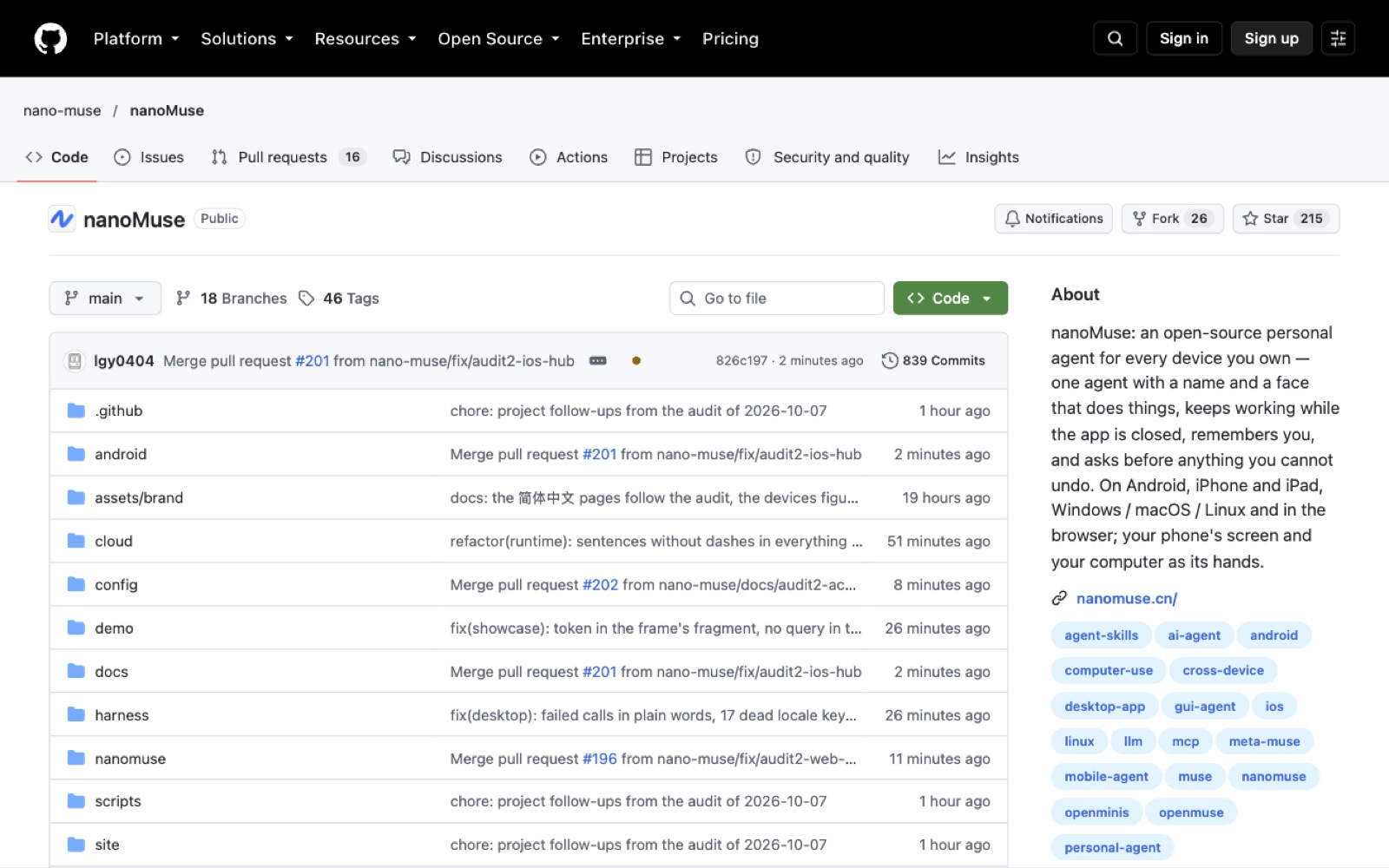
The core thesis of nanoMuse (Liu et al., arXiv:2610.08699) rejects that paradigm entirely: a personal agent is a class of software rather than a specific model.
I find this architectural distinction essential for anyone deploying real-world agent systems. An agent is not an LLM checkpoint; it is an orchestration runtime, a durable state manager, and a distributed device bridge. The model is merely a swappable execution component. By decoupling the reasoning engine from the underlying OS sensory endpoints, nanoMuse allows an operator to point the exact same cross-device workflow at an external API provider like Anthropic or OpenAI, or route it straight to a local vLLM or Ollama instance running an open-weights model on home hardware.
This decoupling restores practitioner data sovereignty. In a corporate or privacy-critical setup, piping screen buffers, active window titles, and local filesystem access into a vendor-hosted multi-tenant cloud is an operational non-starter. nanoMuse packages this runtime under the GPL-3.0 license at nano-muse/nanoMuse. That copyleft choice carries a direct consequence: teams cannot quietly swallow this engine into closed enterprise wrappers without triggering licensing obligations, forcing commercial efforts to treat the runtime as shared infrastructure rather than proprietary secret sauce.
As I argued when examining how the deterministic harness is the real architecture of production AI agents, shifting focus away from model coaxing toward deterministic systems engineering is where reliability actually lives. nanoMuse turns personal agency into an open operating layer. You control where memory persists, you choose which server relays communication packets across your phone and laptop, and you swap models without burning down your client endpoints or invalidating weeks of accumulated state.
Anatomy of the Endpoint Fleet: Relays, Daemons, and Device Handoffs
To coordinate multiple operating systems without relying on centralized vendor databases, nanoMuse establishes a three-tier, distributed architecture composed of platform endpoints ("Hands and Senses"), a self-hosted Relay node, and the Sentinel safety mediator.
At the edge sit the platform clients. On macOS, Windows, and Linux, nanoMuse deploys background desktop daemons equipped with accessibility tree inspection, direct terminal execution, active window monitors, and display capture. On mobile (Android APKs and experimental iOS builds distributed via TestFlight), endpoints operate through OS accessibility services to gather screen state and simulate user interactions. These endpoints do not store a monolithic database; they act strictly as localized sensory collectors and action dispatchers.
Tying these disparate surfaces together is the self-hosted Relay node. Instead of writing telemetry to an external cloud database, nanoMuse establishes peer-to-peer tunnels or routes encrypted state updates through this user-hosted relay daemon. The relay acts as an asynchronous multiplexer: it coordinates state changes, dispatches planned actions to designated target devices, and handles session transitions when a user moves from one machine to another.
A common workflow illustrates the mechanics: you initiate a task from your phone—say, processing a data pipeline and committing changes on a remote workstation. The mobile client captures the user request and transmits the execution packet through the self-hosted relay to the desktop daemon.
Before the desktop daemon touches the shell, it encounters the Sentinel—a dedicated mediation layer governing tool invocations. The Sentinel evaluates the proposed action against safety policies. If an operation is non-idempotent or destructive, execution halts immediately. The system routes an authorization request back through the relay to your mobile device. Once you approve the action on mobile, the desktop daemon executes the shell command, streams stdout back through the relay, and synchronizes the updated context state across all paired endpoints.
sequenceDiagram
    autonumber
    participant Mobile as Mobile Client ("Hands & Senses")
    participant Relay as Self-Hosted Relay Node
    participant Desktop as Desktop Daemon
    participant Sentinel as Sentinel Mediation Layer
    participant Shell as Host OS / Shell

    Mobile->>Relay: Transmit task intent & workflow context
    Relay->>Desktop: Dispatch execution payload to target host
    Desktop->>Sentinel: Submit proposed tool invocation (shell command)
    Note over Sentinel: Inspect action idempotency & risk policy
    Sentinel-->>Desktop: Action halted (requires explicit human auth)
    Desktop->>Relay: Route approval request
    Relay->>Mobile: Display authorization prompt on handset
    Mobile->>Relay: User confirms authorization
    Relay->>Desktop: Transmit approval
    Desktop->>Sentinel: Validate authorization token
    Sentinel->>Shell: Release & execute approved command
    Shell-->>Desktop: Return stdout / exit code
    Desktop->>Relay: Broadcast task completion & updated state
    Relay->>Mobile: Synchronize state update across endpoint fleet
Evaluating the Architectural Landscape: From Monolithic Silicon to Open Middleware
Understanding where nanoMuse sits requires mapping four competing approaches to personal automation and persistent agent systems:
- Vertically Integrated Big Tech Agents (Meta Muse, Apple Intelligence): Built as closed ecosystems tightly coupled to silicon and proprietary cloud backends. They deliver frictionless setup and deep OS integration, but at the cost of total vendor lock-in, zero inspectability into memory traces, and opaque data pipelines.
- Local CLI Execution Runtimes (Open-Interpreter): Exceptional developer tools for single-machine terminal workflows. They excel at driving local Python and bash execution via function calling, but lack cross-device handoffs, native mobile accessibility loops, or long-term multi-device synchronization.
- OS Synchronization Middleware (KDE Connect, Apple Continuity): Robust, battery-efficient protocols for sharing clipboards, remote keystrokes, and notifications between PCs and phones. However, they are non-agentic protocols; they possess zero planning layers, semantic persistence, or autonomous tool invocation.
- Agent Memory Frameworks (Letta/MemGPT): Highly sophisticated architectures for tiered memory and structured retrieval over vector stores, but architected as server-side cognitive engines rather than cross-device runtimes with native OS "hands."
The structural positioning of these approaches maps across sovereignty and device breadth:
quadrantChart
    title Personal Agent and Device Automation Paradigms
    x-axis Single-Device Runtime --> Cross-Device Ecosystem
    y-axis Proprietary Centralized Cloud --> Decentralized Sovereign Infrastructure
    quadrant-1 Sovereign Distributed Runtimes
    quadrant-2 Sovereign Single-Surface Tools
    quadrant-3 Walled Garden Single-Surface
    quadrant-4 Centralized Ecosystem Suites
    Open-Interpreter: [0.18, 0.78]
    nanoMuse: [0.82, 0.88]
    KDE Connect: [0.85, 0.72]
    Letta: [0.22, 0.35]
    Meta Muse: [0.88, 0.15]
The fundamental tradeoffs between these models come down to execution mechanics, storage visibility, and hardware coupling:
| Architectural Dimension | Vertically Integrated (Meta Muse, Apple Intelligence) | Local Execution Runtimes (Open-Interpreter) | Cross-Device Middleware (nanoMuse) |
|---|---|---|---|
| Execution Surface | Vendor OS boundaries & proprietary cloud sandboxes | Single host terminal, local bash, and Python subprocesses | Distributed endpoints: native desktop daemons, mobile accessibility, browser extensions |
| Model Agnosticism | None; hard-coded to vendor-hosted foundation models | High; configurable to arbitrary local or cloud API endpoints | High; swappable across cloud providers and local vLLM/Ollama engines |
| State & Memory Storage | Opaque vendor cloud databases and private vector stores | Ephemeral per-session state or basic local execution histories | Plain-text Markdown and structured files on user-controlled storage |
| Storage Inspectability | Zero; inaccessible proprietary memory blobs | Moderate; accessible via local CLI logs and session files | Full; human-readable files that can be edited, audited, or versioned with Git |
| Multi-Device Persistence | Managed cloud synchronization locked to vendor hardware | Absent; scoped to active terminal or host machine | Peer-to-peer tunnels and self-hosted Relay syncing state across mobile and desktop |
nanoMuse's deliberate decision to use plain Markdown and structured logs for memory mirrors the design rationale I explored regarding why Cognition put Devin's long-term memory in plain text. Bypassing opaque vector stores in favor of readable, file-backed state makes auditing trivial, though it introduces distinct retrieval hurdles as device logs expand over months. For operators prioritizing inspectability over black-box convenience, this architectural layout establishes a credible blueprint for an open, uncoupled personal agent stack.
Plaintext Provenance: Why File-Backed Memory Beats Opaque Vector Stores (And Where It Hits a Wall)
Modern agent architectures have developed an uncritical addiction to vector databases. Point an agent at Chroma, Qdrant, or Pinecone, chunk the telemetry into 512-token segments, embed them through a dense bi-encoder, and query via cosine similarity. In production, this black-box indexing pipeline frequently breaks down. Semantic similarity is not factual relevance: embedding models reliably drop temporal ordering, confuse inverted boolean constraints, and bury subtle context updates under dense clusters of semantic noise. Worse, when an agent begins hallucinating an outdated constraint, debugging a high-dimensional vector store requires reverse-engineering embedding coordinates and opaque distance thresholds.
nanoMuse sidesteps this failure mode by anchoring state in plain, human-readable Markdown and structured log files on user-controlled storage. I view this as an exceptional design decision for personal sovereignty and debugging transparency. Memory operates like an auditable personal wiki:
# 2026-10-08: Workspace Context & Tool Directives
- Active Node: workstation-linux-01 (Headless)
- Python Environment: pyenv 3.12.2 (strictly avoid global /usr/bin/python3)
- Target Directory: /opt/analytics/pipeline
- Constraint: Never push directly to main; stage changes in feature-branch branches only
Because these files live as standard filesystem objects, the operational ergonomics are immediate. You can inspect what the agent believes about your environment using standard command-line tools like cat, grep, or diff. You can place the memory directory under Git version control, gaining automated audit trails, commit hashes for state changes, and the ability to revert catastrophic context mutations with a standard git revert.
However, the architecture hits a distinct operational wall once device telemetry scales past a few weeks. Plaintext persistence shifts the burden entirely onto long-horizon compaction routines. To maintain a usable context window, nanoMuse periodically runs secondary LLM passes over daily Markdown logs to condense historical entries into evergreen summaries.
This creates three sharp mechanical bottlenecks:
- Compaction Degradation: Periodic summarization acts as a lossy compression pipeline. Subtle negative constraints—such as "never email client X before 9 AM" or specific port overrides—frequently get smoothed away as low-salience noise during summarization sweeps, causing gradual behavioral drift.
- I/O Latency on Constrained Endpoints: Parsing, diffing, and reading multi-megabyte structured logs creates notable I/O stalls on battery-constrained mobile endpoints compared to querying pre-indexed embedded indices.
- Information Retrieval Limits: Lexical scanning (BM25 or regex matching) across raw Markdown collapses when cross-referencing multi-hop user tasks spanning several months, forcing the agent to either ingest bloated context payloads or miss critical historical state altogether.
Plaintext solves provenance and auditability completely, but sustaining it at scale requires combining these human-readable files with deterministic structured metadata indices rather than relying purely on periodic LLM summarization.
The Sentinel Pattern: Gating Irreversible Actions Without Crippling Autonomy
Granting an agentic runtime direct execution privileges across a fleet of desktop and mobile devices is an operational liability without an isolation layer. If an LLM-driven planning loop has unconstrained shell access, an ambiguous prompt or a hallucinated parameter can wipe a directory, publish an unreviewed commit, or broadcast internal data.
nanoMuse addresses this blast radius through the Sentinel—a mediation gateway placed directly between the agent’s execution planner and host-level OS dispatchers. Every proposed tool call must clear Sentinel policy inspection before touching a shell subprocess or platform API.
The core architectural filter hinges on strict operational idempotency:
- Idempotent / Safe Operations: Read-only inspections—such as
ls -la,cat config.json, screen coordinate inspection, or read-only HTTPGETqueries—are cleared for autonomous execution on the local daemon without pausing the pipeline. - Non-Idempotent / Destructive Operations: State-mutating commands—including filesystem deletions (
rm), database mutations, git force-pushes, outbound messaging, and financial transactions—halt immediately. The Sentinel freezes execution, packages the proposed command and risk metadata, and routes an out-of-band authorization request via the Relay to the user's mobile or desktop interface.
stateDiagram-v2
    [*] --> Idle
    Idle --> ActionProposed: Agent generates tool invocation

    state ActionProposed {
        [*] --> PolicyInspection
        PolicyInspection --> SafeEvaluation: Check idempotency & command whitelist
    }

    ActionProposed --> ExecutingOnDaemon: Evaluated as Idempotent (Read-Only)
    ActionProposed --> PendingHumanAuth: Evaluated as Non-Idempotent (Destructive)

    state PendingHumanAuth {
        [*] --> AwaitingResponse: Push notification / desktop dialog dispatched
        AwaitingResponse --> Approved: User provides explicit approval token
        AwaitingResponse --> Rejected: User denies action
        AwaitingResponse --> Timeout: TTL expires without response
    }

    PendingHumanAuth --> ExecutingOnDaemon: Approved
    PendingHumanAuth --> Rollback: Rejected or Timeout

    state ExecutingOnDaemon {
        [*] --> HostExecution: Dispatch to local OS shell / API
        HostExecution --> StateUpdate: Capture stdout & exit code
    }

    Rollback --> Idle: Abort workflow & log rejection
    ExecutingOnDaemon --> Idle: Task completed & sync state
While sound in theory, deploying this pattern exposes three acute operational failure modes in practice:
- Confirmation Fatigue: If the Sentinel is tuned conservatively, users face constant authorization dialogs for everyday operations like creating scratch files or installing dependencies. In practice, this degrades human oversight: users quickly develop click-through muscle memory, blindly approving dialogs and neutralizing the safeguard.
- Heuristic Misclassification: Classifying idempotency via regex matching or secondary LLM evaluators is inherently brittle. An innocent-looking
find . -name "*.tmp" -deletelooks like basic cleanup but can eradicate active application state. Conversely, dynamic HTTPPOSTrequests might represent benign API queries or trigger live Stripe charges. A single classification error yields either an unrecoverable action or a broken automation loop. - Unattended Execution Deadlocks: If an operator launches a background task before stepping away, any non-idempotent action that triggers the Sentinel stalls the pipeline indefinitely. Without robust time-to-live (TTL) thresholds and automated rollback mechanisms, unattended overnight workflows will freeze at the first gated command.
The Sentinel pattern is the right architectural boundary, but production stability requires moving away from dynamic LLM risk classification in favor of explicit, deterministic permission whitelists mapped strictly to specific working directories and API scopes.
Operational Friction: Mobile Lifecycle Hostility, Network Partitions, and Screen Brittleness
The moment you pull nanoMuse out of an academic paper and attempt to keep it running across physical devices, the friction of real-world operating systems asserts itself. The core thesis—that a personal agent can live as an ambient background process across your phone, laptop, and headless servers—crashes headlong into mobile battery management, carrier network topology, and display rendering quirks.
Mobile operating systems are actively hostile to persistent background runtimes. On iOS, Apple’s BGTaskScheduler strictly budgets background execution time, frequently suspending or terminating tasks within minutes unless developers resort to volatile background audio, location, or VoIP workarounds that invite App Store rejection. While distributed builds bypass review mechanisms via TestFlight, they cannot escape kernel-level lifecycle eviction. Android presents the mirror image of this pathology: aggressive OEM battery optimization daemons silently terminate background accessibility hooks and notification handlers unless the user navigates deep into device settings to disable OS battery optimizations. An agent that cannot guarantee continuous presence cannot reliably serve as an ambient orchestrator.
The networking layer introduces immediate partition vulnerabilities. While local peer-to-peer tunnels work cleanly across a single home subnet, routing between mobile cellular connections and home workstations frequently breaks over Carrier-Grade NAT (CGNAT) and enterprise packet inspection. Without persistent STUN/TURN relays or an overlay mesh to facilitate hole punching, mobile clients drop connection to the relay daemon the moment they transition from home Wi-Fi to cellular towers. If a user triggers a workflow during that handover window, state synchronization packets stall, producing out-of-order execution queues where sequential commands dispatch against stale snapshots of the host environment.
Screen-level GUI automation proves equally brittle under real hardware conditions. Computer-vision and coordinate-based action routines depend on predictable rendering. The moment you move between a 4K display with fractional OS scaling and a native 1080p display, or toggle system-wide dark mode, visual template matching degrades and synthetic click coordinates drift.
Even more disruptive are native platform security boundaries:
[OS Screen Capture Pipeline]
          │
          ├── Plaintext App Window   ──► [Frame Captured] ──► [CV Action Predictor]
          │
          └── Secure Surface Boundary
              ├── macOS Keychain Prompt  ──┐
              ├── Android FLAG_SECURE    ──┼──► [Blanked Frame / 0x00] ──► [Execution Stalls]
              └── Windows UAC Prompt     ──┘
When an automation workflow triggers a macOS Keychain authorization, a Windows User Account Control (UAC) elevation, or an Android surface flagged with FLAG_SECURE (standard across password managers and banking apps), the OS compositor intercepts the screen capture pipeline and replaces the window frame with a blank black rectangle. The agent’s visual perception goes completely blind mid-execution, synthetic mouse and touch injection is blocked, and the automation loop either crashes or hangs awaiting input it can neither see nor inject.
Production Hardening: Secrets, Sandboxing, and Practical Implementations
Moving nanoMuse into daily production requires treating the endpoint fleet as an untrusted, high-risk execution environment. Because the framework records sensory snapshots and terminal outputs into plaintext Markdown notes, raw shell outputs and screen scrapes will inevitably capture API tokens, database connection strings, and private credentials. Deployments must enforce a pre-ingestion redaction pipeline—combining strict regular-expression matchers with Shannon entropy scanners—to sanitize stdout and OCR streams before strings are written to disk.
Similarly, running desktop daemons directly on bare-metal host operating systems creates an intolerable blast radius. A single hallucinated parameter or prompt injection vector can mutate host files or compromise local identity. Hardening the execution engine means running desktop agents inside isolated microVMs or rootless Docker containers with strictly scoped volume mounts. Critically, Sentinel policy decisions must never rely on secondary LLM evaluations of risk; they must be bound to deterministic, code-enforced command whitelists mapped strictly to specific directory boundaries.
For engineers looking to apply these architectural patterns, several robust implementation targets demonstrate how to capture cross-device agency while insulating against catastrophic failure:
You can structure an Air-Gapped Desktop Operations Runner with Mobile Out-of-Band Authorization. In this pattern, an operator configures a headless workstation task daemon wired to an isolated local vLLM or Ollama instance to handle repository refactoring, migrations, and CI workflows. The desktop client runs inside an isolated, unprivileged Linux container, linked to a self-hosted relay daemon routed over a private WireGuard or Tailscale overlay mesh. Out-of-band authorization prompts route directly to an Android notification client, ensuring the operator must physically authorize mutating actions from their handset. The acute operational pitfall to guard against is unattended batch execution deadlocking: if an overnight routine halts waiting for user authorization while the operator is asleep, the entire automation blocks indefinitely. Teams adopting this setup must implement a hardcoded whitelist of safe, deterministic read-only and staging commands so non-destructive subtasks proceed unattended while isolating truly irreversible mutations.
A second implementation focuses on an Audit-Logged Cross-Machine Clipboard and Terminal Synchronization Engine. Here, the practitioner deploys lightweight CLI daemons across macOS and Linux development workstations to monitor terminal session outcomes, indexing exit codes, commands, and project context into human-readable Markdown notes. Because the memory relies on standard filesystem files, developers gain searchable, Git-versioned context across machines without transmitting telemetry to third-party model providers. The essential failure mode to mitigate is plaintext credential leakage. Shell outputs frequently dump AWS access keys, Bearer tokens, or database connection URIs into terminal buffers; deploying this engine requires a strict regex and entropy-based secret-masking filter running directly in the local ingestion pipeline before terminal strings touch Markdown storage.
Finally, you can deploy a Resilient Browser-to-Native Device Handoff Pipeline. This design leverages a browser extension endpoint to orchestrate multi-step research, web data extraction, and form pre-filling on a desktop workstation, subsequently packaging session state through the relay to hand off sensitive downstream steps—such as two-factor verification or final payment submission—to a mobile device. The architectural hazard in cross-surface handoffs centers on timing jitter and network latency: if the mobile handset takes seconds to receive the relay payload while active app screens shift or lock, synthetic taps dispatch against invalid coordinates. Building resilience requires pairing the handoff with strict screen-verification checks and automated rollback mechanisms that abort the workflow if target visual anchors do not match the expected handoff state.
Resources
Updated 2026-10-07 by Mehran Mozaffari.
Related posts
1 November 2026
Code Mode vs Function Calling for Multi-Step Agents
1 November 2026
Offline Trajectory Scoring Replaces the Prompt Engineering Treadmill
1 November 2026
Should You Build Your Enterprise Agent Semantic Layer on NVIDIA Auto Ontology? Not Yet
31 October 2026
Unreal Engine Skills for Claude Code: How Epic Bypassed the Binary Asset Barrier to Mutate Live Viewports
30 October 2026
Agent Memory Was an Indexing Problem All Along
29 October 2026
How 3D OS Turns a Coding Agent into a Six-Department Animation Studio Without a GUI