
Escaping the In Silico Echo Chamber: What Autonomous Human Research Actually Solves
For the past two years, the autonomous research literature has felt like an echo chamber. When frameworks like Sakana AI's The AI Scientist landed, they generated justified excitement by automating the hypothesis-to-LaTeX lifecycle. But as an operator looking at production utility, the structural ceiling was obvious: they operated exclusively in silico. An agent tweaking hyperparameters on a local GPU cluster, running PyTorch against synthetic benchmarks, and writing a paper reviewing its own loss curves is fundamentally trapped in a closed computational loop. It cannot uncover unmodeled empirical phenomena because its entire world boundary is defined by existing datasets and deterministic code simulators.
The moment an AI system tries to observe the messy, non-deterministic physical world, our architectures usually stall. Wet-lab robotics—like Berkeley's A-Lab—break past this wall, but they demand millions of dollars in capital expenditure, custom hardware integration, and physical maintenance.
This is why the peer-reviewed framework from Gabrielle Wehr and the team at Explore Science (@ExScienceAI), published in Wiley’s Advanced Science (2026, 10.1002/advs.76675), marks a genuine architectural inflection point. Rather than waiting for ubiquitous robotic manipulators or retreating into compute-only benchmarks, Wehr et al. bridged the physical reality gap by treating crowdsourced human participant pools as a programmable empirical sensor array.
+-----------------------------------------------------------------------+
|                       Autonomous Agent Core                           |
|       (Hypothesis Generation -> Task Coding -> Data Ingestion)        |
+-----------------------------------┬-----------------------------------+
                                    │ Programmatic API Call
                                    ▼
+-----------------------------------------------------------------------+
|                    Crowdsourced Participant Layer                     |
|           (288 Human Subjects via Prolific Web API Endpoints)         |
+-----------------------------------┬-----------------------------------+
                                    │ Unfiltered Behavioral Telemetry
                                    ▼
+-----------------------------------------------------------------------+
|               Empirical Ground Truth (Reaction Times, RTs)            |
+-----------------------------------------------------------------------+
By connecting a multi-agent orchestration framework directly to web experiment delivery and recruitment endpoints like Prolific, the system formulated scientific hypotheses, coded interactive behavioral tasks, dispatched them to 288 live human subjects, ingested the behavioral telemetry, and synthesized the empirical findings.
The core breakthrough here is not prompt engineering; it is grounding. Human cognitive responses—measured through reaction-time variance, visual discrimination, and mental rotation latencies—cannot be hallucinated or shortcut by an LLM’s parametric memory. By routing experimental protocols to real subjects via HTTP, the agents receive raw, stochastic variance that exists outside their training distribution. It transforms generative models from self-referential pattern matchers into active interrogators of external reality.
Dissecting the 50-Agent Engine: From Literature Synthesis to Prolific Dispatch
Building an autonomous pipeline that touches live humans requires discarding the monolithic agent pattern entirely. Trying to run end-to-end science through a single conversational context window guarantees failure: context drift will inevitably corrupt experimental conditions, while prompt distraction makes statistical code hallucinate. As I've explored when analyzing multi-agent orchestration topologies, extreme decomposition into specialized roles is the only reliable architecture for complex distributed workloads.
Wehr et al. implemented this separation through an ensemble of 50+ specialized agents operating across discrete inquiry tiers, completing an entire empirical cycle in approximately 17 hours while consuming 32.5 million tokens.
sequenceDiagram
    autonumber
    participant Lit as Literature Synthesis Agent
    participant Task as Task Generator (Coder Agent)
    participant Headless as Playwright Headless Sandbox
    participant Recruit as Recruitment Agent
    participant Prolific as Prolific API / Human Cohort
    participant Ingest as Data Ingestion Engine
    participant Stat as Deterministic Statistical Runtime

    Lit->>Task: Formulated Empirical Hypothesis & Schema
    Task->>Headless: Compiled Browser Task (HTML5/JS)
    Headless-->>Task: Automated DOM & Telemetry Validation Pass
    Task->>Recruit: Validated Experiment Artifact
    Recruit->>Prolific: POST /studies (Dispatches 288 Subject Slots)
    Prolific-->>Ingest: Streams Trial Telemetry & RT Latencies
    Ingest->>Stat: Cleaned Tabular Matrices (Preregistered Schema)
    Stat-->>Lit: Inferential Statistics (F-tests, p-values, Cohen's d)
The execution flow moves linearly through hardened handoffs:
- Literature Synthesis & Hypothesis Formation: Retrieval agents query domain literature, identifying empirical gaps across visual working memory, mental rotation, and imagery vividness paradigms. The output is strictly formatted as a testable directional hypothesis.
- Task Compilation & Contract Validation: Specialized coder agents translate this hypothesis into browser-based psychometric tasks. Rather than deploying raw JavaScript blindly into the wild, the artifact executes in a sandboxed headless browser (e.g., via Playwright) to verify DOM stability, trial progression, and telemetry payload delivery.
- Programmatic Recruitment Dispatch: Once verified, recruitment agents interact with Prolific's REST API. The agent handles quota allocation, participant filtering, and dispatching. Over the run, 288 human subjects were recruited, consented, and routed into the experimental tasks without human operator intervention.
- Telemetry Ingestion & Inferential Isolation: As subjects complete trials, raw telemetry streams into an ingestion layer. The analysis agents do not run open-ended interpretive reasoning on raw text logs. Instead, data feeds into deterministic runtime environments running strict Python/R scripts to calculate summary statistics, filter reaction-time outliers ($<150\text{ ms}$), and run inferential tests.
- Manuscript Drafting: Critic and writer agents consume the static tables, statistical values, and plotted artifacts to draft the manuscript sections.
Decomposing this workload across 50+ narrow personas prevents catastrophic context loss. A task coder agent needs zero awareness of literature search citations; an inferential statistics runner must not have its mathematical precision degraded by narrative prose from the manuscript drafter. The architecture succeeds because each tier acts as an isolated microservice, bounded by strict data schemas.
The Tradeoff Matrix: Autonomous Empirical Science Versus In Silico and Wet-Lab AI
When architecting autonomous discovery systems, we are constantly balancing execution velocity, operational cost, and empirical validity. Pure in silico loops offer speed but zero contact with external reality. Physical wet labs deliver hard physical ground truth but move slowly and carry massive capital expenditure burdens.
The crowdsourced behavioral paradigm pioneered by Wehr et al. carves out an optimal middle ground: it bridges software agents directly to live empirical agents via digital protocols.
| Dimension | Wehr et al. (Explore Science) | Sakana AI (The AI Scientist) | Berkeley A-Lab | FutureHouse Ecosystem |
|---|---|---|---|---|
| Execution Substrate | Crowdsourced human subjects via web APIs (Prolific) | Local GPU clusters / Python runtimes | Custom robotic synthesis beds & XRD sensors | Specialized tool-calling & bio/chem databases |
| Cycle Duration | ~17 hours (3 studies, 288 participants) | ~1 to 5 hours per paper | Days to weeks per batch | Minutes to hours per synthesis query |
| Token & Compute Overhead | ~32.5M LLM tokens (50+ agents) | High GPU hours + moderate LLM tokens | Low LLM tokens + massive physical hardware compute | High token overhead on multi-step reasoning/search |
| Ground-Truth Validity | High empirical validity (Human behavioral variance) | Synthetic only (Trapped in benchmark metrics) | Absolute ground truth (Physical material properties) | High literature fidelity (Deterministic database verifiers) |
| Ethical & Operational Friction | High (IRB approvals, human compensation guardrails) | Low (Sandboxed code execution only) | High (Chemical safety, hardware breakdown, physical waste) | Low (API rate limits & database access constraints) |
From an applied systems perspective, crowdsourced web tasks represent the highest-leverage empirical testing harness currently available to software engineers building scientific agents.
Consider the economics: dispatching an autonomous battery of 288 participants across three cognitive experiments costs a few hundred dollars in token consumption and a modest sum in participant compensation on Prolific. In return, your agent system collects live, un-simulated empirical evidence within 17 hours. Achieving that same empirical grounding in a wet lab like A-Lab requires hundreds of thousands of dollars in specialized robotic arms, liquid handlers, and mass spectrometry instruments, coupled with cycle times measured in weeks. Conversely, running Sakana AI's The AI Scientist costs almost nothing in physical overhead, but its papers remain completely detached from real-world biological or psychological truth.
Digital human experimentation provides the exact operational sweet spot: high-throughput, low-latency, and programmatically addressable empirical grounding. For enterprise teams and applied researchers looking to deploy autonomous inquiry agents, this API-to-human interface offers a viable path to test hypotheses against real-world biological systems without incurring the crushing delays and capital expenditure of automated physical hardware.
The Governance Bottleneck: Umbrella IRBs, Cryptographic Pre-Registration, and Financial Failsafes
The moment an agent touches live humans, pure software autonomy ends and regulatory reality begins. You cannot let an LLM dynamically draft informed consent waivers or invent novel psychometric stress tests on the fly. Institutional Review Boards (IRBs) do not approve autonomous agents; they approve human investigators executing bounded protocols.
To make this operational, I rely on the "umbrella IRB" pattern. Rather than attempting to review every agent-generated hypothesis individually, human researchers secure advance approval for a strictly parameterized experimental envelope. The umbrella protocol defines immutable guardrails: permissible stimulus modalities (e.g., standard 2D visual arrays), bounded exposure durations, non-deceptive instructions, and guaranteed minimum hourly compensation tiers. Within this sandbox, the agent can autonomously vary visual contrast, trial pacing, or cognitive load parameters. If a hypothesis requires deviating outside this parameter space—such as introducing emotional stressors or unvetted psychometrics—the orchestration engine hits an unconditional human gate.
The second governance hurdle is scientific integrity: preventing automated p-hacking. Left unconstrained, an agent facing null results will reflexively alter post-hoc exclusions or slice subgroup demographics. To stop this, I enforce cryptographic pre-registration prior to dispatching recruitment calls. Before any API token touches Prolific, the system serializes the core protocol:
sha256(hypothesis_spec + sample_size_N + outlier_cutoff_ms + analysis_script.py) -> commit_hash
This manifest is pushed to an immutable git tag or pre-registration registry. Downstream statistical agents are strictly sandboxed to execute only the exact hashed script against incoming tabular data.
Finally, unmetered credit lines connected to autonomous loops invite financial disaster. An uncaught loop bug can burn tens of thousands of dollars in automated participant compensation within an hour. Production pipelines require hard financial failsafes: isolated, prepaid API balances per study run and multi-stage rollout gates.
stateDiagram-v2
    [*] --> HypothesisFormulation
    HypothesisFormulation --> PreRegistrationFreeze: Validate within Umbrella IRB Bounds
    PreRegistrationFreeze --> HeadlessBotVerification: Commit Immutable Hash (Git/Ledger)
    HeadlessBotVerification --> PilotValidation: Automated DOM & Telemetry Checks Pass
    PilotValidation --> ProductionCohortDispatch: Human Operator Signs Off on 5-Subject Cohort
    ProductionCohortDispatch --> AnomalyScreening: Ingest Live 288-Participant Telemetry
    AnomalyScreening --> DeterministicAnalysisExecution: Invariants Pass (RT > 150ms, Zero Bot Farm Signatures)
    DeterministicAnalysisExecution --> [*]: Output Static Statistical Tables & Manuscript
By decoupling hypothesis exploration from the physical recruitment trigger, the system preserves empirical agility without violating institutional compliance.
Where the Pipeline Breaks: Client-Side Jitter, API Desyncs, and Post-Hoc Data Dredging
Transitioning an agent workflow from purely computational execution to unmonitored consumer web browsers exposes severe mechanical failure modes. In an in silico cluster, execution environments are hermetic. In crowdsourced behavioral research, your code runs across fragmented consumer hardware, noisy network interfaces, and adversarial participants.
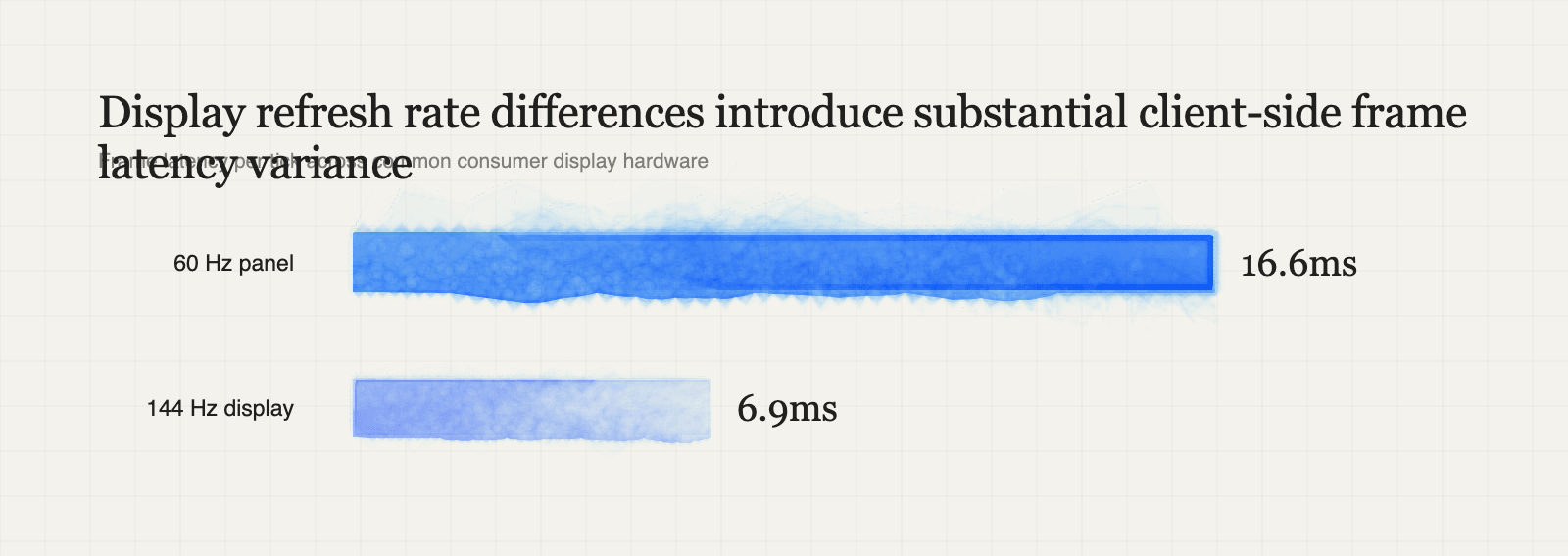
The first point of failure is client-side hardware jitter. Cognitive paradigms like mental rotation or visual working memory depend on sub-second reaction-time (RT) assays. When a coder agent generates raw HTML5/JavaScript tasks without strict display synchronization, hardware heterogeneity invalidates the data. A participant running a 60 Hz laptop panel introduces frame latencies of ~16.6 ms per tick, whereas another on a 144 Hz display records frames at ~6.9 ms. If the agent fails to bind stimulus presentation strictly to requestAnimationFrame and high-resolution performance timers (performance.now()), rendering jitters easily dwarf actual human cognitive variance. Furthermore, subjects routinely background browser tabs or trigger ad-blockers that disrupt WebSocket and fetch payloads. Without transactional local persistence via IndexedDB and offline retry queues, multi-trial experimental runs suffer silent data truncation midway through a block.
The second breakdown happens at the platform orchestration boundary. Interfacing agent workflows with recruitment APIs like Prolific introduces distributed state race conditions. A transient HTTP 502 or delayed webhook during high-volume recruitment can desynchronize study seat counts. Without idempotent study dispatch wrappers and distributed locks—architectures I discussed when examining durable execution and checkpoints—an agent retry loop can rapidly double-allocate recruitment slots, duplicating participant payouts and draining project balances.
Compounding this is pool contamination. Crowdsourced labor pools face automated bot scripts and participants using generative models on attention checks. If the ingestion validator lacks strict behavioral anomaly screening—such as flagging uniform inter-trial click latencies or impossible response times ($<150\text{ ms}$)—the system feeds poisoned noise into the analysis tier.
Finally, the most insidious failure mode is post-hoc data dredging by downstream analysis LLMs. LLMs are trained to be helpful synthesizers; when handed noisy empirical data yielding a null result ($p > 0.05$), an unconstrained analysis agent instinctively attempts to rescue the narrative. It will re-slice the cohort by demographic subsets, retroactively adjust reaction-time trim thresholds, or swap a primary ANOVA for exploratory non-parametric alternatives until an "interpretable" pattern emerges.
To prevent automated post-hoc dredging, analysis agents must never write free-form statistical code on raw data. Telemetry must be piped directly into deterministic Python or R sandboxes running the frozen, pre-registered scripts. The LLM's role must be strictly limited to reading immutable tabular outputs from fixed runtime scripts, completely barring it from recalculating metrics once empirical data has been observed.
Applied Blueprints: Three Production Systems You Can Build with Empirical Multi-Agent Loops
The mechanical pattern established by Wehr et al.—pairing an orchestration core with external human recruitment endpoints—extends far beyond cognitive psychology papers. Any engineering team managing complex interfaces, eval foundations, or security policies can adopt this architecture to collect empirical ground truth overnight.
A high-value enterprise implementation is a Continuous Automated UX and Cognitive Load Regression Harness. Rather than relying on subjective design reviews, this pattern turns UI pull requests into empirical behavioral assays within a nightly CI/CD pipeline. When an engineer alters a checkout flow or dashboard topology, a GitHub Actions webhook triggers a task bundler that wraps the updated view into a standardized jsPsych micro-usability task. A recruitment coordinator calls the Prolific study creation API to dispatch a balanced cohort of thirty human testers. Telemetry streams into an SQLite telemetry store, recording time-to-first-click, total completion latency, and missed affordances. A statsmodels analysis agent executes preregistered two-sample t-tests against baseline versions, failing the CI/CD merge if the interface introduces statistically significant cognitive friction or task degradation. The primary failure mode here is uncontrolled client-side heterogeneity; if the pipeline fails to filter out mobile browsers or high-DPI scaling artifacts, hardware-driven noise drowns out real UI friction. Similarly, without strict behavioral bot screening, automated clickers will generate false performance leaps.
A second operational pattern is an Empirical LLM Benchmark Calibrator Against Human Baseline Cohorts. Public LLM benchmarks suffer from immediate contamination and static difficulty ceilings. By deploying this looped architecture, an evaluation team can pair frontier model benchmarks with matched, real-time crowdsourced human cohorts to establish dynamic difficulty curves on novel reasoning tasks. The pipeline uses a task generation agent to synthesize unseen domain problems, tests them via a headless Playwright harness, and routes them simultaneously to an LLM evaluation cluster and a human participant pool recruited via Prolific. A statistical worker runs psychometric Item Response Theory (IRT) estimation to calibrate the true empirical discriminability and difficulty of each question. The operational tripwire to guard against is instruction ambiguity: if the task-generating agent outputs subtle semantic inconsistencies, human participants fail due to poor framing rather than cognitive difficulty, artificially exaggerating the benchmark's apparent hardness.
Finally, security organizations can instantiate Automated Human-in-the-Loop Red Teaming for Social Engineering Defenses. Static phishing awareness simulations rarely adapt to novel prompt techniques. This architecture uses a persona generation agent to craft adaptive spear-phishing lures and contextual pretexting scenarios, deploying them to consenting crowdsourced test pools inside a simulated corporate React dashboard. As users interact with the environment, a Bayesian logistic regression worker models which narrative hooks, authority frames, and urgency cues exhibit the highest susceptibility variance across participant cohorts. The critical operational danger here is regulatory and platform boundary violation: if the persona agent generates lures that exceed pre-cleared ethical distress parameters or deploy unvetted deceptive claims, you risk triggering immediate recruitment platform account bans or violating human-subject research ethics constraints.
Operating Empirical Agents in Production: Structured DSLs, State Stores, and Model Routing
Running an empirical multi-agent system reliably across dozens of personas requires abandoning informal agentic scripting. If you let an LLM write unconstrained, raw JavaScript for browser-based experiments, your pipeline will constantly break in production. Coder agents will inevitably emit inconsistent state managers, introduce timing jitter, or miss DOM lifecycle events.
The production standard is to constrain code generation to a declarative domain-specific language (DSL). Instead of writing raw client scripts, the task-generation agent must populate a strictly typed JSON schema that defines trial blocks, visual assets, stimulus presentation durations, and allowed input listeners. A pre-compiled, hardened frontend wrapper—built on top of jsPsych or a robust client-side harness—consumes this declarative artifact. This ensures that every task deployed to human subjects inherits guaranteed requestAnimationFrame timing loops, offline IndexedDB telemetry buffering, and automated telemetry retries out of the box, without trusting generative code to get client-side plumbing right.
Similarly, conversational context windows must never serve as the state layer across a 50-agent workflow. Passing execution logs through prompt context across a 17-hour run guarantees context drift, token bloat, and hallucinated experimental parameters. Production empirical pipelines require a decoupled PostgreSQL state store as the single source of truth. Every transition—from the preregistered hypothesis and stimulus manifest to raw participant telemetry logs and computed covariance matrices—must be persisted with SHA-256 integrity hashes in relational tables. Agents must read from and write to this database through deterministic schema contracts, treating conversational context purely as a scratchpad for bounded subtasks.
Finally, controlling operational costs over 30-million-token runs demands a tiered model routing topology. You do not need expensive frontier reasoning models to ingest JSON payloads or compute F-tests. Use high-capability frontier models strictly where semantic reasoning is non-negotiable: literature synthesis, hypothesis framing, and manuscript narration. For trial schema validation, data cleaning, reaction-time outlier filtering, and inferential testing, route workloads to deterministic Python workers or smaller, low-latency models running in sandboxed runtimes. Reserving frontier tokens for conceptual orchestration while offloading data crunching to deterministic code keeps cycle costs predictable and eliminates statistical hallucination entirely.
Resources
Updated 2026-10-11 by Mehran Mozaffari.
Related posts
1 November 2026
Code Mode vs Function Calling for Multi-Step Agents
1 November 2026
Offline Trajectory Scoring Replaces the Prompt Engineering Treadmill
1 November 2026
Should You Build Your Enterprise Agent Semantic Layer on NVIDIA Auto Ontology? Not Yet
31 October 2026
Unreal Engine Skills for Claude Code: How Epic Bypassed the Binary Asset Barrier to Mutate Live Viewports
30 October 2026
Agent Memory Was an Indexing Problem All Along
29 October 2026
How 3D OS Turns a Coding Agent into a Six-Department Animation Studio Without a GUI