The Machine-Native Forge: Stripping Git Down to a Content-Addressable Execution Log
Most engineering teams trying to persist agent state make a classic category error: they treat Git as collaboration software rather than what Linus Torvalds actually designed—a content-addressable object filesystem with built-in directed acyclic graph (DAG) lineage. They stand up internal GitHub Enterprise or GitLab instances, wrap them in personal access tokens, and then wonder why their agent workflows hit API rate limits, grind to a halt waiting on simulated pull request workflows, or buckle under the operational bloat of human-oriented webhooks and access control checks.
In a fully autonomous system, no human is clicking "Approve PR." No one is inspecting a web UI diff before an agent executes its next tool turn. The entire apparatus of code reviews, branch protection rules, and enterprise pull-request machinery is dead weight that introduces tens of seconds of latency and fragile API dependencies into execution loops that need sub-second turnaround.
Perplexity took a radically different path with Perplexity Projects. Internally, every project workspace is an independent Git repository, but stripped down to a machine-native execution engine. Git is treated purely as an append-only, cryptographic state database. Every file mutation across interactive queries, background tool executions, and file generation tasks becomes a deterministic commit object referenced by a cryptographic hash (SHA-1 or SHA-256).
My view as an operator is straightforward: autonomous systems must possess granular, line-by-line auditability and reproducible state tracking, but they cannot afford the human-centric forge tax. Traditional key-value session stores and relational database rows flatten file hierarchies, making surgical rollbacks and partial state branching awkward to implement. Standard container volume persistence, meanwhile, creates opaque binary state blobs that defy structured inspection. A headless Git engine gives you tree-level deduplication, deterministic lineage, and native three-way merge resolution off the shelf.
By eliminating the web layer, ACL validations, and PR review semantics, Perplexity transforms Git into an ultra-lean transport protocol. The forge doesn't ask who approved the patch; it validates tree integrity, writes packfiles, and advances ref pointers at machine speed. As I argued when deconstructing always-on agents and context state engineering, isolating durable lineage from runtime compute is the only way to scale long-horizon execution. Here, Git ceases to be a developer portal and becomes what it was always best suited for: an immutable audit log and deterministic state backend for autonomous code generation.
The Lifecycle of an Agent Turn: From Ephemeral MicroVM to S3 Packfile
Understanding this architecture requires tracing a single execution turn from trigger to persistence. When an agent is invoked to run code, scrape documentation, or mutate an existing project file, it does not connect to a long-lived development server or reuse a dirty container. Instead, the orchestrator provisions an isolated, throwaway compute sandbox—a lightweight container or microVM—with zero persistent disk attached.
sequenceDiagram
    participant Orchestrator as Agent Orchestrator
    participant Sandbox as Ephemeral MicroVM Sandbox
    participant Gateway as Stateless Git Gateway
    participant S3 as S3 Object Store

    Orchestrator->>Sandbox: Spin up container & dispatch turn payload
    Sandbox->>Gateway: Git fetch / clone working tree (repo ref HEAD)
    Gateway->>S3: Read packfiles & tree objects
    S3-->>Gateway: Return objects
    Gateway-->>Sandbox: Stream shallow working tree
    Note over Sandbox: Agent executes tool turn & generates file diffs
    Sandbox->>Sandbox: Stage changes & git commit
    Sandbox->>Gateway: Git push packfile (smart wire protocol)
    Gateway->>S3: Stream raw packfile & commit objects
    Gateway->>Gateway: Atomically update branch ref pointer
    Gateway-->>Sandbox: Ack push success
    Sandbox-->>Orchestrator: Return turn completion response
    Orchestrator->>Sandbox: Destroy sandbox container (zero host drift)
    Gateway-)Orchestrator: Trigger post-commit ingestion & RAG re-index
The ephemeral sandbox initializes by issuing a shallow clone or tree fetch against a stateless Git gateway daemon. This gateway replica sits completely decoupled from durable storage, speaking standard Git smart-HTTP or SSH transport on the frontend while reading and writing raw Git objects, refs, and packfiles directly to S3 on the backend. The sandbox receives only the working tree necessary for the active prompt.
Inside the microVM, the agent completes its assigned task—editing source files, writing new test fixtures, or generating artifacts. Once the step finishes, the sandbox stages the updated files, forms a standard Git commit, and pushes the generated packfile upstream to the Git gateway. The gateway commits the object directly to S3 and atomically advances the branch ref.
Crucially, the moment the push receives an ack, the orchestrator tears down the sandbox container entirely. Throwaway compute guarantees zero host drift: background daemons cannot linger, orphaned processes are terminated, and temporary credentials or scraped sensitive material cannot survive to pollute subsequent turns.
The transaction does not end at the commit ack. Upstream in the orchestrator pipeline, the successful ref advance triggers asynchronous post-commit ingestion workers. These background services inspect the unified diff between the new commit and its parent, parsing updated documents, code symbols, and markdown files into chunked embeddings. By the time the user or the orchestrator dispatches the subsequent turn, the retrieval layer is already synchronized with the exact commit hash of the workspace.
State Storage Architectures: Git DAGs vs. MicroVM Snapshots vs. Shared Worktrees
State persistence across multi-turn agent platforms has coalesced around four architectural models, each trading off snapshot granularity against the coupling of storage and compute.
quadrantChart
    title State Granularity vs Compute-Storage Coupling
    x-axis Coupled Host Disk --> Decoupled Stateless Storage
    y-axis Block & Memory Snapshots --> File-Level Commit DAG
    quadrant-1 Headless Git Forges
    quadrant-2 Intercepting Virtual Filesystems
    quadrant-3 Ephemeral MicroVM Snapshots
    quadrant-4 Persistent Dev Workspaces
    Perplexity Projects: [0.88, 0.86]
    Freestyle Git: [0.82, 0.78]
    Modal Sandboxes: [0.78, 0.32]
    Fly.io Sprites: [0.68, 0.22]
    E2B: [0.72, 0.28]
    Daytona: [0.24, 0.42]
At one extreme sit persistent workspaces like Daytona and local Git worktrees popularized by open-source systems like SWE-agent. These keep a running host or container alive and issue git worktree add commands against a shared local checkout. They avoid network overhead for intermediate tool loops, but they fail catastrophically in multi-tenant consumer products: dormant runners tie up expensive NVMe blocks, and any host crash destroys unpushed progress.
At the other extreme are microVM snapshotters like Modal Sandboxes, E2B, and Fly.io Sprites. These snapshot entire Firecracker memory states and root filesystems to resume execution in sub-second windows. While sub-200ms resume latency is exceptional for running interactive REPLs, block-level snapshotting is fundamentally the wrong abstraction for file-based project workspaces. Storing full disk delta layers forces you to re-persist operating system binaries, system caches, and runtime interpreters over and over. Worse, diff extraction is opaque: to understand what an agent changed across turns for RAG indexing or rollbacks, you must mount the disk image and run external diff utilities rather than parsing an immutable, content-addressed commit tree.
| Dimension | Headless Git on S3 (Perplexity) | MicroVM Snapshots (Modal, Fly.io) | Persistent Workspaces (Daytona, SWE-agent worktrees) |
|---|---|---|---|
| Storage Cost Density | Ultra-High: Deduplicated zlib trees and packfiles stored on S3. Zero cost for idle compute. | Medium–Low: Storing rootfs block layers and memory dumps balloons storage costs. | Poor: Bound to running instances, attached block volumes (EBS/NVMe), and idle VM overhead. |
| Auditability & Diff Extraction | Native & Semantic: Every turn produces an immutable commit hash and line-level diff directly indexed into RAG. | Opaque: Changes are buried in filesystem block layers; extracting text diffs requires mounting disk images. | Native: Emits standard Git commits, but depends on agents running clean CLI commands without state drift. |
| Cold-Start Latency | Fast (Tree Fetch): Fresh microVM boots clean; fetches only working tree files from object storage. | Sub-Second (Resume): Restoring from suspended memory snapshot can resume active processes in under 200ms. | Moderate–Slow: Bound to VM provisioning latency or local container pool attachment. |
| Binary Payload Overhead | Severe without LFS: Large binaries, PDFs, and virtualenvs balloon .git packfile traversal over S3 wire. |
Excellent: Block storage handles multi-gigabyte models, checkpoints, and binaries transparently. | Moderate: Standard local POSIX disk handles large binaries without packfile penalties. |
| Merge & Concurrency Friction | High on Shared Files: Simultaneous agent writes to identical files cause non-trivial three-way merge failures. | Isolated Forks: Sandboxes fork cleanly, but reconciling outputs back into a single branch requires custom logic. | High: Parallel branches require local rebases that fail if agents lack AST-aware conflict resolution. |
This highlights why Perplexity’s choice is so deliberate. In search-driven research platforms, user think-time between turns spans minutes or hours. Paying to preserve running VMs or persistent block disks during idle pauses is economic suicide. Storing packfiles on S3 costs fractions of a cent per month, achieving unrivaled storage density.
The contrast with developer-facing peers like Freestyle (freestyle.sh) clarifies the domain boundary. Freestyle exposes programmatic headless Git microVMs via public APIs, coupling sub-second VM state forking directly to Git branch primitives for general-purpose software builders. Perplexity, conversely, built an internal, specialized storage engine where the Git DAG acts as the direct synchronization bridge between ephemeral sandboxes and consumer RAG pipelines. It trades raw binary handling efficiency for ultra-dense, auditable, file-level persistence.
The S3 Object Store Concurrency Wall: Ref Locking, Thundering Herds, and Lost Commits
The architectural elegance of streaming bare packfiles directly to S3 hits a brutal distributed systems barrier the moment multiple agents push concurrently. Git was designed around POSIX filesystem invariants. When a standard Git server updates a branch reference, it relies on atomic filesystem operations: writing the target commit hash to a temporary lockfile like refs/heads/main.lock and executing an atomic rename() syscall over refs/heads/main.
Object storage does not work this way. S3 provides strong read-after-write consistency for individual keys, but it lacks native multi-key transactions, POSIX file renames, and atomic compare-and-swap (CAS) primitives on arbitrary key writes.
If your stateless Git gateway translates a push directly into an S3 PUT request targeting s3://bucket/repos/<id>/refs/heads/main, concurrent agent pushes trigger a catastrophic race condition. Suppose Agent Alpha and Agent Beta both initialize from commit A. Both complete their respective sandbox tool turns and construct new packfiles containing commits B and C. If both sandboxes push upstream simultaneously, both stateless gateway replicas accept the packfiles, upload them to S3 prefix storage, and issue concurrent PUT operations to update the ref pointer.
Because S3 resolves concurrent overwrites via last-write-wins (LWW), whichever HTTP request finishes milliseconds later overwrites the reference. If commit C lands last, the ref pointer advances to C, while commit B is silently orphaned. Its packfile exists in object storage, but it vanishes from the Git DAG lineage without returning an error to Agent Alpha. Work simply disappears into the ether.
flowchart TD
    subgraph Parallel Sandboxes
        A1[Agent Alpha: Commit B]
        A2[Agent Beta: Commit C]
    end

    subgraph Stateless Gateways
        G1[Gateway Replica 1]
        G2[Gateway Replica 2]
    end

    subgraph Broken Paradigm: Raw S3 Writes
        S3Ref[S3: refs/heads/main]
    end

    subgraph Resilient Paradigm: Atomic CAS
        DDB[(External KV / DynamoDB)]
        S3Data[S3 Packfile Storage]
    end

    A1 -->|Push Packfile B| G1
    A2 -->|Push Packfile C| G2

    G1 -.->|Race: PUT refs/heads/main = B| S3Ref
    G2 -.->|LWW Overwrite: PUT refs/heads/main = C| S3Ref
    S3Ref -.->|Silent Drop| Orphan[Commit B Orphaned in DAG]

    G1 -->|Write Objects| S3Data
    G2 -->|Write Objects| S3Data
    G1 -->|CAS: Check Parent == A, Set B| DDB
    G2 -->|CAS Fails: Parent != B| DDB
    DDB -.->|Rejection & Fast Retry| A2
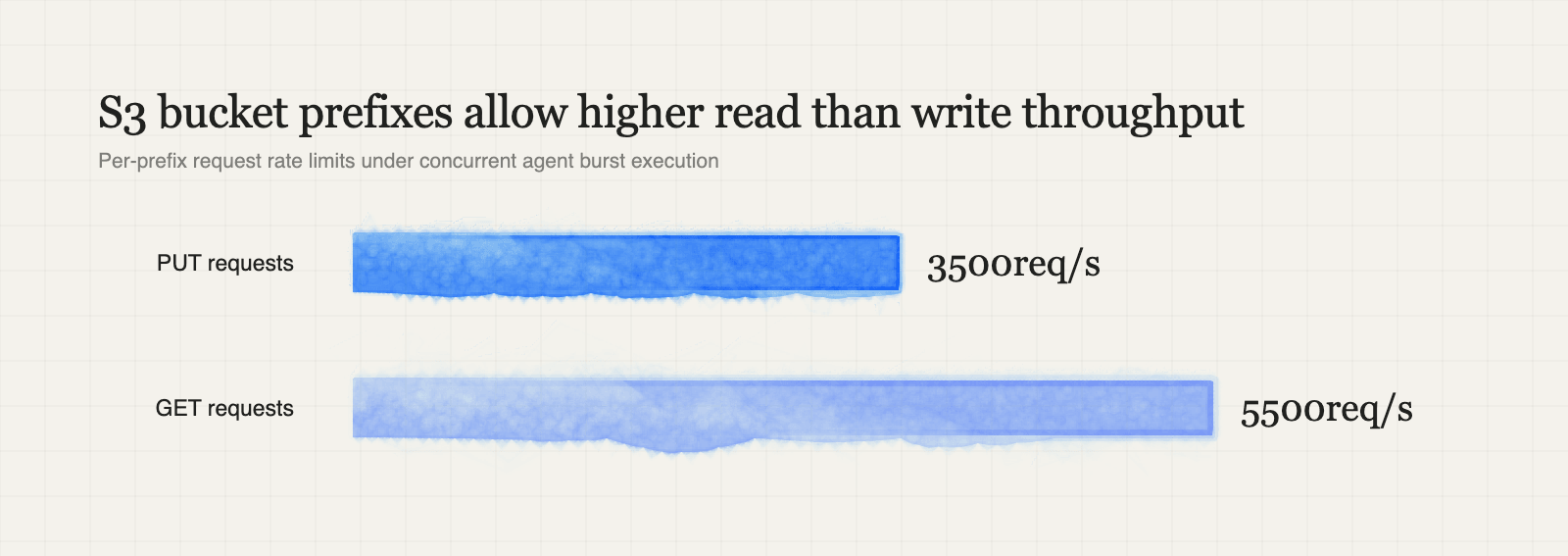
Switching to naive optimistic locking at the Git transport layer merely swaps silent data loss for thundering herds. When gateway workers reject non-fast-forward pushes, dozens of short-lived agent sandboxes enter concurrent retry loops, pulling, rebasing, and attempting to re-push. Under heavy burst execution, this exhausts S3 bucket prefix rate limits (3,500 PUT and 5,500 GET requests per second per prefix) and explodes request billing.
To survive production, an agent forge must strictly decouple object storage from ref coordination. Packfiles and loose Git objects belong on S3, but reference pointers must never be updated via raw object PUT calls. Production topologies must route ref updates through a strongly consistent, transactional metadata layer like DynamoDB using conditional expressions (attribute_exists and expected_hash == current_tip), Spanner, or a distributed Raft consensus group. Only after the external CAS transaction succeeds is the authoritative pointer updated, ensuring strict DAG linearity and protecting parallel executions from silent divergence.
Autonomous Rebase Hell and the Semantic-Syntactic Divergence Problem
Even with strict atomic ref coordination at the storage layer, the algorithmic reality of multi-agent collaboration remains: parallel branches eventually have to merge. In human developer teams, three-way merge conflicts are routine friction resolved by human judgment. In autonomous agent loops, a standard Git three-way merge is a catastrophic failure mode.
When two agents modify intersecting regions of the same file, a standard git pull --rebase fails and injects conflict markers into the working tree. Leaving an autonomous LLM to parse <<<<<<< HEAD, =======, and >>>>>>> markers in raw text without structured guardrails is an invitation to chaos. Absent AST awareness, language models routinely botch line-level reconciliation: they hallucinate synthetic variable names, duplicate function signatures, drop critical closing delimiters, or strip out adjacent logic that wasn't part of the conflict. The agent reports a successful resolution, commits the file, and pushes a syntactically invalid tree that breaks downstream turns.
Yet autonomous rebase failures are merely the obvious problem. The far more dangerous, insidious failure mode in headless forges is the semantic-syntactic divergence problem.
sequenceDiagram
    participant Main as Branch: main (Ref @ Commit A)
    participant Agent1 as Agent Alpha (Refactor Interface)
    participant Agent2 as Agent Beta (Add Interface Consumer)
    participant Gateway as Git Gateway & CI Gate

    Main->>Agent1: Branch at Commit A
    Main->>Agent2: Branch at Commit A

    Note over Agent1: Renames fetch_user() to get_user_by_id()
    Agent1->>Agent1: Commit B (Clean Line Diff)

    Note over Agent2: Adds caller invoke_service(fetch_user)
    Agent2->>Agent2: Commit C (Clean Line Diff)

    Agent1->>Gateway: Push Commit B
    Gateway->>Main: Advance main to Commit B

    Agent2->>Gateway: Push Commit C (Rebase over B)
    Note over Gateway: Line-level 3-way merge succeeds cleanly!<br/>Zero syntactic line collisions.

    rect rgb(240, 210, 210)
        Note over Gateway: Syntactic Linearity Preserved<br/>Semantic Integrity Broken!
        Gateway->>Gateway: Run Pre-Commit Gate: Typecheck & AST Lint
        Gateway-->>Agent2: Gate Failed: NameError 'fetch_user' undefined
        Agent2->>Agent2: Reroute to Isolated Task Branch (agent/task-beta)
    end
Git operates entirely on text syntax. It evaluates line offsets, not Abstract Syntax Trees or execution graphs. Consider a workspace where Agent Alpha refactors an internal module, renaming fetch_user() to get_user_by_id(), while Agent Beta concurrently updates an analytics script to call fetch_user().
When Agent Beta pulls and rebases over Agent Alpha’s commit, Git inspects the line diffs. Because the two agents edited completely different files, the three-way merge completes cleanly with zero text conflicts. Syntactically, the Git DAG is pristine. Semantically, the repository state is completely broken: the runtime will crash with a missing symbol the moment the code runs.
Treating clean Git diffs as proof of state integrity is fatal in an autonomous forge. If an agent system advances branch pointers purely because lines merged without collision, semantic rot silently cascades across every subsequent agent turn, poisoning the retrieval context and embedding outdated or broken interfaces into the project index.
This is why production agent forges must embed fast continuous integration gates directly into the push path. Just as we require durable checkpoints when designing state machines and execution graphs with LangGraph, an autonomous forge must treat every agent push as an untrusted patch. Before advancing the authoritative branch pointer, the gateway must trigger fast, deterministic validation: syntax tree linting, typechecking, and critical unit tests. If the gate fails, the push must be rejected or automatically routed to an isolated exploratory branch (agent/task-<id>), preserving main as a verified, semantically sound baseline.
Mitigating Object Store Latency and Packfile Degeneracy at Scale
The most insidious performance decay in an S3-backed Git forge does not show up on day one. It manifests after a project has survived forty or fifty multi-turn agent sessions. In a local POSIX environment, Git operations leverage kernel buffer caches, memory-mapped files (mmap), and sub-millisecond inode lookups. Over an object store, every individual Git object lookup becomes an HTTPS GET or HEAD request incurring 20 to 80 milliseconds of network round-trip latency.
When agents execute iterative scratchpad loops—generating temporary helper scripts, mutating intermediate test files, and committing every failed turn—they emit an avalanche of loose objects and microscopic .pack and .idx files. If an ephemeral microVM attempts a standard shallow fetch (git fetch --depth 1) against a fragmented upstream repository, the wire protocol must traverse object trees by issuing hundreds of discrete HTTP requests back to S3. I have watched clean sandbox boot latencies degrade from an acceptable 400 milliseconds to upwards of twenty-five seconds simply because the repository’s packfile layout was fragmented into thousands of tiny keys.
flowchart LR
    subgraph Fragmentation Degeneracy
        A[Agent Scratchpad Loops] -->|Dozens of Micro-Commits| B[Fragmented S3 Objects]
        B -->|Hundreds of HTTP GETs| C[Degraded 20s+ Clone Latency]
    end

    subgraph Production Pipeline
        D[Sandbox Pre-Receive Hook] -->|Reject Blobs & .env| E[Stateless Git Gateway]
        E -->|Atomic Push| F[(S3 Packfiles)]
        G[Off-Peak Compactor] -->|Squash & git repack| F
        F -->|Pre-Baked Bundle| H[Local NVMe Cache]
        H -->|Sub-Second OverlayFS Mount| I[Clean Sandbox Boot]
    end
Halting this latency collapse requires three coordinated architectural interventions:
First, eliminate binary pollutants at the perimeter. Unchecked agents routinely check in SQLite scratch databases, local Python virtual environments (.venv), scraped raw HTML dumps, and model caches. Enforce strict server-side pre-receive hooks inside the stateless Git gateway that parse incoming packfiles before they hit S3. Reject any push containing untracked binary blobs over a strict threshold (such as 1 MB) or blacklisted directory patterns, forcing large intermediate assets into dedicated ephemeral scratch buckets rather than the permanent Git DAG.
Second, decouple intermediate agent churn from long-term DAG depth. Autonomous agents need granular commit history while executing a sub-task, but future turns do not need to preserve twelve failed compilation attempts of a single helper script. Implement scheduled background compaction workers that run asynchronous squashing and packfile consolidation. Off-peak compaction jobs download fragmented packfile clusters, squash intermediate micro-commits into discrete milestone commits, run git pack-objects with aggressive delta compression, and write consolidated, multi-megabyte packfiles back to object storage under coordinated locks.
Third, bypass remote network clones entirely via NVMe-backed bundle caches. Running a fresh wire clone over object storage on every sandbox boot is architectural malpractice. Instead, have your host fleet pull consolidated git bundle snapshots onto local NVMe volumes and mount them into execution containers using copy-on-write overlays like OverlayFS. Ephemeral sandboxes boot from local disk in milliseconds, needing only an incremental delta fetch against the S3 gateway to synchronize the few commits pushed since the last bundle snapshot.
Building Headless Agent Forges: Three Practical Blueprints for Production Teams
For engineering teams looking to escape the operational baggage of human-centric code hosts, translating this paradigm into production requires deliberate boundary design. You do not need to build a bespoke storage engine from scratch to reap the benefits of machine-native persistence.
The foundational design I recommend starting with is a DynamoDB-Coordinated Headless Git Gateway on S3. This architecture combines a lightweight, containerized smart-HTTP Git gateway implemented in Go using go-git or C via libgit2 with AWS S3 as the packfile backend. The gateway terminates incoming agent HTTP transport connections, pipes incoming packfiles directly into partitioned S3 prefixes (s3://repos/<project-id>/objects/pack/), and delegates all branch reference management to DynamoDB. Before updating refs/heads/main, the gateway executes a DynamoDB conditional write validating that the parent commit matches the expected tip hash (attribute_exists and expected_tip == current_hash). This gives you strict compare-and-swap semantics without paying for stateful Git daemon servers. The failure mode to design around here is agent retry storms: if a runaway agent enters an unconstrained self-correction loop, rapid-fire non-fast-forward push rejections can trigger dozens of automated re-pushes, threatening AWS S3 prefix request rate limits and inflating your request billing.
To eliminate cold-start penalties across high-throughput agent fleets, teams can extend this baseline into a Copy-on-Write Bundle Caching Layer for Fast Sandbox Cold Starts. Instead of forcing execution sandboxes to fetch remote packfiles over HTTP on every turn, a background daemon periodically serializes the repository’s tip into a compressed git bundle stored on a shared, host-local NVMe scratch directory. When the orchestrator provisions a new microVM, it instantiates the container's root working directory directly from the cached bundle snapshot using an OverlayFS ephemeral mount driver. The sandbox is instantly operational with zero network transfer, pulling only the incremental commits that occurred between the bundle timestamp and the current ref. The critical distributed systems trap in this pattern is cache invalidation race conditions: if an agent container initializes from an out-of-sync local bundle and the gateway accepts its push without validating reference continuity, the agent commits code detached from the upstream tip, introducing silent branch divergence.
Finally, to address the semantic-syntactic divergence problem, high-assurance code generation systems require an AST-Aware Pre-Receive Verification Gate for Agent Commits. Rather than treating clean text-based three-way merges as proof of workspace health, the headless Git gateway routes incoming commits through a dedicated pre-receive daemon equipped with Tree-sitter parsers and language-specific type checkers. The gate validates syntax trees, verifies symbol references, and runs critical unit test suites directly against the proposed tree objects before writing the new reference pointer. If the commit passes syntactic line merging but fails AST validation—such as an agent renaming an interface consumer without updating the provider—the gate intercepts the advance and automatically routes the patch into an isolated quarantine branch (agent/quarantine-<task-id>), preventing silent interface rot from corrupting the authoritative project baseline. The production trap to balance here is push-path latency: language parsers and static analyzers cannot stall the gateway past the sandbox’s HTTP push timeout window, or you will trigger false-positive network failures that abort viable agent turns.
Resources
Updated 2026-10-11 by Mehran Mozaffari.
Related posts
1 November 2026
Code Mode vs Function Calling for Multi-Step Agents
1 November 2026
Offline Trajectory Scoring Replaces the Prompt Engineering Treadmill
1 November 2026
Should You Build Your Enterprise Agent Semantic Layer on NVIDIA Auto Ontology? Not Yet
31 October 2026
Unreal Engine Skills for Claude Code: How Epic Bypassed the Binary Asset Barrier to Mutate Live Viewports
30 October 2026
Agent Memory Was an Indexing Problem All Along
29 October 2026
How 3D OS Turns a Coding Agent into a Six-Department Animation Studio Without a GUI