Moving Past Grammar Polish: Why Technical Documents Need Formal Stress-Testing
We have solved the syntactic surface of technical writing, and it has made reviewing significantly harder. With modern language models baked into every IDE, text editor, and drafting pipeline, documents no longer fail because of clumsy phrasing, disjointed cadence, or grammatical slips. Instead, we are flooded with prose that reads with absolute stylistic fluency while harboring catastrophic conceptual bugs, unstated assumptions, and broken proofs underneath. When text sounds authoritative by default, editorial assistants like Grammarly or Paperpal become functionally obsolete for real technical validation. Polishing the tone of a design specification whose distributed consensus invariants collapse under network partitions is pure waste.
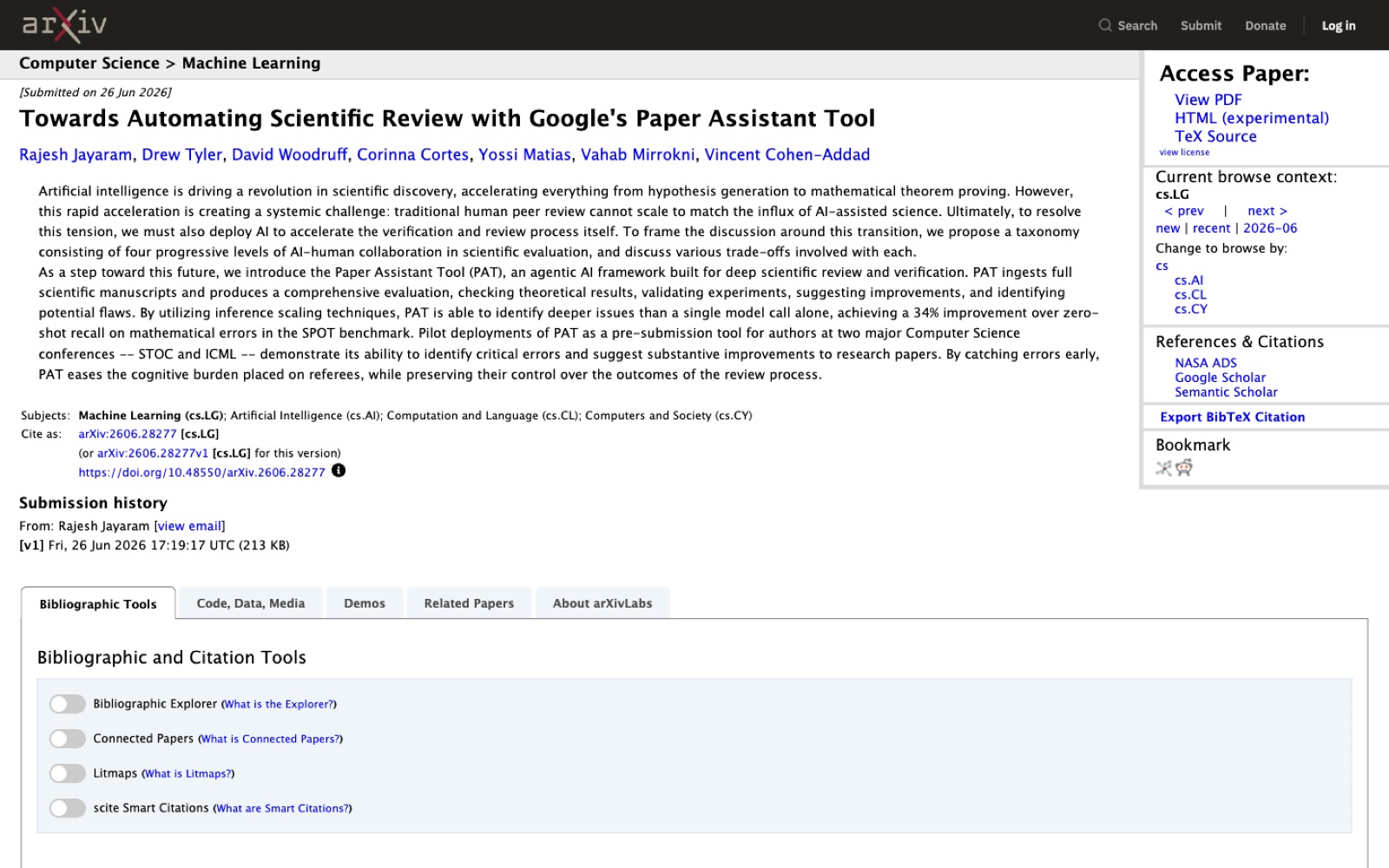
This validation bottleneck is exactly why I find the evolution of Google Research’s Paper Assistant Tool (PAT) into Deep Review so compelling. Documented initially in "Towards Automating Scientific Review with Google's Paper Assistant Tool" (arXiv:2606.28277 by Rajesh Jayaram, Drew Tyler, David Woodruff, Corinna Cortes, Yossi Matias, Vahab Mirrokni, and Vincent Cohen-Addad), the system underwent trial by fire across flagship machine learning and theoretical computer science conferences, processing more than 15,000 manuscript submissions across venues like STOC, ICML, NeurIPS, and ICLR. That pilot corpus exposed the core reality of technical manuscripts: authors do not need another tool to suggest active voice or verify citation styling. They need an adversarial auditor that attacks the internal consistency of their claims before a program committee or production incident does.
The transition from PAT to Deep Review marks an intentional shift from academic pre-submission assistance to a generalized cognitive stress-tester for complex proposals and architectural design docs. Instead of mimicking the superficial persona of an irritable peer reviewer—a parlor trick that fine-tuned wrappers have played for years—the architecture treats a technical proposal as a system of executable claims. If an engineering proposal asserts sub-millisecond p99 latency while relying on a synchronous cross-region database hop, or if a theorem assumes a bounded variance that violates its own earlier lemma, the flaw is semantic and structural, not linguistic. Addressing that requires moving past single-prompt evaluations and building dedicated verification pipelines designed to interrogate logic rather than syntax.
Deconstructing the Document: The Mechanics of Semantic Segmentation
The most common architectural mistake teams make when attempting document auditing is relying on brute-force context windows. Dumping a 30-page research manuscript or a sprawling distributed systems proposal into a single two-million-token context window fails reliably. Long-context models can retrieve scattered facts, but they struggle to maintain the tight, multi-hop deductive rigor needed to verify that a theorem on page 24 strictly abides by an edge-case qualification tucked away in Section 2. Dense attention maps diffuse across high token counts, allowing subtle semantic contradictions to slip through unnoticed.
Deep Review abandons monolithic context evaluation in favor of a structured semantic decomposition pipeline. When raw LaTeX or PDF source enters the system, an ingestion and parsing engine decomposes the text into discrete, semantically typed units: formal propositions, theorem statements, proof blocks, experimental protocol descriptions, and narrative background. This is not arbitrary chunking by character count; it is structural parsing that recognizes the boundaries of mathematical and logical dependency.
flowchart TD
    A["Raw Document Ingestion<br/>(LaTeX / PDF Source)"] --> B["Semantic Segmentation Engine"]

    B --> C1["Mathematical & Proof Blocks<br/>(Lemmas, Bounds, Theorems)"]
    B --> C2["Empirical & Experimental Blocks<br/>(Setups, Baselines, Metrics)"]
    B --> C3["Narrative & Context Blocks<br/>(Related Work, Overview)"]

    D["Global Symbol & Context Table<br/>(Definitions, Invariants, Notation)"] -.-> E1["Domain & Logic Verification Agents"]
    D -.-> E2["Grounding & Web Verification Agents"]

    C1 --> E1
    C2 --> E1
    C2 --> E2
    C3 --> E2

    E1 --> F["Anti-Hallucination Synthesizer<br/>& Cross-Section Arbitrator"]
    E2 --> F

    F --> G["Structured Verification Report<br/>(Logic Gaps, Flawed Steps, Missing Bounds)"]
The engineering crux of this decomposition is maintaining global coherence without drowning sub-agents in local noise. The pipeline extracts a global symbol and invariant table that tracks custom notation, variable scopes, baseline assumptions, and system constraints across the entire document. When a proof block is dispatched to a Domain Logic Verification agent, that agent receives the specific lemma under test alongside the exact global definitions that bound it, rather than the distracting narrative of the introduction.
Similarly, empirical claims and baseline comparisons are routed to Grounding Agents equipped with retrieval tools to cross-reference citations, verify reported baseline metrics against external literature, and check experimental consistency. The outputs of these parallel checks are not simply concatenated into a prompt response; they pass through an Anti-Hallucination Synthesizer. This arbitration layer evaluates contradictions between sections, discards false alarms caused by localized notation shifts, and filters out spurious critiques before delivering a consolidated, structural diagnostic report.
Inference Scaling as an Asymmetric Weapon: Dynamic Compute Allocation
Uniform token compute is an inefficient way to read technical work. In any substantial design doc or mathematical manuscript, information density varies wildly. A three-page literature review or high-level architecture overview requires standard comprehension and basic factual grounding. Conversely, a half-page inductive proof establishing an algorithm's approximation ratio, or a subtle concurrency boundary in a transaction manager, contains exponential branching paths where a single unstated assumption invalidates the entire construction. Treating these sections with identical compute budgets guarantees failure on the parts that actually matter.
Deep Review operationalizes test-time inference scaling by treating compute allocation as an asymmetric resource. Instead of running a static chain across the whole text, the execution engine dynamically routes dense, mathematically loaded blocks into deeper recursive search branches. The system spends its token budget on exploratory derivation passes, counterexample search, and proof-tree backtracking precisely where the density of formal claims warrants it.
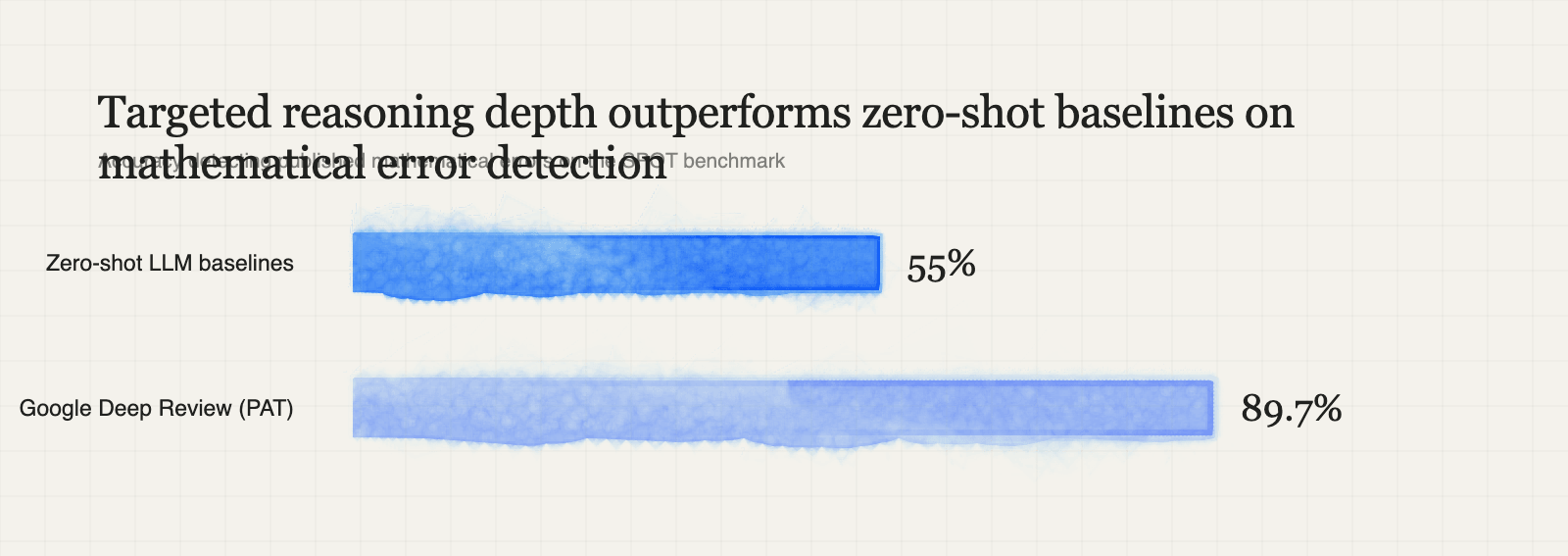
The empirical payoff of this asymmetric strategy is striking. On the SPOT benchmark—a rigorous evaluation dataset consisting of real-world mathematical errors that caused published peer-reviewed papers to require errata or formal retractions—standard zero-shot LLM baselines scored roughly 55% accuracy. They read the erroneous derivations, smoothed over the mathematical gaps, and accepted the flawed conclusions. The underlying PAT architecture, by contrast, leveraged its targeted reasoning depth to reach 89.7% accuracy on detecting those exact failure points.
That performance delta illustrates why naive verification prompts fail. Proof verification is fundamentally a search problem over deductive branches, not a next-token prediction task over smooth prose. When an agent verifies a complex lemma, it must attempt to construct counterexamples, test boundary conditions at infinity or zero, and confirm that every intermediate inequality preserves directionality. Allocating deep reasoning compute specifically to those fragile structural nodes, while leaving narrative sections to lightweight validation passes, delivers deep verification rigor without making full-manuscript auditing economically impossible.
Auditing vs. Emulation: Situating Deep Review in the Automated Review Ecosystem
Most efforts to automate peer review over the past three years have pursued persona emulation rather than verification. Projects like OpenReviewer and Reviewer2 fine-tune open weights or prompt frontier models over conference corpora to simulate the cynical tone of an overburdened reviewer. They generate critiques that mimic the stylistic cadence of program committee feedback—complaining about marginal empirical delta, requesting extraneous baselines, or asserting that an approach lacks novelty—without ever parsing an equation or validating whether a theorem's premises actually imply its conclusion.
At the opposite extreme sit deterministic rule checkers like SciScore and StatReviewer. These systems are invaluable for checking whether an author reported sample sizes, registered clinical trials, or followed reporting guidelines, but they operate via rigid heuristics. They cannot tell you if a lemma collapses under an edge case. Meanwhile, autonomous discovery pipelines like Sakana AI's The AI Scientist embed automated reviewers directly into closed generative loops (a dynamic I explored in my analysis of Closing the Empirical Loop: Engineering Multi-Agent Scientific Discovery with Live Human Participants), but their internal evaluation passes are designed to weed out synthetic hallucinated artifacts rather than adversarial stress-testing of human research.
Deep Review occupies an intentional, high-leverage position in this space. It pairs deep formal verification with strict confinement to Level 1 of the paper's four-level automation taxonomy: author-facing self-auditing.
| Tool Category | Representative Systems | Verification Depth | Compute Model | Primary Blindspots |
|---|---|---|---|---|
| Cognitive Stress-Testers | Google Deep Review (PAT) | High (deductive proofs, logic bounds, empirical consistency) | Heterogeneous inference scaling, multi-agent decomposition | Unstated domain assumptions, high async latency, compute cost |
| Persona-Mimicking LLMs | OpenReviewer, Reviewer2 | Low (semantic critique, review tone emulation, formatting) | Uniform single-pass inference | Superficial critique, hallucinated counter-arguments, algebraic blindness |
| Autonomous Science Loops | Sakana AI Scientist | Moderate (automated metric scoring, synthetic novelty checks) | Iterative generation-and-scoring loop | Self-referential drift, benchmark overfitting, rubber-stamping |
| Deterministic Rule Checkers | SciScore, StatReviewer | Low (regex and NLP guideline adherence) | Fixed deterministic heuristics | Zero conceptual or algebraic understanding |
| Editorial Linters | Paperpal, Writefull | Minimal (grammar, tone, structural style) | Lightweight text-transformation models | Purely syntactic; blind to invalid logic |
Resisting the temptation to deploy Deep Review as an automated conference gatekeeper (Level 4) is the most critical architectural decision Google made. The moment you place an automated auditor at the front door as an acceptance filter, you incentivize authors to game its semantic segmentation heuristics. Confining the engine to a pre-submission diagnostic mirror keeps it an adversarial ally for the author.
The 10% Failure Envelope: Hidden Constants, Measure-Zero Flaws, and Recursive Hallucinations
Achieving 89.7% accuracy on the SPOT benchmark is an impressive empirical baseline, but in a production auditing workflow, that remaining 10% failure envelope is where the sharpest engineering risks hide. The failure modes of deep document verification do not look like ordinary model hallucinations; they manifest as subtle mathematical blindspots and runaway reasoning loops.
The first major class of failures stems from soft asymptotic boundaries and implicit regularity conditions. Large language models struggle when an asymptotic bound holds generically, but collapses under hidden constant blowups or measure-zero edge distributions. If an author writes an algorithm running in $O(n)$ time while suppressing a constant factor that scales exponentially with a secondary parameter ($2^{k^2}$), verification sub-agents routinely treat the step as sound because the algebraic notation matches canonical forms. Similarly, if a derivation implicitly assumes a smooth, continuous probability density without explicitly stating it, the domain agent will often accept the step without recognizing that the proof fails on discrete supports.
Equally dangerous is the gap between deductive validity and semantic significance. A multi-agent verifier can trace every line of a derivation, confirm that every algebraic substitution is airtight, and deliver a clean bill of health on an argument that ultimately proves a vacuous tautology. Because the system audits internal consistency rather than real-world utility, authors can receive a false sense of security regarding the actual contribution of their work.
The most insidious operational failure mode, however, is recursive hallucination fueled by test-time inference scaling. Because the engine allocates deep recursive compute to dense mathematical sections, its reasoning trees branch aggressively. If an agent misparses an author's custom notation or misinterprets an initial scoping definition in Step 1, spending 10x the token compute does not correct the error. Instead, the downstream reasoning chain treats the flawed initial premise as ground truth and expends its compute budget constructing an elaborate, highly persuasive, and completely incorrect formal proof that the author's sound logic is flawed.
When this happens, the author receives an authoritative, multi-page critique alleging a fatal gap in their proof. Deciphering that the auditor's critique is logically rigorous but anchored in a phantom misread of Section 2 burns hours of engineering time. Until arbitration layers can cross-examine their own root premise assumptions before scaling up deductive compute, human authors must remain the final arbiter of every flagged critique.
Operational Realities: Asynchronous Latency, Review Paralysis, and Triage Architecture
The primary operational friction of Deep Review is not token consumption; it is the human workflow disruption created by a 10-to-20-minute turnaround. In modern engineering and research environments, authors are conditioned for either instantaneous inline completion or asynchronous human peer review that takes days. A multi-agent audit landing twenty minutes after submission creates an awkward operational middle ground. During crunch periods—such as the final forty-eight hours before a major conference deadline or an architectural review board—authors iterate in rapid bursts. Submitting a draft, continuing to rewrite downstream sections, and receiving a twenty-page critique against a stale revision induces severe context thrash. Managing these asynchronous runs cleanly requires durable workflow orchestration rather than ephemeral API calls, an operational requirement central to architectures like those I analyzed in Beyond Ephemeral Loops: State Machines, Checkpoints, and Durable Execution with LangGraph and LSD.
When that asynchronous critique finally arrives, raw output generates immediate review paralysis. If an adversarial auditor returns forty unfiltered observations, authors drown in noise. The pipeline’s narrative and domain agents routinely flag stylistic liberties, unstated engineering conventions, or benign local notation variations as "missing assumptions" alongside genuine structural flaws. When a pedantic formatting critique sits right next to a proof-breaking sign error or an unhandled network partition, authors burn cognitive energy parsing trivia.
To make this operational, adopting teams must implement a strict automated triage layer that partitions observations before human delivery. The pipeline needs to distinguish critical structural defects—such as formal logical contradictions, invalidated core lemmas, or impossible distributed state guarantees—from advisory inquiries like unstated edge-distribution assumptions or missing baseline sweeps. Below both sits syntactic noise: localized notation shifts, minor variable redefinitions, or pedantic formatting flags. Without an automated gate that suppresses or collapses advisory and syntactic feedback into an unobtrusive summary, authors will spend hours debating semantic nitpicks while overlooking fatal structural defects.
Equally critical is grounding privacy. While an academic system like PAT benefits from querying public literature indices via web search, deploying document auditing across enterprise design docs, term sheets, or patent disclosures creates immediate data leakage vulnerabilities. Sub-agents given unfettered search tools will unwittingly emit internal service names, proprietary project codenames, and confidential operational metrics in their query parameters. Production auditing pipelines must enforce air-gapped retrieval boundaries, restricting domain verification agents to enterprise-internal knowledge bases and strictly isolated vector stores.
Implementing Pre-Submission Auditing Pipelines: Architectures for Applied Teams
The first governance rule for any team implementing an internal stress-testing pipeline is resisting the urge to automate approval gates. The moment you wire an automated verifier into a mandatory CI/CD sign-off check or an automated conference rejection filter, you trigger Goodhart's Law: engineers and researchers begin writing to placate the semantic segmentation heuristics rather than communicating clearly with human peers. Deep Review’s high utility depends entirely on its posture as an author’s private, pre-submission mirror. It is an adversarial sparring partner designed to help authors find their own blindspots before human review, not an automated gatekeeper.
For teams managing distributed systems documentation, a high-leverage blueprint to build is an Internal RFC and Architecture Decision Record (ADR) Stress-Tester. Implemented as an asynchronous auditing webhook listening on Markdown repositories or Notion workspaces, the pipeline’s semantic segmentation engine isolates service contracts, state guarantees, and failure modes from high-level narrative prose. Specialized consistency agents run reasoning models against internal API schemas and service dependencies to flag cross-service consistency gaps, network partition blindspots, or unstated throughput assumptions prior to team review, while an anti-hallucination reconciliation worker compiles inline annotations. The primary operational hazard here is proprietary nomenclature drift: sub-agents will frequently misinterpret internal shorthand or microservice acronyms as undefined variables, requiring a tightly maintained internal symbol table in the global context.
Where formal numbers carry legal or balance-sheet consequences, teams can adapt this architecture into a Financial and Contractual Risk Bound Verification Pipeline. This pre-signing audit system ingests financial models, term sheets, or vendor service agreements to mathematically audit fee schedules, payment triggers, and liability boundary conditions. The architecture links a structural document chunker that maps prose clauses to tabular numeric formulas, pairs formal logic derivation agents with code-interpreter sandboxes for deterministic arithmetic recalculation, and enforces a strict local-grounding engine with zero external search access to guarantee deal privacy. The implementation pitfalls to guard against are twofold: accidental query leaks of confidential project codenames via tool calls, and uncontrolled recursive reasoning spend when agents attempt to parse deliberately ambiguous or obfuscated legal phrasing.
Finally, for applied research groups, the most immediate implementation is a Pre-Submission ML Empirical and Benchmark Integrity Auditor. Acting as an automated pre-flight check, the tool audits paper drafts directly against the underlying experiment codebase to catch data leakage, mismatched baseline claims, and inconsistent ablation statistics. The system couples a LaTeX parser that extracts metric tables and claim statements, a static code analysis agent inspecting data loader splits and random seed routines in the repository, and a cross-modal verification agent that cross-checks plotted error bars in figures against reported tabular checkpoints. Adopting teams must watch for parsing fragility: complex multi-column LaTeX tables and rasterized vector plots frequently trigger false discrepancy alerts, demanding robust table normalizers before running expensive reconciliation passes.
Resources
Updated 2026-10-13 by Mehran Mozaffari.
Related posts
1 November 2026
Code Mode vs Function Calling for Multi-Step Agents
1 November 2026
Offline Trajectory Scoring Replaces the Prompt Engineering Treadmill
1 November 2026
Should You Build Your Enterprise Agent Semantic Layer on NVIDIA Auto Ontology? Not Yet
31 October 2026
Unreal Engine Skills for Claude Code: How Epic Bypassed the Binary Asset Barrier to Mutate Live Viewports
30 October 2026
Agent Memory Was an Indexing Problem All Along
29 October 2026
How 3D OS Turns a Coding Agent into a Six-Department Animation Studio Without a GUI