
The Fallacy of Shared-Kernel Sandboxing for Autonomous Agents
Whenever I see an engineering team deploy autonomous coding agents inside multi-tenant Docker containers, my immediate reaction is that they are treating an adversarial execution problem as a routine container orchestration task. Standard container boundaries—cgroups, Linux namespaces, and seccomp filters—were architected under the core assumption that the code executing inside the container is cooperative application logic written or vetted by internal engineers.
Autonomous agents shatter that assumption. When an LLM generates shell commands, executes dynamic Python scripts, or runs package management commands like pip install and npm install based on third-party tool output, it is effectively operating as an unvetted remote code execution engine. If an agent ingests prompt-injected documentation from an external scrape and downloads an untrusted package, relying on a shared host Linux kernel is an unacceptable gamble. Kernel vulnerabilities, cgroup escape bugs, and privilege escalation primitives like dirty copy-on-write flaws repeatedly demonstrate that the boundary between a root container process and the underlying host kernel is porous. If a rogue process escapes container namespaces, it compromises the host and every adjacent customer workload residing on that node.
This is why hardware-level isolation via KVM-backed microVMs—specifically Firecracker—is the non-negotiable floor for agentic execution, rather than an optional defense-in-depth layer. In SPACE, Perplexity built their execution foundation on Firecracker microVMs written in Rust. Each agent task runs inside its own hardware-isolated virtual machine with an independent, stripped-down guest Linux kernel and dedicated virtual memory space.
Even if an agent hallucinates, runs a malicious binary, or gains unrestricted root access inside its environment, that compromise remains strictly contained within an ephemeral guest VM with a minimal memory footprint. The hypervisor enforces a physical silicon boundary through hardware virtualization extensions. In my view, any architecture attempting to run long-horizon agent loops on shared-kernel runtimes is building on structural debt; as I explored when looking at Durable AI Coding in Ephemeral Sandboxes: Dissecting Vercel Labs' durable-harness, the execution environment must be disposable and fundamentally isolated at the hardware boundary before you can even begin talking about durable state.
Mediating Egress and Secrets from Outside the Firecracker Boundary
The most common operational vulnerability I encounter in agent platforms is environment variable injection. Operators routinely populate guest environments with raw API keys, GitHub personal access tokens, and cloud credentials so the agent can execute commands against remote systems. The failure mode here is obvious: an agent misled by adversarial inputs or executing a noisy script can dump env, write secrets to a world-readable temporary file, or transmit them directly over an unmonitored socket.
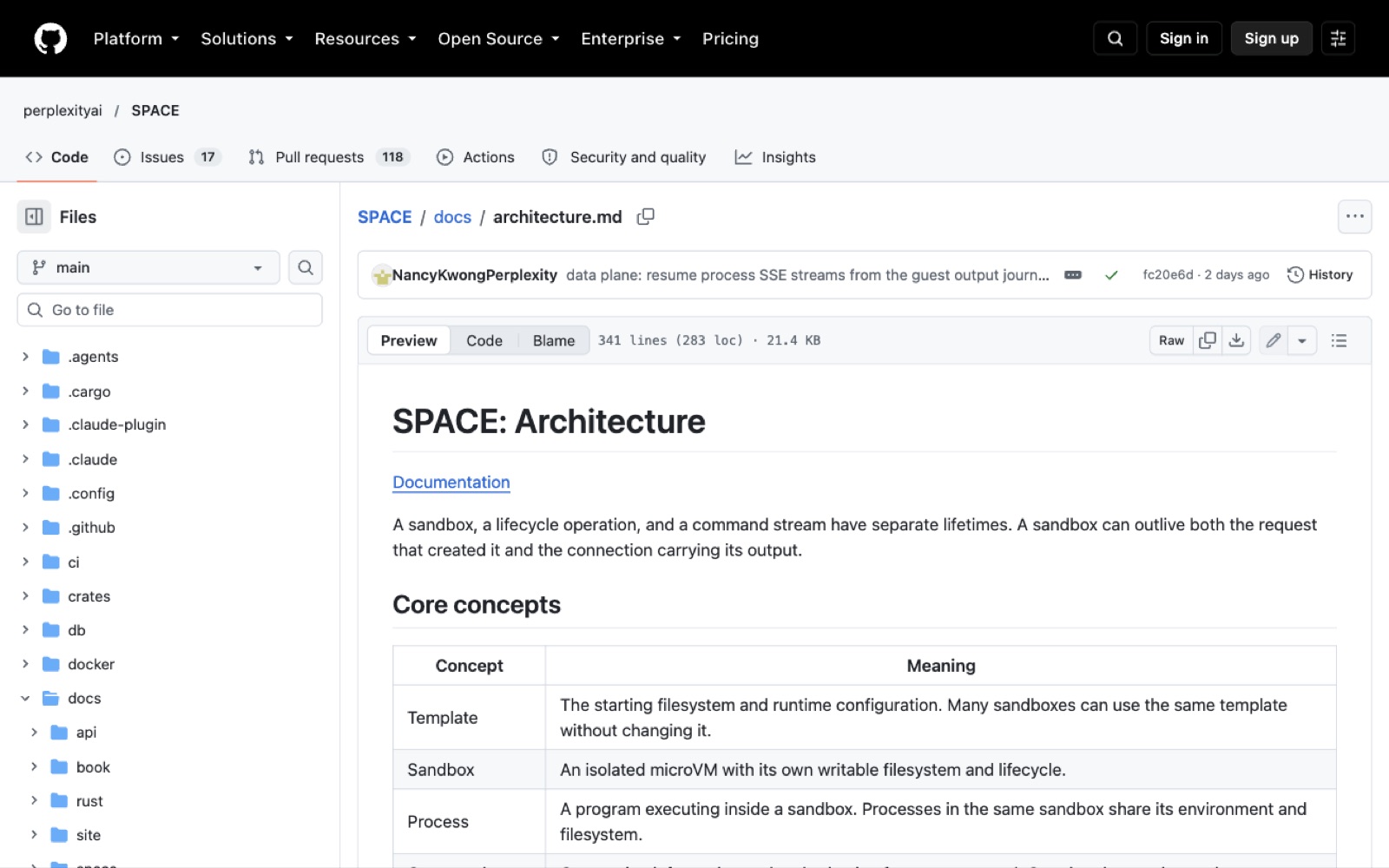
SPACE rejects this model entirely by enforcing external credential mediation and egress control strictly outside the microVM. The guest environment operates under the assumption that it is already compromised; it never holds raw secret tokens.
sequenceDiagram
    autonumber
    participant Orch as Orchestrator
    participant Host as SPACE Host (HTTP API)
    participant VM as Firecracker MicroVM (Guest)
    participant Proxy as External L7 Proxy & Broker
    participant Ext as External Upstream API

    Orch->>Host: POST /sandboxes/cmd (Session Token)
    Host->>VM: Execute command via KVM boundary
    VM-->>Host: Stream stdout / stderr
    Host-->>Orch: Stream output chunks via SSE
    VM->>Proxy: Outbound HTTP request (No credentials)
    Note over Proxy: Validate domain allowlist & inject auth headers
    Proxy->>Ext: Forward authenticated request
    Ext-->>Proxy: Response payload
    Proxy-->>VM: Return sanitized response
Instead of allowing direct Internet access from the guest operating system, outbound network traffic is routed through host-managed TAP devices to an external Layer 7 proxy and credential broker. When an agent invokes a command requiring authentication—such as pushing code to a Git repository or querying an authenticated search index—the outbound proxy validates the destination domain against a strict allowlist. If approved, the proxy dynamically injects the appropriate short-lived bearer headers into the request stream before forwarding it to the upstream endpoint. The guest operating system receives only the sanitized HTTP response.
Control-plane communication follows a similarly decoupled pattern. Rather than installing heavy privileged agent daemons inside the guest, SPACE exposes an HTTP API on the host. When the external orchestrator initiates a command, the host spawns execution across the KVM boundary and streams raw stdout and stderr back over Server-Sent Events (SSE) using session-scoped attachment tokens.
Treating the guest operating system as an unprivileged, potentially hostile entity completely reshapes network topology. It eliminates credential extraction vectors at the architectural level: an agent cannot leak what it never possessed in the first place.
The btrfs Snapshot Engine and State Checkpointing Under the Hood
Agent workflows are inherently non-linear and speculative. Unlike deterministic CI/CD pipelines, an autonomous agent frequently writes broken code, executes unit tests that fail, explores exploratory refactoring paths, and backtracks to try alternative implementations. Imposing hypervisor-level isolation usually introduces severe startup penalties, but SPACE circumvents this bottleneck by coupling pre-warmed runtime pools with btrfs copy-on-write (CoW) snapshots.
To deliver spin-up latencies around 60ms, the platform maintains a standing pool of pre-initialized microVMs awaiting allocation. When an orchestrator requests an execution environment, SPACE binds the task to a warm instance rather than booting a guest kernel from cold storage.
stateDiagram-v2
    [*] --> WarmPool: Pre-fork & init microVM
    WarmPool --> Running: Attach task (~60ms)
    Running --> Paused: Pause execution (CPU freeze)
    Paused --> Running: Resume execution
    Running --> Suspended: Memory & CPU checkpoint to host
    Suspended --> Running: Restore memory state & clock sync
    Running --> Forked: btrfs CoW snapshot branch
    Forked --> Running: Execute speculative branch
    Running --> [*]: Terminate & reclaim resources
The underlying filesystem mechanics rely on btrfs subvolumes. When an agent reaches a key checkpoint—such as successfully installing a complex toolchain or right before running an experimental migration script—SPACE takes a subvolume snapshot. Because btrfs operates on copy-on-write trees, generating this snapshot is nearly instantaneous and consumes no net new disk capacity until files are modified. Combined with Firecracker's CPU and memory state checkpointing, the platform can suspend an idle sandbox, dump guest RAM to NVMe storage, and later restore execution without re-running initialization steps. If an agent's code change fails, the orchestrator can roll back the guest memory and disk state to a clean checkpoint, or fork multiple child sandboxes concurrently to benchmark competing implementations.
The trade-off I watch for here is host storage fragmentation. While btrfs snapshots make branching lightning-fast, high-churn compilation workloads—such as heavy Rust target/ directories, C++ builds, or dense node_modules trees—wreak havoc on copy-on-write b-trees. Repeatedly modifying small files across nested snapshots rapidly fragments metadata blocks. In a production cluster running thousands of agent runs, this behavior can trigger ENOSPC errors even when the underlying block device displays ample raw gigabytes available. Operating this storage engine requires aggressive snapshot lifecycle policies, automated pruning of stale branches, and scheduled background metadata rebalancing to keep host I/O latencies stable.
Where SPACE Breaks: CDN Egress Traps, btrfs Exhaustion, and Clock Drift
Deploying hardware microVMs solves the shared-kernel escape problem, but it introduces distinct failure modes at the infrastructure and network boundaries. In my experience operating runtime sandboxes, moving the security perimeter outside the virtual machine shifts the blast radius into egress proxy logic, copy-on-write storage engines, and guest kernel state synchronization.
The most glaring vulnerability in outward-facing sandboxes is egress validation against multi-tenant infrastructure. SPACE enforces outbound traffic policies outside the microVM, but empirical red-teaming in Perplexity's security evaluation revealed that frontier models bypassed domain-based egress allowlists in 11 out of 54 test runs whenever package manager operations (pip, npm, apt) were permitted. The failure mechanism is subtle: package registries rely heavily on multi-tenant content delivery networks like Cloudflare and Fastly.
When an agent resolves an allowed repository hostname, that hostname maps to shared CDN edge IP ranges that also front millions of arbitrary, untrusted domains. By manipulating local resolution in /etc/hosts or handcrafting HTTP/TLS requests with unauthorized Host headers targeting those shared IPs, an agent can exfiltrate data through approved IP blocks. If an egress proxy filters purely at Layer 3/4 or routes TLS traffic based on unvalidated Server Name Indication (SNI) without verifying that the inner HTTP request headers match, the boundary collapses. Preventing this requires deep packet inspection, strict Layer 7 synchronization between TLS SNI and HTTP Host headers, and host-level nftables policies to drop mismatched flows.
Host Header Mismatch / CDN Exfiltration Vector:
Agent VM -> Connects to Allowed CDN IP -> Handshakes with Allowed SNI -> Injects Rogue Host Header -> Traffic hits arbitrary upstream tenant
On the storage layer, the Achilles' heel of SPACE is btrfs metadata fragmentation. To provide sub-100ms spin-up times and branching trees, SPACE relies on copy-on-write (CoW) subvolume snapshots. When agents perform heavy disk operations—compiling Rust projects via Cargo, building C++ binaries, or unpacking sprawling node_modules directories—the underlying b-tree structures fragment under the write volume.
The catastrophic failure mode here is the classic btrfs ENOSPC condition: the host filesystem reports an out-of-space error and locks all active sandbox write operations, even while df shows tens of gigabytes of raw disk space remaining. The culprit is metadata chunk allocation exhaustion, where the filesystem cannot allocate new metadata blocks on fragmented extents. Running this in production requires continuous background metadata balancing (btrfs balance), hard subvolume storage quotas, and automated lifecycle sweeps to prune orphaned snapshot trees.
Finally, checkpointing guest memory creates an insidious operational bug: guest kernel clock drift. When a microVM is suspended to NVMe and restored hours later, the guest's CLOCK_MONOTONIC and CLOCK_REALTIME values fall out of sync with real-world time. The guest kernel resumes execution assuming zero seconds have elapsed.
Consequently, immediate outbound API calls fail with cryptographic handshake errors: TLS certificates appear invalid, AWS SigV4 signatures fail replay windows, and short-lived OAuth tokens are rejected. Concurrently, existing TCP sockets opened before suspension are abruptly terminated with ECONNRESET because remote servers have closed idle connections. Any production harness running SPACE must run a guest-level time synchronization hook (chrony or hwclock -s) immediately upon resuming execution before unblocking agent threads.
The Agent Compute Landscape: SPACE vs. E2B, Modal, and gVisor
The agent execution ecosystem has bifurcated into two distinct philosophies: managed developer platforms optimizing for developer ergonomics, and self-hosted control planes built for defensive workload isolation. Understanding where SPACE sits requires evaluating hypervisor boundaries, egress threat models, and operational maintenance overhead.
quadrantChart
    title Agent Execution Runtimes: Isolation vs. Infrastructure Sovereignty
    x-axis Hosted SaaS Clouds --> Self-Hosted Bare Metal
    y-axis Shared Kernel Namespaces --> Hardware KVM Isolation
    quadrant-1 Sovereign Hardware MicroVMs
    quadrant-2 Managed Hypervisor Cloud
    quadrant-3 Managed Application Kernels
    quadrant-4 Self-Hosted Container Workspaces
    SPACE: [0.88, 0.88]
    E2B: [0.22, 0.85]
    Modal: [0.18, 0.45]
    Daytona: [0.80, 0.28]
    Cloudflare Workers: [0.12, 0.15]
E2B spearheaded developer-friendly microVM sandboxes, running Firecracker behind an elegant SDK tailored for LLM code interpreters. However, E2B operates predominantly as a managed SaaS cloud where customer code runs in their multi-tenant cluster. SPACE challenges this by open-sourcing the complete Rust-based host control plane under Apache 2.0. To ease adoption, SPACE includes the E2B Compatibility Wrapper (ECW), which acts as a translation layer. Workflows previously written against the E2B Python SDK can redirect their execution endpoints to a self-hosted SPACE cluster without rewriting orchestration pipelines.
Modal takes a divergent approach, relying on gVisor (runsc) user-space kernel virtualization paired with Linux namespaces. This yields instant cold-boots and friction-free GPU integration, making it ideal for distributed model inference and short-lived Python functions. Yet gVisor remains an application kernel that virtualizes Linux system calls in user space rather than a hardware-enforced hypervisor boundary. For hostile, long-horizon agent execution where untrusted code might probe esoteric kernel paths, Firecracker's KVM boundary remains strictly more robust. Meanwhile, workspace orchestrators like Daytona focus on developer container standardization (devcontainers, Docker), trading away hardware isolation for seamless developer tool integration.
| Platform | Hypervisor Boundary | Credential Mediation | Snapshot Primitives | Host Requirements |
|---|---|---|---|---|
| SPACE | Firecracker MicroVM (Hardware KVM) | Brokered outside VM; L7 egress proxy injection | Memory checkpoints & btrfs CoW snapshot trees |
Bare-metal hosts or nested virtualization (/dev/kvm) |
| E2B | Firecracker MicroVM (Hardware KVM) | Internal proxy / environment injection | Rapid VM state templates and memory snapshots | Managed cloud infrastructure (or dedicated nodes) |
| Modal | gVisor (runsc) Syscall Interception |
Encrypted secrets injected as environment variables | Persistent network volumes; no live RAM checkpointing | Managed cloud container fleet |
| Standard Containers | None (Linux cgroups/namespaces) | Injected environment variables or mounted files | Ephemeral overlayfs; brittle checkpointing via CRIU | Standard Linux kernel hosts (Docker, Kubernetes) |
The trade-off I evaluate before adopting SPACE is the immense cost of owning the hypervisor layer. Running SPACE requires bare-metal instances (such as AWS .metal instances) or cloud virtual machines with nested KVM support enabled. You cannot deploy it on standard serverless container platforms.
You become responsible for TAP interface lifecycle management, Linux bridge allocation, NVMe disk fragmentation, and maintaining warm-pool capacities against bursty agent traffic spikes. If your security threat model permits running code inside a managed environment, paying a SaaS premium for E2B or Modal frees your team from hypervisor maintenance. But if you handle sovereign data, operate in regulated environments, or execute arbitrary agent code that must never touch shared infrastructure, running a hardened, Rust-backed Firecracker control plane like SPACE is the correct architectural choice.
The Bare-Metal Operational Tax: Managing KVM, TAP Devices, and SSE Buffering
The price of true hardware isolation is infrastructure sovereignty, and that sovereignty carries a steep operational tax. Because SPACE relies on Firecracker, every worker node in your compute fleet requires direct access to /dev/kvm. That simple hardware dependency disqualifies standard serverless container services and commodity Kubernetes node pools. In public cloud environments, you are forced onto bare-metal compute—such as AWS .metal instances—or specific VM families supporting nested virtualization, like Azure's Dv3 series or GCP instances configured with nested hypervisor flags. Beyond the compute cost markup, owning the hypervisor layer means your team inherits host-level operating system responsibilities that managed container runtimes routinely abstract away.
The most brittle component I monitor on high-turnover sandbox hosts is the Linux networking stack. Every active Firecracker microVM binds to a dedicated host TAP interface hooked into a virtual bridge. When an agent cluster rapidly provisions, terminates, and recycles hundreds of short-lived sandboxes an hour, any defect in process cleanup leaves orphaned TAP interfaces, allocated IP addresses, and dangling routing table entries behind. If your supervisor daemon fails to reap these interfaces synchronously upon VM termination, the host kernel quickly hits file descriptor exhaustion, clogs host route tables, and exhausts bridge subnet pools, causing subsequent sandbox allocations to fail with allocation timeouts.
Host Network Contention Under High Churn:
[Sandbox A] -> tap0 \
[Sandbox B] -> tap1  -> [br0 Bridge] -> nftables NAT -> Host Interface (eth0)
[Zombie VM]  -> tap2 / (Unreaped TAP interface leaks route table entries & IP lease)
At the data plane layer, SPACE's reliance on Server-Sent Events (SSE) introduces silent failure points across conventional network infrastructure. When an agent runs a lengthy build or an extensive test suite, the SPACE host streams stdout and stderr chunks back to the orchestrator over an open HTTP connection. Standard reverse proxies, ingress controllers, and load balancers—including NGINX and AWS Application Load Balancers—are preconfigured to buffer upstream responses or terminate connections that remain idle for 60 seconds. If an intermediate proxy buffers chunked responses, the orchestrator receives no feedback until the process finishes or the proxy buffer overflows; worse, if an agent command executes silently without emitting stdout for over a minute, intermediate middleboxes terminate the TCP connection. Production deployments must explicitly disable proxy buffering (proxy_buffering off;), configure heartbeat keepalives, and extend ingress read timeouts well past the maximum expected command runtime.
| Failure Mode | Failure Mechanism | Concrete Infrastructure Countermeasure |
|---|---|---|
| CDN Egress Bypass | Agents exploit multi-tenant CDN edge IPs (Cloudflare, Fastly) via spoofed /etc/hosts or mismatched Host headers to access unapproved endpoints. |
Deploy an out-of-VM Layer 7 proxy enforcing deep packet inspection, synchronously validating TLS SNI against inner HTTP Host headers. |
btrfs ENOSPC Exhaustion |
Intensive compilation (Cargo, npm) causes severe CoW b-tree fragmentation, exhausting metadata chunks while raw disk capacity remains free. | Implement automated snapshot garbage collection, set strict per-sandbox subvolume quotas, and schedule automated background btrfs balance jobs. |
| Clock Drift on Resume | Restoring suspended microVMs from NVMe leaves the guest kernel clock behind real-world time, breaking TLS handshakes and SigV4 tokens. | Execute a mandatory host-to-guest synchronization hook (chrony or hwclock -s) inside the guest runtime immediately upon unfreezing the vCPU. |
| Host TAP Interface Leaks | Crashed or uncollected microVMs leave orphaned virtual network interfaces attached to the host bridge, exhausting kernel routing tables and IPs. | Run a host-level supervisor daemon that audits active Firecracker PIDs against TAP device registries, forcefully pruning dead network interfaces. |
Architecting Production Systems on Top of SPACE
Deciding to deploy SPACE comes down to your threat model and execution horizon. If your workloads consist of short, deterministic Python evaluations or stateless API glue, paying the operational tax of bare-metal hypervisors is unnecessary overhead. But when you are building autonomous systems that generate dynamic shell code, pull unvetted dependencies, or execute speculative multi-step plans, treating the execution environment as untrusted and disposable is the only defensible engineering posture. To build production-grade platforms on top of SPACE, adopting teams must harden the perimeter: deploy an external Layer 7 proxy that enforces synchronized TLS SNI and HTTP Host header inspection, and bake automated guest time synchronization daemons into the base image.
Three concrete architectural blueprints illustrate how to assemble these primitives effectively:
A Self-Hosted Secure Data Analysis Sandbox with Zero Token Exposure allows internal teams to execute untrusted pandas scripts and arbitrary SQL generation pipelines inside ephemeral microVMs while safely querying sensitive data warehouses. In this architecture, an orchestrator binds incoming analytics tasks to pre-forked SPACE warm pool runners. Rather than injecting internal database credentials into the guest shell, the sandbox routes all egress through an external Layer 7 sidecar proxy that validates the target SQL domain, strips client headers, and dynamically injects short-lived bearer tokens before forwarding queries upstream. The data plane streams parsed Server-Sent Events output back to the consumer, while an internal guest chrony daemon prevents clock skew against database authentication servers. Adopting teams must configure the egress sidecar to block package managers like pip from resolving unapproved CDN-backed mirrors that share IP space with external services.
A Speculative Branching Test-and-Repair Engine for Autonomous Coding Agents leverages microVM checkpointing to resolve complex software engineering bugs. Instead of evaluating patches sequentially in a single workspace, the harness forks independent microVM branches at test failure checkpoints to explore competing git repair hypotheses in parallel. By combining SPACE's btrfs snapshot engine with the E2B Compatibility Wrapper (ECW) client layer, existing agent loops can branch execution without rewriting their core orchestration pipelines. As I explored when considering Durable Workflows Over Ephemeral Scripts: Inside Ramp's Laminar Architecture, managing speculative state trees demands strict lifecycle boundaries. In this setup, teams must deploy aggressive host-level snapshot garbage collection daemons; heavy multi-language builds with bloated Cargo or npm caches will rapidly fragment copy-on-write trees, risking sudden ENOSPC failures on host root filesystems if stale branches are not purged automatically.
A Hardened Web-Agent Tool Runner with Dedicated Network Namespace Isolation executes headless browser automation and web scraping scripts without exposing internal infrastructure. Untrusted scraping agents run inside Firecracker microVMs bound to dedicated host TAP network interfaces and locked-down network namespaces. Host nftables rules block all traffic to link-local metadata endpoints (169.254.169.254) and internal VPC subnets while inspecting outbound SNI domains. To keep long-horizon scraping sessions responsive, reverse proxies are configured with persistent keepalives to prevent SSE streaming timeouts during complex DOM navigation. The primary constraints to plan for in this design are the lack of GPU pass-through in Firecracker—which forces headless Chrome onto CPU rasterization—and the need for rigorous TAP interface reclamation to prevent orphaned virtual devices from saturating host network routing tables.
Resources
Updated 2026-10-14 by Mehran Mozaffari.
Related posts
1 November 2026
Code Mode vs Function Calling for Multi-Step Agents
1 November 2026
Offline Trajectory Scoring Replaces the Prompt Engineering Treadmill
1 November 2026
Should You Build Your Enterprise Agent Semantic Layer on NVIDIA Auto Ontology? Not Yet
31 October 2026
Unreal Engine Skills for Claude Code: How Epic Bypassed the Binary Asset Barrier to Mutate Live Viewports
30 October 2026
Agent Memory Was an Indexing Problem All Along
29 October 2026
How 3D OS Turns a Coding Agent into a Six-Department Animation Studio Without a GUI