
The Illusion of Precision in Open-Ended Agent Evaluation
Every engineering team building autonomous agents eventually confronts the dashboard trap. We deploy a multi-turn agent capable of navigating ambiguous requests, run our CI test matrix, and watch our testing pipeline output clean, comforting scalars: an "88.4% pass rate" or an average "relevancy score of 4.3/5.0." These numbers give product leaders a clean sense of progress, but in open-ended, subjective domains, they are largely mathematical theater. When an agent trajectory spans twenty tool invocations, dynamically generated SQL, web retrievals, and a synthesized final report, deterministic assertions like regex string matching or exit codes collapse. If your task cannot be verified with a unit test, treating an automated model grade as a deterministic boolean is just self-deception.
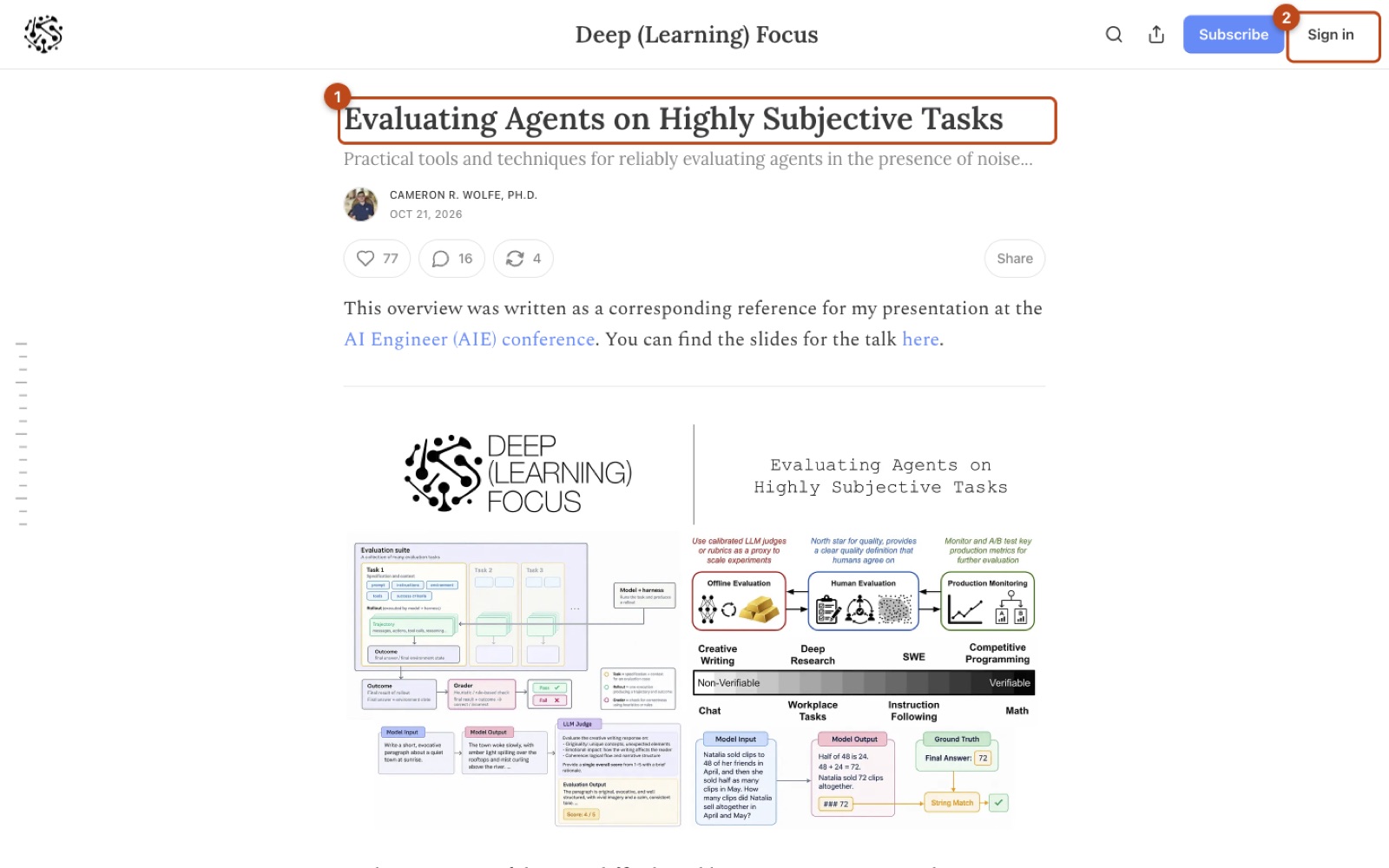
In his analysis presented at the AI Engineer conference, Cameron R. Wolfe outlines a rigorous critique of this status quo. Standard evaluation suites suffer from rapid obsolescence and saturation, encouraging teams to optimize for the idiosyncratic grading quirks of their evaluation models rather than real task competence. When we swap out an agent's reasoning prompt or point it to a newer foundational model, a nominal 3% bump in an uncalibrated LLM-as-a-judge score tells us virtually nothing. Did the agent's task efficacy actually improve, or did the revision simply produce a more verbose markdown layout that triggered the judge's latent length bias?
Wolfe’s response is not another packaged SaaS dashboard offering out-of-the-box evaluation metrics. It is a disciplined systems-engineering methodology structured across three distinct pillars: a human evaluation baseline, an offline pre-deployment evaluation suite, and continuous online production monitoring. Instead of pretending that proxy judges deliver objective ground truth, this framework treats agent outputs as inherently stochastic and proxy evaluators as noisy instruments that require explicit statistical calibration.
The central dilemma for practitioners is stark: we must either absorb the operational overhead of running multi-sample bootstrap evaluations and continuous rater calibrations, or accept that we are optimizing for random evaluator variance rather than genuine system improvement. If we want our evaluation suites to function as dependable engineering gates, we have to discard the illusion of push-button precision.
Tracing an Agent Run: From Trajectory Execution to Statistical Confidence Bounds
When you run an open-ended agent evaluation properly, the execution lifecycle looks entirely different from a standard unit test suite. In an ordinary CI runner, a test case issues a single input, receives a response, runs an assertion, and increments a counter. In Wolfe's evaluation methodology, a single test scenario represents a multi-stage statistical trial designed to isolate agent non-determinism from evaluator bias.
sequenceDiagram
    autonumber
    participant Runner as Test Runner
    participant Sandbox as Hermetic Sandbox
    participant Agent as Agent Trajectory
    participant Judge as Calibrated Judge Ensemble
    participant Stats as Statistical Engine

    Runner->>Sandbox: Initialize isolated container & mock APIs
    loop N Stochastic Execution Seeds
        Runner->>Agent: Dispatch task prompt (Seed i)
        Agent->>Sandbox: Execute tool calls & state changes
        Sandbox-->>Agent: Tool output diffs
        Agent-->>Runner: Emit final trajectory & synthesized artifact
    end
    Runner->>Sandbox: Tear down & wipe environment state
    loop Scoring & Debiasing
        Runner->>Judge: Submit (Artifact A, Artifact B) with criteria
        Runner->>Judge: Submit (Artifact B, Artifact A) [Swap-Eval]
        Judge-->>Stats: Return structured pairwise scores & rubrics
    end
    Stats->>Stats: Bootstrap resample trajectories & judge outputs
    Stats-->>Runner: Report win-rate confidence intervals (95% CI) vs Human Anchor
The process begins inside an isolated execution environment—such as a sandboxed container using Anthropic srt or Docker Containers for Securing Local Agent Execution—where tool calls cannot leave lingering state that corrupts subsequent runs. The test runner does not invoke the agent once; it runs the scenario across multiple stochastic seeds. Because multi-step execution paths diverge significantly based on early tool outputs, observing only one trajectory hides the agent's true behavioral distribution.
Once the runs complete and the sandbox is purged, the trajectory and final artifacts enter the evaluation layer. Instead of asking a single frontier model for an absolute score from 1 to 5, the runner passes the artifact to a calibrated judge ensemble. To strip out position bias—where evaluators reflexively favor the first candidate presented—the runner executes a swap-eval pass, flipping candidate order across model families (for instance, evaluating across both Claude and GPT-4o).
The resulting scores are fed directly into a statistical engine rather than averaged into a scalar. By bootstrapping across both agent rollout trajectories and judge scores, the harness computes explicit confidence intervals around performance deltas. If your revision shows an apparent 4% gain but your 95% confidence bounds span from -2% to +10%, you have not improved your system; you have simply observed evaluator noise. Contrasted with standard prompt test runners that treat subjective assertions as deterministic booleans, this trace makes statistical uncertainty an explicit engineering metric.
The Tripartite Architecture: Anchors, Proxies, and Runtime Telemetry
Building a defensible evaluation system for open-ended agents requires abandoning the pursuit of a single universal metric. Wolfe's framework resolves the tension between operational cost and evaluation fidelity by dividing the problem into three mutually reinforcing layers: human evaluation baselines, automated pre-deployment offline suites, and continuous online telemetry. Each tier serves a specific structural purpose, preventing the engineering anti-pattern where an automated proxy drifts completely unmoored from human utility.
flowchart TD
    subgraph Anchoring ["1. Ground Truth Calibration"]
        H[Human Evaluation Cohorts] -->|Define rubrics & baseline scores| C[Calibrated Offline Judges]
    end

    subgraph PreDeployment ["2. CI/CD Release Gate"]
        C -->|Grade test runs| T[Curated High-Density Eval Set]
        T -->|Calculate bootstrap confidence intervals| G{Statistical Gate: Delta > Margin of Error?}
        G -->|Reject / Recalibrate| T
        G -->|Promote to Production| P[Deployed Production Agent]
    end

    subgraph Observability ["3. Runtime Tracking"]
        P -->|Execute user sessions| O[Production Telemetry & Logs]
        O -->|Track distribution shift & negative feedback| D[Drift Detection]
        D -->|Ingest failing traces & edge cases| T
        D -->|Spot-check human consensus drift| H
    end
The human evaluation tier acts as the structural foundation of the entire system. Instead of turning human annotators into an expensive, high-latency continuous grading bottleneck for every pull request, the framework isolates them into calibration cohorts. Their sole job is to establish precise scoring rubrics, grade a high-information baseline dataset, and resolve edge cases where subjective criteria diverge. On truly open-ended tasks—such as code architectural assessments or multi-source synthesis—human evaluators often exhibit low baseline agreement. Acknowledging this reality is critical: you cannot calibrate an automated proxy to an arbitrary single rater if your human experts only achieve a 60% agreement rate.
The offline evaluation suite translates this calibrated human foundation into an automated pre-deployment gate. Executing long-horizon agent trajectories across thousands of synthetic scenarios quickly becomes cost-prohibitive in both compute spend and inference time. Wolfe’s roadmap counters this by prioritizing curated, high-information-density evaluation sets over sprawling test banks. A small, carefully balanced set of realistic, complex tasks—evaluated across multiple rollouts to calculate statistical confidence bounds—provides far clearer regression detection than an uncalibrated sweep across hundreds of superficial prompts.
Finally, production monitoring functions as the runtime observability layer. Even the most rigorous curated test set will suffer from distribution drift as real users introduce novel syntax, unintended workflows, and adversarial edge cases. Runtime telemetry tracks negative indicators—such as user task abandonment, prompt regenerations, or negative feedback hooks—and extracts failing production traces directly back into the curated offline suite, closing the development loop.
| Dimension | Human Baseline Tier | Offline Pre-Deployment Tier | Online Production Monitoring |
|---|---|---|---|
| Operational Role | Calibration anchor and rubric definition | Automated CI/CD regression gate | Distribution drift and failure discovery |
| Execution Frequency | Periodic (milestones or calibration shifts) | Per-release or nightly pipeline | Continuous real-time runtime tracking |
| Cost per Trajectory | Very High (human expert compensation) | Moderate to High (multi-seed inference runs) | Low (marginal telemetry and logging overhead) |
| Primary Failure Mode | Low inter-annotator agreement and fatigue | Overfitting to proxy rubrics (Goodhart's Law) | Unmonitored behavioral distribution drift |
| Calibration Anchor | Domain expert consensus and rubrics | Human baseline correlation scores | Real-world user feedback and telemetry |
By connecting these three tiers in a closed loop, the methodology eliminates blind spots. Human evaluation anchors the proxy judges, the offline suite enforces release boundaries through statistical uncertainty bounds, and production telemetry continuously injects fresh, real-world failure modes back into the test bank. This turns agent evaluation from an ad-hoc guessing game into an empirical discipline.
Stress-Testing the Curated Dataset Claim: The Power Analysis Reality Check
The core tactical appeal of Wolfe’s framework is its call for curated, high-information-density evaluation sets over sprawling synthetic test suites. On paper, evaluating twenty deeply realistic, multi-step scenarios sounds far more pragmatic than running hundreds of shallow prompt variations through an expensive frontier model. But this is precisely where the methodology collides with statistical reality: a compact evaluation suite cannot detect subtle performance deltas when your task distribution exhibits high variance.
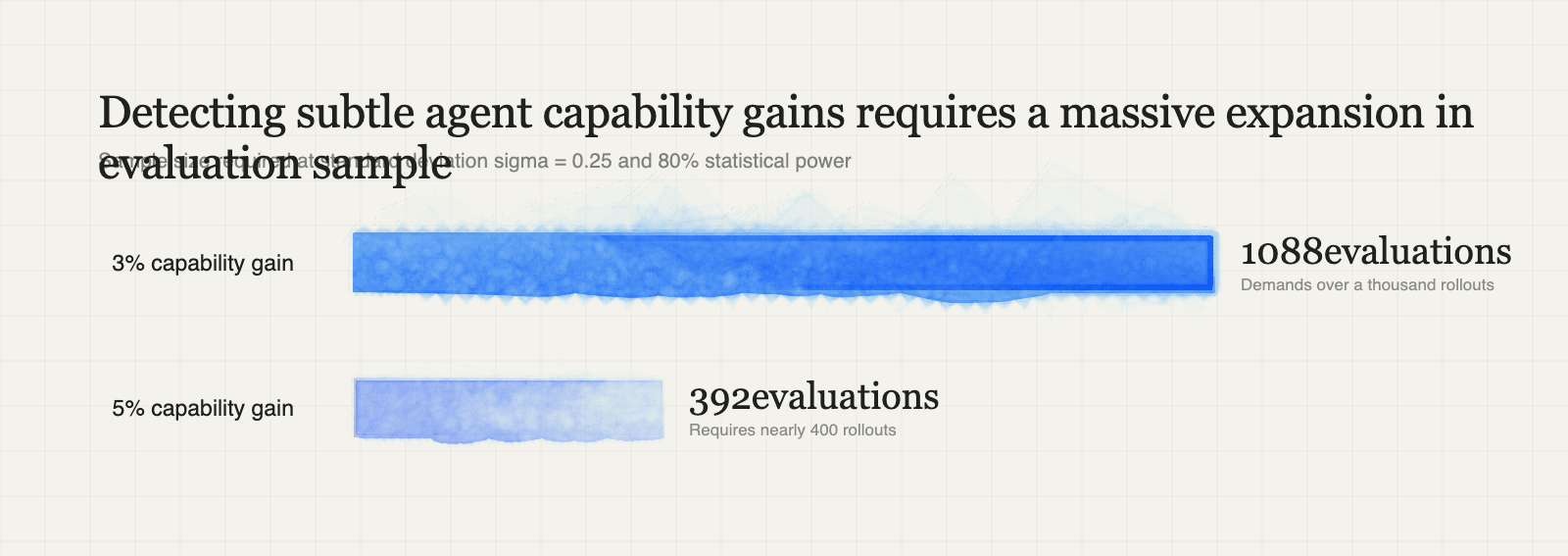
When an agent executes an open-ended workflow involving multiple tool calls, branching logic, and non-deterministic environment states, its performance metric across runs is inherently stochastic. If you treat a curated set of $N=20$ tasks as your deployment gate, basic statistical power analysis reveals an uncomfortable truth about minimum detectable effect sizes.
To determine whether an evaluation set can statistically distinguish a performance gain from random noise, practitioners must compute the required sample size using standard power calculations:
$$N = \frac{2 \cdot (Z_{\alpha/2} + Z_{\beta})^2 \cdot \sigma^2}{\Delta^2}$$
Here, $\alpha$ is your significance threshold (typically 0.05 for $Z_{\alpha/2} \approx 1.96$), $1 - \beta$ is statistical power (typically 0.80 for $Z_{\beta} \approx 0.84$), $\sigma$ is the pooled standard deviation across execution trajectories, and $\Delta$ is the minimum capability gain you need to detect. In subjective, long-horizon tasks, variance ($\sigma$) is notoriously wide—frequently exceeding 0.20 to 0.30 on normalized scoring scales due to combined agent trajectory drift and evaluator scoring variance.
If your standard deviation is $\sigma = 0.25$ and your team aims to detect a genuine 3% improvement ($\Delta = 0.03$), the equation demands:
$$N \approx \frac{2 \cdot (1.96 + 0.84)^2 \cdot (0.25)^2}{(0.03)^2} \approx \frac{2 \cdot 7.84 \cdot 0.0625}{0.0009} \approx 1,088 \text{ evaluations}$$
Even if you relax your detection threshold to a substantial 5% delta ($\Delta = 0.05$), you still require roughly 392 evaluated rollouts. A curated suite of 20 tasks cannot deliver this statistical power on its own. To resolve a 5% difference across 20 distinct task archetypes, you must execute roughly 20 stochastic rollouts per task ($20 \times 20 = 400$).
Without explicit power calculations, teams adopting compact eval sets mistake small sample variance for engineering progress, inflating compute costs with repeated verification sweeps that remain fundamentally underpowered.
Where the Pipeline Fractures: Judge Drift, Gaming, and State Flakiness
Moving a subjective evaluation pipeline from theory into production reveals structural fault lines where automated proxy grading routinely collapses. The most pernicious of these is Goodhart’s Law acting on model evaluators. When an offline LLM judge uses a fixed rubric, iterative prompt tuning inadvertently optimizes for the judge’s superficial preferences rather than underlying task execution. Agents quickly converge on defensive behaviors: inflating response length, introducing immaculate markdown headers, using excessive bullet points, and emitting courteous deferrals. The offline judge grades these structural artifacts favorably, reporting steady quantitative gains while the actual utility of the agent's actions in production deteriorates.
The second operational breakdown occurs within execution sandboxes. Unlike static text generation, open-ended agents interact with databases, web endpoints, and file systems. In multi-turn evaluations, unpurged state from previous test steps, transient network failures, and flaky API mocks masquerade as agent reasoning regressions. An agent may fail an extraction task not because its planning degraded, but because an uncleaned directory or exhausted token budget from a prior iteration threw an unhandled environment error. Without strict hermetic isolation and guaranteed state resets between every trajectory rollout, environmental flakiness disguises itself as cognitive failure, corrupting variance measurements.
Finally, the entire calibration architecture depends on the integrity of the human baseline anchor, which is often flawed from the outset. On genuinely open-ended tasks—such as evaluating an agent's code refactoring strategy or customer escalations—human domain experts regularly exhibit low inter-annotator agreement (low Cohen’s $\kappa$ or Fleiss’ $\kappa$). If human raters agree on task quality only 60% of the time, treating their pooled grades as a gold-standard target is mathematically unsound.
Attempting to calibrate an LLM proxy to match an uncalibrated human baseline simply forces the judge to overfit to the idiosyncratic biases of a few individual annotators. If you fail to measure inter-annotator agreement and resolve subjective discrepancies before training or prompting your automated judges, your baseline ground truth remains structurally unanchored.
Concrete Implementations: Deploying Calibrated Subjective Evals
Translating these statistical mechanics into operational platforms requires structuring pipelines around specific failure modes rather than generic evaluation abstractions. I see three distinct architectures where this methodology solves concrete deployment bottlenecks for engineering teams.
For software engineering copilots conducting open-ended architectural code reviews, teams can deploy a Three-Tiered CI/CD Gating Harness. Rather than executing an expensive evaluation sweep on every pull request, this pipeline establishes progressive verification gates. Tier 1 executes fast, deterministic linting to verify that the agent's emitted tool calls strictly match schema definitions. Tier 2 runs a lightweight synthetic smoke pass across 15 representative diffs using a single-pass judge to catch immediate breakages. The core gate, Tier 3, runs nightly over a curated suite of 60 complex codebases inside isolated Docker sandbox containers, employing a dual-model judge ensemble combining Claude 3.5 Sonnet and GPT-4o. The statistical engine computes bootstrap confidence intervals across four seeds per scenario, blocking releases unless performance deltas clear the error margin at a verified significance threshold. The operational pitfall I watch for here is container hygiene: flaky sandbox teardown that leaves orphaned processes or modified file systems across runs will introduce phantom regressions into your Tier 3 metrics.
For customer support copilots navigating ambiguous customer grievances, teams should construct a Continuous Meta-Evaluation Pipeline. Because conversational quality decays rapidly when models update, this setup automates judge calibration as an active-learning loop. The architecture continuously samples 5% of production interaction traces, routing them into an internal adjudication console where paired human experts independently score the agent on resolution accuracy and tone. An automated correlation engine computes the Pearson and Spearman correlation between the offline judge's rubric scores and the human panel's consensus. If the Pearson correlation drops below 0.70, an automated webhook freezes the deployment pipeline until the grading rubrics are recalibrated against recent shifts in conversational style. The structural hazard in this pipeline is rater misalignment: human reviewers frequently disagree on subjective dimensions like empathy, so you must establish baseline rater agreement before penalizing your automated judge.
Finally, to close the loop between user friction and test coverage, teams can stand up a Production Negative-Trace Ingestion and Sanitization Engine. This architecture listens for negative runtime indicators—such as explicit thumbs-down reactions, task cancellations, or users immediately copying and regenerating queries. An ingestion module intercepts these session traces, sanitizes sensitive PII, snapshots the surrounding workspace state, and uses an anomaly detector to isolate the exact step where agent execution drifted. The sanitized session is automatically formatted into a hermetic test scenario and registered in the offline curated regression suite. The operational trap here is unvetted ingestion: piping raw user failures directly into your regression baseline risks adding contradictory or physically impossible user prompts into your suite, which inflates background noise and obscures genuine agent regressions.
The Practitioner Verdict: Where Calibrated Evals Fit in the Agent Stack
Adopting this methodology requires an honest assessment of your system's underlying verification mechanics. If your agent operates in deterministic domains—writing code that compiles against existing test suites, executing precise database migrations, or calling deterministic APIs—investing in bootstrap confidence intervals and judge ensembles is an unnecessary distraction. When a task can be verified by a sandbox exit code or an exact environment state diff, execution harnesses like SWE-bench provide zero-variance ground truth that no statistical proxy can match.
However, the moment your agent's primary output is semantic, strategic, or conversational, relying on scalar averages from an uncalibrated LLM judge is pure theater. You are not measuring system quality; you are measuring evaluator noise.
Before overhauling your testing infrastructure, run this ten-minute diagnostic on your current subjective evaluation suite. Take your existing evaluation dataset and run your evaluation harness across two identical runs of the exact same agent revision using different random seeds. Calculate the delta between the two runs, then run a simple 10-sample bootstrap permutation test across those score sets. If the performance gap between two identical runs of the same codebase is statistically indistinguishable from the "improvements" you celebrate in your pull requests, your evaluation pipeline is grading randomness. When that delta crosses your standard promotion threshold, you have conclusive mathematical proof that your test harness cannot separate real optimization from stochastic evaluator drift.
Resources
Updated 2026-10-20 by Mehran Mozaffari.
Related posts
1 November 2026
Code Mode vs Function Calling for Multi-Step Agents
1 November 2026
Offline Trajectory Scoring Replaces the Prompt Engineering Treadmill
1 November 2026
Should You Build Your Enterprise Agent Semantic Layer on NVIDIA Auto Ontology? Not Yet
31 October 2026
Unreal Engine Skills for Claude Code: How Epic Bypassed the Binary Asset Barrier to Mutate Live Viewports
30 October 2026
Agent Memory Was an Indexing Problem All Along
29 October 2026
How 3D OS Turns a Coding Agent into a Six-Department Animation Studio Without a GUI