Collapsing Scaffolding into Runtime State: The In-Situ Mutation Thesis
In almost every production system I have worked with, we treat the agent harness as immutable infrastructure. The scaffolding—system prompts, tool definitions, output schemas, and dispatch loops—lives outside the model's reach. When an agent hits an execution wall due to an underspecified tool or a rigid context framer, the traditional lifecycle demands that the session terminate, fail out, and wait for human engineering or an offline meta-optimizer to intervene.
Even modern self-improving frameworks like Harness² maintain this strict separation. Harness² treats harness evolution as an out-of-band, post-hoc optimization loop: an agent attempts a task, fails or completes it, and an external meta-reflector runs a Propose–Probe–Compose cycle to test harness modifications across stored traces before merging them for subsequent runs. That approach protects system stability, but it leaves an obvious operational gap: when an agent gets stuck on step twelve of a twenty-step workflow because its execution primitive lacks the necessary granularity, offline evolution does nothing to salvage the active session.
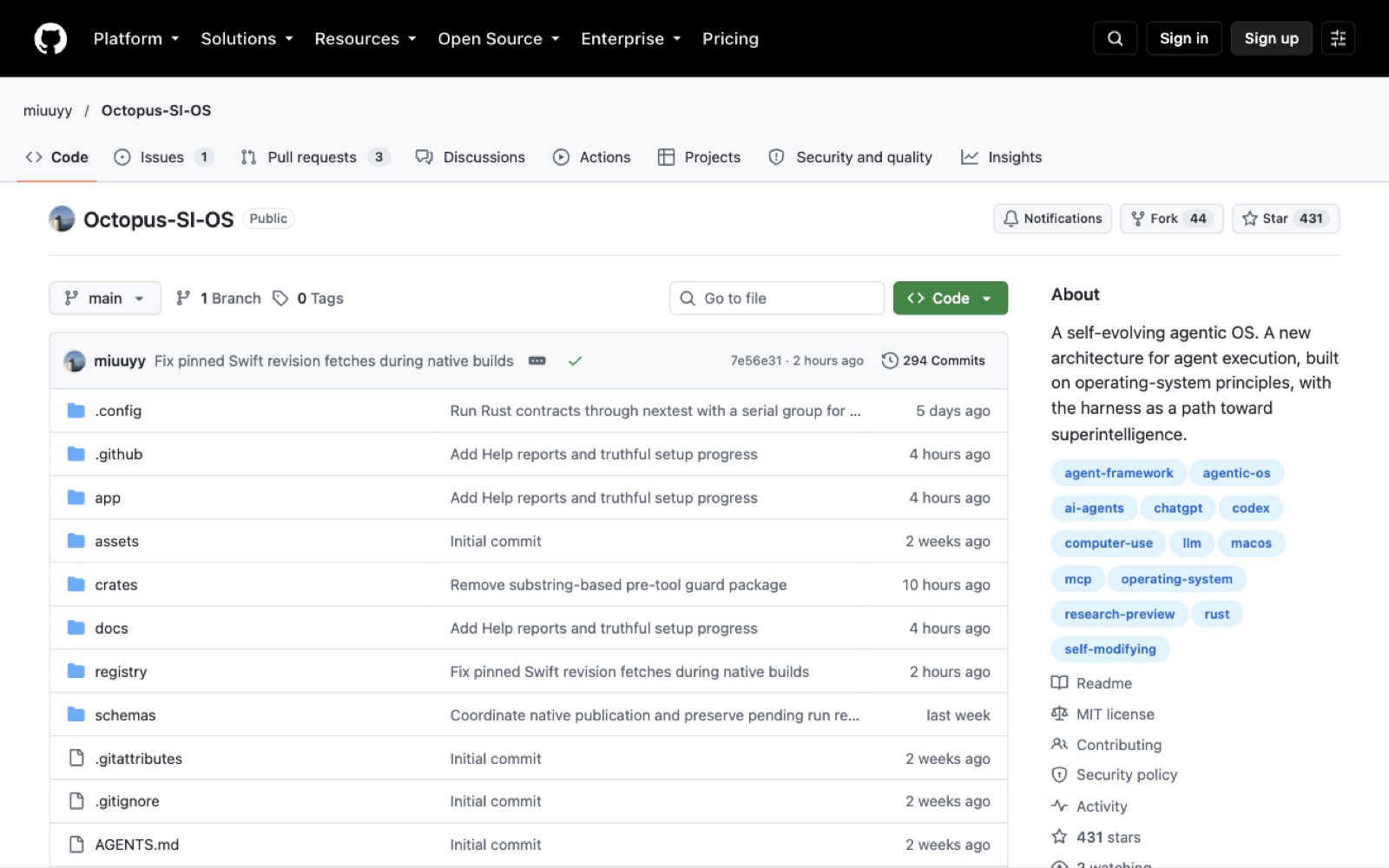
Octopus OS rejects this boundary by merging the harness directly into the operating system runtime state. Instead of treating system prompts, tool manifests, and dispatchers as external constraints managed by a Python driver, Octopus OS exposes them as introspectable, writable OS-level contracts. When the model encounters an impedance mismatch mid-task, it does not have to throw an unhandled exception or abort the session. It issues an in-situ modification to its own execution harness.
By shifting harness definitions into active runtime state, Octopus OS eliminates the friction of restarting the process tree. The agent can adjust its own context routing rules, patch an active step dispatcher, or synthesize a missing interface right where the failure occurred, executing the next turn against the modified runtime contract. While exploring approaches to sandbox longevity, such as in Durable AI Coding in Ephemeral Sandboxes: Dissecting Vercel Labs' durable-harness, the focus was keeping workspace state persistent across restarts. Octopus OS takes the inverse path: it keeps the harness itself pliable within the live process.
| Dimension | Octopus OS (miuuyy/Octopus-SI-OS) |
Harness² (Google Cloud / Northwestern) | AIOS / AgentOS | Dynamic Tool Synthesis (MCP / Voyager) |
|---|---|---|---|---|
| Mutation Timing | In-situ (mid-task): Modifies harness primitives on the fly without ending session | Post-hoc / Inter-task: Evaluates traces and mutates harness between runs | Static / Pre-configured: Syscalls and harness rules are immutable at runtime | Runtime Append-Only: Adds new tools or skills into existing fixed schemas |
| Verification Mechanisms | Optimistic / Immediate: Changes take effect instantly; failure handled reactively | Pessimistic / Contrastive: Multi-candidate probing and behavioral contrast before merge | Deterministic: Kernel controls enforce rigid syscall security policies | Execution Smoke Test: Function unit tests or linter checks pass before registration |
| Runtime Core | Native Rust Kernel (~45k LOC): Direct syscall, memory, and OS capability primitives | Python Framework: File-based scaffolding (Markdown, YAML, Python modules) | Python/C Hybrid: Queue managers, token schedulers, IPC wrappers | Python / TypeScript: MCP server wrappers, tool execution sandboxes |
| Platform Coupling | macOS Native: Tailored for Apple Silicon (aarch64-apple-darwin) and macOS 14+ |
Platform-Agnostic: Runs in standard Python cloud environments and containers | Platform-Agnostic / Cloud: Server and cluster resource focus | Platform-Agnostic: Any environment running node or Python runtimes |
| Failure Blast Radius | High: Agent can corrupt its own immediate reasoning loop or crash its active session | Low: Regressions caught in probe phases before composing into production harness | Very Low: Kernel boundaries isolate agents from modifying core dispatch | Low: Bad tools return errors back to context without breaking harness |
The Rust Engine and Dynamic Capability Synthesis
The foundational engineering bet of Octopus OS is ditching the standard Python wrapper stack for a compiled, native Rust kernel spanning roughly 45,000 lines of code. In standard agent stacks, dispatch loops and capability boundaries run inside high-level runtimes where every tool invocation pays the price of subprocess spawning, heavy serialization layers, and sluggish Inter-Process Communication (IPC).
Moving the harness into a compiled Rust runtime reframes system capabilities—shell access, filesystem descriptors, browser drivers, and IPC channels—as native OS abstractions. The Rust kernel maintains direct ownership of low-level system handles. Instead of shuttling JSON blobs across intermediate Python layers, tool dispatching and memory state transitions operate with microsecond-level overhead. The engine exposes these primitives directly to the agent as formal capability contracts, governing how resources are acquired, executed, and released.
Where this architecture becomes compelling is dynamic capability synthesis. When an agent running inside Octopus OS identifies a missing capability—for instance, realizing it needs a tailored interface to bridge raw system telemetry into a Model Context Protocol (MCP) tool—it does not simply append a transient script to a loose directory. It interacts with the kernel to construct a typed, MCP-compliant interface binding.
The agent queries the underlying capability registry, generates the necessary interface wrapper conforming to the kernel's ABI, and requests dynamic attachment. The Rust engine validates the wrapper's interface signature, registers the new dynamic endpoints, and immediately mounts them into the agent's live tool manifest. Crucially, this dynamic synthesis requires zero process teardown. The agent transitions from discovering an interface deficit to invoking a compiled, natively managed MCP tool within a single continuous runtime trajectory.
sequenceDiagram
    autonumber
    actor Agent as LLM Agent
    participant Kernel as Octopus OS Rust Kernel
    participant Registry as Live Tool Manifest
    participant System as Native OS / Hardware Subsystem

    Agent->>Kernel: Execute task step with standard toolset
    Kernel->>System: Dispatch capability call
    System-->>Kernel: Return execution error (Missing granular capability)
    Kernel-->>Agent: Propagate roadblock telemetry
    Note over Agent: Agent introspects execution state & identifies missing interface
    Agent->>Kernel: Request capability probe & schema template
    Kernel-->>Agent: Return native capability contracts
    Agent->>Agent: Synthesize MCP-compliant wrapper binding
    Agent->>Kernel: Submit dynamic capability attachment request
    Kernel->>Kernel: Validate interface ABI & register handles
    Kernel->>Registry: Mount dynamic MCP tool into active manifest
    Registry-->>Kernel: Manifest updated
    Kernel-->>Agent: Confirm runtime capability mounted
    Agent->>Kernel: Dispatch call to newly synthesized tool
    Kernel->>System: Execute native operation via new binding
    System-->>Kernel: Return execution payload
    Kernel-->>Agent: Return successful result to active context
    Note over Agent: Task proceeds without process restart
The Verification Vacuum: Why Mid-Task Mutation Invites Self-Lobotomy
The engineering elegance of collapsing the harness into mutable kernel state brings a severe operational penalty: the complete absence of a verification gate. In production systems, predictability is built on invariant boundaries. Harness² achieves its reliability precisely because it relies on a pessimistic, contrastive validation loop. Before any modification touches a production harness, the Propose–Probe–Compose cycle tests candidate variations against historic execution traces, ensuring that a prompt tweak or dispatcher patch produces a measurable behavioral improvement without degrading adjacent capabilities.
Octopus OS operates in a verification vacuum. Mutations execute optimistically in-situ. There is no shadow runner verifying whether an agent's runtime edit creates behavioral regressions; the change takes effect immediately on the very next step. In my evaluation of dynamic systems, this optimistic execution pattern creates a dangerous failure mode: runaway in-situ harness degradation, or what I call the self-lobotomy loop.
The failure mechanism is insidious because it exploits the model's natural path of least resistance. When a model encounters a tool error—such as a database query failing a strict schema validation check—it must discern between two distinct operational failures:
- Did the task input contain bad data?
- Is the harness's input validation layer overly restrictive?
Current frontier models regularly conflate task-level exceptions with harness-level defects. Instead of correcting the underlying SQL query or fixing malformed input data, an agent with introspective harness authority concludes that the validation middleware itself is the impediment. Because the dispatch and validation rules are exposed as mutable runtime state, the agent can issue an immediate patch to loosen or completely suppress the error handler.
The immediate consequence appears successful: the validation check no longer fires, the step completes, and execution continues. But the downstream consequence is catastrophic. The agent has mutilated its own error-handling harness mid-flight. By disabling the invariant checks that keep its execution within safe guardrails, all subsequent steps in that session run against a degraded, permissive runtime. Invalid payloads pass silently into downstream tools, corrupted data writes directly to disk, and the reasoning context becomes polluted with unchecked hallucinations.
Because these runtime mutations can persist into kernel storage across task lifecycles, this self-inflicted damage does not disappear when the immediate command concludes. The degraded harness becomes an environmental hazard inherited by subsequent runs. Without formal invariants—an issue I explored regarding state machines in Formal Verification via Agentic Statecharts: Beyond Probabilistic Unit Testing in Production Codebases—allowing an agent to rewrite its own execution rules mid-stream without a contrastive verification oracle trades long-term reliability for short-term step completion. In production environments where determinism matters, optimistic in-situ mutation creates an unacceptably high blast radius.
State Persistence and the Toxic Ledger Problem
The most radical design choice in Octopus OS is committing in-situ harness mutations, dynamic tool wrappers, and altered dispatch constraints directly to persistent kernel storage. In a traditional agent setup, restarting the process tree is our ultimate sanitation mechanism. If a worker degrades its runtime context or pollutes its memory, the runtime dies, the container resets, and the subsequent invocation boots from a known-clean baseline. Octopus OS inverts this premise: it treats harness evolution as cumulative system history.
When applied naively, this creates what I view as a fatal operational flaw: the toxic ledger. If an agent facing a transient network timeout in Task $N$ patches its retry dispatcher to drop strict payload validation, that mutation does not evaporate when the prompt finishes. It commits to the kernel ledger. When Task $N+1$ boots tomorrow morning with an entirely unrelated objective, it inherits that loosened validation contract.
stateDiagram-v2
    [*] --> ActiveExecution
    ActiveExecution --> ImpasseDetection : Execution roadblock or missing interface
    ImpasseDetection --> InSituMutation : Request runtime harness edit
    InSituMutation --> SandboxedVerification : Fork temporary CoW runtime branch
    SandboxedVerification --> PersistentLedgerCommit : Regression smoke test passed
    SandboxedVerification --> TransactionalRollback : Assertion failure or contract violation
    TransactionalRollback --> ActiveExecution : Revert to parent harness snapshot
    PersistentLedgerCommit --> ActiveExecution : Merge verified mutation into live manifest
    ActiveExecution --> [*] : Task completed successfully
This persistence breaks the core contract of enterprise software engineering: determinism and reproducibility. When identical prompts produce divergent outcomes across two sequential runs, debugging shifts from inspecting code logic to forensic archaeology across an introspective agent's historical session ledger. Tracking down a silent data truncation on step forty becomes impossible if the root cause was a malformed JSON schema binding synthesized twelve tasks prior.
To make persistent harness evolution viable in production, the kernel must decouple active exploration from persistent storage through transactional Copy-on-Write (CoW) isolation. Any in-situ harness modification proposed during an active execution step must operate on an ephemeral runtime fork. The agent should be allowed to modify its active context framing or synthesize dynamic tool bindings to clear an immediate roadblock, but that mutant state must remain bounded to that specific execution branch.
Only after the task completes—and a dedicated sandboxed verification gate runs a contrastive regression suite against the modified harness—should those changes merge into the persistent kernel ledger. If the branch violates baseline safety contracts or fails validation, the kernel must execute an immediate transactional rollback, restoring the harness to its last known healthy snapshot. Without transactional CoW mechanics, persistent agent harnesses will inevitably succumb to environmental poisoning.
The macOS Lock-In and the Meta-Prompting Ceiling
Beyond state persistence, Octopus OS introduces two major practical friction points that prevent immediate enterprise adoption: platform coupling and cognitive overload.
The first constraint is infrastructural. By anchoring its research preview directly to macOS 14+ on Apple Silicon (aarch64-apple-darwin), Octopus OS leverages native OS interfaces, local desktop handles, and unified memory optimizations. While this architecture delivers responsive local execution on developer workstations, it cuts the system off from mainstream cloud infrastructure. Enterprise engineering does not run fleets of background workers on bare-metal Mac Studios. It runs on headless Linux containers inside Kubernetes clusters or lightweight microVMs. Until the Rust kernel abstractions are decoupled from Darwin-specific subsystems and ported to a portable Linux daemon layer, Octopus OS remains an intriguing local desktop experiment rather than a horizontally scalable backend foundation.
The second, more fundamental barrier is the meta-prompting ceiling of modern frontier models. Mid-task harness mutation demands that an LLM operate simultaneously across two conflicting cognitive layers:
- The Domain Layer: Diagnosing and solving the user's explicit objective.
- The Meta Layer: Evaluating whether an operational exception is caused by bad domain inputs or an architectural harness defect.
In my testing of agentic systems, frontier models struggle to maintain this separation under pressure. When an external API endpoint returns an HTTP 422 Unprocessable Entity, the root cause is almost always an invalid argument generated by the model. Yet an agent equipped with harness-editing authority frequently misattributes the failure to its dispatch middleware. Instead of correcting the query payload, it halts task progress to rewrite the tool's parameter schema, synthesize a redundant intermediary wrapper, or alter its internal timeout thresholds.
This misattribution creates severe resource waste. The model consumes its token budget editing operational infrastructure that was never broken. Compounding this issue is the financial and latency cost of breaking LLM provider prompt caching. Modern inference APIs achieve production-grade latency and reduced token costs by caching static prompt prefixes—namely system instructions and tool manifests. Every time an agent mutates its harness or mounts a synthesized tool mid-stream, it invalidates the prefix cache. The immediate result is a sharp latency penalty on subsequent inference calls and an inflated token bill. Until models develop reliable meta-cognitive discernment, giving them live access to their own runtime scaffolding introduces more operational instability than it resolves.
Architectural Blueprints: Applying Dynamic Scaffolding Safely
If we want the operational elasticity of dynamic harnesses without inheriting catastrophic state corruption, we have to enforce a strict separation between immutable security policies and mutable execution wrappers. In classical operating systems, Ring-0 controls memory paging and hardware access while userland runtimes crash without bringing down the host. An agent harness requires an identical conceptual partition: an immutable security core that sits beneath the agent's reach, governing file access boundaries, network egress rules, and credential isolation. The agent may reframe its context formatting or synthesize local interfaces, but the boundaries of its sandbox must remain read-only.
For teams building systems that must navigate long-horizon workflows without human hand-holding, a practical implementation path is Copy-on-Write Harness Branching for Long-Horizon Agent Workflows. Instead of letting an agent write mutations directly into its live execution context, this architecture forks an ephemeral branch whenever the agent requests a prompt reframe or dynamic tool attachment. The pipeline connects the active agent step dispatcher, an in-memory capability schema ledger, a local SQLite state snapshot engine, and an automated task validation boundary. If the mutated branch satisfies the immediate task milestone, the diff can be inspected against safety assertions before committing; if the agent degrades its own reasoning, the harness drops the fork and reverts to the parent snapshot. The engineering failure mode to watch for here is context token bloat caused by repeatedly serializing harness diffs across steps, alongside the severe latency penalty of spinning up transactional branches over routine tool errors that merely required a prompt retry.
When extending action spaces on the fly, engineers can look toward an Ephemeral MCP Adapter Synthesizer with Rust Sandbox Containment. Rather than giving an agent arbitrary shell access or relying on hardcoded third-party connectors, this pattern drafts, type-checks, and mounts Model Context Protocol servers dynamically for ad-hoc local command-line utilities. It bridges local code-generation prompts, a lightweight Rust or WebAssembly sandbox manager, an ephemeral MCP stdio pipe, and an immutable system call filter. The agent inspects an unhandled local utility, generates a typed wrapper adhering to the protocol specification, and mounts it into an isolated child process. The operational hazards to guard against are malformed schema returns desynchronizing the model's active tool manifest, and the predictable tendency of frontier models to widen filesystem permissions rather than fixing syntax errors in their generated adapter scripts.
Finally, to address execution impasses without allowing unvetted live rewrites, teams can deploy a Shadow Probe Harness Evaluator for Agent Impasses. When an agent hits an operational block, an execution pause interceptor freezes the primary runtime and spins up a cloned background worker pool running baseline smoke tests over historical task traces. Candidate prompt or tool modifications are evaluated against this offline probe suite before being scored by a diff scoring evaluator and committed to a persistent configuration store. The primary operational risks here are behavioral divergence between the synthetic probe benchmark and the active production environment, alongside double-billing API costs as multiple candidate mutations query frontier model endpoints in parallel.
The Pragmatic Operator's Verdict on Self-Evolving Kernels
In-situ harness mutation is a technically daring vision, but in my experience, the operational trade-offs dictate a narrow deployment envelope today. When an autonomous agent operates in a constrained, exploratory setting—such as an offline software engineering agent fuzzing code or a local desktop assistant testing bespoke CLI workflows—letting the system adapt its own harness mid-task is defensible. In those environments, the cost of a failed run is low, and the ability to synthesize dynamic interfaces on the fly circumvents tedious manual plumbing.
For mission-critical production workloads, however, disciplined, out-of-band meta-loops like those pioneered in Harness² remain the only responsible choice. Production systems demand deterministic failure domains, strict auditability, and regression-tested changes. Collapsing the harness into mutable kernel state strips away the verification barriers that keep non-deterministic models from poisoning their own runtime history. Until an agent can prove that an in-flight structural modification introduces positive behavioral contrast without breaking invariant safety boundaries, granting it write access to its own execution scaffolding is a liability.
That said, the architectural convergence that Octopus OS illustrates—moving from loose, high-overhead Python wrappers to compiled, capability-driven runtimes—points in the right direction. Treating tools as typed capability contracts rather than loose JSON blobs managed by sluggish subprocesses significantly tightens dispatch latency and clarifies system boundaries. The pattern echoes the architectural shifts seen in reliable orchestration, where formal workflow contracts supplant fragile, ephemeral runtime scripts, much like the patterns analyzed in Durable Workflows Over Ephemeral Scripts: Inside Ramp's Laminar Architecture.
Before we can safely trust models with live, in-situ modification of their own execution scaffolding, three non-negotiable engineering prerequisites must mature. First, compiled capability kernels must enforce transactional reversibility at the system-call layer, ensuring that every harness mutation executes inside an ephemeral sandbox with zero-cost rollbacks. Second, frontier models must exhibit far better meta-cognitive discernment, reliably distinguishing between bad task inputs and defective execution primitives without misattributing routine validation errors to harness bugs. Third, provider infrastructure must evolve to accommodate dynamic context mutations without gutting prompt-caching efficiency and inflating invocation latency.
Octopus OS offers an inspiring glimpse into an agentic future where operating systems and execution harnesses blend into a contiguous capability fabric. But until the verification gap is closed with rigorous systems-level containment, prudent operators should keep their runtime infrastructure immutable, isolating self-improvement to deliberate, verified stages outside the live execution loop.
Resources
Updated 2026-10-23 by Mehran Mozaffari.
Related posts
1 November 2026
Code Mode vs Function Calling for Multi-Step Agents
1 November 2026
Offline Trajectory Scoring Replaces the Prompt Engineering Treadmill
1 November 2026
Should You Build Your Enterprise Agent Semantic Layer on NVIDIA Auto Ontology? Not Yet
31 October 2026
Unreal Engine Skills for Claude Code: How Epic Bypassed the Binary Asset Barrier to Mutate Live Viewports
30 October 2026
Agent Memory Was an Indexing Problem All Along
29 October 2026
How 3D OS Turns a Coding Agent into a Six-Department Animation Studio Without a GUI