
The Arithmetic of Memory Bandwidth: Why 92 Tokens/s on a Base Mac Is Physically Impossible in Pure Autoregressive Decoding
Whenever I see a benchmark claiming a 4x leap in local token generation on identical consumer silicon, my first instinct is to calculate the hardware bus limits. Hardware physics sets hard ceilings that software engineering cannot simply bypass with cleaner code.
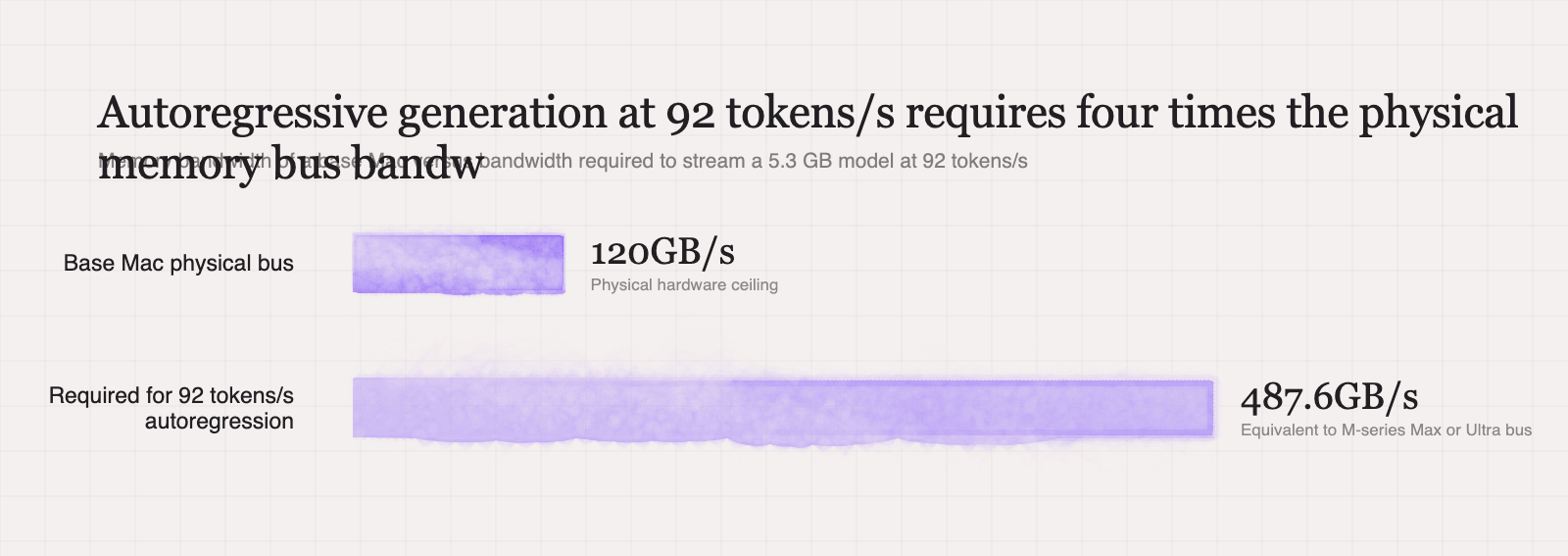
In single-stream autoregressive generation (batch size = 1), large language model inference is almost purely memory bandwidth bound. For every newly emitted token, the runtime must stream every active weight parameter across the memory bus from system RAM into the GPU’s registers. Compute utilization remains low because the arithmetic intensity—the ratio of floating-point operations performed to bytes moved—is minimal. The governing relationship is straightforward:
$$\text{Generation Throughput (tokens/s)} \approx \frac{\text{Memory Bandwidth (GB/s)}}{\text{Active Parameter Footprint (GB)}}$$
Consider the actual footprint of a 9B parameter model quantized to 4 bits. Even under an aggressive quantization format, a 9B model consumes roughly 5.0 to 5.5 GB of memory once weight scales, biases, and normalization parameters are included.
A base-tier Apple Silicon processor operates on a 128-bit LPDDR memory bus, delivering roughly 100 to 150 GB/s of theoretical memory bandwidth. In practice, sustained achievable memory throughput rarely exceeds 80–85% of theoretical peak due to bus contention, DRAM refresh cycles, and display controller overhead. If we plug these numbers into the governing equation:
$$\text{Upper Bound} \approx \frac{120\text{ GB/s}}{5.3\text{ GB}} \approx 22.6\text{ tokens/s}$$
This aligns with what llama.cpp actually delivers out of the box on this tier: approximately 22 tokens per second. The engine saturates the physical memory bus. It reads the model's 5.3 GB footprint once per token, executes the dequantize-GEMV pass, appends the output to the key-value cache, and repeats.
To output 92 tokens per second while executing standard autoregressive token generation against that same 5.3 GB model footprint, an engine would require:
$$\text{Required Bandwidth} = 92\text{ tokens/s} \times 5.3\text{ GB/token} \approx 487.6\text{ GB/s}$$
That figure matches the memory bus of an M-series Max or Ultra chip, not a base Mac with 16 GB of RAM. When an engine logs 92 tokens per second on a base machine, it is not moving 5.3 GB of weights 92 times every second. No Metal compute shader can pull half a terabyte per second across a 120 GB/s physical bus.
The 4x throughput delta is not a testament to brute-force kernel optimization. Mathematically, it proves that the engine drastically reduces the physical volume of parameters read per emitted token. That jump relies on algorithmic reductions in memory transfers: speculative token drafting, recurrent state compression like Gated Delta Networks, or a combination of both.
How the Runtimes Differ Under the Hood: Unified Memory Graph Compilation vs. Portable Metal Shaders
To evaluate why execution profiles diverge so sharply between Apple MLX and llama.cpp, you have to examine how each project structures memory, compiles graphs, and dispatches compute work to the GPU.
llama.cpp is built around ggml, a tensor library engineered primarily for cross-platform portability. Its primary architectural strength is also its performance constraint on Apple hardware: ggml must maintain a unified memory layout and dispatch model that functions identically across x86 CPUs, ARM NEON, Nvidia CUDA, AMD ROCm, Vulkan, and Apple Metal. On macOS, llama.cpp delegates compute to custom Metal compute shaders defined in ggml-metal.metal. While these shaders are hand-tuned, the orchestration layer remains modular and conservative. The host runtime manages buffer pointers, handles explicit synchronization barriers, and tracks tensor lifecycles through generic buffer abstractions designed to accommodate systems without unified memory.
Apple’s MLX framework discards portability entirely. Built exclusively for Apple Silicon, MLX models the hardware as a single address space with zero distinction between host and device memory. It uses unified virtual addressing directly: host code allocates an array, and the Metal pipeline accesses those exact physical pages with zero buffer copies, zero marshalling, and no staging buffers.
At the execution layer, MLX relies on lazy evaluation combined with an automatic compute graph compiler. When you define operations in mlx or mlx-lm, the framework constructs a directed acyclic graph rather than immediately queuing GPU dispatches. During graph evaluation, MLX fuses adjacent nodes into unified Metal kernels. Operations like layer normalization, rotary position embeddings, on-the-fly 4-bit weight dequantization, and generalized matrix-vector multiplication (GEMV) collapse into monolithic compute passes.
Crucially, MLX tailors these fused routines to Apple’s hardware primitives. Its matrix kernels target Apple’s SIMDgroup matrix operations (simdgroup_matrix), loading quantized weights and activation vectors directly into tile registers within a 32-thread SIMD execution unit. By keeping intermediate activations in hardware registers rather than spilling them back to system RAM or shared threadgroup memory, MLX keeps cache pressure minimal.
This architectural difference shows up most clearly in dispatch overhead. In standard dense transformer decoding, llama.cpp issues discrete command encodings and dispatches across intermediate buffers. When processing one token at a time, that dispatch latency is masked by the memory transfer duration. But when a runtime switches to fast multi-token verification loops or processes small recurrent state updates, dispatch latency becomes the dominant bottleneck. Because MLX compiles the verification pass into an optimized graph executed in a single Metal command buffer, host-to-device launch overhead drops to near zero. llama.cpp spends non-trivial time orchestrating execution across portable layer boundaries, while MLX executes the entire verification block directly against the unified memory controller.
The Mechanics of the 4x Speedup: Speculative Drafting and Recurrent State Compression
Once we accept that the physical memory bus cannot stream 5 GB of parameters 92 times a second, the mechanics of how MLX hits ~92 tokens/s become apparent: it decouples the number of generated tokens from the number of full parameter passes.
The primary mechanism driving this throughput is speculative decoding, accessible via mlx-lm using the --draft-model flag. Autoregressive decoding spends most of its time waiting for memory reads while processing tokens that are largely predictable (such as code syntax, standard grammatical transitions, and structured data tokens). Speculative decoding exploits this by running a small, high-throughput draft model (for instance, a 1B or 2B parameter variant) alongside the primary 9B target model.
Because the draft model occupies only 1.0 to 1.5 GB in memory, the base chip’s bus can stream its weights rapidly, generating a candidate sequence of 3 to 6 tokens in speculative bursts at over 80 tokens per second. Once the draft sequence is produced, the 9B target model does not evaluate those tokens sequentially across multiple full weight passes. Instead, it reads its 5.3 GB weight matrix once to verify all drafted candidate tokens in parallel within a single forward evaluation pass.
sequenceDiagram
    autonumber
    participant Host as MLX Host Process
    participant Draft as 1B Draft Model
    participant GPU as Unified Memory Controller
    participant Target as 9B Target Model

    Note over Host,Draft: Phase 1: High-Speed Draft Generation
    loop Generate K Speculative Tokens
        Host->>Draft: Forward pass (Autoregressive step)
        Draft->>GPU: Stream ~1.2 GB draft weights
        GPU-->>Draft: Return logits
        Draft-->>Host: Candidate token t[i]
    end

    Note over Host,Target: Phase 2: Parallel Batch Verification
    Host->>Target: Submit draft sequence [t1, t2, t3, t4]
    Target->>GPU: Single weight read (~5.3 GB target weights)
    GPU-->>Target: Compute parallel verification logits
    Target->>Target: Verify acceptance via sampling criteria
    Target-->>Host: Accept verified tokens + 1 correction token
When the target model accepts four candidate tokens from that single forward pass, the memory transfer cost per emitted token drops by 75%:
$$\text{Effective Transfer per Token} \approx \frac{5.3\text{ GB}}{4\text{ accepted tokens}} \approx 1.32\text{ GB/token}$$
Streaming 1.32 GB across a 120 GB/s bus yields an effective throughput of roughly 90 tokens per second. MLX executes this draft-and-verify loop inside a single unified Metal command buffer, preventing CPU-GPU synchronization stalls between candidate generation and acceptance testing.
The second factor is model architecture. Modern models like Qwen3.5 incorporate hybrid attention structures, specifically Gated Delta Networks (GDN) linear attention layers. Unlike standard transformer blocks that must reload and extend a quadratic key-value cache across the entire context history for every token, GDN layers maintain fixed-size recurrent state matrices. Updating this recurrent state requires only a constant-size linear recurrence pass.
In llama.cpp, recurrent and state-space updates have historically run through generic tensor arithmetic paths that lack Apple-specific register-tiled kernel specialization. In contrast, MLX’s graph compiler maps the linear recurrent updates directly to fused SIMDgroup operations, bypassing the memory-bandwidth tax of attention lookups altogether. Combined with speculative execution, this hardware-matched kernel specialization turns what would be an intractable hardware constraint into sustained 92-token-per-second generation.
Direct Framework Comparison: MLX, llama.cpp, and the Production Landscape
When evaluating local runtimes, I categorize frameworks by their core optimization target: single-stream token latency versus multi-tenant cluster throughput. The 4x throughput figures logged on Apple Silicon highlight this philosophical divide.
Apple MLX (mlx-lm) is purpose-built for the single-user workstation. It discards hardware abstraction layers entirely to treat Apple’s unified LPDDR architecture as a first-class citizen. By coupling lazy compute graph evaluation directly to Metal Shading Language dispatch, MLX eliminates CPU-GPU synchronization stalls. This tight integration makes multi-token speculative verification viable at minimal latency overhead. However, that performance comes with total ecosystem isolation: MLX does not run on Linux, CUDA, or ROCm, locking deployments strictly to Darwin.
llama.cpp sits at the opposite end of the engineering spectrum. Its priority is universal portability. Built on ggml, it executes seamlessly across x86 CPUs, ARM NEON, Metal, Vulkan, and CUDA. While its hand-crafted Metal kernels deliver reliable baseline performance, its orchestration layer incurs modular abstraction taxes. Maintaining portable tensor representations and explicit synchronization across disparate hardware backends makes speculative verification loops and non-transformer recurrent updates harder to optimize down to raw bare-metal speeds.
Data-center engines like vLLM and SGLang operate on an entirely different design thesis. They prioritize aggregate throughput across concurrent requests using PagedAttention, continuous batching, and chunked prefill. In a multi-tenant cloud environment, keeping tensor cores saturated across hundreds of concurrent user streams matters far more than minimizing single-sequence latency on an integrated GPU. Running vLLM on a single edge laptop introduces excessive memory overhead and driver complexity without delivering interactive benefits for a solitary developer prompt.
| Metric / Dimension | Apple MLX (mlx-lm) |
llama.cpp (ggml) |
vLLM / SGLang |
|---|---|---|---|
| Target Hardware | Apple Silicon exclusively (M-series SoC) | Universal (Metal, CUDA, ROCm, Vulkan, CPU) | Data-center GPUs (Nvidia CUDA, AMD ROCm; experimental Metal) |
| Memory Mechanics | Zero-copy unified virtual addressing; dynamic memory pool | Unified buffer management with explicit host/device pointers and mmap backing |
Paged KV cache allocation (PagedAttention); dynamic continuous batch scheduling |
| Speculative Decoding Maturity | Native draft model verification via unified Metal command buffers | Supported via CLI/draft GGUF; higher dispatch overhead on Metal | Advanced multi-candidate verification (EAGLE, Medusa, draft models) across batched streams |
| Model Formats | Split Safetensors, Hugging Face configs, MLX weight shards | Single self-contained GGUF binaries (metadata, tokenizer, quantized tensors) | Hugging Face Safetensors, AWQ, GPTQ, FP8 weight checkpoints |
| Runtime Packaging | Python package (mlx, mlx-lm) or Swift runtime bindings |
Standalone static C/C++ executable (llama-cli, llama-server) |
Python daemon, Triton/CUDA kernels, Ray orchestration dependencies |
Operational packaging also separates these tools in production. llama.cpp packages weights, quantization scales, and tokenizer configurations into a single, immutable GGUF binary, eliminating the silent tokenization mismatches common in open-source deployments. In contrast, MLX mirrors standard Hugging Face directory layouts, requiring Python dependency management and separate weight shards. For isolated workstation automation or embedded Mac agents, MLX offers unmatched interactive speed, while llama.cpp remains the dependable workhorse for heterogeneous fleets.
The Speculative Decoding Cliff and Production Failure Modes
Deploying an engine capable of 92 tokens per second on a 16 GB laptop creates an immediate operational challenge: benchmark throughput is not guaranteed throughput. The 4x leap relies entirely on algorithmic shortcuts, and those shortcuts fail under real-world runtime variance.
The primary vulnerability is the speculative throughput cliff. Speculative execution achieves peak speed when output entropy is low. Structured generation tasks—such as generating repetitive JSON schemas, boilerplate Python classes, or predictable conversational text—yield draft acceptance rates above 80%. Under these conditions, the target model accepts four or five candidate tokens per forward evaluation, comfortably sustaining the 90+ tokens/s mark.
quadrantChart
    title Inference Engine Architectural Positioning
    x-axis Single-User Low Overhead --> Multi-Tenant Continuous Batching
    y-axis Apple Silicon Exclusive --> Universal Hardware Portability
    quadrant-1 Universal Distributed Serving
    quadrant-2 Universal Lightweight Edge
    quadrant-3 Dedicated Apple Silicon Edge
    quadrant-4 Specialized Fleet Serving
    Apple MLX: [0.15, 0.15]
    llama.cpp: [0.25, 0.85]
    vLLM and SGLang: [0.85, 0.85]
When production inputs shift to high-entropy domains—such as mathematical reasoning chains, high-temperature sampling, parsing fragmented machine logs, or processing multilingual inputs—draft acceptance drops precipitously. If the acceptance rate falls below roughly 30%, speculative decoding transforms from an accelerator into an anchor.
Every failed draft sequence forces the engine to pay a double penalty: it burns memory bus bandwidth streaming the draft model's weights to generate speculative tokens, and it burns target model forward evaluation cycles validating tokens that are promptly discarded. Throughput collapses back down to the memory-bandwidth boundary—around 18 to 22 tokens per second—and latency jitter spikes dramatically. If an SLA is sized around peak speculative speed, high-entropy prompts will breach response deadlines.
The second major failure mode stems from macOS memory governance. In server environments running discrete GPUs, memory allocation failures trigger interceptable CUDA exceptions that an application supervisor can handle cleanly. On macOS, unified memory is shared between the display pipeline, running applications, and the inference runtime. Darwin manages extreme memory pressure through Mach Jetsam.
When hosting a 9B model quantized to 4 bits (5.3 GB) alongside an active draft model (1.5 GB), baseline memory consumption already exceeds 6.8 GB. As generation progresses and the context window expands toward 16k or 32k tokens, the key-value caches for both the draft and target models consume several additional gigabytes of unified RAM.
If background processes or developer tools cause a sudden memory spike, macOS does not raise a recoverable Python out-of-memory exception. Instead, the OS kernel terminates the process instantly with an uncatchable SIGKILL.
By comparison, llama.cpp uses pre-allocated, bounded scratch buffers backed by memory-mapped files (mmap), allowing an operator to verify memory constraints before execution begins. When engineering edge services on top of MLX, operators must configure strict context length limits and enforce fixed memory ceilings via system controls to avoid sudden process termination.
Deployment Tradeoffs: Bare-Metal Darwin Fleets, Packaging Friction, and Driver Resets
Scaling an inference runtime beyond an isolated laptop into shared infrastructure immediately reveals whether an engine was engineered for server operations or local prototyping. Adopting MLX across team workflows means confronting the operational constraints of macOS as a server platform.
Operating racks of Mac Mini or Mac Studio hardware presents distinct orchestration hurdles. Enterprise provisioning stacks rely on Linux primitives—OCI container standards, Kubernetes device plugins, and systemd units. On macOS, there is no native Docker GPU pass-through. Containerizing an MLX service inside a standard Linux container running under virtualization cuts the process off from the Metal pipeline and unified memory. Operators are forced to run MLX as a bare-metal host daemon managed through launchd. This reintroduces traditional configuration drift: managing Python virtual environments, pinning native wheel extensions, and navigating macOS system updates that can alter system Python linkages or Metal framework drivers without warning.
+-------------------------------------------------------------------------+
| macOS Host Architecture (No Linux Container GPU Passthrough)           |
|                                                                         |
|  [ Linux OCI Container ]        [ Bare-Metal Darwin Host Process ]      |
|           |                                      |                      |
|     (No Metal Access)                            v                      |
|           x                           launchd Service Supervisor        |
|           |                                      |                      |
|           +--------------------------------+     v                      |
|                                            |  MLX Runtime Engine        |
|                                            |     |                      |
|                                            v     v                      |
|                                 [ Unified Memory / Metal Pipeline ]     |
+-------------------------------------------------------------------------+
Beyond lifecycle management, the execution pipeline introduces runtime stability issues that rarely manifest in llama.cpp. MLX compiles Metal Shading Language (MSL) pipelines just-in-time based on dynamic tensor shapes. In variable-length inference loops, processing a prompt sequence length or generation batch that falls outside previously compiled dimensions forces the runtime to stop and JIT-compile a new Metal pipeline state object. This shows up in production logs as random latency spikes—several hundred milliseconds of dead air before the first token streams.
Worse than cold-start latency is the Metal watchdog reset. In standard consumer setups, the unified GPU manages both display rendering and compute dispatch. When an MLX service processes a large prefill context without chunking the prompt evaluation across separate command buffers, the continuous compute kernel saturates the Metal command queue. If execution occupies the GPU beyond macOS WindowServer's timeout threshold, Darwin's graphics subsystem interprets the stall as an unresponsive driver and executes a watchdog reset. The display pipeline reboots, the active Metal context is invalidated, and the inference process terminates mid-stream. Running MLX reliably at scale demands defensive execution hygiene: explicit context bucketing to eliminate runtime MSL recompilations, and chunked prefill schedules that periodically release the Metal command queue to prevent host system resets.
Concrete Implementations: How to Architect for High-Throughput Edge Inference
Engineering a resilient edge inference stack around Apple Silicon requires treating benchmark throughput as an opportunistic ceiling rather than a guaranteed baseline. To harness the interactive speed of native Metal execution without sacrificing production stability, teams must introduce defensive routing, strict shape control, and cross-platform fallbacks.
flowchart TD
    Client["Client Request (OpenAI API)"] --> Gateway["Edge Gateway Router"]

    subgraph Scheduling ["Pre-Processing & Validation"]
        Gateway --> Bucket["Fixed-Bucket Context Quantizer\n(Pad to 512 / 1024 / 2048 / 4096)"]
        Bucket --> Prewarm["Pre-Warmed Metal KV Allocator"]
    end

    subgraph RuntimeRouting ["Runtime Selection Shim"]
        Prewarm --> CheckMem{"Memory Pressure &\nPlatform Check"}
        CheckMem -- "Darwin / Memory Safe" --> MLXEngine["MLX-LM Engine\n(9B Target + 1B Draft)"]
        CheckMem -- "Linux / High Pressure" --> LLAMEngine["llama.cpp Engine\n(Bounded GGUF Context)"]
    end

    subgraph DynamicExecution ["Speculative Loop with Entropy Fallback"]
        MLXEngine --> DraftExec["Generate Draft Sequence"]
        DraftExec --> Verify["Target Verification Pass"]
        Verify --> WindowTrack{"Rolling 32-Token Window\nAcceptance Rate >= 40%?"}
        WindowTrack -- "Yes" --> EmitSpec["Stream Speculative Tokens"]
        WindowTrack -- "No" --> ToggleOff["Disable Draft Model\n(Fallback to Pure Autoregressive)"]
        ToggleOff --> EmitDense["Stream Verified Tokens"]
    end

    EmitSpec --> Gateway
    EmitDense --> Gateway
    LLAMEngine --> Gateway
A core architectural pattern to build is a Dynamic Draft-Aware Inference Router with Entropy Fallback. This pattern deploys a local proxy service that mediates between client requests and an mlx-lm backend pairing a 9B target model with a 1B draft model. Instead of committing blindly to speculative execution, the proxy tracks the draft acceptance ratio across a rolling 32-token window. During low-entropy structured generation, the speculative pipeline hums along near peak efficiency. The moment output entropy spikes—such as during formal logic proofs, mathematical reasoning, or raw binary payloads—and the acceptance rate drops below 40%, the router dynamically disables the draft forward pass. It drops straight into unassisted autoregressive decoding, dodging the compute penalty of verifying rejected tokens.
The primary failure mode to guard against in this dual-model setup is memory thrashing: loading both the 9B parameter target and the 1B draft model into a 16 GB unified address space leaves razor-thin margins for the operating system, creating a significant risk of instant Mach Jetsam SIGKILL evictions if background memory spikes.
To decouple services from Darwin hardware lock-in, architects can layer this into a Dual-Runtime Edge Gateway with GGUF and MLX Dual-Stack Fallback. This gateway exposes a uniform OpenAI-compatible HTTP interface that routes to mlx-lm on bare-metal Apple Silicon for single-stream interactive performance, but maintains a hot standby llama-server engine. When system metrics detect memory starvation, or when the service deploys onto heterogeneous Linux or CUDA worker nodes, the gateway seamlessly shunts generation down to llama.cpp using pre-allocated, bounded GGUF memory buffers. When structuring dual-engine fallbacks, the most common operational trap is tokenizer configuration divergence: differences between Hugging Face Safetensors metadata used by MLX and embedded GGUF tokenizer profiles can silently corrupt special tokens, chat templates, and stop-sequences across runtime handoffs.
Finally, to stabilize latency and shield the operating system from GPU watchdog events, implement a Fixed-Bucket Context Cache for Metal JIT Stutter Prevention. This request pre-processor quantizes incoming prompt sequences and generation allocations into discrete power-of-two boundaries—such as 512, 1024, 2048, and 4096 tokens—backed by pre-warmed Metal pipeline state caches generated during initial daemon boot. By enforcing discrete tensor shapes, the runtime eliminates mid-flight MSL recompilation stutters. When paired with chunked prefill batches that break large prompt ingestions across multiple command buffers, this prevents long-running transformer evaluations from monopolizing the Metal queue long enough to trigger Darwin's WindowServer watchdog.
Resources
Updated 2026-10-07 by Mehran Mozaffari.
Related posts
1 November 2026
Direct Weight Editing Is Machine Code Hot-Patching for Transformers
31 October 2026
Unreal Engine Skills for Claude Code: How Epic Bypassed the Binary Asset Barrier to Mutate Live Viewports
30 October 2026
Agent Memory Was an Indexing Problem All Along
28 October 2026
The Codebase Is an Environment, Not a Context Window
26 October 2026
Should you self-host OpenDuet as your proactive AI coworker? Not yet
24 October 2026
How AutoSwarm Turns Isolated AI CLIs into a Coordinated Swarm Without a Shared Runtime