The Meta-Orchestrator Architecture Behind AutoSwarm
I spend my days jumping between specialized developer interfaces. Claude Code shines at terminal-native file exploration and diff inspection; Cursor indexes whole codebases into semantic vector graphs; OpenAI Codex runs fast code completion loops; DeepSeek Harness tears apart logic flaws during review. Yet every one of these tools sits inside an isolated execution silo. When I want them to collaborate on a single objective, I end up acting as a manual copy-paste clipboard layer between terminal panes.
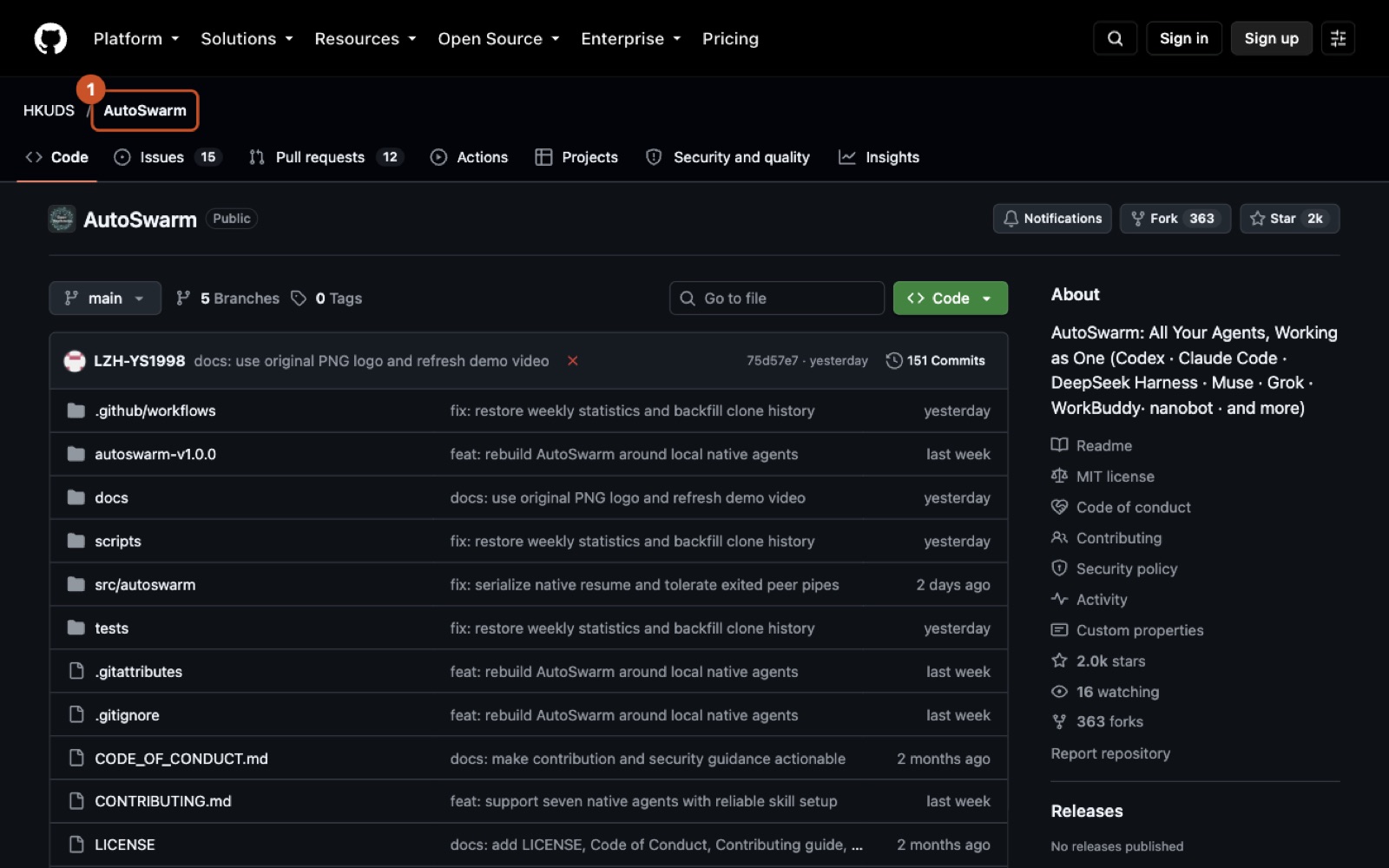
AutoSwarm (HKUDS/AutoSwarm, tagged at autoswarm-v1.0.0) tackles this fragmentation from an unconventional angle. It is neither a standalone background daemon nor a traditional Python multi-agent framework like AutoGen or CrewAI. Instead, it installs directly as a host-agent skill or plugin inside an existing primary agent workspace.
flowchart TD
    User["User Objective"] --> HostAgent["Host Lead Agent (e.g., Codex)"]

    subgraph HostRuntime["Host Agent Environment"]
        HostAgent --> AutoSwarm["AutoSwarm Meta-Orchestrator Plugin"]
        AutoSwarm --> Dispatch["Local Subprocess Dispatcher"]
    end

    Dispatch -->|"Subshell Exec"| Sub1["Claude Code CLI (Diff & Inspection)"]
    Dispatch -->|"Subshell Exec"| Sub2["Cursor CLI / Agent (Workspace Search)"]
    Dispatch -->|"Subshell Exec"| Sub3["DeepSeek Harness CLI (Logic Review)"]
    Dispatch -->|"Subshell Exec"| Sub4["Other CLIs (Copilot, Muse, Hermes)"]

    Sub1 --> Collector["Output & Context Collector"]
    Sub2 --> Collector
    Sub3 --> Collector
    Sub4 --> Collector

    Collector --> Synthesizer["Verification & Synthesis Engine"]
    Synthesizer --> HostAgent
    HostAgent --> Response["Unified Synthesized Response"]
By leveraging local command execution privileges, AutoSwarm uses whichever lead agent you are already running to orchestrate external, black-box developer CLIs across your machine. Rather than defining internal agent personas that invoke raw language model completion endpoints, AutoSwarm delegates subtasks out to independent commercial binaries—including Claude Code, Codex, Cursor, GitHub Copilot CLI, DeepSeek Harness, OpenCode, Meta Muse Code, and Hermes.
This design presents a sharp architectural choice: do we wait for protocol-level unifications like Architecting Asynchronous Agent Systems: A Deep Dive into MCP Tasks and Elicitations to establish native agent-to-agent delegation across competing vendors, or do we pragmatic-wrap existing command-line interfaces today? AutoSwarm bets on the latter. It bypasses proprietary API silos by treating the local shell itself as the integration bus, bringing together disparate agent runtimes that were never originally built to speak to one another. AutoSwarm turns finished terminal tools into programmable sub-agents without requiring upstream vendor cooperation.
Tracing a Request Through Subprocess Fan-Out, Alignment, and Synthesis
To understand how AutoSwarm operates in practice, trace what happens when you hand a complex, multi-stage task to your lead agent. You submit a high-level goal—such as refactoring an asynchronous queue, updating the affected call sites, and validating the edge cases.
First, the host agent evaluates the prompt using the AutoSwarm plugin logic. Instead of executing every step sequentially within its own prompt loop, AutoSwarm decomposes the prompt into specialized subtasks. The orchestration layer routes specific operational requirements to the distinct tools best equipped to handle them: drafting code changes might go to Codex, repository diff analysis to Claude Code, and adversarial verification to DeepSeek Harness.
sequenceDiagram
    autonumber
    actor User
    participant Host as Host Agent (AutoSwarm)
    participant Codex as Codex CLI
    participant Claude as Claude Code CLI
    participant DeepSeek as DeepSeek Harness CLI

    User->>Host: Submit complex refactor & audit task
    Note over Host: Decompose task & evaluate agent capabilities

    Host->>Codex: Subprocess spawn (task context + drafting instructions)
    Codex-->>Host: Return proposed implementation diffs

    par Global Alignment & Parallel Inspection
        Host->>Claude: Subprocess spawn (inspect diffs & test boundary conditions)
        Host->>DeepSeek: Subprocess spawn (adversarial logic & regression review)
    end

    Claude-->>Host: Return test logs & file sanity diagnostics
    DeepSeek-->>Host: Return adversarial failure analysis

    Note over Host: Synthesize outputs & verify consensus
    Host->>User: Deliver unified resolution & merged artifacts
Once subtasks are mapped, AutoSwarm serializes the surrounding task context, including path locations, diff expectations, and requirements. It packages these context objects into structured arguments or pipes them through standard input to fire concurrent child subshell invocations on the local system.
Managing state during this parallel execution phase requires active alignment. Because subordinate processes run as isolated external CLIs, they do not share internal execution memory or key-value caches. AutoSwarm maintains a central tracking loop in the host environment, monitoring exit codes, polling standard error feeds, and aggregating intermediate responses as child processes complete. If a worker encounters an environment failure or produces an incomplete diff, the orchestrator detects the failure state and can re-dispatch the modified context before proceeding.
Once the subordinate workers terminate, AutoSwarm triggers its verification and synthesis pass. The host agent ingests the raw textual outputs, diff hunks, and diagnostic reports emitted across the child processes. It parses these disparate fragments, reconciling conflicting suggestions between workers, and merges the code modifications into a coherent diff. Finally, the lead agent constructs a single, unified response summarizing the completed execution for the user. The orchestrator hides subprocess plumbing beneath a single conversational return, making a fleet of disparate terminal commands feel like a unified internal runtime.
The Core Components: Routing, Context Serialization, and Dual-Agent Verification
Deconstructing HKUDS's repository layout reveals three structural pillars that keep this meta-wrapper functional: dynamic agent routing, string-based context serialization, and dual-agent verification loops.
| Architectural Component | Runtime Responsibility | Repository Module Reference |
|---|---|---|
| Host Plugin Layer | Registers AutoSwarm into the primary agent workspace as an operational skill; validates local prerequisites and handles environment configuration. | README.md, README.zh-CN.md setup flows |
| Task Router | Parses incoming natural-language objectives, maps domain requirements against installed CLI binaries, and assigns worker targets. | Task dispatch & agent selection definitions |
| Context Serializer | Translates repository state, conversational history, and file paths into child process arguments and standard input streams. | Context management & propagation handlers |
| Multi-Agent Concurrency Engine | Manages subprocess lifecycle, handling concurrent shell execution, timeouts, and child-process return collection across platforms. | Parallel execution & process orchestration logic |
| Verification Synthesizer | Implements "one writes, one reviews" validation patterns; merges disjointed worker outputs into verified end deliverables. | Verification, alignment, and synthesis routines |
The core design payoff here is obvious: you gain immediate access to turnkey proprietary capabilities. Claude Code's terminal navigation and Cursor's semantic indexing do not need to be rebuilt inside custom Python harness code; AutoSwarm simply borrows them wholesale.
Yet this abstraction carries steep operational penalties. Because these external agent binaries run as disconnected black boxes without access to a shared memory bus, AutoSwarm must summarize, format, and re-inject conversational context at every process boundary. That serialization introduces latency, balloons cumulative token spend across multiple provider accounts, and forces the host agent to act as an imperfect translation layer.
This context cost makes AutoSwarm's dual-agent verification model ("make and review") essential. Rather than trusting a single model's blind spots, AutoSwarm pairs generative agents with adversarial checkers—dispatching draft edits from one binary straight into the critique loop of another. Cross-model consensus checks catch catastrophic hallucinations before they reach the working branch, provided your orchestration pipeline can handle the serialization overhead.
Testing the Universal Swarm Assumption Against Headless Subshell Realities
The core architectural promise of AutoSwarm rests on an enticing premise: if an engineer has already configured several cutting-edge developer CLIs on their machine, an orchestration layer can simply treat those tools as plug-and-play worker subprocesses. On paper, it sounds frictionless. In practice, this assumption collides head-on with how commercial coding agents are built.
Modern terminal coding agents—whether Claude Code, GitHub Copilot CLI, or Cursor—are not bare UNIX filter utilities that consume standard input and cleanly emit standard output. They are rich, interactive terminal user interfaces (TUIs) built with curses-like screen drawing, designed specifically for a live human in the loop. They expect to prompt for file modification permissions, pause for command authorizations before running shell actions, and initiate browser handshakes when tokens expire. When AutoSwarm spawns these tools as unattended subshells, the entire mental model fractures.
Without a live terminal allocation or human operator watching stdout, an unhandled interactive confirmation becomes a fatal roadblock. If an underlying CLI stops to ask whether it may touch a configuration file or execute a build script, the child process simply sits waiting for keyboard input that never arrives. The orchestrator's central loop has no native mechanism to parse arbitrary terminal escape sequences, detect that a sub-agent is blocked on a confirmation question, or auto-respond with an approval. The host agent simply waits until an arbitrary subshell timeout trips, or hangs indefinitely.
Furthermore, background process lifecycle management is entirely absent from the underlying tooling docs. If the host agent faults or cancels an active task, orphaned child processes can linger unnoticed, continuing to burn CPU cycles and API quota in the background. Because AutoSwarm relies on local shell privileges rather than structured container APIs, the burden falls completely on the engineer to verify that every downstream binary can run in an unattended, headless mode. Commercial agent CLIs assume a human is watching the terminal, and treating them as black-box worker pipes without headless guarantees turns local orchestration into an exercise in debugging blocked subshells.
A Failure Mode Analysis of Workspace Concurrency and Auth Drift
When you move past single-agent dispatch and attempt parallel execution across multiple local CLIs, the operational failure modes multiply rapidly. Applying Failure Mode and Effects Analysis (FMEA) to AutoSwarm's architecture highlights three distinct systemic vulnerabilities: workspace concurrency hazards, token expenditure explosions, and authentication fragmentation.
stateDiagram-v2
    [*] --> Dispatched
    Dispatched --> HeadlessSpawning
    HeadlessSpawning --> InteractivePromptBlocking: Unhandled TUI / Auth Prompt
    InteractivePromptBlocking --> [*]: Deadlock & Timeout
    HeadlessSpawning --> WorkspaceLocked: Parallel Dirty Write Collision
    WorkspaceLocked --> [*]: File Lock Conflict
    HeadlessSpawning --> Completed: Clean Execution
    Completed --> Synthesized
    Synthesized --> [*]
The most immediate danger is local directory contention. Most coding agents operate under the implicit assumption of exclusive write access to the working tree. When AutoSwarm fans out tasks across multiple workers concurrently—instructing one CLI to generate an implementation while another inspects surrounding files—both tools share the same physical filesystem path. If two subordinate agents attempt git operations or concurrent file writes simultaneously, they trigger index lock collisions, clobber uncommitted buffer edits, and produce dirty working trees that cause build verification steps to fail intermittently.
The second hazard is economic. AutoSwarm's parallel flows—such as having multiple agents ingest broad documentation sets or running iterative "one writes, one reviews" validation cycles—quietly trigger massive token multiplication. Each delegated agent initializes its own context windows, loads local files, and calls expensive frontier reasoning models under the hood. Without centralized budget governance, an unconstrained consensus loop across three separate commercial CLI subscriptions can deplete an entire monthly quota on a single refactoring task.
Finally, operators must confront authentication drift. Unlike unified platforms, AutoSwarm relies on whatever heterogeneous tokens happen to reside in local dotfiles: Anthropic OAuth sessions, OpenAI platform keys, GitHub Copilot subscriptions, and IDE session tokens. If any single provider hits a rate limit or encounters an expired session mid-run, the global task graph stalls without unified failover mechanisms. Before attempting multi-agent dispatch, an operator must run a manual sanity pass: verify that every underlying tool succeeds with non-interactive flags, isolate test executions to throwaway branches, and confirm that all child processes terminate cleanly when interrupted.
Production Guardrails: Where AutoSwarm Fits in the Modern Agent Stack
Navigating today's agent ecosystem requires choosing the right abstraction layer for the problem at hand. If your goal is building reliable, programmatic agent graphs with deterministic memory, white-box frameworks like AutoGen or LangGraph remain far superior because they expose full control over the execution loop. If your goal is standardizing how agents talk to databases and external tools, protocol standards like the Model Context Protocol handle the interface boundary cleanly without black-box subprocess wrapping.
AutoSwarm occupies a niche outside both paradigms: it is a practical meta-wrapper for power users who already run distinct, branded terminal CLIs and want to bridge them without manual context-switching. To operate it safely, teams must implement strict production guardrails. First, enforce workspace isolation: never let subordinate agents write to your primary checkout; instead, isolate executions within separate git worktrees or ephemeral Docker containers, merging changes back only after verification. Second, configure centralized telemetry to monitor child process lifetimes, error distributions, and token spend across diverse provider endpoints. Finally, treat all multi-agent synthesized code as untrusted diffs that must clear deterministic linting and test suites before landing.
For engineering teams looking to apply these mechanics, two architectures showcase where this pattern delivers genuine leverage.
The first is a Dual-Agent Automated Code Authoring and Adversarial Review Pipeline. In this setup, an engineer configures the host agent to route greenfield module drafting to a generative tool like Claude Code or Codex, immediately passing the resulting diff into an adversarial reviewer like DeepSeek Harness. The secondary agent conducts a rigorous review of edge cases and security vulnerabilities before any human reviews the pull request. The primary failure mode to guard against here is stale diff analysis caused by dirty working tree states, alongside runaway token costs if the two models are allowed to enter an unconstrained revision loop.
The second application is an Isolated Multi-Agent Documentation and Test Generation Harness. An operator can partition a sprawling codebase across several specialized agents, tasking one tool with deep AST parsing while another writes end-to-end integration test harnesses in parallel isolated directories. The host orchestrator aggregates and validates the resulting test suites deterministically before committing the artifacts. In this scenario, teams must monitor for subprocess resource exhaustion and ensure that any aborted host run aggressively cleans up background child processes. Handled with appropriate isolation, meta-orchestration bridges the gap between isolated developer tools, turning a fragmented CLI toolchain into a cooperative engineering fleet.
Resources
Updated 2026-10-24 by Mehran Mozaffari.
Related posts
26 October 2026
Should you self-host OpenDuet as your proactive AI coworker? Not yet
24 October 2026
Should You Switch Your Agent Harness to Anvaya? Only if Orchestrator Memory Is Your Bottleneck
24 October 2026
Recurrent State Kernels Move the Local Inference Bottleneck from Memory to Dispatch
24 October 2026
Autonomous Coding Scales Through Process Resets Rather Than Context Retention
22 October 2026
Decoupling the Bot From the Runtime Turns Chat Surfaces Into Remote Terminals
22 October 2026
Anthropic srt or Docker Containers for Securing Local Agent Execution