
The Verdict: OpenDuet Is an Excellent Product Blueprint, Not a Production-Ready Daemon
OpenDuet gets the user experience architecture for proactive agents right, but it is not ready to run unattended in an enterprise environment. Most developer frameworks leave you stranded in terminal input loops or force you into a proprietary web chat box. OpenDuet attacks the correct problem: shifting an assistant from a passive turn-taking responder to an event-driven coworker that delivers a structured morning brief, flags what needs your input, and presents interactive approval modals across Slack, Microsoft Teams, and web surfaces.
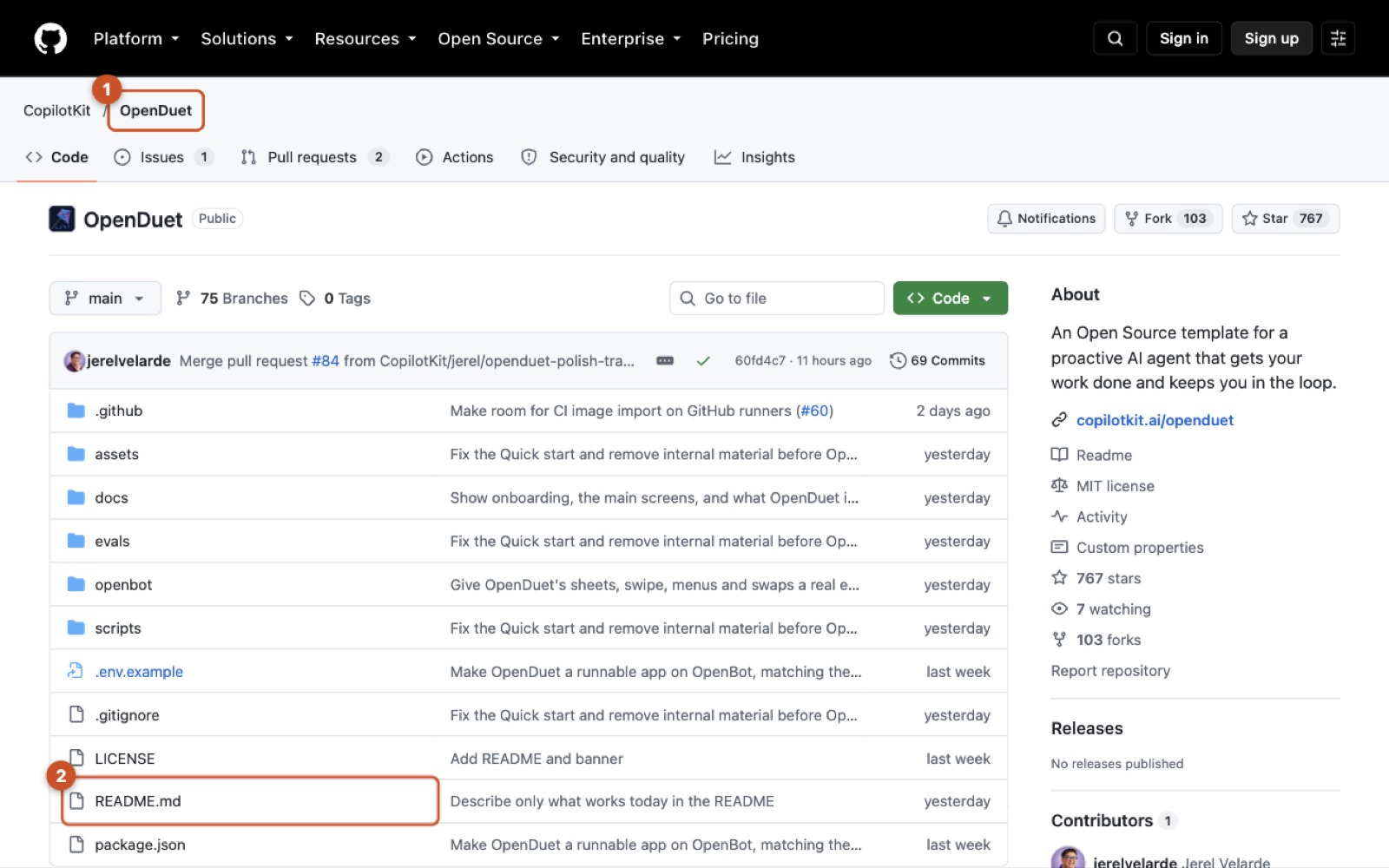
Under the hood, however, OpenDuet remains an early-stage prototype rather than an enterprise-grade drop-in daemon. The repository shows just 69 commits and an explicit early development status. More critically, its branding as "self-hostable" obscures a mandatory cloud umbilical cord: thread state, shared context, and long-term memory require a hosted CopilotKit Intelligence project.
If you put this directly onto an executive inbox today, you are adopting unmanaged operational risk. A probabilistic triage classifier that decides what can wait will eventually drop an urgent incident escalation. Furthermore, long-running headless browser tasks will inevitably stall on unexpected multi-factor authentication challenges or CAPTCHAs while you are away from keyboard.
Dissecting OpenDuet: OpenBot, Dedicated Sandboxes, and the CopilotKit Middleware
To evaluate OpenDuet, you have to peel back the branding. OpenDuet is not a foundation model, nor is it a bespoke agent framework competing with LangChain or CrewAI. It is an opinionated product persona that runs on top of OpenBot, CopilotKit's open-source server built on Hono and the CopilotKit runtime.
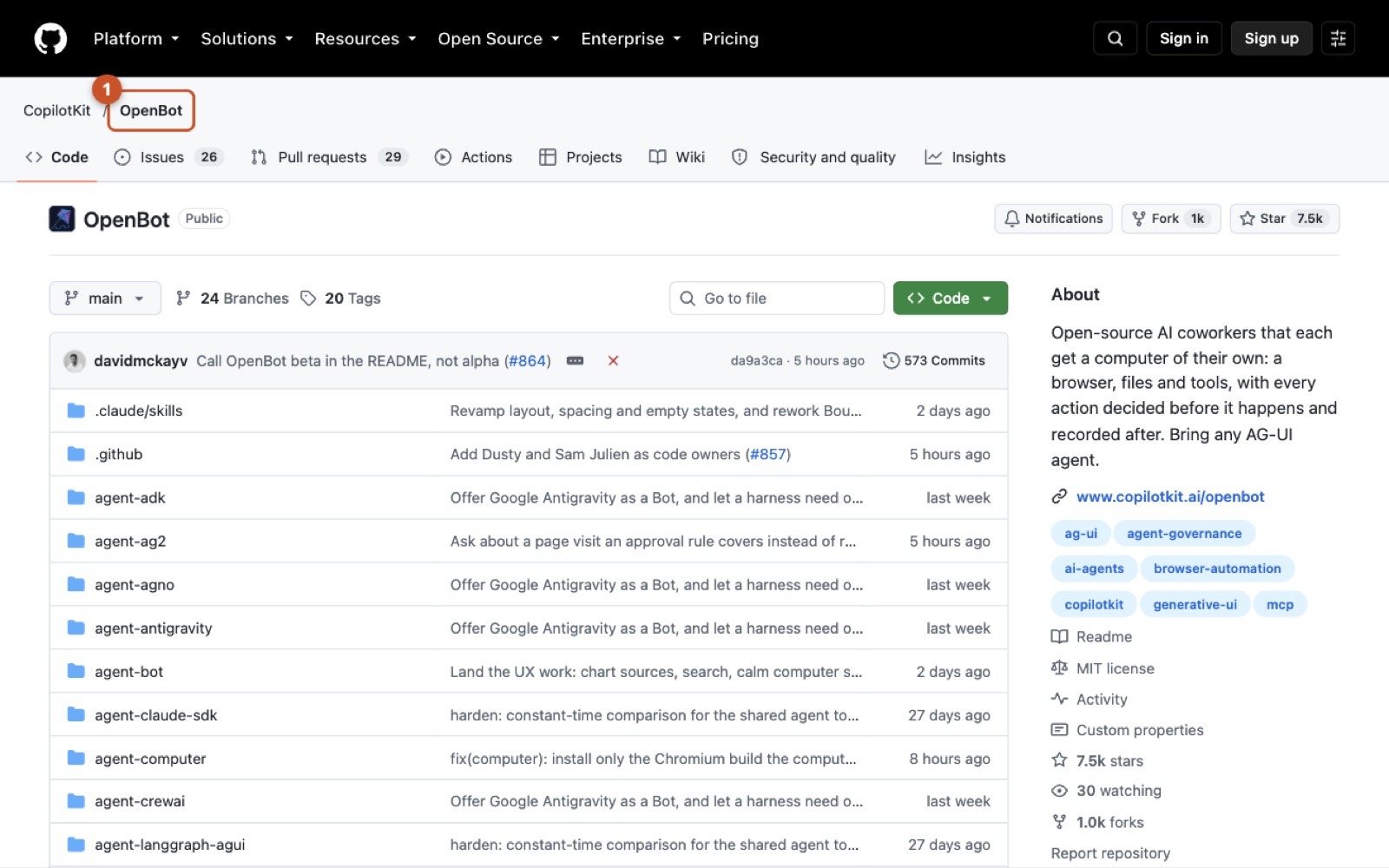
The mechanical separation of concerns is the strongest part of the design. Rather than executing arbitrary bash calls or visual mouse controls directly on the user's host OS—the hazardous approach popularized by local terminal daemons—OpenDuet provisions "a computer of its own." The agent operates inside a dedicated environment containing Chromium, a scoped /workspace filesystem, and a shell. Every tool execution is mediated back through OpenBot's gateway before reaching external systems.
quadrantChart
    title Agent Architecture: Execution Isolation vs Interface Fidelity
    x-axis Local Host OS --> Dedicated Headless Workspace
    y-axis Raw CLI / API Output --> Multi-Channel Interactive UI
    quadrant-1 Native Proactive Coworkers
    quadrant-2 Enterprise SaaS Silos
    quadrant-3 Local Automation Daemons
    quadrant-4 Headless Sandbox Infrastructure
    Open-Interpreter: [0.15, 0.25]
    E2B microVMs: [0.85, 0.20]
    SaaS Copilots: [0.30, 0.75]
    OpenDuet: [0.82, 0.85]
This positions OpenDuet in an underpopulated quadrant. As I've explored when analyzing how an agent that edits its own harness must not be its own kernel, decoupling execution from orchestrator logic is mandatory for stability. Infrastructure primitives like E2B offer isolated microVM execution without an interface layer, while SaaS productivity copilots trap users inside closed application silos. OpenDuet targets the intersection: a dedicated execution sandbox paired with interactive multi-channel UI streams. It allows developers to plug in external harnesses via AG-UI while preserving centralized policy enforcement across Gmail, Google Calendar, and Slack.
The Operational Scorecard: Where the Architecture Holds and Breaks
Evaluating OpenDuet against production standards requires separating CopilotKit's ambitious interface vision from the current operational reality. The architecture handles human-in-the-loop front-ends better than almost anything in the open-source ecosystem, but it introduces clear friction points in state management, network governance, and session persistence.
| Evaluation Dimension | Practical Rating | Operational Reality & Architectural Cause |
|---|---|---|
| Proactivity & Scheduling | Mixed | Morning briefings and inbound triaging successfully break out of chat-only loops. However, probabilistic categorization across email and Slack risks false negatives, and processing heavy message streams risks context window flooding without strict aggregation fences. |
| Workspace Isolation | Strong | Isolating execution inside a containerized sandbox with its own Chromium instance and /workspace prevents blast-radius spillover onto the host machine. The tradeoff is headless browser brittleness: DOM mutations, session timeouts, and bot-detection challenges stall unattended off-hours runs. |
| Multi-Channel Delivery | Strong | Rendering structured approval cards ("Allow once", "Always allow", "Refuse") across Web, Slack, and Microsoft Teams solves human-in-the-loop ergonomics. The operational challenge is preventing approval fatigue and guarding against race conditions when approvals sit unconfirmed while real-world state drifts. |
| Framework Pluggability | Strong | Decoupling agent reasoning through AG-UI allows teams to wire in custom agents built on LangChain, CrewAI, PydanticAI, or bespoke code without rewriting front-end adapters or notification webhooks. |
| Self-Hosting Autonomy | Fragile | While published under the MIT license with Docker deployment options, OpenDuet explicitly mandates an external CopilotKit Intelligence cloud project for thread persistence and long-term memory. It fails true zero-dependency air-gap requirements. |
The gap between a compelling blueprint and a stable daemon comes down to resilience under edge cases. The codebase is early, with core files organized across openbot/ and scaffolding scripts like bun openbot/scripts/setup-learning.ts. When adopting this architecture, your engineering effort will shift almost entirely to hardening edge cases: managing OAuth token refresh cycles across Google and Microsoft providers, handling zombie browser sessions, and implementing time-to-live expiration policies on stale approval payloads.
Where OpenDuet Wins: Replacing Terminal Prompts with Native Confirmation Cards
Most developer-focused agent frameworks run into an immediate usability wall when they leave the terminal. Tools like Open-Interpreter either require you to stare at a command line waiting to press y or n, or they commandeer your local desktop, fighting you for mouse and keyboard control. That execution model is completely unworkable for executive assistance. If an agent is supposed to help manage my workday, it cannot hijack my cursor while I am drafting an email, nor can it expect me to keep an active terminal session open on my secondary monitor.
OpenDuet solves this interaction model cleanly by pushing structured confirmation cards directly into the communication channels I already inhabit: Slack, Microsoft Teams, and the web client. When an agent workflow identifies an action with real-world side effects—sending an outbound email, booking a calendar invite, transferring funds, or deleting a record—it halts execution at the OpenBot gateway. Instead of dumping raw JSON or halting on an obscure CLI prompt, it renders an interactive card showing the exact payload, offering three unambiguous choices: "Allow once", "Always allow", or "Refuse".
Critically, OpenDuet pairs this multi-channel confirmation flow with dedicated workspace isolation. The agent does not execute browser automation on my primary machine. It runs its own headless Chromium instance, scoped /workspace filesystem, and shell inside an isolated container. I can dispatch a complex web research or administrative task, close my laptop, and review the resulting payload when an approval card pings my phone via Slack. Decoupling execution from the user's physical display while binding authorization to native work surfaces is the exact architectural pattern autonomous copilots need to adopt across the board.
The Operational Costs: Threat Modeling Inbound Triage and Testing the Cloud Tether
Despite OpenDuet’s compelling interface design, deploying it against real operational communications introduces critical vulnerabilities that engineering teams cannot overlook. The most urgent vulnerability lies in the proactive triage pipeline.
By design, OpenDuet continuously ingests inbound messages from Gmail and Slack to construct the morning brief and decide what can wait versus what requires immediate attention. In security terms, inbound emails and chat messages are untrusted, adversary-controlled inputs. If an external attacker sends an email containing an indirect prompt injection—such as instructing the model to summarize sensitive correspondence, attach it to a draft, or update approval rules—the triaging agent processes that payload directly within its reasoning context. While destructive actions should theoretically trigger an approval card, social engineering inside the preview payload or confusion caused by nested instructions can trick a busy operator into clicking "Allow once". Without cryptographic origin validation and strict message sanitization, proactive inbox triaging functions as an open ingestion vector for prompt injection.
The second major operational concern is the reality of its self-hosting claim. The documentation markets OpenDuet as a self-hostable template, yet step two of the setup process explicitly requires authenticating against a proprietary cloud project:
npx --yes copilotkit@latest login
npx --yes copilotkit@latest project select
bun openbot/scripts/setup-learning.ts
You can verify this cloud umbilical cord yourself with a simple egress firewall test. Spin up the container using Docker:
docker run -p 3001:3001 --env-file .env \
  -e EMBEDDED_POSTGRES=on -v openbot-data:/var/lib/postgresql \
  ghcr.io/copilotkit/openbot:latest
Drop all outbound network egress toward external CopilotKit endpoints while keeping local network access open. The server will initialize its embedded PostgreSQL instance, but thread state, multi-session memory, and message routing will fail to persist. If your compliance mandate prohibits sending customer communications, thread metadata, or calendar schedules to a third-party managed backend, this architectural coupling is an immediate disqualifier.
What Would Change My Mind on Running OpenDuet in Production
I want OpenDuet's architectural model to succeed because proactive multi-channel coordination is vastly superior to passive chatbot turn-taking. However, before I would consider attaching it to production communications or sensitive corporate channels, the core platform must make three distinct engineering shifts:
First, the runtime must completely sever its mandatory cloud dependency. OpenBot already bundles PostgreSQL with pgvector for policy and audit records. That local database layer—or a self-managed Redis cluster—must become the primary target for thread history and working memory. True self-hosting means a container running in an air-gapped VPC can process tasks without authenticating against an external CopilotKit project.
Second, the approval subsystem needs strict time-to-live expiration policies. If an agent drafts an email reply or proposes rescheduling a double-booked calendar slot at 8:00 AM, and I do not review the Slack card until 2:00 PM, the underlying state has almost certainly drifted. Executing an approval against stale context causes duplicate messages and booking collisions. I need configurable TTLs that automatically abort expired payloads and require the agent to re-validate state before re-prompting. As explored in how agentloop enforces run bounds on LLM agents without a state graph, deterministic boundaries around state lifecycles are essential for reliability.
Finally, inbound communication pipelines require deterministic, isolated preprocessing. The agent cannot blindly ingest raw email HTML and Slack webhooks into the reasoning window. I need structured, zero-trust sanitization that strips executable injection patterns before the LLM evaluates priority.
Until those operational guardrails land, OpenDuet remains an exceptional prototyping lab for multi-channel generative UI, but a liability if run unattended on live operational data.
Resources
- GitHub - CopilotKit/OpenDuet: An Open Source template for a proactive AI agent that gets your work done and keeps you in the loop. · GitHub
- GitHub - CopilotKit/OpenBot: Open-source AI coworkers that each get a computer of their own: a browser, files and tools, with every action decided before it happens and recorded after. Bring any AG-UI
- CopilotKit: bring your agent into any app
Updated 2026-10-26 by Mehran Mozaffari.
Related posts
24 October 2026
How AutoSwarm Turns Isolated AI CLIs into a Coordinated Swarm Without a Shared Runtime
24 October 2026
Should You Switch Your Agent Harness to Anvaya? Only if Orchestrator Memory Is Your Bottleneck
24 October 2026
Recurrent State Kernels Move the Local Inference Bottleneck from Memory to Dispatch
24 October 2026
Autonomous Coding Scales Through Process Resets Rather Than Context Retention
22 October 2026
Decoupling the Bot From the Runtime Turns Chat Surfaces Into Remote Terminals
22 October 2026
Anthropic srt or Docker Containers for Securing Local Agent Execution