
The Single-Pass Shift: Why Generative Routers Never Belonged in the Critical Path
Every production inference gateway reaches a point where someone kludges an intent router out of an autoregressive model. I have watched engineering teams wire up GPT-4o-mini, Claude 3.5 Haiku, or a local Qwen2.5-3B-Instruct instance inside the ingress path just to determine whether an incoming query should hit a vector store, trigger an SQL agent, or get dropped by a safety filter. The argument is always convenience: you can drop a system prompt into an existing endpoint, define five JSON keys, and pretend your dispatch layer is solved.
In practice, placing an autoregressive decoding loop in front of your primary compute pipeline is an architectural mistake. Autoregressive models impose a severe latency tax—typically 150ms to 1200ms—purely to execute prefill and generate a dozen formatting tokens. Worse, they suffer from token formatting drift, intermittent JSON truncation, schema deviations, and non-deterministic hallucinations. When an ingress triage step hiccups on a missing closing bracket or decides to emit unsolicited conversational preamble before the payload, the entire downstream orchestration chain stalls.
As I explored when rethinking the routing layer with Decision 2.0, gating is a classic "System 1" problem: fast, reflexive, and categorical. You do not need an autoregressive generation loop to pick one route out of six candidates.
Incoming Request ──► [ Decision 3.0: Single Forward Pass ] ──► Target Logits / Probabilities
                            (No KV-Cache Generation Loop)         ├── route_billing: 0.94
                                                                  ├── route_support: 0.04
                                                                  └── route_safety_drop: 0.02
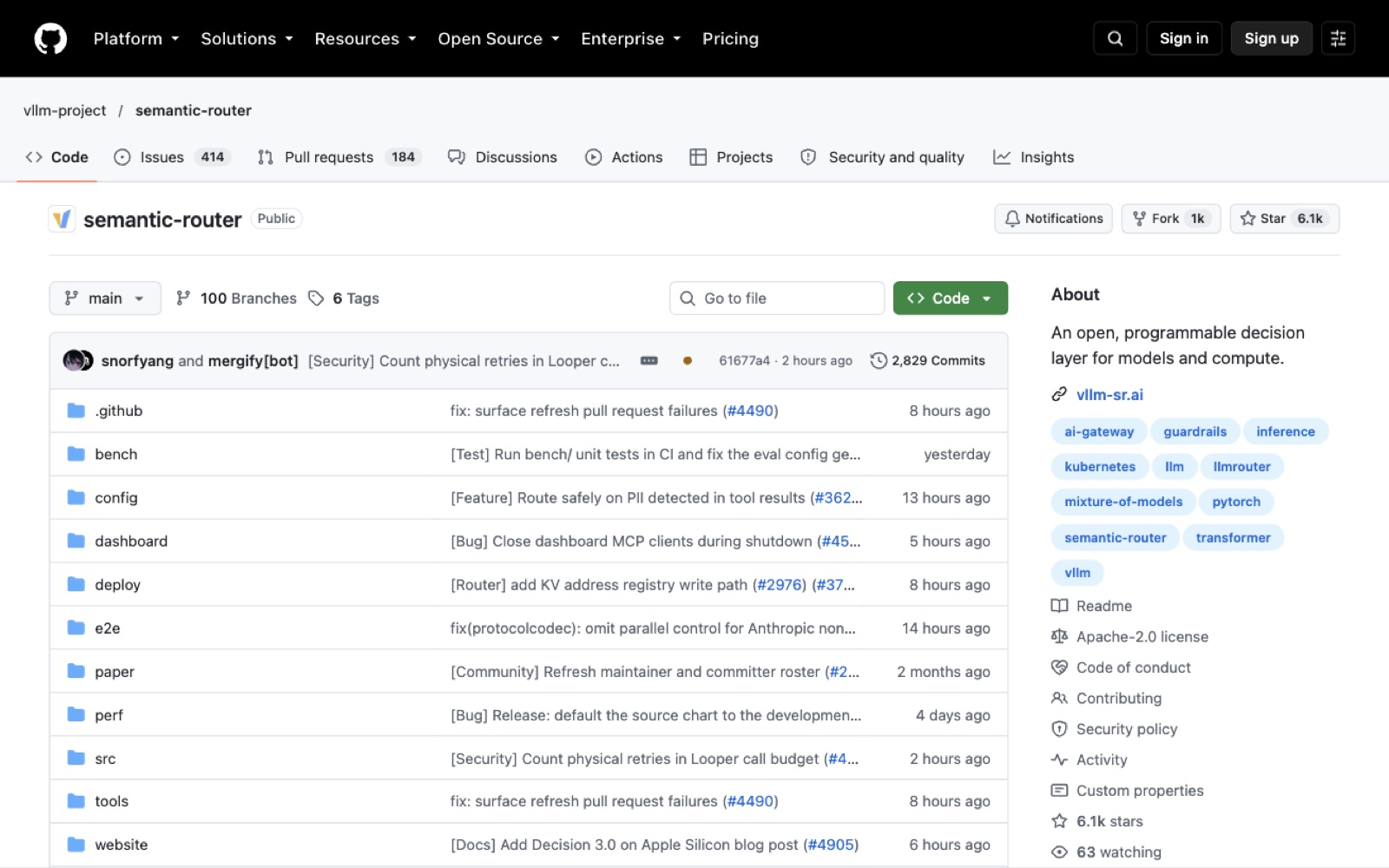
Decision 3.0 addresses this mismatch by returning to direct logit extraction. Released by the vllm-sr (vLLM Semantic Router) team under Apache-2.0, Decision 3.0 discards token decoding loops entirely. Instead of generating text or structured JSON tokens sequentially, the model outputs calibrated probability distributions over predefined candidate targets in a single forward pass. There is no KV-cache expansion, no auto-regressive state drift, and no downstream parser failure. You feed the context—whether natural language, raw JSON schemas, or images—and the network evaluates the candidate targets concurrently, yielding crisp confidence scores in tens of milliseconds.
Inside the Decision 3.0 Family: Architecture, Qwen Backbones, and Parameter Tiering
Decision 3.0 represents a clear architectural evolution from earlier text-only iterations in this lineage—progressing through Decision 1.0, Decision 2.0, MoM 1.0, and Vela 2.0. Where earlier iterations were primarily bounded by text classification, Decision 3.0 unifies multimodal context conditioning into a non-autoregressive decision interface.
The core models are built upon Qwen3.5 and Qwen3.8 base architectures, integrating native vision encoders to ingest raw text, structured JSON schemas, high-resolution images, and video frames within a unified attention context. Published under an Apache-2.0 open-source license, the release provides a six-tier parameter ladder structured to bridge edge runtimes and high-throughput cluster gateways:
vllm-sr/d3-edge(0.6B): An ultra-low-latency gating variant designed for local edge deployment, including Core ML conversions running on Apple Silicon unified memory.vllm-sr/d3-lite(~0.85B–0.9B): A compact model geared for local device agents requiring lightweight visual inspection.vllm-sr/d3-nano(~2.0B–2.2B): A step up in semantic resolution for multi-intent client-side dispatch.vllm-sr/d3-mini(~4.5B–5.0B): Balanced mid-tier variant suitable for high-density GPU worker nodes.vllm-sr/d3-flash(~8.0B–8.4B): High-accuracy operational tier optimized for complex structured schemas and multi-turn contextual histories.vllm-sr/d3(~26B–27B): The flagship foundation decision model built for dense multimodal cross-attention, video stream gating, and complex policy arbitration.
According to release evaluations, the family claims the #1 position on both boards of the Jev Decision Index, establishing a new Pareto frontier across accuracy, operational latency, and parameter footprint. (It is worth noting that while Hugging Face weights and model configurations are public, the private test methodology of the proprietary Jev Decision Index suite is not fully documented in public repository cards, so internal validation remains essential.)
The technical distinction lies in runtime execution: these backbones are optimized directly for the vllm-project/semantic-router runtime. Rather than serving as an open-ended conversational engine, the forward pass projects directly onto predefined classification targets, allowing operators to run multimodal triage without provisioning the massive VRAM footprints typically demanded by conversational vision-language models.
Architectural Archetypes: Where Decision 3.0 Lands Against Embedding and Guardrail Stacks
To understand where Decision 3.0 fits in a production architecture, it helps to map it against the competing paradigms teams currently employ for intent detection and traffic gating.
At the lowest latency tier sits embedding-based routing—exemplified by aurelio-labs/semantic-router or vector cosine distance classifiers against static anchor vectors. These run in under 10ms on bare CPU instances. However, vector similarity fails when faced with syntactic nuance, negation, or visual conditions. A cosine distance calculation over query embeddings cannot reliably differentiate "route this to refund unless the user upload shows an unboxed hardware item" from its exact inverse. Embedding models lack the compositional attention required to bind negative constraints to visual evidence.
Specialized encoder-only models like ModernBERT or DeBERTa-v3 handle nuanced text logic with low latency, but they require supervised fine-tuning for new routes and fall short when arbitrary video frames, screenshots, and structured payloads must be jointly evaluated out of the box.
Dedicated safety guardrails such as Llama-Guard 3-Vision offer vision-language classification, but their parameter heads are strictly tuned to predetermined safety taxonomies (such as hate speech or self-harm). They cannot act as generalized application routers for compute tier dispatch, tool triage, or dynamic schema-based classification.
Autoregressive models (GPT-4o-mini, Claude 3.5 Haiku) provide flexible schema handling, but you pay a 150ms to 1200ms toll on every call and risk parsing failures.
| Dimension | Embedding Routers (e.g., Aurelio) | Generative VLMs (e.g., GPT-4o-mini) | Dedicated Safety (e.g., Llama-Guard 3 Vision) | Decision 3.0 (vllm-sr/d3) |
|---|---|---|---|---|
| Output Mechanism | Vector Cosine / Euclidean Distance | Autoregressive JSON / Text Tokens | Autoregressive / Token Classification | Direct Logit / Calibrated Target Probability |
| Multimodal Context | Text-only (unless using loose CLIP pairing) | Full Multimodal (Images, Video, Text) | Text + Images (Restricted taxonomy) | Full Multimodal (Images, Video, Text, JSON Schemas) |
| Latency Profile | < 10ms (CPU/GPU) | 150ms – 1200ms+ (GPU) | 100ms – 400ms (GPU) | 15ms – 80ms (GPU / Apple Silicon Core ML) |
| Failure Modes | Negation failure, semantic collapse | Token drift, hallucinated keys, syntax errors | Inflexible policy heads, no general routing | Silent overconfidence on out-of-distribution inputs |
| Deployment Footprint | In-process / CPU memory lookup | Remote API / Large shared GPU cluster | Dedicated Gateway Sidecar | Inference Gateway (vllm-project/semantic-router) / Edge |
Decision 3.0 lands in the operational sweet spot: delivering the multimodal reasoning depth of a vision-language model while retaining the deterministic, 15ms–80ms single-forward-pass latency profile required for an ingress decision layer.
The Mechanics of Multimodal Routing: Ingestion, Jinja Delimiters, and Vision Token Overhead
To understand why Decision 3.0 behaves differently from standard token classifiers, you have to look at the prompt prefill pipeline inside the vllm-project/semantic-router runtime. Because the underlying backbones are Qwen3.5 and Qwen3.8 vision-language models, the single forward pass does not bypass vision tokenization; it merely short-circuits the subsequent generation loop.
When you submit an interleaved multimodal request—such as a user query, a structured JSON routing schema, and an attached UI screenshot or video clip—the gateway transforms visual artifacts into dense sequences of patch tokens. In the Qwen architecture, visual inputs are wrapped in strict ChatML delimiters:
<|im_start|>user
<|vision_start|><|image_pad|>...<|image_pad|><|vision_end|>
Evaluate intent against schema: {"routes": ["billing_dispute", "hardware_defect", "general_faq"]}
User note: Screen flickers upon power connection.<|im_end|>
<|im_start|>decision
This formatting layer is exceptionally brittle. The underlying Jinja templates enforce rigid syntactic contracts. If your API gateway alters token delimiters, strips <|vision_start|>, or injects video frames into a system turn—which triggers an unrecoverable template exception inside Qwen's template engine stating that system turns cannot contain video—the forward pass aborts before tensor computation begins. I treat template normalization as a hard prerequisite at ingress: every payload must pass through strict input sanitation to ensure token boundaries match the expected tokenizer configuration exactly.
The more significant operational hurdle is vision token inflation during prefill. While Decision 3.0 avoids the latency tax of autoregressive decoding, it remains bound by the compute physics of transformer prefill. A high-resolution image or a short video sequence decompresses into hundreds or thousands of <|image_pad|> tokens.
Raw Image / Video Frames ──► Vision Encoder ──► [ 1000+ Image Patch Tokens ]
                                                          │
Context Schema + User Text ───────────────────────────────┼──► Dense Prefill Attention
                                                          │    (Prefill Latency Surge)
Target Route Definitions  ────────────────────────────────┘               │
                                                                          ▼
                                                          Direct Logit Classification
On a 26B/27B backbone like vllm-sr/d3, processing unconstrained video streams causes immediate time-to-first-token surges. The latency advantage over lightweight text routers quickly erodes if you pass 4K frames or high-FPS video into the vision encoder. To keep response times strictly within the 15ms–80ms envelope, production gateways must enforce aggressive pre-processing policies: downsampling incoming images to bounding resolutions, extracting discrete keyframes rather than raw video clips, and hard-capping the visual token budget before dispatching tensors to GPU memory.
Where It Breaks: Silent Calibration Collapse, OOD Drift, and Edge Disparities
The core architectural virtue of Decision 3.0—replacing autoregressive text generation with direct logit extraction—is also the source of its most insidious failure mode: silent calibration collapse.
When an autoregressive model encounters an ambiguous prompt or contradictory context, it typically leaves clues: repetitive rambling, malformed JSON, or hedging commentary. A non-autoregressive classifier fails silently. When presented with out-of-distribution (OOD) inputs or conflicting multimodal evidence, Decision 3.0 still emits a crisp vector of target probabilities. The network will happily assign a 0.82 confidence score to an incorrect route without generating a single exception or syntax alert.
Relying on raw softmax scores at your gateway introduces severe routing jitter. Softmax normalizes logits across candidate targets, but it does not represent true Bayesian confidence. If the routing set contains high-entropy ambiguity, the highest score can be completely uncalibrated. Production implementations must apply post-hoc calibration, such as temperature scaling or Platt scaling against a curated validation set, and evaluate the Shannon entropy of the output distribution before dispatching traffic.
sequenceDiagram
    autonumber
    actor User as Client Request
    participant GW as vllm-project/semantic-router<br/>(Decision 3.0)
    participant Fallback as Entropy & Calibration<br/>Verification
    participant TierLLM as Tiered LLM / Worker Pool<br/>(Downstream)
    participant Human as Human Triage /<br/>Safe Fallback

    User->>GW: POST /route (Multimodal Context + Schema)
    GW->>GW: Single Forward Pass (Target Logits)
    GW->>Fallback: Raw Probabilities P(C)
    alt Entropy H(P) <= Threshold AND max(P) >= Tau
        Fallback->>TierLLM: Dispatched Request (Target Route)
        TierLLM-->>User: High-Confidence Execution Response
    else Entropy H(P) > Threshold OR max(P) < Tau (OOD / Ambiguous)
        Fallback->>Human: Quarantine / Review / Safe Default
        Human-->>User: Safe Fallback / Manual Triage Acknowledgment
    end
Beyond calibration drift, two operational traps demand proactive engineering:
- Edge-to-Datacenter Boundary Skew: A common architectural pattern is deploying
vllm-sr/d3-edge(0.6B) via Core ML on client devices for local filtering, while reservingvllm-sr/d3(27B) for central cloud clusters. This creates mismatched classification boundaries. A prompt and threshold set calibrated for the 27B model will frequently misfire on the 0.6B edge variant, which possesses a far smaller capacity for nuanced compositional reasoning. Decision boundaries and confidence cutoffs must be tuned independently for each parameter tier. - Candidate Target Dilution: In zero-shot classification mode, all candidate targets and descriptions must reside within the context window. As your routing topology expands from half a dozen paths to dozens of granular sub-routes, the candidate schema expands, diluting attention mass across the prompt. Probability mass spreads thin, confidence margins contract, and the network becomes increasingly vulnerable to minor prompt perturbations. For complex architectures with vast routing spaces, hierarchical routing trees consistently outperform broad flat schemas.
Production Hardening: Platt Scaling, Entropy Fallbacks, and Prefix Cache Hygiene
Deploying Decision 3.0 within vllm-project/semantic-router requires treating the model's raw probability output with deep skepticism. In my experience, the fastest route to production instability is hardcoding a static routing threshold like 0.80 across all candidate routes. A raw logit passed through a standard softmax layer reflects relative separation between candidates in the forward pass, not genuine empirical confidence.
To harden this layer, you need post-hoc probability calibration. I recommend fitting temperature scaling or per-class Platt scaling parameters against an in-domain gold validation set containing both typical queries and borderline edge cases. Temperature scaling softens or sharpens the logit landscape across the entire target space via a learned scalar $T$, while Platt scaling fits a logistic regression model over the raw outputs, anchoring the scores to real-world precision and recall targets.
Simultaneously, an ingress router must guard against silent out-of-distribution drift. When an input matches none of the defined candidates, a softmax distribution can either collapse into artificial overconfidence or fracture into uniform uncertainty. Computing the Shannon entropy $H(P) = -\sum P(c) \log P(c)$ over candidate probabilities creates a resilient circuit breaker. If the peak probability falls below your calibrated threshold $\tau$, or if the normalized entropy exceeds an empirical ceiling (indicating high confusion), the request should bypass downstream dispatch entirely, falling back to a safe deterministic default or human review.
Request Stream ──► [ Jinja Normalizer ] ──► [ Frozen Prefix KV-Cache ] ──► Logit Calibration & Entropy Guard
                     - Fixed Delimiters       - Candidate Schemas           - Platt Scaling
                     - Asset Resizing         - Policy Instructions         - Safe Circuit Breaker
Finally, operational efficiency hinges on KV-cache hygiene. While Decision 3.0 skips token generation loops, transformer prefill still incurs compute costs. If every incoming request reorganizes how candidate routes, instructions, and schemas are laid out, you invalidate prefix caching on every invocation. You must treat candidate schemas and policy instructions as immutable, front-loaded context blocks. Dynamic user text, metadata, and vision embeddings must always be appended after the frozen schema prefix. This discipline allows vllm-project/semantic-router to cache the initial schema states across stateless calls, reducing prefill latency to the incremental cost of the new payload.
| Production Risk | Failure Mode | Architectural Mitigation |
|---|---|---|
| Probability Miscalibration | Overconfident incorrect routing on borderline classifications. | Fit per-route Platt scaling or temperature scaling parameters against a curated gold validation split before setting cutoffs. |
| Out-of-Distribution Drift | Silent routing leakage when queries fail to match any valid target route. | Implement Shannon entropy checks alongside peak probability gating ($\max(P) \ge \tau$) to divert anomalous traffic to fallback queues. |
| Vision Token Inflation | Prefill latency surges caused by high-resolution images and dense video frames. | Enforce client-side image resizing, strict keyframe decimation policies, and an upper limit on input patch token budgets. |
| Silent Regression on Updates | Routing topology mismatches during schema or weight updates. | Route live traffic concurrently through a dark-traffic shadow tier to baseline divergence and class agreement before cutting over. |
Deploying Decision 3.0 in Production: Architecture Blueprints for Practitioners
Moving Decision 3.0 into a real architecture means organizing your inference paths to match the model's single-pass strengths while safeguarding against physical runtime bottlenecks.
For teams building client-facing workflows, an Edge-to-Cloud Multimodal Triage Gateway offers a pragmatic blueprint. In this topology, you wire a lightweight d3-edge (0.6B) model directly onto the client device using Core ML on Apple Silicon unified memory. This edge tier evaluates local UI interactions, performs immediate intent triage, and scrubs sensitive user data without exposing local interactions to network latency. When an interaction presents high semantic complexity or ambiguous intent, the client escalates the context to a centralized d3 (27B) instance hosted within vllm-project/semantic-router in a cloud GPU cluster for definitive tool selection. The critical watchpoint here is threshold mismatch: the compressed 0.6B model possesses a significantly smaller representational capacity than the 27B variant. Prompts and thresholds calibrated against d3 in the cloud will inevitably skew on d3-edge, requiring distinct confidence boundaries and validation sweeps for each deployment footprint.
Another high-impact blueprint is the Zero-Generation Multimodal Safety and Moderation Sidecar. Instead of incurring the massive latency and compute cost of routing every customer interaction through a generative vision-language model, you drop vllm-sr/d3-flash (8B) into an inline Kubernetes sidecar proxy directly in front of your customer-facing API. The sidecar intercepts mixed text, image attachments, and short video clips, making single-pass safety evaluations and policy enforcement calls in under 50ms before downstream inference endpoints ever see the payload. Prometheus metrics tracking output entropy provide real-time monitoring of policy boundary health. When implementing this pattern, you must watch out for video frame ingestion latency spikes during transformer prefill. High-frame-rate inputs can saturate the sidecar's GPU memory bandwidth, creating head-of-line blocking for the entire gateway. Enforcing strict image downsampling, frame extraction caps, and token limits prior to the vision encoder keeps ingress response times deterministic.
For complex orchestration systems, practitioners can implement a Multi-Criteria Dynamic Tool and Compute Router. Rather than chaining multiple classification prompts to determine model selection, tool dispatch, and compute tiering, a central vllm-sr/d3 (27B) deployment can evaluate an incoming query and its structured JSON payload across dozens of routing targets in a single forward pass. Incoming jobs are steered cleanly toward lightweight SLMs, expensive reasoning engines, or specialized external services. As the tool registry expands, however, you must avoid candidate cardinality bloat. Stuffing dozens of granular tool definitions into a single prompt spreads attention thin and dilutes output probability mass. Maintain modular, hierarchical routing sets, and always front-load static route definitions to maximize prefix cache reuse across incoming traffic.
Resources
Updated 2026-10-10 by Mehran Mozaffari.
Related posts
1 November 2026
Direct Weight Editing Is Machine Code Hot-Patching for Transformers
31 October 2026
Unreal Engine Skills for Claude Code: How Epic Bypassed the Binary Asset Barrier to Mutate Live Viewports
30 October 2026
Agent Memory Was an Indexing Problem All Along
28 October 2026
The Codebase Is an Environment, Not a Context Window
26 October 2026
Should you self-host OpenDuet as your proactive AI coworker? Not yet
24 October 2026
How AutoSwarm Turns Isolated AI CLIs into a Coordinated Swarm Without a Shared Runtime