
The Generative Tax on Routine Housekeeping
Whenever I inspect the cost and latency profiles of production agent loops, I notice an embarrassing pattern: our most expensive compute cycles are rarely spent on novel reasoning. Instead, frontier models like Claude 3.5 Sonnet or GPT-4o burn hundreds of milliseconds re-emitting text that was already sitting inside their context windows. When Neal Patel of ScaleDown posed the question—"You already gave the LLM the answer. So why is it writing it out from scratch?"—he captured the core design flaw of modern agent harnesses. We are paying a steep generative tax to perform deterministic clerical work.
In a complex multi-turn execution graph, the primary reasoning model spends a staggering amount of time on background hygiene. It trims conversational histories, parses structured values out of API responses, classifies incoming user intent against static taxonomies, and filters thousands of lines of terminal output down to three relevant error lines. None of these tasks require open-ended natural language generation. The target entities, error codes, and category boundaries are already fully present in the prompt.
Yet standard autoregressive architectures tackle this by projecting logits across an entire vocabulary of 32,000 to 128,000 tokens, predicting token by token, forward pass by forward pass. To extract an order ID from a JSON payload, a frontier model will initialize its attention layers, compute KV caches across tens of thousands of prompt tokens, and sequentially generate formatting boilerplate—quotes, braces, keys, whitespace—before finally generating the ID string that was already sitting at character position 4,120 of the input.
This is architectural overkill. Autoregressive next-token prediction over an expansive vocabulary is an exceptional mechanism for creative drafting, code synthesis, and multi-step inference. But applying it to bounded context operations introduces three distinct penalties: high time-to-first-token (TTFT) and generation latency, inflated token bills that scale quadratically with context length, and non-zero hallucination rates where numbers or identifiers subtly mutate during decoding. As I argued when evaluating Harness Engineering Over Raw Weights: Why Modular Dev-Primitives Crush Monolithic Coding Agents, building production-grade agent pipelines requires decoupling lightweight mechanical operations from the core reasoning engine. If an agent already has the text, forcing a 200-billion-parameter network to compose it anew is a failure of system architecture.
Under the Hood: Span Pointers, Categorical Projections, and Massive Contexts
ScaleDown’s Constrained Decoding Models (CDMs) attack this generative tax by fundamentally reshaping the decoder’s output space. To understand how CDMs operate mechanically, it helps to distinguish them from standard grammar masking. Traditional structured generation libraries wrap an autoregressive model at inference time, evaluating a finite state machine to set invalid vocabulary logits to negative infinity. While effective at ensuring syntactically valid JSON, the model is still executing standard next-token predictions across a 100k-token dictionary.
CDMs shift this constraint from a runtime logit mask into the model’s native projection architecture. Rather than projecting hidden states into a general vocabulary head, the model decodes directly into task-bounded objective heads. For extraction and compression tasks, the network relies on pointer mechanisms that output index pairs—start and end token spans directly addressing the input sequence. For classification and routing, the output head projects strictly over a discrete, predefined label space, computing logit scores across categorical distributions without emitting intermediate conversational tokens.
sequenceDiagram
    autonumber
    participant Orchestrator as Agent Orchestrator
    participant Tool as External System / Tool
    participant SDCompress as ScaleDown Compress
    participant SDExtract as ScaleDown Extract
    participant Frontier as Frontier LLM (Reasoning)

    Orchestrator->>Tool: Execute batch query or API call
    Tool-->>Orchestrator: Return raw verbose payload (e.g. 80k tokens)
    Orchestrator->>SDCompress: Forward payload with target query
    Note over SDCompress: Pointer mechanism isolates relevant input spans
    SDCompress-->>Orchestrator: Return isolated context spans
    Orchestrator->>SDExtract: Extract schema fields from spans
    Note over SDExtract: Direct span indexing and confidence scoring
    SDExtract-->>Orchestrator: Return typed entities with token offsets
    Orchestrator->>Frontier: Dispatch sanitized state and extracted entities
    Note over Frontier: Focuses pure compute on core synthesis and planning
    Frontier-->>Orchestrator: Yield next action decision
This structural shift produces immediate operational dividends. Because the decoder does not generate decorative syntax, conversational transitions, or filler tokens, the decoding loop finishes in a fraction of the forward passes required by a standard LLM. Generation latency ceases to be a function of output verbosity; it becomes largely bound by encoder ingestion speed.
Crucially, ScaleDown pairs these constrained heads with massive input context windows, supporting up to 1 million tokens across multimodal inputs, including raw text, scanned PDFs, and document images. In task-specific variants like ScaleDown Compress, ScaleDown Extract, ScaleDown Summarize, and ScaleDown Classify, this combination allows an orchestrator to feed sprawling, messy context directly to an endpoint that isolates the exact token spans containing the answer. By replacing unconstrained text generation with direct span indexing and categorical scoring, token costs drop dramatically while factual grounding becomes mathematically bounded to the source text.
The Four Architectural Approaches to Deterministic Context Handling
The problem of trimming context bloat and enforcing deterministic structure in agent loops has yielded four competing engineering approaches across the stack. Understanding where CDMs sit requires evaluating them against runtime grammars, extractive cross-encoders, prompt compressors, and distilled small language models.
quadrantChart
    title Context Handling Strategies: Flexibility vs Context Capacity
    x-axis Low Context Capacity --> High Context Capacity
    y-axis Extractive / Deterministic --> Free Generative Flexibility
    quadrant-1 Generative Long Context
    quadrant-2 Generative Short Context
    quadrant-3 Extractive Short Context
    quadrant-4 Extractive Long Context
    Distilled SLMs: [0.72, 0.82]
    Inference Grammars: [0.60, 0.70]
    ScaleDown CDMs: [0.88, 0.18]
    LLMLingua 2: [0.38, 0.22]
    Classical Cross Encoders: [0.20, 0.15]
Inference-time grammar engines like Outlines, Guidance, and SGLang represent the most common pattern today. They offer unmatched flexibility: you supply any open-weights model or supported provider API, define a Pydantic schema or regular expression, and the engine ensures every emitted token adheres to that schema. However, because grammar engines operate as masks over traditional decoders, they do not bypass the autoregressive tax. The model must still generate every whitespace character, quotation mark, and key name token-by-token. Even with jump-forward decoding optimizations, the GPU is executing forward passes for tokens whose values are predetermined.
Classical extractive cross-encoders (such as DeBERTa-v3 or dedicated bi-encoder re-rankers) sit at the opposite extreme. They use pointer heads to extract spans with exceptional speed and zero generative drift. But their Achilles' heel in production is input context: their attention layers collapse beyond small 512 to 8,192 token windows. They cannot ingest a 400-page regulatory filing or an expansive agent execution trace.
Prompt compression frameworks, pioneered by Microsoft’s LLMLingua and LLMLingua-2, take an alternative route by calculating token perplexity to drop low-information words before dispatching prompts to an LLM. While this cuts token counts, it operates as a lossy filter. Pruning tokens based on perplexity can strip away syntactic markers, resulting in unnatural inputs that degrade downstream reasoning on complex coding or mathematical tasks.
Finally, teams frequently deploy distilled small language models (SLMs) like Claude 3.5 Haiku, GPT-4o-mini, or Llama 3.2 3B as dedicated subagent workers. These models are inexpensive and handle long contexts, but they remain unconstrained generative models. They can still hallucinate values, misread boundary edge cases, and invent formatting quirks under pressure.
ScaleDown’s CDMs effectively occupy the high-context, extractive quadrant that has historically been empty. They combine the massive ingestion capacity of frontier LLMs with the deterministic precision and low decoding overhead of pointer networks.
| Dimension | ScaleDown CDMs | Inference Grammars (Outlines, SGLang) | Prompt Compressors (LLMLingua-2) | Distilled SLMs (Haiku, 4o-mini) |
|---|---|---|---|---|
| Decoding Mechanism | Native span-pointer projection and categorical logits | Dynamic logit masking over broad vocabulary via FSM/CFG | Perplexity thresholding and extractive token dropping | Full autoregressive next-token prediction |
| Context Capacity | Ultra-long (up to 1M tokens), multimodal | Inherited from base LLM (32k–128k+) | Low to medium chunk windows | Standard frontier window (128k–200k+) |
| Output Format | Direct span pointers, taxonomy logits, bounded text | Schema-conforming JSON, regex strings, typed values | Sub-sampled prompt string (lossy text) | Free-form natural language, JSON, tool payloads |
| Hallucination Profile | Near zero for extraction and classification tasks | Eliminates syntax invalidity; can still hallucinate facts | Zero new tokens, but can alter semantic dependencies | Prone to factual hallucination and schema drift |
| Deployment Topology | Managed API endpoint (langchain-scaledown) |
Local Python runtime or self-hosted inference server | Local pre-processing library or sidecar | Multi-tenant SaaS API or self-hosted weights |
Where the Mechanics Fail: Pointer Rigidity and Context Erosion
While stripping generative latitude eliminates formatting hallucinations, deploying pointer heads and constrained projections into production agent loops creates distinct failure boundaries. When an architecture replaces open generation with strict span selection, edge cases shift from subtle creative drift to hard mechanical truncation.
The most immediate failure mode emerges inside ScaleDown Compress during tool-output ingestion. In complex agent runtimes, tool outputs are rarely pure semantic text; they carry operational telemetry. When a database tool returns an empty set alongside an HTTP 429 backoff header, or a CLI command fails with a deprecation notice and a non-zero exit code, ScaleDown Compress evaluates relevance strictly against the immediate task query. Because the diagnostic metadata has zero lexical overlap with the user's domain goal, the pointer mechanism drops it entirely. The primary reasoning model receives a sanitized, empty payload, blinding it to the operational bottleneck and triggering redundant retry loops.
The second boundary condition lies in ScaleDown Extract's pointer mechanics. Pointer networks identify indices; they cannot synthesize novel tokens. When extracting structured entities from unstructured logs, production data frequently requires arithmetic aggregation, date normalization, or semantic reconciliation. If a contract says "payable within thirty days of the date above" and "date above" is April 12th, a pointer head cannot emit 2026-05-12. It either grabs an invalid verbatim snippet or returns a null field with degraded confidence. The moment an extraction task demands multi-hop deduction before structuring, pure span indexing collapses.
Finally, inserting ScaleDown Summarize into rolling conversational memory introduces compounding semantic drift. In an agent loop running dozens of turns, compressing state every $N$ cycles turns turn 25 into a summary of a summary. Because length-minimizing decoders prioritize positive actions over boundary constraints, negative instructions—such as "never drop table users" or "do not touch files matching *.lock"—are routinely pruned as non-essential tokens. As I observed when discussing Architecting the AI-Native SDLC: Versioned Intent, Deterministic Hooks, and Invariant Test Gates, state that governs behavioral guardrails must remain immutable; letting an extractive summarizer compress operational invariants is an invitation to silent permission creep.
| Task / Module | Production Failure Mode | Root Cause | Architectural Mitigation |
|---|---|---|---|
Context Compression (ScaleDown Compress) |
Blinded retries; supervisor model unaware of API rate limits or runtime warnings | Semantic query relevance filtering discards non-semantic diagnostic headers and exit codes | Store raw tool payloads in an ephemeral object store; inject compact summaries with a retrieval key for raw debug access |
Span Extraction (ScaleDown Extract) |
Null values or typed schema validation errors on computed or normalized entities | Pointer heads can only index existing tokens; cannot perform arithmetic or format transformations | Implement a confidence fallback cascade that routes low-confidence pointer results to a lightweight generative model |
Iterative Summarization (ScaleDown Summarize) |
"Telephone game" state drift; catastrophic loss of negative constraints across turns | Cascaded compression cycles systematically prune non-active negative behavioral rules | Pin core system invariants and user constraints in an immutable block outside the rolling summarization window |
Taxonomy Classification (ScaleDown Classify) |
Silent failure on novel tool exceptions or ambiguous policy states | Fixed logit distributions over static taxonomies spread out under out-of-distribution inputs | Set strict entropy and confidence floors; trip a fail-safe fallback whenever softmax margin between top candidates falls below threshold |
The Two-Hop Latency Tax and Operational Bottlenecks
Engineering around token costs often blinds teams to network mechanics. Inserting client-side or gateway middleware like langchain-scaledown before every invocation introduces a mandatory pre-execution hop: the orchestrator must serialize the tool payload, issue an external network call to the ScaleDown endpoint, parse the extracted pointers or compressed text, and only then dispatch the sanitized context to the frontier reasoning model.
flowchart LR
    A[Agent Runtime] -->|1. Raw Payload 1.5k tokens| B[ScaleDown API]
    B -->|2. Compressed Spans 200 tokens| A
    A -->|3. Sanitized Prompt| C[Frontier LLM]
    C -->|4. Next Action| A
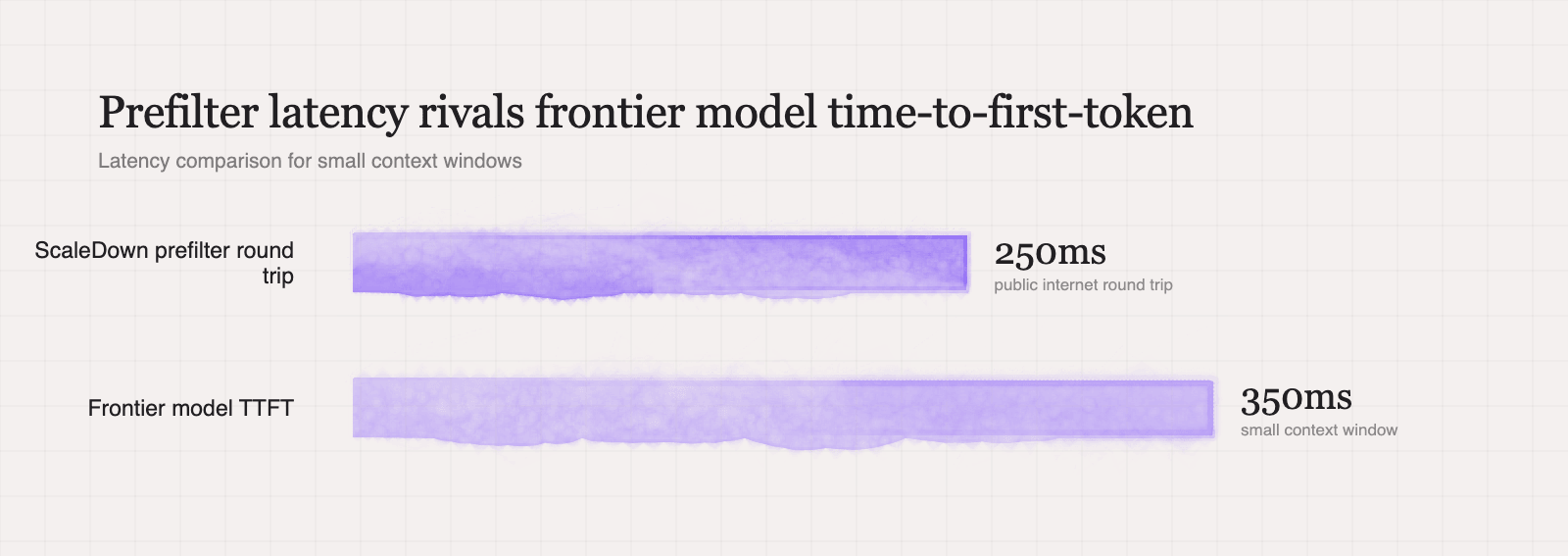
On massive document dumps—such as ingesting a 150-page legal brief or parsing an 80,000-token server log—this trade-off pays for itself immediately. But inside an iterative agent loop where tool payloads routinely measure between 500 and 2,000 tokens, this two-hop topology becomes an operational tax. Modern frontier models running on optimized inference backends routinely achieve a time-to-first-token under 350 milliseconds for small context windows. If the ScaleDown prefilter requires a 250-millisecond round trip across the public internet, the combined pipeline latency matches or exceeds the latency of sending the uncompressed tokens straight to the primary reasoning model. You save fractions of a cent on token ingress while doubling the wall-clock execution time of the agent loop.
The operational hazards deepen when looking at observability and infrastructure resilience. When automated middleware compresses tool outputs directly within the in-memory message history, downstream tracing platforms like LangSmith or Langfuse record only the scrubbed context. If an agent hallucinates a file path or corrupts a state transition five steps later, the debugging engineer has no way to inspect what the underlying CLI or API actually returned; the ground-truth execution trace was overwritten in-place before reaching the logger.
Furthermore, relying on a managed SaaS endpoint for every internal state transition introduces a catastrophic point of failure into the critical path. If the secondary provider experiences elevated error rates, API gateway throttling, or TLS negotiation spikes, the entire agent fleet stalls—even if your primary frontier model provider maintains five nines of uptime.
To deploy CDMs safely, I treat them as asynchronous, threshold-gated tools rather than blanket middleware. By establishing a dynamic bypass rule—routing only payloads exceeding 4,000 tokens through the compression endpoint—teams preserve baseline responsiveness on fast iterations. Combining this with strict client-side timeout circuits (capping prefilter hops at 600ms before falling back to truncated raw text) prevents secondary network dependencies from paralyzing the autonomous loop.
Hardening the Pipeline: Production Architecture Patterns
Making constrained decoding reliable in production requires treating CDMs not as drop-in middleware, but as targeted primitives wrapped in strict failure-containment boundaries. I structure these boundaries around three non-negotiable architectural patterns: isolating state invariants, enforcing dynamic payload thresholds, and establishing fallback cascades.
The foundation of long-horizon execution is isolating behavioral boundaries from rolling context compression. In a pattern I recommend building—a Pinned-Invariant Memory Compactor for Long-Horizon Agents—the agent memory manager explicitly partitions conversational state into two distinct tiers: an immutable system prompt buffer and a rolling dialogue trace. The immutable buffer houses inviolable operational rules, project guidelines, and negative constraints (such as "never touch table X" or "avoid destructive edits"). When context accumulates, only the conversational turn history routes to the ScaleDown Summarize API for compaction before injection into the downstream context window. The failure mode to watch for in this setup is the subtle contextual drift that occurs across successive compaction passes; by keeping negative constraints physically separated from the summarization target, the agent avoids the classic trap where safety boundaries are gradually eroded as routine text.
For dynamic context ingestion, teams should implement an Ephemeral Raw-Store Hybrid Tool Pruner. Rather than forcing every tool return through langchain-scaledown, the orchestrator inspects payload size, instantly bypassing the prefilter whenever returns fall below a defined threshold, such as 4,000 tokens. When a massive payload exceeds this boundary, the middleware intercepts it, issues a query-focused compression call to ScaleDown Compress, and asynchronously caches the complete, uncompressed raw payload inside a Redis key-value store indexed by an execution identifier. The sanitized, pruned spans are passed to the primary frontier reasoning model (such as Claude 3.5 Sonnet or GPT-4o) alongside the payload reference key. The critical risk here is relevance-based over-pruning: diagnostic headers, pagination cursors, or rate-limit warnings frequently lack lexical overlap with user queries and get stripped out. Equipping the supervisor model with an on-demand hydration tool (hydrate_raw_payload(execution_id)) ensures that whenever an unexpected empty state or execution bottleneck occurs, the frontier model can retrieve the raw headers and resolve the anomaly without human intervention.
Finally, structured extraction demands an automated fallback mechanism when deterministic pointers encounter synthesis boundaries. A Dual-Tier Contract Span Extractor with Synthesis Fallback illustrates how to handle this balance. The pipeline feeds dense multimodal PDF agreements—leveraging input windows up to 1 million tokens—into ScaleDown Extract to perform zero-hallucination span identification on explicit contractual clauses. The extraction output routes through a strict confidence scoring router. If the extracted schema fields return high confidence, the typed values proceed downstream immediately. If the confidence score drops below an operational floor (for example, 0.85) or returns null fields, the router dispatches the relevant document chunk to a lightweight generative model like Claude 3.5 Haiku or GPT-4o-mini. The failure mode to guard against is implicit reasoning: when contracts specify calculated liabilities, net settlements, or relative dates like "30 days following quarter end," literal strings do not exist in the source document. A pure pointer head fails on these terms, but cascading to a small generative model guarantees semantic transformation while keeping latency and costs bounded to rare edge cases.
Proprietary Gateways versus Open-Weights Infrastructure
Deciding between adopting ScaleDown’s managed endpoints and building an in-house open-weights stack comes down to where you choose to spend engineering capital: on external network dependencies and vendor lock-in, or on GPU cluster orchestration.
The managed CDM route offers an undeniable time-to-market advantage. Provisioning ScaleDown’s API via the LangSmith gateway gives you immediate access to 1-million-token multimodal context windows and optimized pointer projections without having to provision, shard, or maintain high-memory GPU nodes. For teams operating cloud-native agent runtimes, delegating context compression and entity extraction to a managed endpoint removes substantial infrastructure overhead. However, this convenience introduces hard operational trade-offs. ScaleDown remains a proprietary black box. You cannot inspect the underlying weights, fine-tune the encoder on proprietary domain vocabularies, or run the service inside an air-gapped VPC. If enterprise compliance requires that sensitive legal agreements or customer records never leave your dedicated tenant boundaries, an external managed endpoint is a non-starter.
The open-weights alternative—deploying vLLM paired with SGLang or Outlines, or serving fine-tuned 1B-to-3B parameter models like Llama 3.2 3B or Phi-3.5 Mini—solves the sovereignty problem entirely. Running local models guarantees complete data privacy, eliminates unpredictable external API round trips, and allows deterministic grammar enforcement directly alongside your application containers. But the hidden cost lies in serving physics. While a 3B model has a modest parameter footprint, ingesting 100k+ token documents requires immense KV cache memory allocation. In high-concurrency environments, managing long-context attention kernels, continuous batching, and tensor parallelism across clusters of enterprise GPUs quickly turns an applied engineering team into a full-time infrastructure maintenance shop. Similar to the operational trade-offs I analyzed in Dissecting Claude Dynamic Workflows: Anatomy, Failure Modes, and Operational Realities of 64-Way Server-Side Swarms, orchestration complexity and compute contention at scale often negate the expected performance gains of self-hosting.
My decision boundary for production architectures centers on context length and data governance. I reach for ScaleDown’s managed CDMs when the primary bottleneck is ingesting massive, heterogeneous document sets—such as 50k to 500k token multimodal PDFs or raw system traces—where third-party API processing meets enterprise regulatory requirements, and where maintaining dedicated high-memory GPU instances is cost-prohibitive. Conversely, I deploy a dedicated 1B-to-3B parameter model running vLLM and SGLang when input contexts are bounded below 8,000 tokens, where internal microsecond-level latency budgets cannot tolerate external HTTP round trips, or where strict VPC isolation is mandatory. For high-frequency, low-context tool parsing in private environments, a compact local model with grammar-guided decoding yields superior operational autonomy without the GPU memory penalties of long-context serving.
Resources
Updated 2026-10-12 by Mehran Mozaffari.
Related posts
1 November 2026
Direct Weight Editing Is Machine Code Hot-Patching for Transformers
31 October 2026
Unreal Engine Skills for Claude Code: How Epic Bypassed the Binary Asset Barrier to Mutate Live Viewports
30 October 2026
Agent Memory Was an Indexing Problem All Along
28 October 2026
The Codebase Is an Environment, Not a Context Window
26 October 2026
Should you self-host OpenDuet as your proactive AI coworker? Not yet
24 October 2026
How AutoSwarm Turns Isolated AI CLIs into a Coordinated Swarm Without a Shared Runtime