The Agent Sandboxing Dilemma: Anthropic srt Versus Docker and MicroVMs
Granting autonomous coding agents direct shell execution and tool privileges is where theoretical safety models crash into operational reality. When an operator provisions local Model Context Protocol (MCP) servers or launches an iterative coding assistant like Claude Code, the model requires execution access to manipulate files, run test suites, and install packages. Leaving that loop unbounded is unacceptable; a single indirect prompt injection or hallucinated command can wipe local directories, harvest SSH keys, or exfiltrate private credentials. Yet locking execution down cannot come at the expense of developer flow. In my view, the boundary decision hinges on balancing sub-50ms developer ergonomics against hard multi-tenant kernel isolation.
We face three distinct runtime tiers for local agent containment: native process wrapping via Anthropic sandbox-runtime (srt), OCI containerization through Docker or Podman, and hardware-level virtualization with cloud microVMs such as E2B or AWS Firecracker. Each runtime anchors to a different defense boundary. Cloud microVMs establish hardware virtualization boundaries, isolating untrusted multi-tenant workloads so that a guest kernel panic or exploit never touches the host. Docker groups processes within Linux namespaces and cgroups, creating a hermetic container filesystem. Anthropic's srt bypasses container virtualization entirely, running directly on the host OS and applying dynamic execution policies to native binaries.
When I evaluate these options for interactive developer environments, the operational fault lines become immediate. Running an untrusted external agent on a hosted multi-tenant platform demands hardware virtualization; anything less invites severe container-escape risks. But for an engineer pairing locally with an agent in an active git repository, forcing all interactions through an external microVM breaks local socket connections, dev server inspection, and editor synchronization.
Docker offers an intermediate isolation model, yet treating local developer environments as disposable containers introduces massive setup overhead. As I explored when analyzing how an agent that edits its own harness must not be its own kernel, separating the execution boundary from the orchestrator is critical. Anthropic extracted srt from Claude Code to tackle this pragmatic desktop threat model: preventing accidental destructive operations and prompt-injection data theft without forcing developers into heavyweight container environments.
Execution Overhead and Developer Ergonomics Across the Three Runtimes
The primary differentiator between srt, Docker, and cloud microVMs comes down to startup latency and local toolchain fidelity. Coding agents do not execute a single long-running monolith; they fire dozens of rapid, exploratory shell commands—checking file diffs, inspecting directories, running linters, and executing unit tests. In this interactive loop, lifecycle latency dictates whether pairing with an agent feels instantaneous or agonizing.
Anthropic's srt wraps invocations directly via execvp, achieving near-zero startup latency under 50 milliseconds. Because srt executes commands straight against the host OS, it immediately inherits the developer's pre-existing toolchains. Compilers, language runtimes, package caches, global linters, and custom git configurations resolve naturally without reconfiguration. An invocation of a local toolchain binary executes directly against the host CPU and filesystem without boot delays or filesystem translation layers.
In contrast, OCI containers introduce between 1 and 3 seconds of initialization overhead per clean execution. Beyond that startup penalty, Docker disrupts developer ergonomics. To make a containerized agent effective, you must replicate the host's complete development state inside the image: toolchain versions, shell configurations, compilers, dotfiles, and SSH authenticators. Volume mounting the host workspace into a container incurs noticeable I/O penalties on macOS due to virtualization bridge overhead. Furthermore, when an agent spawns a background service or attempts to query a local database running on localhost, container networking creates boundary friction that requires explicit port forwarding and host gateway mapping.
Cloud microVMs occupy the extreme end of the friction spectrum for local development. Booting a Firecracker or E2B guest takes between 150 and 300 milliseconds of runtime initialization, but the true bottleneck is network latency and state synchronization. Every repository file modified by the remote agent must synchronize across an external network connection, and running local frontend dev servers or inspecting GUI states requires complex tunneling layers.
For local coding workflows, sacrificing host toolchain integration for total container isolation cripples the iterative feedback loop. Unless you are executing unvetted third-party code in an automated pipeline where hard containment is non-negotiable, the near-instantaneous execution speed of srt delivers vastly superior developer ergonomics.
Filesystem, Network, and IPC Isolation Mechanics
To understand how srt achieves process containment without containers, we must inspect its underlying operating system primitives. Rather than implementing its own virtualization subsystem, srt delegates enforcement to platform-specific host kernels alongside a local proxy interceptor.
sequenceDiagram
    autonumber
    participant Agent as Agent Tool Execution
    participant SRT as Sandbox Runtime (srt)
    participant Kernel as OS Kernel (Seatbelt / bwrap)
    participant Proxy as Transparent Network Proxy
    participant Target as Host Resource / Network

    Agent->>SRT: Invoke command with policy
    SRT->>Kernel: Enforce path rules & spawn process
    activate Kernel
    alt Path access permitted
        Kernel->>Target: Execute local read / write
        Target-->>Kernel: Filesystem result
    else Restricted path violated
        Kernel-->>SRT: Deny access (EPERM / log record)
        SRT-->>Agent: Operation not permitted error
    end
    deactivate Kernel
    opt Command initiates outbound network call
        Agent->>Proxy: Outbound HTTP/HTTPS request
        activate Proxy
        Proxy->>Proxy: Evaluate host against allowedDomains
        alt Domain is allowlisted
            Proxy->>Target: Forward egress traffic
            Target-->>Proxy: Return response
            Proxy-->>Agent: Return data payload
        else Domain is blocked or unrecognized
            Proxy-->>Agent: Connection blocked by network allowlist
        end
        deactivate Proxy
    end
On macOS, srt builds dynamic sandbox profiles executed through Apple's kernel Seatbelt facility via sandbox-exec. File read and write permissions are evaluated directly by kernel sandbox hooks, while policy violations are captured in real time by tapping into the macOS unified log store. On Linux, srt shifts enforcement to bubblewrap (bwrap), leveraging unprivileged user namespaces (CLONE_NEWUSER, CLONE_NEWNS) to assemble isolated mount tables and strip root privileges without requiring setuid binaries.
Network containment is handled through a transparent proxy architecture rather than raw network namespace isolation. Outbound HTTP and HTTPS egress routes through an internal proxy evaluating requests against explicit allowedDomains and deniedDomains configurations. This design permits selective domain allowlisting—such as allowing package registries while denying unknown remote destinations—without cutting off internet access entirely.
| Isolation Dimension | Anthropic srt |
OCI Container (Docker) | Cloud MicroVM (E2B / Firecracker) |
|---|---|---|---|
| Filesystem Controls | Granular declarative rules (denyRead, allowWrite, denyWrite) enforced via Seatbelt profiles or bwrap bind-mounts. |
Mount namespaces, layered storage drivers, and explicit read-only container flags. | Completely virtualized disk image isolated per guest microVM instance. |
| Network Filtering | Application-layer proxy filtering evaluated against domain allowlists and denylists. | Coarse bridge networks, port mapping, or container network namespaces requiring external forward proxies. | Hardware-level VPC, virtual TAP devices, and hypervisor firewall packet filters. |
| IPC & Local Sockets | Explicit restriction of Unix domain sockets to prevent out-of-band host escapes. | Unix socket isolation via IPC namespaces; host daemon sockets can be mounted manually. | Hard hardware boundary; guest VM cannot access host sockets without dedicated network tunnels. |
| Host Process Visibility | Host process table visibility restricted by bwrap on Linux; macOS processes run in host context under Seatbelt. |
Isolated PID namespace; container cannot view or interact with host processes. | Complete separation; guest OS kernel maintains an entirely independent process tree. |
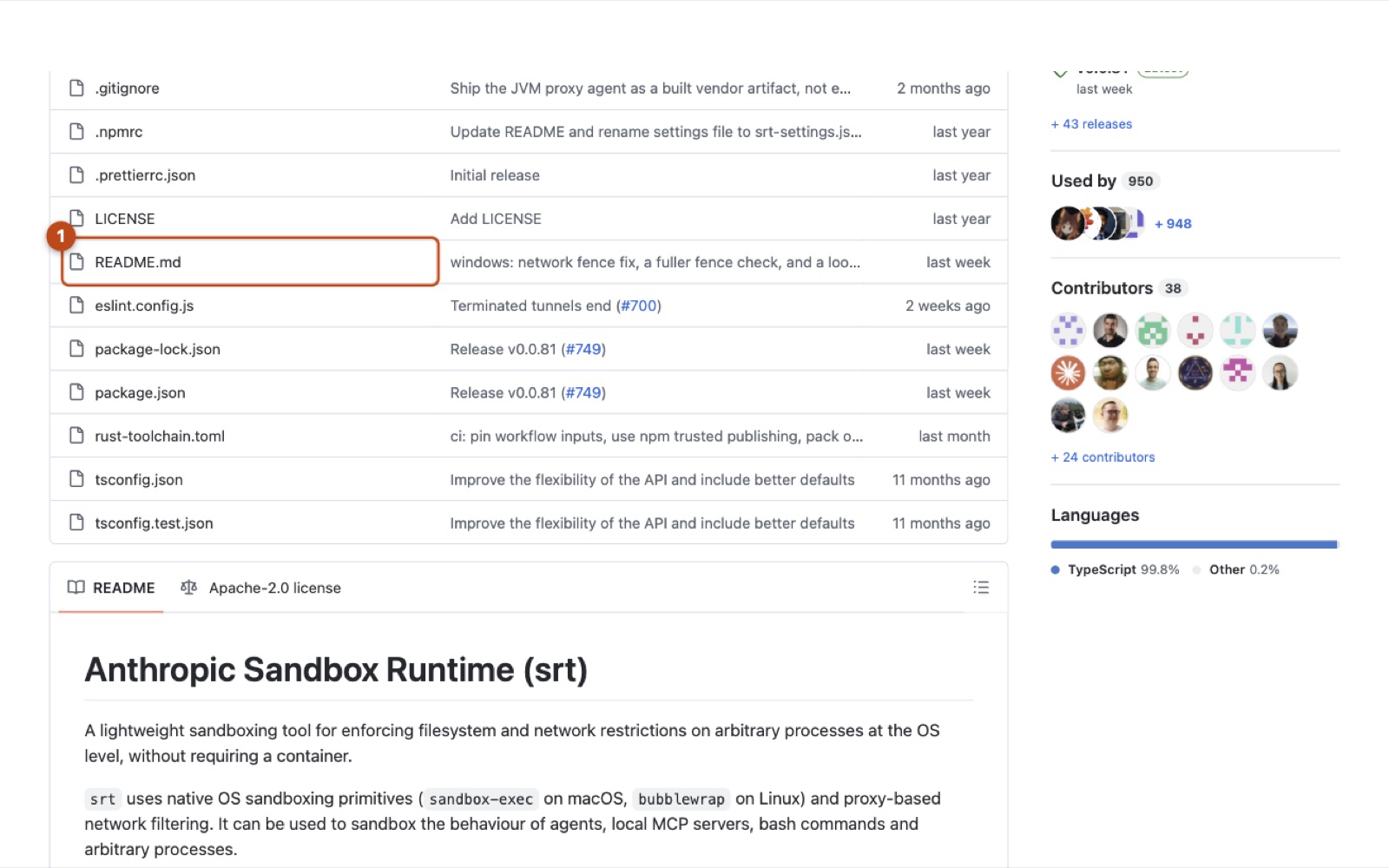
For local MCP servers and agent execution, srt strikes a pragmatic balance: it restricts Unix domain sockets to prevent out-of-band IPC bypasses while using targeted path rules to keep agents within the project directory.
Threat Modeling Agent Sandboxes: Where Lightweight Process Wrapping Breaks
When an engineering team considers wrapping agent execution in srt, they are often tempted to treat it as an impenetrable perimeter. That assumption is dangerous. To deploy process wrapping responsibly, we have to model its explicit failure boundaries: what holds firm under pressure versus what inevitably collapses.
Process wrapping reliably defeats two classes of failure: accidental host destruction and straightforward prompt-injection exfiltration scripts. If an agent executes an errant recursive deletion command targeting the home folder or attempts to read sensitive paths like ~/.ssh/id_rsa, OS kernel hooks block the read or write syscall. If a malicious context injects a payload attempting to send file contents to an untrusted domain via curl, the transparent network proxy intercepts the HTTP egress and halts the request against the allowlist. For routine single-tenant development on a trusted engineer's laptop, this containment is effective and welcome.
Where lightweight process wrapping breaks is under adversarial conditions targeting the host boundary. The architecture does not protect against kernel-level local privilege escalation (LPE). Because the process executes directly against the host kernel without hypervisor separation, any unpatched kernel vulnerability allows an attacker to break confinement entirely.
Furthermore, network filtering relies on an application proxy inspecting hostnames. If an agent bypasses high-level HTTP tools to establish raw TCP sockets directly to an explicit external IP address, domain-level allowlists provide no barrier unless low-level packet filtering is enforced.
Local IPC presents an equally severe vector. Modern toolchains frequently rely on Unix domain sockets for background tasks. If you punch a hole to let an agent control local container workloads or authenticate git commands, the sandbox collapses from within.
Finally, relying on Apple's Seatbelt via sandbox-exec introduces long-term platform fragility. Apple has designated sandbox-exec as deprecated for years without offering a public replacement for third-party CLI tools. Operating on an undocumented kernel interface means any point update to macOS can alter policy parsing or logging mechanics. In contrast, Linux's unprivileged user namespaces via bwrap offer a standardized kernel interface, but fail in locked-down enterprise environments where user namespaces are administratively disabled. In my view, process wrapping delivers developer safety, not adversary-grade isolation.
The Structural Evaluation Matrix for Local and Remote Agent Runtimes
Choosing between srt, OCI containers, and microVM runtimes requires balancing developer velocity against execution risk. No single runtime satisfies both extremes of the design space.
quadrantChart
    title Agent Runtime Tradeoffs: Ergonomics vs Multi-Tenant Isolation
    x-axis Low Multi-Tenant Security --> High Multi-Tenant Security
    y-axis Low Developer Ergonomics --> High Developer Ergonomics
    quadrant-1 Specialized Hybrid
    quadrant-2 Local Developer Sweet Spot
    quadrant-3 Impractical Boundary
    quadrant-4 Multi-Tenant Cloud Defense
    Anthropic srt: [0.35, 0.88]
    Docker containers: [0.72, 0.48]
    E2B or Firecracker: [0.92, 0.22]
The quadrant highlights the fundamental tension. Anthropic's srt maximizes developer ergonomics by eliminating container startup delays and preserving access to host toolchains, but its reliance on host kernel boundaries limits its security boundary. Cloud microVMs provide complete hypervisor containment at the cost of local workflow integration, while Docker occupies the middle ground.
| Evaluation Dimension | Anthropic srt |
Docker Containers | Cloud MicroVMs (E2B / Firecracker) |
|---|---|---|---|
| Startup Latency | Near-zero (<50ms) via direct host execvp invocation. |
High (1–3s) due to container namespace and daemon initialization. | Moderate (150–300ms) VM boot overhead plus network sync. |
| Developer Ergonomics | Native: instantly leverages local compilers, git config, and caches. | Medium: requires mirroring tools, dotfiles, and port bindings into images. | Low for local dev: requires remote filesystem synchronization bridges. |
| Cross-Platform Parity | Asymmetric: relies on deprecated macOS Seatbelt versus Linux bwrap. |
High: identical OCI images run consistently across host platforms. | High: uniform Linux guest environments running in cloud infrastructure. |
| Network Filtering | Application proxy evaluating granular domain allowlists and denylists. | Coarse network flags unless integrated with dedicated forward proxies. | Network-level VPC isolation, TAP devices, and hypervisor packet rules. |
| Multi-Tenant Security | Low-to-Moderate: vulnerable to host kernel LPE and socket escapes. | High: strong namespace isolation backed by cgroups and seccomp. | Very High: hardware-enforced virtualization boundary per workload. |
When structuring an agent deployment, match the runtime to your trust boundary. Wrapping local coding tools like Claude Code with srt prevents devastating local command mishaps while keeping the feedback loop instant. However, when executing untrusted customer prompts in automated production environments, hardware virtualization remains non-negotiable.
Operational Gotchas and the Outside Verification Check
Moving srt from a local experiment into production tooling exposes several sharp operational edges. The most immediate barrier appears on hardened enterprise Linux distributions like RHEL, Debian, or Ubuntu where administrators set sysctl kernel.unprivileged_userns_clone = 0. Because srt relies on bubblewrap to assemble user namespaces without setuid binaries, executing in these environments fails at launch unless host kernel configurations are loosened.
A related breakdown occurs in nested CI environments. If you attempt to drop srt into standard Docker-based GitHub Actions runners or locked-down Kubernetes pods, bwrap cannot construct nested mount or user namespaces without CAP_SYS_ADMIN or privileged execution flags. Teams attempting to run sandboxed agent evaluation suites inside locked-down CI containers will hit immediate startup halts.
Network interception introduces its own configuration friction. Because srt intercepts outbound traffic via an internal proxy, inspecting HTTPS egress without encountering broken TLS handshakes requires CA bundle harmonization. Developer runtimes do not share a unified trust store; Python tools relying on pip look to SSL_CERT_FILE or CURL_CA_BUNDLE, while Node CLI tools evaluate NODE_EXTRA_CA_CERTS. Without explicit environment variable propagation, agents executing multi-language builds will see unhandled certificate authority rejections.
To verify that your configuration holds before turning an agent loose on a repository, you must run an outside verification check against your path and domain boundaries.
First, verify filesystem restriction enforcement. With a configuration containing:
{
  "filesystem": {
    "denyRead": [],
    "allowWrite": ["."],
    "denyWrite": ["~/sensitive-folder"]
  },
  "network": {
    "allowedDomains": [],
    "deniedDomains": []
  }
}
Invoke an unpermitted read against a private key and an unauthorized write against a restricted path:
$ srt "cat ~/.ssh/id_rsa"
Running: cat ~/.ssh/id_rsa
cat: /Users/ollie/.ssh/id_rsa: Operation not permitted  # Specific file blocked
Next, test your domain boundary rules directly against the proxy:
$ srt "curl anthropic.com"
Running: curl anthropic.com
<html>...</html>  # Request succeeds

$ srt "curl example.com"
Running: curl example.com
Connection blocked by network allowlist  # Request blocked
In my experience, validating these failure strings outside your agent loop is essential before trusting any automated wrapper with repository execution.
Selection Heuristics: Matching Runtimes to Agent Workloads
Choosing the correct isolation tier requires mapping the agent's degree of autonomy directly against your operational blast radius. I look at runtime selection through a single architectural question: are you shielding an interactive engineer from accidental command destruction, standardizing a unified development toolchain across a fleet, or containing untrusted execution in a shared multi-tenant backend?
For interactive developer tooling and local agent execution, Anthropic's srt is the most pragmatic harness available. When an engineer runs Claude Code or configures local tools via Model Context Protocol definitions, the primary hazard is an errant shell command executing a destructive file deletion or an indirect prompt injection attempting to exfiltrate dotfiles to an unknown server. Forcing developers to interact with Docker containers for local CLI tools introduces container launch latency, breaks localhost dev server inspection, and cuts off access to local editors. By placing srt in front of your server definitions, you gain process containment without degrading developer flow:
{
  "mcpServers": {
    "filesystem": {
      "command": "srt",
      "args": ["npx", "-y", "@modelcontextprotocol/server-filesystem"]
    }
  }
}
When team standardization or complex environment replication takes priority over sub-50ms execution speed, Docker containers remain the appropriate tool. If your agent requires a specialized C compiler toolchain, fixed system libraries, or dependencies that cannot be assumed on an individual developer's machine, containerizing the runtime eliminates the "works on my machine" failure mode across heterogeneous OS fleets.
Finally, never deploy process wrappers like srt as the security perimeter for hosted SaaS applications. If your service takes arbitrary prompts or code from external users and executes them on shared infrastructure, relying on host kernel primitives like Seatbelt or user namespaces exposes you to local privilege escalations and kernel escape vulnerabilities. Untrusted multi-tenant execution demands hardware-enforced hypervisor virtualization.
Aligning these three runtimes to their corresponding threat boundaries ensures you never sacrifice developer velocity for unnecessary container overhead, nor compromise multi-tenant security on lightweight process wrapping.
Resources
Updated 2026-10-22 by Mehran Mozaffari.
Related posts
26 October 2026
Should you self-host OpenDuet as your proactive AI coworker? Not yet
24 October 2026
How AutoSwarm Turns Isolated AI CLIs into a Coordinated Swarm Without a Shared Runtime
24 October 2026
Should You Switch Your Agent Harness to Anvaya? Only if Orchestrator Memory Is Your Bottleneck
24 October 2026
Recurrent State Kernels Move the Local Inference Bottleneck from Memory to Dispatch
24 October 2026
Autonomous Coding Scales Through Process Resets Rather Than Context Retention
22 October 2026
Decoupling the Bot From the Runtime Turns Chat Surfaces Into Remote Terminals