
The Verdict: Pass for General Tooling, Pilot for High-Density Daemon Swarms
Anvaya brings genuine systems rigor to a problem space that has largely ignored binary efficiency: wrapping agent loops in a compiled Rust binary with a ~5 MB idle RSS, benchmarked as 17x lighter than Node.js harnesses like Claude Code. In my view, orchestrator footprint matters only when scaling hundreds of background concurrent tasks, not when running an interactive coding assistant on a developer workstation.
If you run single-agent developer workflows, saving 80 MB of RAM while waiting on a 200 ms remote inference call or a 4.5 GB local model provides zero tangible benefit, while forfeiting the expansive Python and TypeScript ecosystem. But if you need to run dozens of persistent daemon processes monitoring endpoints or pinging remote APIs on a cheap VPS, Anvaya shifts agent infrastructure from interpreted bloat into an efficient background service.
Under the Hood: Tokio Futures and Zero-Allocation State Machines
To understand how Anvaya drops idle memory to ~5 MB, you have to look at the execution substrate. A typical Node.js harness instantiates the V8 runtime, heap allocators, and dynamic module caches before processing a single character. Anvaya dispenses with interpreters entirely, compiling to a static native binary driven by an asynchronous Tokio event loop.
Instead of dedicating an OS-level thread to each loop, Anvaya models every agent instance as a compact, asynchronous state machine multiplexed across a minimal worker thread pool. When an agent enters an I/O wait—such as polling an external endpoint or awaiting a response from an Ollama stream—its task yields immediately. Rust's strict ownership model manages allocations deterministically: the moment a turn finishes, context formatting buffers and intermediate JSON representations are cleared without runtime garbage collection passes.
This architecture handles context window formatting, JSON payload transformations, and HTTP streaming to Ollama natively. Rather than stacking dynamic middleware layers, Anvaya writes structured prompts directly into reusable memory buffers. For teams exploring coordinated agent architectures like those examined in How AutoSwarm Turns Isolated AI CLIs into a Coordinated Swarm Without a Shared Runtime, native execution offers an appealing host footprint. But that mechanical cleanliness holds only while the agent is idling; working context buffers demand their own operational accounting.
Scorecard: Evaluating Anvaya Against Claude Code, Rig, and Python Runtimes
Evaluating Anvaya requires decoupling raw systems performance from operational agent utility. While Anvaya and Rig occupy the native systems tier, frameworks like LangGraph and harnesses like Claude Code prioritize rapid authoring and dynamic tool access.
quadrantChart
    title Agent Harness Positioning: Footprint vs Ecosystem
    x-axis Low Efficiency Interpreted or VM --> High Efficiency Compiled Native
    y-axis Constrained Ecosystem --> Rich Ecosystem & Agility
    quadrant-1 Native Agility
    quadrant-2 Dynamic Productivity
    quadrant-3 Scripting Overhead
    quadrant-4 Systems Infrastructure
    LangGraph: [0.18, 0.88]
    Claude Code: [0.32, 0.72]
    Rig: [0.82, 0.42]
    Anvaya: [0.91, 0.28]
The quadrant highlights the core tradeoff: native binaries optimize host resources at the cost of tooling agility. While Claude Code and LangGraph accept substantial memory overhead to leverage Python and JavaScript packages, Anvaya strips runtime costs down to bare metal.
| Evaluation Criterion | Anvaya Profile | Operational Reality |
|---|---|---|
| Idle Memory Footprint | ~5 MB RSS | Excellent. Compiles to native code, eliminating VM and GC runtime overhead completely. |
| Concurrency Scaling | Up to 256 agent loops | High task density via Tokio futures, but bounded strictly by memory when active contexts swell. |
| Local LLM Inference Throughput | Pass-through to Ollama | Bottlenecked. Harness concurrency cannot bypass single-batch or small-batch local GPU limits. |
| Tooling and Dynamic Extensibility | Native Rust implementations | Friction-heavy. Authoring tools requires Rust compilation rather than ad-hoc scripting or MCP packages. |
| Error Resilience with Local Models | Compile-time serde parsing | Fragile. Malformed JSON outputs from local models trigger unhandled deserialization drops without recovery logic. |
When compared directly, Anvaya wins decisively on process density, but loses on flexibility. It serves as an ultra-compact execution harness, provided your workflow does not require dynamic local scripting.
Where Anvaya Actually Wins: Background Daemons and High-Density API Swarms
The architectural justification for Anvaya sharpens when you stop treating it as an interactive development tool and view it as an always-on infrastructure worker. Where Anvaya genuinely succeeds is in high-density daemon fleets—orchestrating up to 256 lightweight, concurrent agent loops configured to query remote inference endpoints, track distributed logs, or poll external APIs.
In an interpreted environment, scaling to that density breaks down at the runtime level. Spinning up two hundred concurrent agent workers in Python via asyncio or Celery, or inside Node.js, forces the host to carry massive heap overhead. Dynamic imports, V8 object allocations, and uncollected intermediate states routinely eat several gigabytes of system memory before the agents even issue their first network request. In contrast, Anvaya’s asynchronous Tokio architecture allocates only the compact stack frames needed for active futures. When an agent enters an I/O wait on an external frontier model, its memory consumption drops to near zero.
Beyond raw execution density, the operational win is shipping a self-contained static binary that eradicates environment drift. Deploying background agent swarms across a fleet of low-spec cloud instances usually means wrestling with virtual environments, pip dependencies, or container base images that balloon disk footprints to hundreds of megabytes. A compiled binary that runs directly on bare metal without external runtimes turns agent deployment into an atomic file transfer, making Anvaya a formidable daemon engine for cloud-bound I/O workloads.
What It Costs You: The Working-Memory Illusion and Ollama Contention
The claim that Anvaya operates at a 5 MB footprint is technically accurate at rest, but in production, it is an idle-state metric that evaporates under real token load. An agent harness does not execute prompts in a vacuum; it maintains chat histories, tool schemas, tokenized buffers, and deserialized JSON payloads.
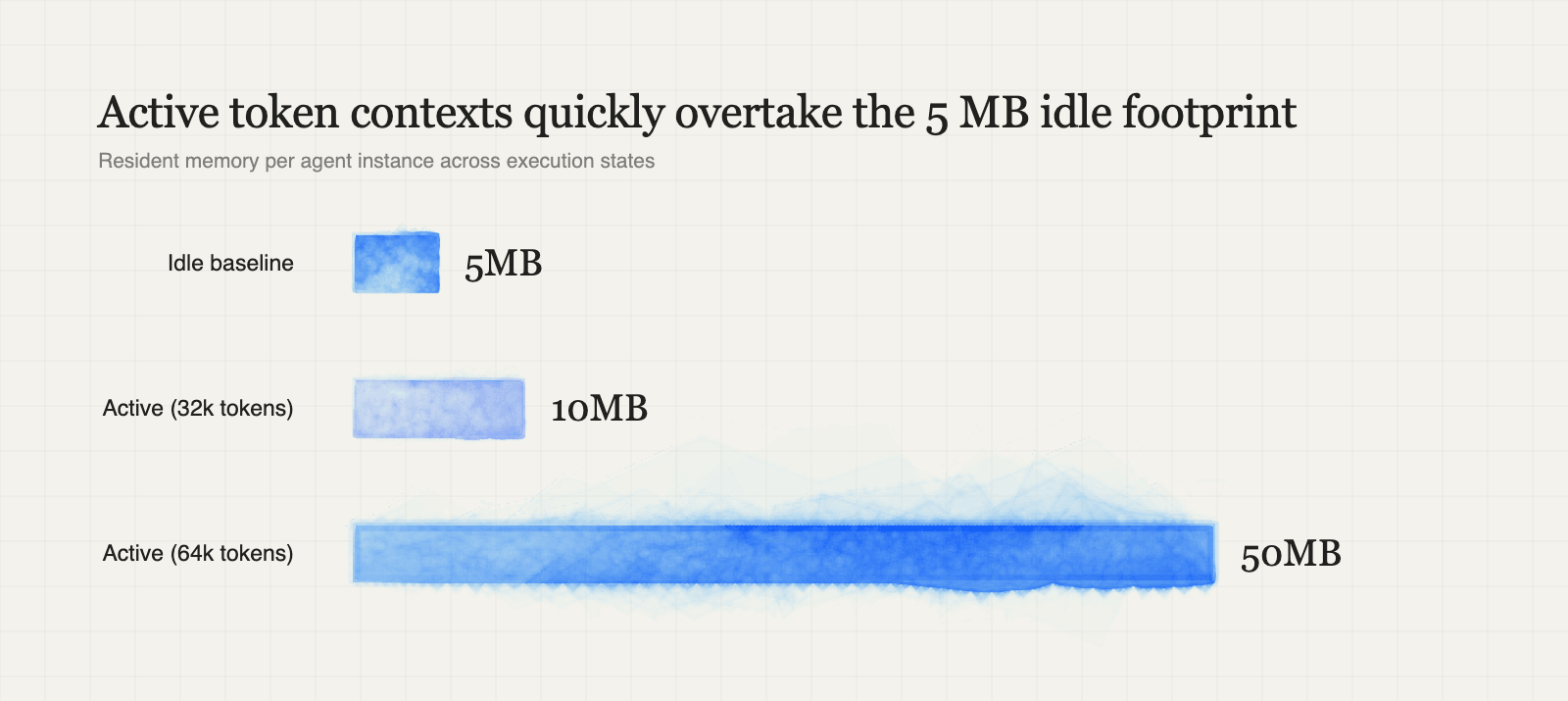
When you scale to 256 concurrent agent tasks, the memory math is dictated by context size, not compiled binary efficiency. If each agent loop maintains an active 32k to 64k token context window alongside raw API response buffers, each instance consumes between 10 and 50 MB of resident memory. Multiplying that across 256 active states demands between 2.5 and 12.8 GB of system RAM solely for conversation state. Rust's strict deallocation prevents heap leaks upon turn completion, but it cannot shrink the physical working memory required to hold active conversational context.
The operational breakdown becomes severe when pairing high agent concurrency with local inference engines like Ollama. Unlike cloud endpoints with elastic infrastructure, local models run on hardware-constrained execution queues. Ollama schedules requests across a single GPU or unified memory bus with limited continuous batching. Bombarding a local 7B model with 256 concurrent turns instantly triggers head-of-line blocking. The underlying engine thrashes KV caches between system RAM and VRAM trying to service competing context states, driving tail latency into minutes and timing out the harness's client connections.
To verify this divergence before deploying, run a stress test while tracking process metrics. Launch the binary and monitor resident memory using standard process tools like ps targeting the process ID, observing the 5 MB idle baseline. Then trigger fifty concurrent loops with 32k token histories. Watching memory growth via top reveals how quickly working context overtakes the static binary footprint, proving that model payload sizing, not harness architecture, dominates system capacity.
What Would Change My Mind: Resilient Schema Repair and Local Backpressure
For Anvaya to transition from a specialized daemon harness into a reliable operational standard, it must solve the failure points unique to local inference and systems-level orchestration.
First, the harness must introduce a resilient schema repair layer. Rust relies on compile-time static typing through Serde, which expects structured JSON to match rigid data structures. Smaller open models running on Ollama routinely drop quotation marks, hallucinate extraneous keys, or truncate arguments. When Serde encounters malformed payloads, it aborts the turn. Without an adaptive deserialization layer that intercepts syntax errors and triggers automatic reflection turns, local model integration remains brittle.
Second, the runtime needs native backpressure primitives. Anvaya should expose configurable Tokio semaphores that throttle simultaneous model calls to match local GPU capacity while allowing hundreds of downstream network checks to proceed unimpeded. Finally, executing dynamic local code requires built-in process containment—isolating subprocesses within isolated namespaces rather than raw host execution, mirroring the sandbox discipline detailed in Durable AI Coding in Ephemeral Sandboxes: Dissecting Vercel Labs' durable-harness.
If you decide to evaluate Anvaya, stage your rollout strictly as a background daemon for remote APIs first. Do not deploy it as an interactive local coding assistant or point a high-concurrency fleet at a single Ollama instance. Validate its process density against hosted inference endpoints where network latency dominates and schema outputs remain compliant, reserving local multi-agent deployments until backpressure controls and resilient parsing mature.
Resources
(no official sources were available to link)
Updated 2026-10-24 by Mehran Mozaffari.
Related posts
26 October 2026
Should you self-host OpenDuet as your proactive AI coworker? Not yet
24 October 2026
How AutoSwarm Turns Isolated AI CLIs into a Coordinated Swarm Without a Shared Runtime
24 October 2026
Recurrent State Kernels Move the Local Inference Bottleneck from Memory to Dispatch
24 October 2026
Autonomous Coding Scales Through Process Resets Rather Than Context Retention
22 October 2026
Decoupling the Bot From the Runtime Turns Chat Surfaces Into Remote Terminals
22 October 2026
Anthropic srt or Docker Containers for Securing Local Agent Execution