The State Collapse in Long-Horizon Generative Pipelines
When engineering teams scale creative generation from thousand-word scenes to hundred-thousand-word serialized manuscripts, they inevitably hit a wall that raw model capability cannot breach. The industry default is to lean on million-token context windows, shoving past chapters into a prompt buffer and trusting the model's attention mechanism to maintain continuity. In practice, long-horizon narrative pipelines do not collapse because a model lacks prose eloquence or situational reasoning; they collapse from state mutation bleed, where unreviewed draft events and speculative hallucinations prematurely contaminate the canon.
If an authoring agent decides mid-draft that a supporting character dies, leaves behind a critical artifact, or resolves an active conflict, and that draft text immediately mutates the working memory buffer, every subsequent generation pass treats that speculation as ground truth. Even if an editorial pass rejects the scene prose for poor pacing or structural divergence, the underlying entity records—character inventories, faction allegiances, and active narrative tensions—often remain warped. Once corrupted state seeps into the prompt baseline, downstream chapters spiral into narrative incoherence.
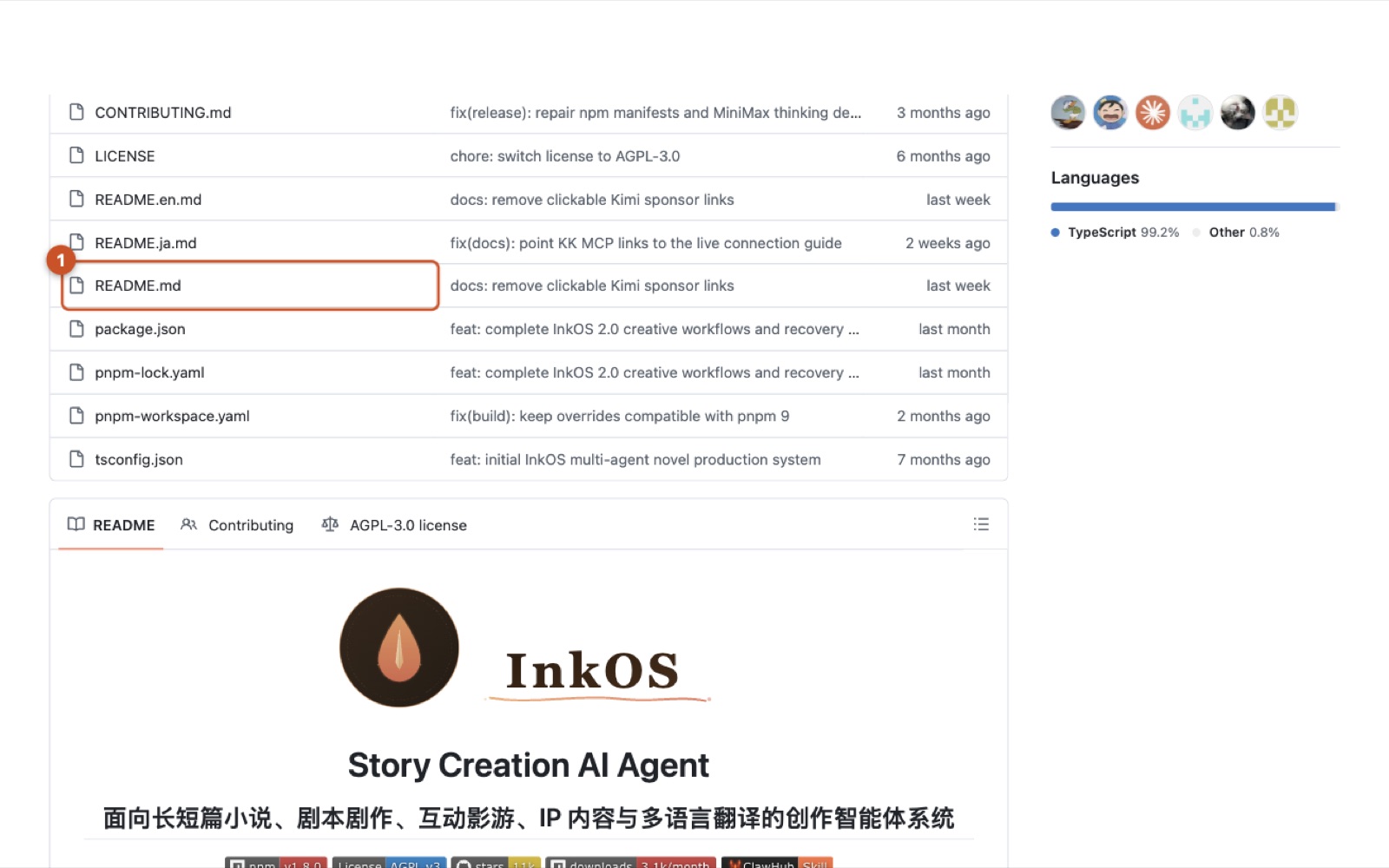
InkOS enters the stack to solve this specific coordination vulnerability. Distributed as the AGPL-3.0 TypeScript orchestration package @actalk/inkos, it operates as an explicit harness that strictly decouples volatile prose drafting from permanent narrative state transitions. Rather than letting the language model directly append to a running conversation history or unstructured world bible, InkOS stages candidate prose alongside candidate entity mutations in an isolated staging boundary.
The harness formalizes story progression into schema-governed operational layers. High-level story concepts, world constraints, character registries, and open plot threads are isolated into structured state records rather than floating as loose narrative summary text.
By formalizing these seeds as discrete entities rather than ephemeral prose hints, InkOS prevents the memory loss typical of progressive summarization. The harness verifies that narrative obligations cannot simply evaporate across long chapter arcs. It turns what is normally treated as a loose generative task into a deterministic, auditable software lifecycle.
Tracing a Chapter from Outline to Canon: The Execution Path
To understand how InkOS shields the narrative canon from speculative drift, trace a single chapter generation pass across its operational surfaces: the command-line interface (inkos write next), the terminal UI (inkos), and the visual Studio workbench.
sequenceDiagram
    autonumber
    participant Orch as Orchestrator
    participant Plan as Planner
    participant Store as Canonical Store
    participant BM25 as Local BM25 Index
    participant Writer as Writer Agent
    participant Stage as Staging Buffer
    participant Review as Editorial Review (审稿)

    Orch->>Plan: Trigger chapter workflow
    Plan->>BM25: Query active entities & foreshadowing seeds
    BM25-->>Plan: Return precise lexical matches
    Plan->>Writer: Dispatch scene outline & constraints
    Writer->>Stage: Emit candidate draft prose & staged mutations
    Orch->>Review: Dispatch staged chapter for validation
    alt Editorial Check Passes
        Review->>Store: Commit prose & update world state
        Review->>BM25: Re-index newly committed chapter text
        Review-->>Orch: Approval response
    else Continuity or Quality Failure
        Review->>Stage: Roll back draft & discard staged mutations
        Review-->>Orch: Rejection critique with revision feedback
        Orch->>Writer: Trigger targeted rewrite
    end
The execution flow begins when the Orchestrator initiates a scene pass. The Planner inspects the current narrative trajectory, reading active plot constraints and unfulfilled foreshadowing obligations. Instead of scanning an unindexed monolithic document, the harness queries its local lexical index to pull character sheets, active location bounds, and relevant plot seeds into the active context.
Once the prompt context is assembled, the Writer agent produces candidate prose. Critically, the output of the Writer does not touch the canonical story database. Both the raw prose and any implied entity mutations—such as a character acquiring an item, sustaining an injury, or shifting location—are written directly into an isolated staging buffer.
Next, the Editorial Review agent (审稿) audits the staged content against the canonical world rules and stylistic criteria. If the critique agent detects a continuity break, the orchestrator triggers an immediate rollback: the staged mutations are discarded, the canonical world state remains pristine, and the review critique routes back to the Writer for targeted revision (修订). Only when the editorial check explicitly passes does the orchestrator execute a commit, writing the chapter prose to the canon and re-indexing the updated entities into the retrieval layer.
| Module / Interface | Architectural Role | State-Isolation Boundary |
|---|---|---|
@actalk/inkos Core |
Orchestrates agent role assignment, planning schedules, and state lifecycle hooks. | Enforces runtime boundaries between volatile draft buffers and canonical state stores. |
| Studio Web UI | Visual workbench for manuscript inspection, entity mapping, and human-in-the-loop review. | Read-heavy presentation layer; state commits require explicit interface triggers or automated review approval. |
| Terminal UI (TUI) | Interactive terminal console for monitoring live agent loops and scene streaming. | Operates over local project workspace state; holds uncommitted scene generation in active memory buffers. |
| CLI Daemon | Headless automation tool for scripted generation, background batch jobs, and doctor audits. | Ephemeral execution scope per invocation; writes strictly to disk-backed staging files until commit phase. |
| MCP Gateway Adapters | Standardized interface for querying external world databases, lore tools, and domain skills. | Read-only external boundary; retrieves reference facts into system prompts without granting state write access. |
| Kimi K3 Context Bridge | High-capacity model interface for deep contextual planning and multi-stage long-horizon analysis. | Stateless inference pipe; relies on external harness state management rather than raw context persistence. |
Through this division, the system guarantees that speculative generation never pollutes long-term memory. It treats creative drafting with the same rigor a database engine applies to transactional writes, ensuring that failure at the generation boundary does not compromise structural integrity.
Lexical Retrieval vs. Semantic Drift: Why BM25 Anchors Narrative Integrity
A major point of friction in narrative architecture is the choice of retrieval mechanism. The prevailing default across modern agent toolchains is dense vector retrieval: embed chunks into high-dimensional vector spaces and query via cosine similarity. While dense embeddings excel at fuzzy thematic classification, vector similarity fails catastrophically when applied to the strict continuity requirements of serialized fiction.
In creative writing, vector search creates semantic confusion. If a scene requires the protagonist to draw a specific ancestral dagger named Moonfang, a dense vector query against a world bible often surfaces every passage describing chilly weather, generic blade combat, or silver jewelry. The embedding model evaluates high semantic similarity based on ambient tone, dragging irrelevant artifacts into the prompt while missing the exact named entity card.
InkOS avoids this by deploying local BM25 retrieval for its internal story engine, complemented by Model Context Protocol (MCP) servers for external domain knowledge.
flowchart TD
    subgraph Retrieval Pipeline
        Q["Scene Generation Query"] --> BM25["Local BM25 Index<br/>(Term Frequency / Inverted Index)"]
        Q --> MCP["MCP Gateway<br/>(External Domain Tools)"]

        BM25 --> |Exact Lexical Recall| R1["Character Profiles & Aliases<br/>Immutable World Rules<br/>Tracked Foreshadowing Seeds (伏笔)"]
        MCP --> |Structured Tool Context| R2["External Domain Reference<br/>Specialized Lore Bibles<br/>Technical Setting Constraints"]

        R1 --> Context["Assembled Scene Context"]
        R2 --> Context
        Context --> Writer["Writer Agent Generation"]
    end
By prioritizing exact-token lexical matching over latent semantic proximity, the harness guarantees that queries for specific proper nouns, inventory items, and registered foreshadowing keys retrieve the exact canonical schemas required. If a character enters the Iron Citadel, BM25 matches the inverted index for that precise term without pulling extraneous fortresses from distant narrative arcs.
This lexical determinism carries an architectural tradeoff. BM25 cannot resolve implicit entity references or metaphorical paraphrasing out of the box. If a writer refers to a character solely as "the cloaked exile" without using their indexed name, raw term frequency yields zero recall.
InkOS balances this constraint by separating internal continuity from external reference. Local BM25 handles strict, within-universe entity indices where proper noun precision is paramount. For broad technical reference, external setting material, or specialized world knowledge, the engine routes through MCP gateways prior to drafting. This dual-path architecture keeps the core narrative state anchored in verifiable facts, insulating long-form creative pipelines from the slow creep of hallucinated world rules.
Testing the Transactional Staging Claim: A Database Isolation Audit
When an orchestration framework promises transactional staging for narrative memory, I evaluate it using the same rigor I apply to relational database engines. In traditional storage theory, transactional isolation guarantees that uncommitted mutations cannot be observed by concurrent readers (Read Committed) and that aborting an operation restores the system to a clean prior state. InkOS pitches an isolated staging boundary where draft text and world-state modifications remain sequestered until the editorial critique pass (审稿) approves them. But does the TypeScript harness actually provide true transaction isolation, or is it merely syntactic sugar around an in-memory queue?
To test this boundary, I look at the storage mechanics underlying the @actalk/inkos runtime. While the harness enforces a multi-agent control loop where candidate prose cannot proceed without an editorial pass, the system architecture does not implement an ACID-compliant engine, write-ahead logging (WAL), or copy-on-write (CoW) page isolation. In practice, the staging area behaves as an application-level state buffer rather than an isolated transactional environment. If an asynchronous event loop executes multiple speculative scene branches concurrently, mutating the world state in Node.js memory, there are no database-level isolation guarantees preventing cross-branch race conditions.
stateDiagram-v2
    [*] --> UncommittedDraft: Writer Generates Scene & State Deltas
    UncommittedDraft --> StagedReview: Stage Prose and Candidate Mutations
    StagedReview --> EditorialRejection: Review Agent Rejects Pacing or Continuity
    EditorialRejection --> UncommittedDraft: Roll Back State & Dispatch Rewrite Feedback
    StagedReview --> CanonicalCommit: Review Agent Approves Continuity
    CanonicalCommit --> [*]: Persist Prose & Re-index Entities to Disk
The primary risk in this architecture is dirty state leakage during interrupted generation cycles. You can verify this locally using the CLI by initiating a headless chapter run and inspecting disk state upon a forced rejection:
inkos write next --service moonshot --model kimi-k2.5 --no-stream
This CLI command executes a single synchronous chapter generation step using the Moonshot service without streaming the response to standard output.
If you trigger a revision cycle where the critique agent rejects the scene, the harness discards the staged chapter prose and prevents writing to the canonical manuscript file. However, if any intermediate tool calls executed during the draft generation pass—such as external writes or dynamic environment updates—those side effects persist outside the harness rollback boundary.
Without a strict rollback ledger for every tool interaction and environmental mutation, what InkOS provides is staging, not transactional isolation. For single-thread serialized generation, application-level staging is often sufficient to keep the canon clean. But if you attempt to scale this harness across distributed workers or multi-branch exploration, treating this staging layer as an ACID database will lead directly to corrupted state.
Failure Modes: The 1M Context Trap, Tokenizer Skew, and Aggregator Fragility
Deploying InkOS in a production environment exposes three distinct operational vulnerabilities that emerge at the boundary between the TypeScript runtime, retrieval mechanics, and upstream model APIs.
The most deceptive trap is what I call the one-million-token illusion. Moonshot AI's Kimi K3 provides an expansive context window, and the temptation for engineering teams is to treat that million-token capacity as an excuse to stop pruning history. Dumping entire previous volumes into the prompt alongside active world state does not solve narrative continuity; it induces attention diffusion across long spans. As the prompt approaches hundreds of thousands of tokens, models suffer from severe recall degradation for subtle details buried in the middle of the context.
More critically, brute-force prompt stuffing breaks economic viability under iterative editing. If an editorial review rejects a chapter and requires a three-paragraph revision, regenerating that scene with an unpruned million-token prefix invalidates prompt caches across model gateways. The resulting time-to-first-token latency and token expenditure compound exponentially over serialized runs.
# Assign different models/providers to different agents
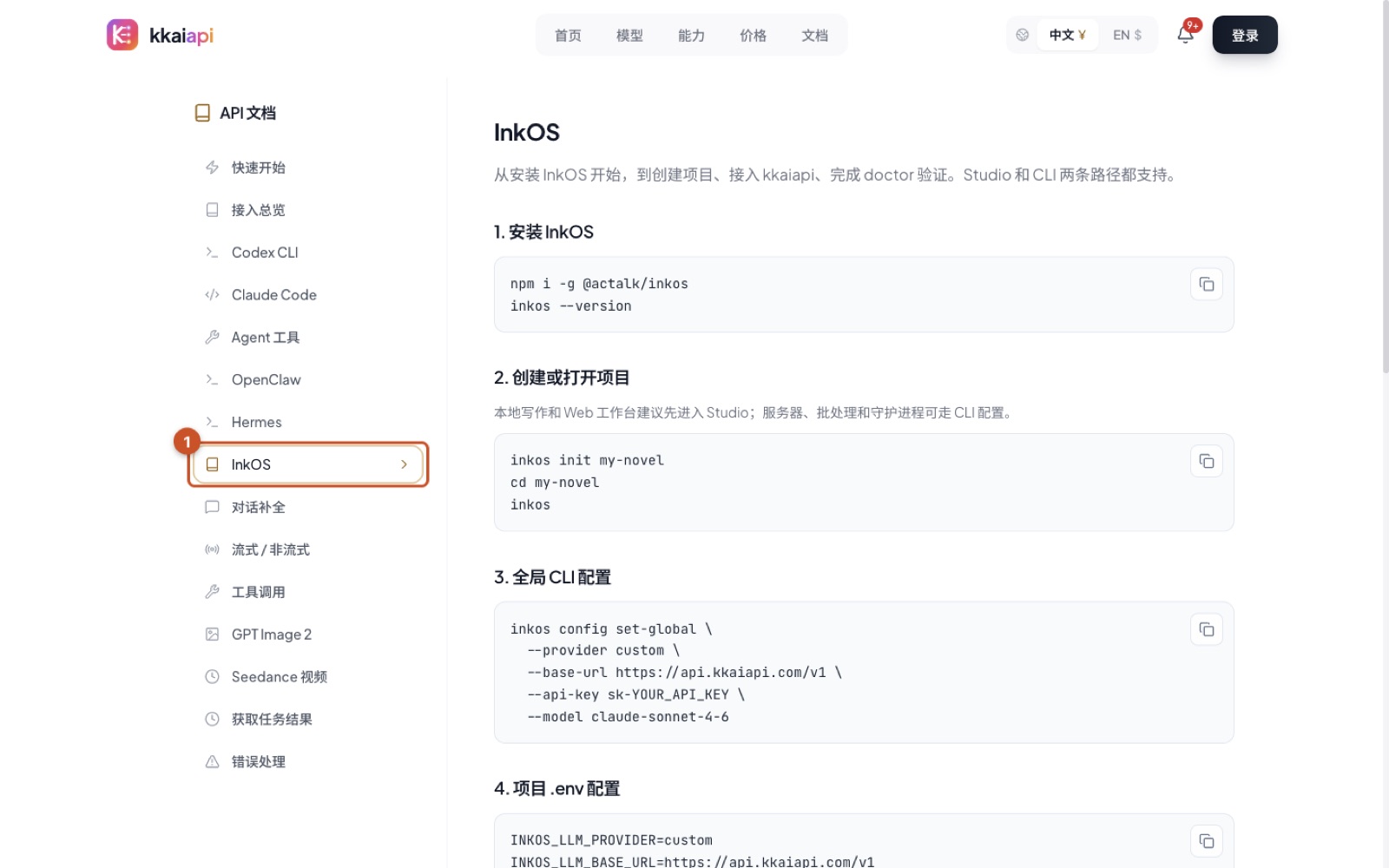
inkos config set-model writer <model> --provider <provider> --base-url <url> --api-key-env <ENV_VAR>
inkos config set-model auditor <model> --provider <provider>
inkos config show-models        # View current routing
This configuration maps discrete model providers and API keys to specialized agent roles while printing the active routing table.
The second systemic failure point is tokenizer skew inside the local BM25 retrieval engine. InkOS relies heavily on term-frequency matching to anchor proper nouns, inventory items, and registered foreshadowing hooks (伏笔). In multilingual settings—especially within CJK web-novel and cross-lingual translation workflows—TypeScript tokenizers frequently fail on coined fantasy terminology. If a custom cultivation realm or synthetic sci-fi proper noun is split into common standalone glyphs by standard segmentation algorithms, the inverted index gets polluted with high-frequency noise. BM25’s inverse document frequency scoring breaks down, causing the retrieval layer to return irrelevant lore cards or drop critical world constraints entirely.
Finally, relying on single gateway aggregators introduces severe operational fragility. While routing through unified endpoints simplifies multi-model orchestration across Writer and Auditor roles, sequential narrative workflows are unforgiving of gateway interruptions. A single chapter requires a deterministic chain: planning, drafting, editorial critique, revision, and state commit. If an upstream aggregator encounters rate limiting or schema variations halfway through a multi-stage execution, long-running batch pipelines crash mid-sequence, requiring manual intervention to untangle uncommitted staging files.
Production Architectures: What You Can Build on Staged State Harnesses
Understanding the limitations of uncommitted staging allows us to design robust, production-grade systems on top of the InkOS architecture. Rather than deploying the harness as a black-box autonomous generator, teams can extract its core pattern—decoupling volatile generation from schema-validated state commits—to power complex, long-horizon workflows.
Consider an engineering team building a continuous lore engine for interactive branching games (互动影游). In this architecture, an automated quest-generation and narrative branch engine dynamically updates character relationship scores, faction allegiances, and world variables across player decision trees. The system connects the InkOS CLI headless runner to a local SQLite game-state store, using BM25 to index faction rulebooks and routing scene generation through Kimi K3 via OpenAI-compatible endpoints. The primary failure mode to guard against is state desynchronization across concurrent branches: if asynchronous event loops attempt to mutate shared character records without isolated branch forks, choices in one storyline corrupt parallel timelines. The operational solution is to enforce a strict copy-on-write fork pattern in SQLite, treating each narrative branch as an isolated transaction that commits only when player progression reaches an authenticated milestone.
A second compelling deployment is an automated continuity checker for serialized web fiction. Instead of generating prose, a studio can configure the harness as a headless editorial validation pipeline that ingests raw chapter drafts written by human authors, extracts implicit entity changes, and cross-references active foreshadowing seeds against the established story bible. This implementation combines the InkOS editorial review agent with local BM25 entity retrieval and a Zod schema validation layer in TypeScript to catch continuity errors before publication. The technical hurdle here centers on lexical recall: BM25 easily misses implicit entity references and evolving aliases when a character is referred to by a newly acquired title, family moniker, or disguise rather than their canonical proper noun. Integrating an entity-resolution preprocessing step before lexical indexing ensures the audit agent never evaluates an alias as a continuity violation.
Finally, enterprise teams can adapt this paradigm for a regulated multi-stage technical document assembly pipeline. In compliance-heavy industries, generating long-form audit reports or regulatory filings requires the same continuity guarantees as serialized fiction: assertions made in early sections must strictly constrain downstream conclusions. This setup integrates the @actalk/inkos orchestration core with domain MCP knowledge servers and an explicit human-in-the-loop review interface inside the Studio workbench. Staged sections cannot commit to the primary corporate knowledge repository without explicit validation against authoritative data feeds. When implementing this enterprise pattern, teams must carefully evaluate the licensing implications: because the core harness is distributed under AGPL-3.0, modifying and hosting the orchestration runtime as part of a proprietary cloud service triggers copyleft disclosure requirements unless custom enterprise logic remains cleanly separated across network and process boundaries, much like the isolation architectures explored in Wrapping Thirty Coding Agents Inside a Single Container: Inside HarnessRouter's Protocol and Process Boundaries.
Resources
Updated 2026-10-26 by Mehran Mozaffari.
Related posts
29 October 2026
Should You Run OpenDuet in Production? Steal the Chat Patterns, Leave the Runtime
28 October 2026
Wrapping Thirty Coding Agents Inside a Single Container: Inside HarnessRouter's Protocol and Process Boundaries
27 October 2026
In-Browser WebGPU Agents or Native Daemons for Private Local Coding
26 October 2026
Should you self-host OpenDuet as your proactive AI coworker? Not yet
26 October 2026
How AgentBox Bridges Local Tooling Into Ephemeral Sandboxes Without Host Exposure
24 October 2026
How AutoSwarm Turns Isolated AI CLIs into a Coordinated Swarm Without a Shared Runtime