The Terminal Ceiling: Why Text Streams Fail Complex Agent Workflows
When terminal-based AI coding agents like Claude Code or Codex CLI execute autonomously across local filesystems, their speed and execution authority are unmatched. But as soon as an agent transitions from raw code generation to architectural planning, design system trade-offs, or multi-file refactoring reviews, the terminal buffer reveals a severe ergonomic and cognitive ceiling. Monospaced ANSI streams are designed for linear logs and unidirectional output, not for multi-dimensional spatial comprehension.
In my experience running autonomous agents through substantial codebase refactors, the failure mode is almost always human review fatigue. When an agent attempts to present two competing architectural designs or compare a status-first versus metrics-first layout inside a terminal, the interface collapses. Monospace ASCII boxes, truncated columns, and scrolling markdown blocks turn what should be an instantaneous visual decision into an exhausting scrollback investigation. Multi-file unified diffs flash past at terminal speeds, stripping away syntax context and hierarchical file trees. If you miss a crucial modification in the stream, your only recourse is manually piping the terminal history or breaking your flow to inspect git diff.
+-------------------------------------------------------------+
| CLI Buffer Overflow: Pseudo-formatted ASCII tables & trees  |
| >>> 4,000 output tokens spent aligning space characters     |
+-------------------------------------------------------------+
Worse still is the token tax. When an agent attempts to force rich data into terminal buffers, it spends valuable generation budget on pseudo-formatting: emitting hundreds of whitespace padding characters, unicode border glyphs (┌───┬───┐), and hand-rolled ASCII box-drawing characters. Models burn substantial forward-pass latency and context window space simply computing column offsets for terminal alignment. This is fundamentally inverted: output generation should capture high-entropy domain logic and structured intent, leaving visual layout and rendering to a dedicated client runtime.
When you confine an agent to an 80-column terminal, you force a multimodal reasoning engine to communicate through a teletype emulator. The result is a persistent communication bottleneck: humans skim past critical structural changes because text streams cannot visually prioritize information, while models burn compute trying to simulate visual canvases within terminal streams. To make autonomous agents genuinely steerable during complex operations, we must decouple their runtime execution environment from their presentation surface.
Deconstructing the Surface Model: Token-Optimized Client Chrome Over Raw HTML
The architectural breakthrough of Sideshow lies in how it frames the visual presentation problem over the Model Context Protocol (MCP). Rather than attempting to embed an entire IDE canvas or run an ad-hoc local file server, Sideshow exposes a structured, decoupled companion board via two core MCP tools: publish_post and update_post.
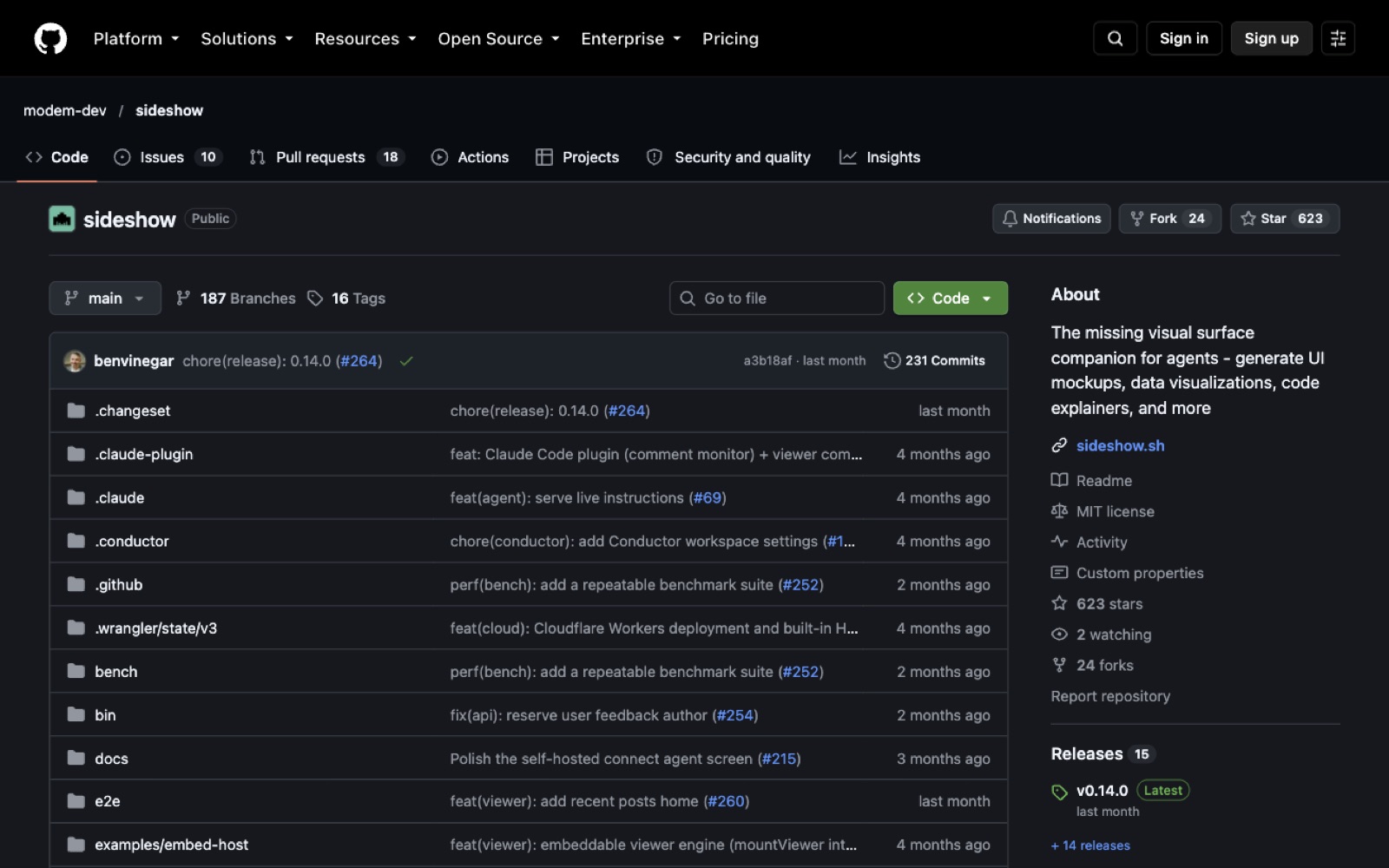
At the center of this protocol is the Post, which acts as an ordered container of typed content blocks termed Surfaces. Sideshow defines 9 discrete surface types designed to cover the core modalities of software development:
html: Sandboxed, interactive UI mockups and component sketches.mermaid: Live-rendered state machines, sequence diagrams, and architecture flows.diff: Syntax-highlighted code comparisons and review patches.markdown: Formatted documentation, architectural rationales, and tables.terminal: Monospace command output with full ANSI color support.image: Visual assets and diagrams accompanied by captions.trace: Granular, step-by-step execution timelines of agent reasoning.codeandjson: Structured data viewers with collapsible object nodes.
The core design win here is token efficiency through client-side chrome. Traditional attempts to give CLI agents visual capabilities rely on prompting the model to emit standalone HTML files. A model generating a raw HTML mockup must write monolithic boilerplate: <!DOCTYPE html>, CDN script tags for Tailwind or Google Fonts, hundreds of inline CSS utility classes, and nested layout wrappers. This routinely consumes 2,000 to 4,000 output tokens per preview.
As I explored when analyzing constrained decoding models, wasting autoregressive generation budget on repetitive structural scaffolding directly degrades both inference speed and reasoning coherence. Sideshow flips this responsibility. The browser viewer hosts the design system, typography scales, layout containers, and color tokens. When an agent invokes publish_post, it transmits only the bare domain payload: a pristine Mermaid graph definition, raw JSON structures, or a lightweight HTML fragment containing only semantic tags:
{
  "title": "Ingestion Pipeline Refactor",
  "surfaces": [
    {
      "type": "mermaid",
      "content": "graph TD\n  A[Event Ingest] --> B{Valid?}\n  B -->|Yes| C[Kafka Topic]\n  B -->|No| D[Dead Letter Queue]"
    },
    {
      "type": "diff",
      "content": "--- a/worker.py\n+++ b/worker.py\n@@ -12,3 +12,4 @@\n+async def push_dlq(payload):"
    }
  ]
}
By pushing presentation styling down to the client chrome, payload generation drops to a few hundred tokens. The agent emits structural truth; the client handles aesthetic presentation.
Bidirectional Steerability: Closing the Loop Between Human Review and Agent Execution
A presentation surface that only streams passive visuals is little more than a web-based log viewer. The true operational leap occurs when visual surfaces become bidirectional steering surfaces that can pause an agent's execution loop, collect targeted human judgment, and resume execution with structured context.
In standard terminal agent setups, human-in-the-loop review is strictly coarse-grained: either you press y to allow a bash command or edit, or you hit Ctrl+C to abort the process. Sideshow turns visual surfaces into fine-grained checkpoints. When an agent reaches an architectural crossroad—such as deciding between an immediate synchronous write path or an asynchronous queue—it invokes publish_post with an architectural Mermaid diagram or an interactive HTML mockup. Crucially, the agent pair-programs by waiting on an MCP tool call that acts as a suspension checkpoint.
sequenceDiagram
    autonumber
    participant Agent as CLI Agent (Claude Code / Codex)
    participant MCP as Sideshow MCP Server
    participant Browser as Sideshow Browser Board
    participant Human as Developer

    Agent->>MCP: publish_post(title, surfaces=[mermaid, diff])
    MCP->>Browser: Broadcast Post payload via WebSocket / Server Event
    Browser->>Browser: Render interactive Mermaid diagram & syntax diff
    Note over Agent,MCP: Agent waits on review response
    Human->>Browser: Clicks node: "Add idempotency key check here"
    Browser->>MCP: Submit structured annotation payload
    MCP-->>Agent: Return tool response with selected node & review comment
    Agent->>Agent: Ingest comment into active context window
    Agent->>MCP: update_post(status="Approved with Modifications")
    Agent->>Agent: Resume code generation with updated constraints
Rather than forcing the reviewer to type an ambiguous explanation into a scrolling terminal prompt ("in the second diagram, under the ingestion step, change the retry policy"), the human interacts directly with the rendered visual surface. Clicking on a specific node in the Mermaid diagram opens an inline review input. When submitted, the browser packages the node ID, metadata, and the developer's exact annotation into a typed JSON payload.
The MCP connection routes this structured payload back to the awaiting agent session. Because the return structure is deterministic and scoped to the exact component identifier, the agent does not have to parse messy spatial references from free-form chat. It injects the feedback directly into its active reasoning context, updates the post status on the board to reflect the decision, and executes the approved implementation path without losing execution state.
Ecosystem Topology: Decoupled Companion Boards Versus IDE Webviews and Cloud Walled Gardens
When evaluating how AI agents convey visual and structural information to developers, the landscape splits into four distinct architectural archetypes. Each represents a different compromise between filesystem access, rendering efficiency, and developer environment coupling.
quadrantChart
    title Agent Visual Surface Landscape
    x-axis "Tightly Bound to IDE/Cloud" --> "Decoupled / Agent Agnostic"
    y-axis "Raw File / Full App Scaffolding" --> "Token-Optimized Structured Surfaces"
    quadrant-1 "Decoupled Structured Companions"
    quadrant-2 "Proprietary Cloud Artifacts"
    quadrant-3 "Integrated IDE Webviews"
    quadrant-4 "Ad-hoc Local File Servers"
    Sideshow: [0.82, 0.78]
    Claude Artifacts: [0.25, 0.72]
    Cursor: [0.28, 0.40]
    Cline: [0.38, 0.52]
    Satchel: [0.75, 0.22]
At one end of the spectrum sit proprietary web artifacts like Claude Artifacts and ChatGPT Canvas. They offer polished, turnkey client styling, but they operate inside cloud walled gardens. They possess zero filesystem authority, cannot run your local test suite, and cannot interact with live git trees. Instant prototyping sandboxes like Bolt.new and v0 move execution into virtualized WebContainers to spin up full applications, yet they are engineered for greenfield scaffolding rather than surgical edits across mature local repositories.
Inside the local editor, IDE-integrated webviews like Cline and Cursor provide zero-setup context. The agent and its visual panels share a single viewport alongside the active editor tab. But this integration comes at the cost of environment lock-in. These webviews are tied to specific desktop IDE runtimes, carry heavy memory overhead, and break down completely when an agent runs inside a headless cloud VM or across a remote SSH session.
| Architectural Pattern | Exemplars | Protocol Binding | Rendering Token Cost | Filesystem Authority | Headless / SSH Compatibility |
|---|---|---|---|---|---|
| Decoupled Companion Surfaces | Sideshow, Satchel | Standard MCP (STDIO / HTTP) | Low (Bare structured payloads styled by client chrome) | Direct local filesystem access via host agent | Native support via remote ports or hosted relay |
| IDE-Integrated Panels | Cursor, Cline | Proprietary IDE extension APIs | Moderate (Editor webview overhead and raw diffs) | Direct local workspace access | Poor (Tied to desktop GUI editor instances) |
| Proprietary Cloud Artifacts | Claude Artifacts | Closed provider web APIs | Low to Moderate (Pre-styled React / SVG containers) | None (Sandboxed cloud execution only) | Complete cloud isolation (No local repo access) |
| App Scaffolding Platforms | Bolt.new, v0 | Proprietary virtual container APIs | High (Monolithic project scaffolding and packages) | Ephemeral virtualized container filesystem | Browser-contained (Not applicable to local shells) |
This is where decoupled companion surfaces establish their operational moat. By binding through the open Model Context Protocol (MCP), Sideshow operates independently of any specific CLI tool, model vendor, or desktop editor. An autonomous agent running in a headless devcontainer or a multiplexed tmux session on a remote server invokes standard MCP tools over STDIO or HTTP, publishing rich surfaces to an accessible browser board. This abstraction is especially potent in multi-agent orchestration, where multiple autonomous workers can publish updates to a shared team feed rather than contending for an interactive terminal prompt.
The ergonomic compromise is the two-window friction. Unlike Cursor or Cline, where the visual surface is tightly unified in the editor frame, decoupled companion tools require you to maintain a terminal beside an open browser window. But for engineers operating in remote environments or running multi-agent workflows, untethering visual comprehension from a desktop GUI is well worth the secondary window.
Deployment Realities: Localhost Traps, Cloudflare Workers, and the Headless Screenshot Gap
Adopting a decoupled visual companion in practice forces you to confront the operational divide between local execution and team-scale collaboration. Sideshow addresses this through three deployment tiers, but the transition from local experimentation to shared infrastructure introduces significant capability divergences that will bite an unprepared engineering team.
| Capability Dimension | Local Node Runtime (npx sideshow) |
Self-Hosted Cloudflare Workers | Sideshow Cloud (Managed) |
|---|---|---|---|
| Authentication Requirements | None (Open local port) | Custom (Cloudflare Access / Worker Secrets) | Managed organization invitations & SSO |
| Automated Screenshot Capture | Unsupported (No local headless browser engine) | Supported (Cloudflare Browser Rendering API) | Supported (Managed headless browser fleet) |
| State Persistence | Ephemeral in-memory (Wiped on process restart) | Persistent (Cloudflare D1 / KV / R2 storage) | Persistent managed database history |
| Public Team Shareability | None (Restricted to localhost without tunnels) |
Fully shareable via team domain URLs | Turnkey shared team feeds and read-only links |
The most immediate operational hurdle is what I consider the localhost trap. Running npx sideshow spins up a local web server on localhost:8228 (requiring Node >= 22.18). This is seamless if your agent runs in your local macOS terminal. But when your agent runs inside a Docker devcontainer, GitHub Codespaces, or a remote cloud instance—environments I often favor for isolating agent authority, as discussed when exploring autonomous workspaces—localhost:8228 binds inside the isolated network namespace. Without deliberate port forwarding, the browser cannot reach the board. Furthermore, running concurrent agent sessions locally triggers port collisions unless dynamic port allocation is explicitly wired into the agent's MCP configuration.
The second, and more consequential, architectural fissure is the headless screenshot gap. In automated CI/CD pipelines or headless review scripts, you want an agent to post an architectural diff, capture a static image of the rendered board, and attach that snapshot directly to a pull request comment. On Sideshow Cloud or a self-hosted Cloudflare Workers deployment, this rendering is handled transparently by Cloudflare's browser rendering engine.
On the local Node runtime, however, this server-side screenshotting capability is completely unavailable. There is no bundled Chromium instance to rasterize the DOM. If your automated scripts expect static visual artifacts from a local daemon, the call simply fails.
Finally, state persistence requires careful forethought. The local CLI daemon maintains ephemeral board state. If you bounce the Node process, your post history vanishes. When an agent attempts an update_post call targeting an earlier post identifier, the server throws an unrecoverable 404 error, breaking multi-turn state continuity. For team environments, self-hosting the Cloudflare stack with D1 or KV persistence is not optional—it is the baseline requirement for reliable operation.
Where Sideshow Breaks: Mermaid Parse Failures, Sandboxed CSPs, and Fire-and-Forget Drift
While decoupled visual boards solve the terminal’s spatial constraints, pushing rendering downstream to a browser client introduces fragile interface boundaries that can silently degrade an agent's operational loop.
The most insidious failure mode is the silent Mermaid syntax crash. When an agent calls publish_post with a mermaid surface, the MCP server performs transport-level validation: it verifies that the JSON payload is well-formed, writes the string to memory or storage, and returns an immediate success response to the CLI agent. But large language models are notorious for corrupting diagram syntax—injecting unescaped parentheses inside bracketed node text ([Parse (v2)]), unquoted hyphens, or invalid subgraph definitions. In the terminal, the agent receives an affirmative acknowledgment and operates under the assumption that the architectural plan is clearly displayed to the developer. Meanwhile, the browser client hits an unhandled parse exception in Mermaid.js, crashing the viewport or rendering a blank, broken box. Because there is no validation feedback loop returning parse errors through the MCP response, the agent remains completely blind to the fact that its human collaborator is staring at an error screen.
A parallel breakdown occurs within the html surface sandbox. To prevent rogue agent scripts from hijacking the host session, the browser viewer renders HTML fragments inside sandboxed iframe containers with strict Content Security Policies (CSP). When an agent attempts to scaffold a modern UI component, it routinely hallucinates references to external CDNs—importing Tailwind scripts, Lucide icon libraries, Google Fonts, or chart packages like Chart.js or D3. Under standard iframe isolation, the browser blocks these external network calls. The mockup renders stripped of all styling, SVG icons fail to mount, and dynamic components collapse into invisible DOM nodes. Compounding this is the viewer callback contract. If an agent constructs an interactive form or button intended to collect user input, it must bind explicitly to Sideshow's native postMessage protocol. If the agent instead generates standard event handlers or writes to localStorage, user clicks never bubble out of the sandbox. The interaction fails silently, marooning the human reviewer without a mechanism to return their selection to the agent.
The final operational pitfall is fire-and-forget execution drift. Autonomous CLI agents are fundamentally continuous execution loops; unless an MCP tool explicitly suspends execution to await a return value, the runtime sprints immediately to the next turn. When developers integrate publish_post without pairing it with a blocking confirmation tool or an explicit suspension checkpoint, the agent publishes its architectural diagram and instantly begins mutating code. By the time a developer glances at the browser board, the agent has already executed twenty file edits past the review point. Without deterministic blocking checkpoints, a visual board ceases to function as a steerable collaboration surface and degenerates into an asynchronous post-mortem audit log.
Applied Architecture: Three Production Blueprints for Structured Agent Surfaces
Successfully deploying structured agent surfaces into daily development requires enforcing strict protocol contracts across prompts, storage backends, and redaction filters.
The first priority is hardening LLM generation against parse crashes. When configuring system prompts for terminal agents, I treat Mermaid generation as an exact constrained decoding problem. The prompt must instruct the model to use strictly alphanumeric node identifiers, wrap all display labels in explicit double quotes, avoid nested parentheses, and restrict its vocabulary to simple top-down flowcharts or sequence diagrams. Equally critical is data hygiene: because surfaces may be pushed to team-accessible boards, an agent pipeline must run deterministic pre-publish redaction filters across all diff, terminal, and trace payloads to strip API tokens, environment variables, and customer database records before they hit external relays. Finally, robust multi-turn collaboration requires replacing ephemeral in-memory storage with persistent backends like Cloudflare D1 or SQLite. As I noted when exploring state machines and durable execution, surviving process restarts without throwing 404 errors on subsequent update_post calls is the baseline requirement for reliable agent coordination.
These operational constraints crystallize across three concrete deployment blueprints.
For teams running autonomous multi-file refactoring, an Interactive Architectural Gate for Headless CLI Refactors establishes a mandatory human-in-the-loop review boundary. In this setup, a terminal agent MCP client like Claude Code or Codex CLI connects to a local Sideshow instance via npx sideshow. Before touching local source files, the agent publishes module dependency trees and proposed schema diffs to the board, pairing the post with a blocking confirmation tool call that suspends the execution loop. The core implementation hazards to monitor here are agents bypassing the gate by proceeding without awaiting human approval, and unescaped special characters in LLM-generated Mermaid labels crashing the browser renderer before the review can occur.
When evaluating user interface iterations, teams can implement a Dual-Variant Frontend Component Evaluator. Here, a local Node agent harness generates competing layout proposals—such as contrasting navigation hierarchies—and publishes them side-by-side within two distinct html surfaces on a single post. The client-side chrome handles consistent typography and responsive bounds, while embedded postMessage callback handlers capture the developer's click selection and feed the winning variant back into the agent context. When building this, watch for strict iframe Content Security Policies blocking external font or CSS resources, and layout clipping caused by conflicting CSS wrapper assumptions between the agent's markup and Sideshow's container.
Finally, teams operating distributed CI workflows can deploy an Automated Pull Request Visual Summary Reporter. In this blueprint, a headless CI runner executes integration test suites, aggregates execution traces, and invokes publish_post over HTTP MCP against a self-hosted Sideshow deployment on Cloudflare Workers backed by D1 storage. The worker utilizes Cloudflare's browser rendering engine to capture static screenshot artifacts and embed them directly into pull request comments for asynchronous team review. The primary failure modes to guard against are local Node runners lacking screenshot generation capabilities, and accidental leakage of internal API keys or sensitive customer telemetry within the published trace surfaces.
Resources
Updated 2026-10-03 by Mehran Mozaffari.
Related posts
31 October 2026
Unreal Engine Skills for Claude Code: How Epic Bypassed the Binary Asset Barrier to Mutate Live Viewports
30 October 2026
Agent Memory Was an Indexing Problem All Along
28 October 2026
The Codebase Is an Environment, Not a Context Window
26 October 2026
Should you self-host OpenDuet as your proactive AI coworker? Not yet
24 October 2026
How AutoSwarm Turns Isolated AI CLIs into a Coordinated Swarm Without a Shared Runtime
24 October 2026
Should You Switch Your Agent Harness to Anvaya? Only if Orchestrator Memory Is Your Bottleneck