Moving Beyond Hand-Coded DAGs to Runtime-Generated Agent Swarms
For the past two years, our standard pattern for multiagent engineering has rested on hand-coded directed acyclic graphs. Whenever I needed to coordinate multiple agent behaviors, I turned to state-graph frameworks like LangGraph or LlamaIndex. We defined explicit state schemas, hand-wired node functions, and wrote conditional edges to govern every transition. When a workflow has a predictable topology—say, an ingest-extract-validate pipeline with deterministic validation gates—developer-defined DAGs remain the gold standard. You know the exact failure modes, you control the routing boundaries, and you can write integration tests against every edge.
The breakdown happens when you push deterministic state machines into open-ended, high-entropy problem spaces. If you task an agent with modernizing an undocumented legacy monolith, auditing 50 internal repositories for dependency vulnerabilities, or synthesizing cross-system telemetry, you cannot pre-script the execution graph. You do not know how many subtasks exist until step one completes. Forcing an LLM through a rigid, developer-coded state machine in these environments results in fragile branching logic, brittle conditional routers, and sprawling graph definitions that collapse the moment a repository deviates from your expected file structure.
Anthropic’s launch of Dynamic Workflows for Claude Managed Agents (released into public beta on October 9, 2026) attacks this exact architectural friction. The lineage of this engine is familiar: I watched its initial patterns emerge in Claude Code’s experimental research branches under flags like ultracode, where the harness allowed an agent to inspect a local repository and autonomously fork child tasks to map dependencies. Promoting this capability into the generalized Claude Managed Agents API transforms the lead agent from an execution node inside a developer’s graph into a runtime planner that synthesizes the orchestration program on the fly.
Instead of traversing a fixed state machine, the lead agent ingests a high-level objective, decomposes the problem into distinct execution phases, maps runtime dependencies, and instantiates specialized worker subagents on demand. When Phase 1 discovers an unexpected dependency tree across three microservices, the lead agent restructures Phase 2 dynamically rather than failing on an unhandled graph edge. We are moving from compile-time workflow definitions written by human engineers to runtime-generated execution swarms synthesized by the model itself.
Inside the Execution Harness: Concurrency Limits, Session Sandboxes, and Streaming Aggregation
Plumbing this dynamic capability into an existing stack requires enabling Anthropic's beta protocol. Direct requests pass the beta header:
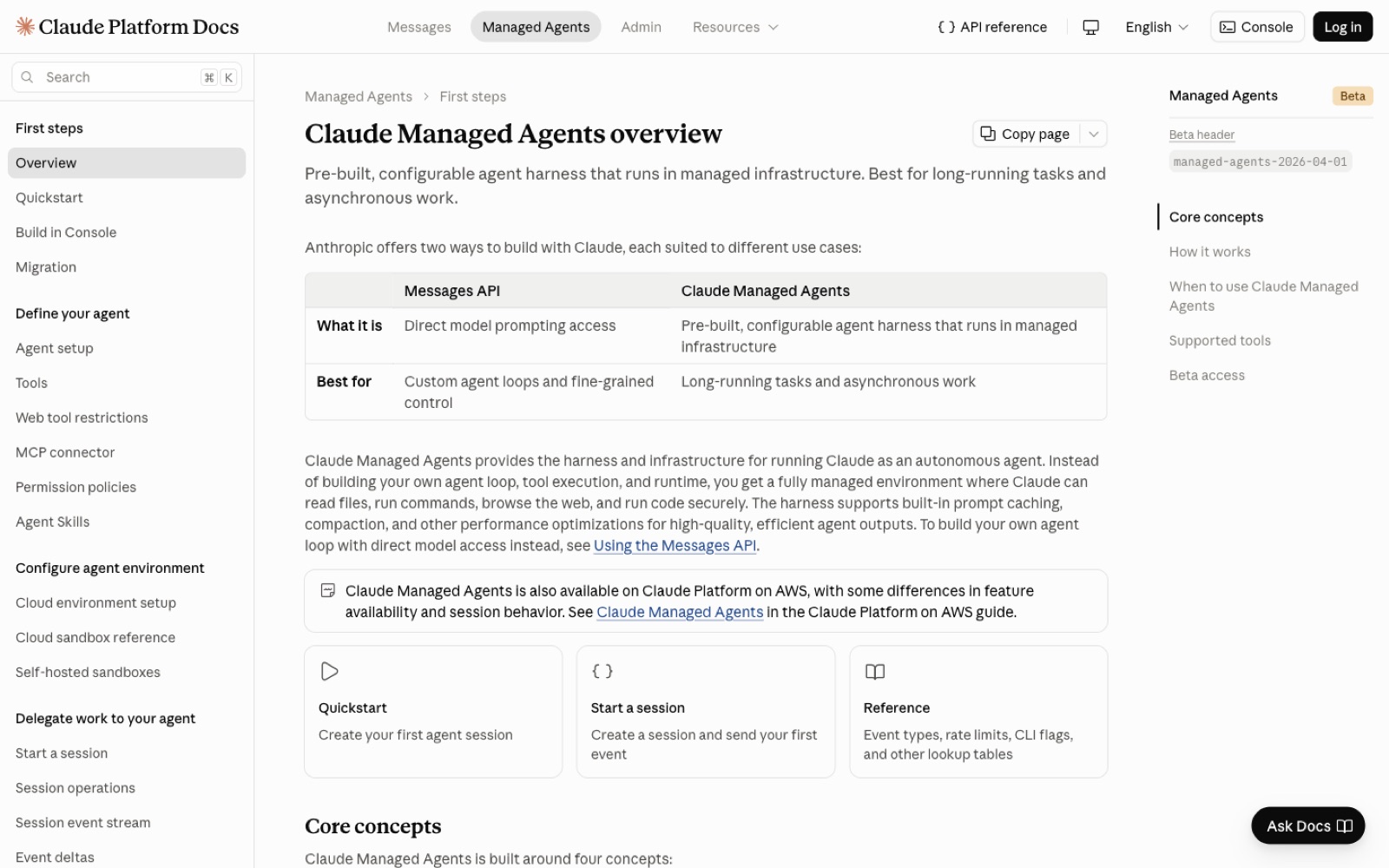
anthropic-beta: managed-agents-2026-04-01
In the API payload, enabling orchestration centers on configuring the multiagent parameter in the agent definition. Under the hood, Anthropic backs this configuration with concrete capacity limits: a single workflow run can spawn up to 1,000 lifetime subagents, with up to 64 subagents executing concurrently. The pricing model avoids per-workflow surcharges, billing standard model tokens across all invoked agents alongside a flat compute charge of $0.08 per session-hour.
The primary engineering value here is not just the model's decomposition reasoning—it is the execution harness. Orchestrating 64 concurrent subagents in user-managed infrastructure is notoriously painful. You have to spin up microVM or container pools, wire Redis task queues, persist state across node crashes, and manage telemetry streams. Claude Managed Agents absorbs this operational burden entirely on the server side by spinning up ephemeral, isolated micro-sandboxes for each subagent run.
Crucially, the parent session remains responsive while worker agents fan out. In naive multiagent implementations, a coordinating agent blocks synchronously while waiting for downstream workers to finish. In Claude Managed Agents, the lead agent maintains an open interaction loop. A user or supervisory system can submit steering instructions, alter constraints, or inspect intermediate status while dozens of subagents execute in parallel.
As subagents execute tools via the Model Context Protocol (MCP), their logs, diffs, and intermediate outputs stream back to the harness. The harness delivers these aggregated outputs to the lead agent, which synthesizes the results, runs cross-validations, and updates downstream phases. This mirrors the aggregation dynamics I analyzed when deconstructing Pi's architecture and context compaction mechanics: keeping the parent context unpolluted requires disciplined log aggregation at the harness boundary before intermediate findings feed back into the planning loop.
sequenceDiagram
    autonumber
    actor Client as Client Caller
    participant Lead as Responsive Parent Lead Agent
    participant Harness as Managed Orchestration Harness
    participant Subagents as Sandboxed Subagents (up to 64 concurrent)
    participant MCP as Model Context Protocol Tools

    Client->>Lead: Submit complex objective (multiagent enabled)
    Lead->>Harness: Generate dynamic execution plan & dispatch tasks
    Harness->>Subagents: Provision isolated server-side micro-sandboxes
    par Concurrent Tool Execution
        Subagents->>MCP: Execute sandboxed tool calls via MCP
        MCP-->>Subagents: Tool output & environment state
    and Mid-Flight Steering
        Client->>Lead: Submit steering adjustment
        Lead->>Lead: Re-evaluate operational constraints
    end
    Subagents-->>Harness: Stream intermediate logs, diffs, and return values
    Harness-->>Lead: Deliver aggregated worker telemetry
    Lead->>Lead: Synthesize findings & adapt downstream phases
    Lead-->>Client: Stream consolidated progress updates & final result
The Architectural Matrix: Hosted Autonomous Swarms Versus Code-First DAGs and Durable Workers
To understand where Claude Managed Agents fits in a production architecture, we have to map it against the prevailing paradigms: developer-defined state graphs (LangGraph), in-process conversational swarms (AutoGen/AG2), durable execution engines (Temporal), and vertically specialized coding harnesses (Cognition Devin).
quadrantChart
    title Multiagent Orchestration: Infrastructure vs Control Model
    x-axis Self-Hosted / Infra Agnostic --> Fully Managed Cloud Harness
    y-axis Developer Deterministic Code --> Autonomous Model-Driven Orchestration
    quadrant-1 Hosted Autonomous Swarms
    quadrant-2 Local Conversational Swarms
    quadrant-3 Durable Deterministic Code
    quadrant-4 Managed Deterministic Pipelines
    Temporal: [0.15, 0.15]
    LangGraph: [0.30, 0.35]
    AutoGen: [0.25, 0.75]
    Claude Managed Agents: [0.85, 0.85]
| Framework / Platform | Orchestration Control | Infrastructure Hosting | Concurrency Limits | Sandbox Isolation | Failure Recovery |
|---|---|---|---|---|---|
| Claude Managed Agents | Autonomous dynamic re-planning via lead agent | Fully managed Anthropic cloud harness | 64 concurrent subagents (1,000 lifetime) | Server-side isolated micro-sandboxes | Lead agent inspects intermediate logs and restructures downstream phases |
| LangGraph | Developer-defined deterministic state graph with conditional edges | Self-hosted application containers / LangGraph Cloud | Application-bound (developer manages async event loop) | Developer-managed containers or local process memory | Deterministic checkpointing and programmatic fallback branches |
| AutoGen / AG2 | Conversational roleplay and manager agent routing | Self-hosted / local Python runtime | Local process limits (developer manages threading/queues) | Optional Docker wrappers, defaults to local environment | Conversation backtracking or human-in-the-loop intervention |
| Temporal (with LLM Activities) | Strict procedural code workflows (TypeScript, Python, Go) | Self-hosted cluster or Temporal Cloud | Cluster-scale task queues (thousands of parallel activities) | Developer-managed worker execution environments | Event-sourced durable execution with guaranteed state replay |
| Cognition Devin | Hierarchical planner-worker tuned for software engineering | Fully hosted proprietary cloud environment | Platform-managed execution threads | Dedicated containerized workspace with full dev tooling | Continuous internal test evaluation and autonomous re-attempts |
My architectural stance here is clear: offloading orchestration and sandbox management to Anthropic's hosted harness makes sense when task discovery is non-deterministic and the operational cost of managing worker infrastructure exceeds the value of deterministic execution control. If I need to scan 100 repositories to detect unpinned dependencies, write migration diffs, and cross-reference API changes, building a custom Temporal DAG with dynamic activity generation is an inefficient use of engineering time. Anthropic's flat $0.08 session-hour compute pricing easily beats maintaining warm container pools and Celery queues.
However, moving orchestration into a provider-managed black box introduces a non-negotiable trade-off: you surrender deterministic code guarantees and lock yourself into a single model provider. In regulated production environments—such as financial transaction verification, compliance reporting, or systems requiring open-weight local models—letting an LLM autonomously decide how many subagents to spawn and how to partition tasks introduces unacceptable execution variance. In those domains, I will keep orchestration anchored in LangGraph or Temporal, retaining absolute ownership over state transitions and execution boundaries.
The Combinatorial Cost Trap and the $0.08 per Hour Illusion
When an infrastructure team sees Anthropic’s pricing sheet advertising $0.08 per session-hour for Claude Managed Agents, the initial reaction is almost always relief. In standard systems engineering, running containerized worker pools, maintaining warm Redis queues, and operating Kubernetes clusters routinely run up steep baseline infrastructure bills. At eight cents an hour, managed session compute feels virtually free.
That nominal compute rate, however, is a dangerous psychological decoy. The real cost driver in dynamic multiagent architectures is never the compute time—it is the combinatorial token burn of unconstrained model fan-out.
Consider the mathematics of a single long-running workflow. When a lead agent partitions an ambitious repository migration or an extensive code audit across 64 concurrent subagents, each subagent is an independent Claude instance instantiated with its own context window. Every child worker ingests the operational instructions, tool definitions under the Model Context Protocol, and local repository files before making its first edit. If each worker consumes a modest 50,000 tokens of input context and iterates through five sequential tool interactions, a single operational phase consumes tens of millions of tokens in minutes. Because the lead agent generates the orchestration program dynamically rather than adhering to developer-scripted fan-out gates, an over-ambitious decomposition plan will eagerly spin up the maximum allowable concurrency to explore peripheral tasks. Token expenditure does not scale linearly with wall-clock time; it compounds exponentially across worker depth and tool iterations.
To protect against runaway loops, Anthropic provides session-level budget caps. Setting a cap is mandatory hygiene, but relying on it reveals a harsh operational trade-off: hitting the limit triggers a hard session freeze. Unlike a graceful timeout in a deterministic queue where a worker can trap the interrupt and execute a teardown routine, a provider-level budget kill immediately severs execution across all active workers.
If thirty subagents are mid-flight—holding dirty working directories, uncommitted file modifications, or half-applied schema mutations—the platform drops the connection instantly. Because the session is terminated at the billing threshold, the lead agent is denied the remaining compute and token budget required to reconcile divergent diffs, issue rollbacks, or report a coherent failure manifest. You are left with corrupted intermediate state across your target systems and zero automated path to recovery. Controlling this economic exposure demands implementing rigid pre-flight token estimators and bounding child concurrency long before the session reaches Anthropic's hard billing fence.
Autonomy Breakdown: Decomposition Drift, Workspace Collisions, and Summary Dilution
Handing orchestration authority to a model eliminates brittle DAG boilerplate, but it introduces failure modes that are fundamentally architectural rather than syntactic. In deterministic pipelines, execution failures trigger explicit stack traces at known graph vertices. In dynamic agent swarms, failure presents as silent structural drift. When evaluating dynamic workflows for production workloads, I monitor three critical breakdown points: decomposition drift, workspace collisions, and summary dilution.
The most catastrophic failure mode is upstream decomposition drift. When a developer hand-codes a DAG, human intuition enforces structural invariants—such as ensuring that an interface contract is locked before downstream modules implement it. A lead agent enjoys no such structural guardrails. If its initial planning phase misinterprets a core architectural boundary or hallucinates an incorrect dependency order, that flawed premise is instantaneously broadcast to up to 64 concurrent subagents. The child workers execute their assigned tasks diligently, burning through compute and generating seemingly valid code against a fundamentally broken interface. By the time the lead agent attempts to aggregate their deliverables, the blast radius spans dozens of mutually incompatible changesets. Catching an error after 64 agents have completed their work turns remediation into an expensive, chaotic rollback problem.
The second operational hazard is the collision of concurrent mutations in shared workspaces. While Anthropic spins up isolated micro-sandboxes for each subagent, software engineering tasks ultimately converge on a single repository or shared database. If the lead agent dispatches multiple subagents to modify interconnected files without enforcing strict git branch or worktree boundaries, the aggregation phase devolves into merge chaos. Two subagents optimizing adjacent functions in the same module will produce conflicting diffs. Without automated abstract syntax tree reconciliation—a design pattern I examined when dissecting why generative UI compiles to an AST instead of raw code—the lead agent struggles to resolve these conflicting changesets autonomously, often inventing hybrid code that silently breaks type safety or introduces logic regressions.
The third failure mode is summary dilution at the aggregation boundary. Subagents generate extensive telemetry, including verbose compiler outputs, test failures, and tool logs. Because passing raw logs from 64 workers back to the parent would instantly overflow the lead agent’s context window, the execution harness must compact and summarize intermediate results. This compaction is lossy by design. Subtle compiler warnings, edge-case test failures, or subtle deprecation notices are routinely stripped away during summarization. The lead agent receives a sanitized report indicating that a subtask succeeded with minor adjustments, blinding it to critical low-level warnings. Downstream phases proceed under the false assumption of clean health, masking regressions until the entire workflow completes.
stateDiagram-v2
    [*] --> PlanGeneration
    PlanGeneration --> ConcurrentFanOut : Valid plan created
    PlanGeneration --> RePlanningLoop : Flawed decomposition detected

    ConcurrentFanOut --> ToolExecution : Dispatch to micro-sandboxes
    ConcurrentFanOut --> BudgetHalt : Hard limit reached

    state ToolExecution {
        [*] --> WorkspaceRun
        WorkspaceRun --> ToolCall : Invoke via MCP
        ToolCall --> WorkspaceRun : Return tool output
    }

    ToolExecution --> Aggregation : Stream diffs and logs
    ToolExecution --> BudgetHalt : Token cap exceeded

    Aggregation --> RePlanningLoop : Merge conflicts or test failures
    Aggregation --> CleanResolution : All phases validated

    RePlanningLoop --> ConcurrentFanOut : Re-dispatch adapted tasks
    RePlanningLoop --> RePlanningLoop : Cyclical planning stall
    RePlanningLoop --> BudgetHalt : Spend limit reached

    BudgetHalt --> [*] : Frozen mid-flight without rollback
    CleanResolution --> [*]
Blueprints for Production: High-Leverage Multiagent Workloads to Build Today
Deploying 64 concurrent subagents makes sense only when a workload exhibits high structural entropy—problems where task topology cannot be predicted before inspection, yet individual operational subtasks can execute in isolated scopes. If a problem fits a clean directed acyclic graph, hand-code it in LangGraph or Temporal. But when task decomposition itself requires exploratory reasoning, dynamic workflows unlock massive leverage.
A prime candidate is an Autonomous Monorepo SDK Deprecation and Framework Migration Engine. When migrating dozens of internal packages away from an obsolete internal SDK, a human or static script struggles with cross-package coupling. Here, the lead agent ingests the monorepo root, maps call sites, and dynamically formulates a dependency graph of affected consumer packages. It then fans out 40 to 50 concurrent subagents via the GitHub Model Context Protocol server and isolated sandbox file trees, assigning each subagent to rewrite call sites, update test suites, and execute local compilation checks within a single target module. The architectural pitfall to mitigate in this pattern is workspace collision on root configuration manifests and global lockfiles. If three subagents concurrently mutate the root dependency manifest, the run collapses into unresolvable git diffs. The lead agent must enforce directory boundaries, restricting subagents to package-isolated subtrees while reserving root dependency updates for a sequential consolidation phase.
A second high-leverage application is a Parallel Cross-Surface Security Audit and Differential Fuzzing Swarm. Instead of running sequential linters, the lead agent ingests an API specification and decomposes the attack surface along orthogonal vectors: session management, serialization boundaries, and role-based access controls. It dispatches 30 concurrent subagents inside custom sandbox execution tools running ephemeral containers, instructing each to construct targeted fuzz harnesses, generate malformed payloads, and evaluate behavioral edge cases using an outbound AST analysis tool. The critical failure mode here is outbound rate limiting. If 30 child agents hammer local mock endpoints or external authentication services simultaneously, downstream services trigger cascading HTTP 429 rejections. The execution harness must place a rate-limiting proxy between the subagents and verification targets to absorb concurrency spikes.
Finally, consider a High-Throughput Regulatory Compliance and Evidence Synthesis Pipeline. Ingesting thousands of pages across contradictory compliance frameworks breaks single-context analysis. A lead agent can parse the statutory requirement, query enterprise document stores through MCP servers, and fan out 64 concurrent subagents to extract audit evidence, verify policy clauses, and validate assertions against structured JSON schema validators. The failure mode I watch closely here is summary dilution. When 64 subagents compact their findings into parent summaries, low-level regulatory exclusions and minority edge cases are easily scrubbed away during intermediate aggregation. Retaining compliance traceability requires forcing subagents to return structured validation manifests with exact document URI pointers rather than freeform narrative summaries.
Hardening the Swarm: Worktrees, Outbound Rate Buffers, and Human Approval Gates
Taking dynamic workflows from an experimental prototype to production demands surrounding Anthropic’s hosted harness with defensive infrastructure. If you expose raw external APIs to 64 uncoordinated subagents or let them write directly to a shared repository, the swarm will chew through budgets and corrupt downstream state.
First, concurrent file modifications require strict git worktree isolation. Even though Anthropic provisions separate micro-sandboxes, merging code changes back into a shared project tree cannot happen on a single branch. Each subagent task that produces file modifications must operate within an isolated, ephemeral git worktree branched off a pinned commit SHA. When subagents finish their modifications, the lead agent ingests the branch heads as atomic diffs, running an automated abstract syntax tree merge tool before running integration test suites.
Second, every outbound tool call made by subagents over the Model Context Protocol must route through an outbound caching and rate-limiting proxy. Left unconstrained, dozens of parallel Claude instances executing search tools, database queries, or GitHub lookups will trigger immediate downstream rate limiting. Deploying a token-bucket proxy that implements request deduplication, jittered exponential backoff, and local caching shields external dependencies and prevents subagents from stalling on HTTP 429 throttles.
Third, observability requires streaming the session event stream directly into OpenTelemetry spans. Flat terminal logging fails when 64 subagents execute concurrently. By treating the lead agent’s planning loop as a root trace and each subagent invocation as a child span enriched with token consumption metrics and tool payloads, engineering teams gain instant visibility into runaway re-planning cycles and tool failures.
Finally, leverage the responsive parent session to enforce mandatory human approval checkpoints before destructive phases. Allowing an autonomous swarm to identify vulnerabilities or prepare code migrations is safe; allowing it to push commits upstream or alter production schemas without human sign-off is negligence. A robust production pipeline suspends the lead agent at phase boundaries, streaming an aggregated change manifest to a human supervisor whose explicit approval unfreezes the deployment.
| Vulnerability | Root Mechanical Cause | Exact Engineering Mitigation |
|---|---|---|
| Workspace Merge Collision | Multiple concurrent subagents writing to shared files or global package lockfiles | Enforce ephemeral git worktree isolation per subagent; restrict writes to isolated subtrees and reconcile root configs sequentially. |
| External Service Throttling | 64 concurrent subagents making simultaneous uncoordinated requests to external MCP tools | Front MCP servers with an outbound token-bucket proxy enforcing caching, deduplication, and jittered backoff. |
| Mid-Flight Budget Severance | Runaway fan-out hitting Anthropic's hard session budget cap without executing rollbacks | Implement client-side token estimators and per-phase spending thresholds, leaving reserve budget for clean rollbacks. |
| Unmonitored Destructive Execution | Lead agent executing high-blast-radius operations without validation gates | Utilize the responsive parent session to introduce mandatory human approval checkpoints before state mutation phases. |
Resources
Updated 2026-10-08 by Mehran Mozaffari.
Related posts
31 October 2026
Unreal Engine Skills for Claude Code: How Epic Bypassed the Binary Asset Barrier to Mutate Live Viewports
30 October 2026
Agent Memory Was an Indexing Problem All Along
28 October 2026
The Codebase Is an Environment, Not a Context Window
26 October 2026
Should you self-host OpenDuet as your proactive AI coworker? Not yet
24 October 2026
How AutoSwarm Turns Isolated AI CLIs into a Coordinated Swarm Without a Shared Runtime
24 October 2026
Should You Switch Your Agent Harness to Anvaya? Only if Orchestrator Memory Is Your Bottleneck