The Serverless Mismatch: Why Long-Running Coding Harnesses Shatter on Ephemeral Compute
When you drop an autonomous coding harness—whether it is Claude Code, OpenCode, Codex, or an in-house runtime—into cloud serverless infrastructure, you immediately run into an architectural collision. Modern agent loops are inherently stateful, conversationally cumulative, and long-running. Serverless primitives, conversely, are built on aggressively bounded execution windows, hard CPU and memory caps, and sudden container teardowns.
In local development, if an agent stalls while debugging a test suite or pauses for ten minutes waiting for an external build, your workstation preserves the process tree, the dirty Git staging area, and the in-memory context window. Move that workload to an ephemeral cloud runner, and an unexpected spot eviction, memory spike, or gateway timeout immediately blows the process out of existence.
The resulting damage is both financial and logical. When an agent crashes ungracefully mid-run, a naive supervisor attempts a cold restart from scratch. That means re-running tens of thousands of tokens of accumulated conversation through expensive frontier models, effectively paying twice—or three times—for reasoning turns the system already computed. Worse than the double-billed inference is the half-executed shell command. If a harness dies halfway through applying a patch, running a multi-stage database migration script, or executing a dirty rebase, a blind restart leaves the workspace corrupted. The re-invoked agent boots into a state it did not expect, trips over broken lockfiles or half-written source trees, and spirals into catastrophic hallucination loops.
As I argued when examining Why I Stopped Building Separate Stacks for Chat and Background Agents: The Durable Rails Architecture, the industry cannot keep building delicate glue code to prop up brittle, stateful agent loops. We need durable foundations beneath the execution layer.
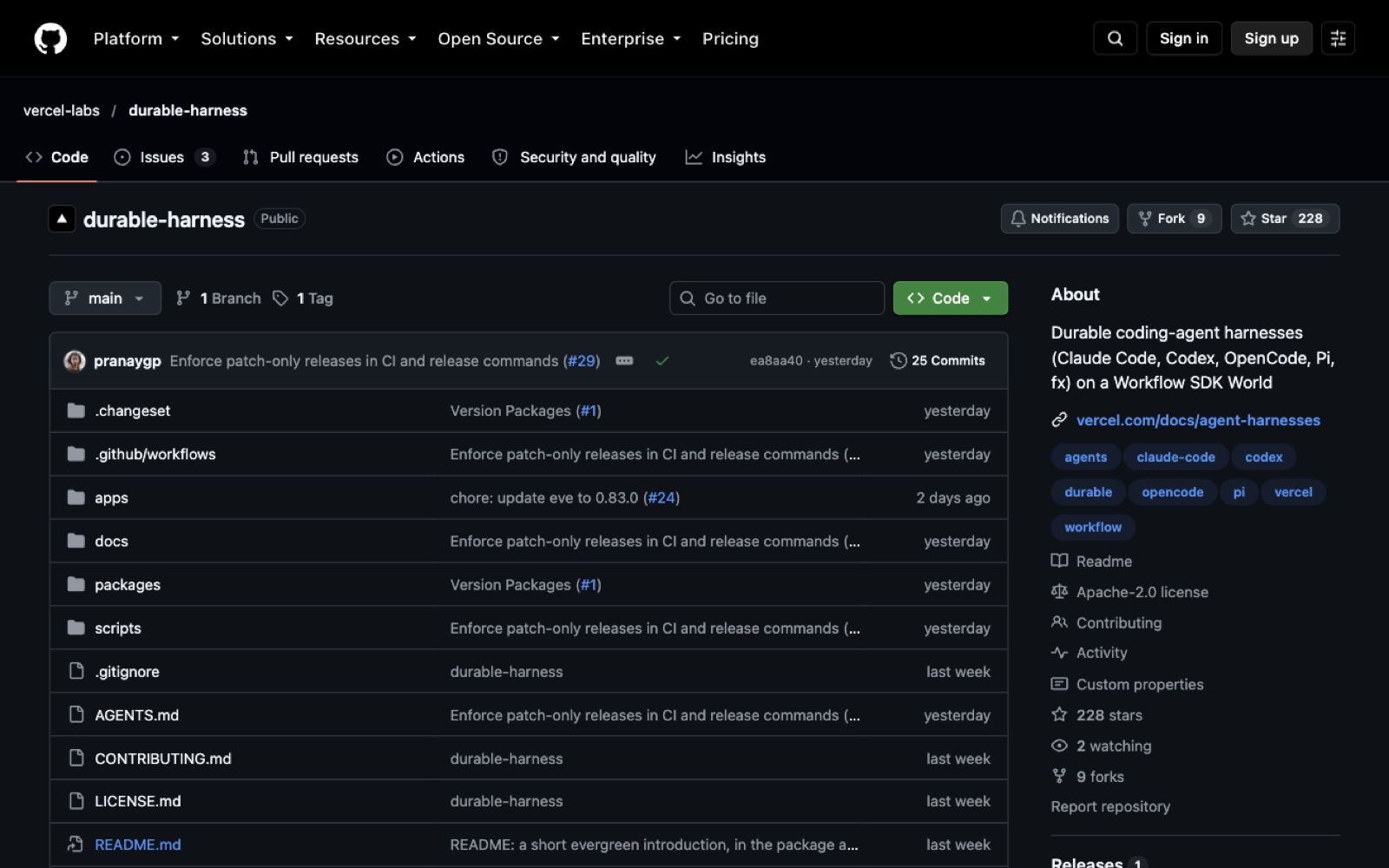
This is the exact wedge durable-harness targets. Developed by Vercel Labs, it does not attempt to rewrite upstream coding agents into bespoke graph frameworks or proprietary DAG DSLs. Instead, it serves as an adapter layer that wraps arbitrary existing coding harnesses—running over the Vercel Workflow SDK and ephemeral Vercel Sandbox environments—and injects durable execution semantics directly underneath them.
Intent and Outcome: Inside the Event-Sourced Replay Architecture
Under the hood, durable-harness operates as a middleware adapter that decouples the outer agent lifecycle from the raw compute host. For full terminal-driven CLI agents like Claude Code or Codex, it proxies shell commands and terminal input/output directly into isolated Vercel Sandbox microVMs. For lightweight library harnesses such as Pi, eve, or fx, it can drive the loop within standard function runtimes.
The mechanical backbone of this abstraction is an event-sourced append-only log powered by the Vercel Workflow SDK engine. Instead of storing a monolithic snapshot of the agent process, the harness breaks down every interaction into discrete, deterministic events modeled around two explicit phases: an intent and an outcome.
Before dispatching an inference request to an LLM provider or launching a bash command inside a microVM, durable-harness commits an intent record to the workflow log. Once the external system responds—whether that is a completed tool execution or a model completion payload—the harness persists the corresponding outcome record.
When a container teardown or execution failure kills the active worker, the workflow orchestrator spins up a new instance and initiates a deterministic replay loop. Instead of re-querying the model API, the harness intercepts outbound requests, matches them against prior intent/outcome pairs in the event stream, and returns the recorded inference response directly from the log. The agent's conversational state is reconstructed turn by turn without re-incurring latency or duplicate provider charges.
sequenceDiagram
    autonumber
    participant Harness as durable-harness
    participant Log as Workflow SDK Log
    participant LLM as LLM API
    participant VM as Sandbox microVM

    Note over Harness,VM: Standard Turn Execution
    Harness->>Log: Append Intent (LLM Request)
    Harness->>LLM: Dispatch Prompt
    LLM-->>Harness: Stream Response / Tool Call
    Harness->>Log: Append Outcome (Inference Result)
    Harness->>Log: Append Intent (Tool Run: git status)
    Harness->>VM: Execute Command
    VM-->>Harness: Stdout Result
    Harness->>Log: Append Outcome (Tool Output)

    Note over Harness,VM: Mid-Flight Crash & Eviction
    Harness->>Log: Append Intent (LLM Request Turn 2)
    Harness->>LLM: Dispatch Prompt
    LLM-->>Harness: Response Received
    Note over VM: Host Eviction / SIGKILL (Process Dies)

    Note over Harness,VM: Deterministic Replay on Resumption
    Harness->>Log: Rehydrate Turn 1 History
    Log-->>Harness: Cached Turns & Tool Outcomes
    Harness->>Log: Check Intent (LLM Request Turn 2)
    Note over Harness: Cache Hit in Durable Log
    Harness-->>Harness: Deduplicate Call (Skip LLM API)
    Harness->>VM: Boot Clean Sandbox & Continue
By guaranteeing that completed steps yield cached responses on replay, the agent loop resumes right at the frontier of uncommitted work.
Decoupled Lifecycles: Bridging Vercel Sandboxes and Workflow State
While the event log solves logical recovery, operational reality gets messy when you look at the relationship between the orchestrator and the execution environment. In durable-harness, the Vercel Workflow instance and the Vercel Sandbox microVM possess completely decoupled lifecycles. A workflow execution can easily span hours or days—particularly when pausing for human reviews, waiting on lengthy integration test suites, or holding for asynchronous webhooks. A sandbox microVM, however, is an ephemeral Linux container with strict idle timeouts, resource caps, and aggressive termination policies.
Decoupling the conversational decision log from the underlying terminal environment is essential for survivability; if the microVM dies under memory pressure, your agent does not lose its train of thought. But it creates a brutal hydration hurdle when you must spin up a clean microVM mid-task. A freshly booted microVM contains an empty disk. If the agent loop resumes at Turn 35, the harness cannot simply replay every command to reach the current state without triggering unintended side effects.
This is where strict operation boundaries become mandatory:
- Read-Only Operations: Commands like
git status,cat package.json, or running static linters are naturally idempotent. If the container crashes mid-read, the harness can re-evaluate them safely during replay or simply replay the recorded standard output from the workflow log. - State Mutations: Operations that alter local or remote state—such as
git checkout -b, modifying source files, running database seeders, or invoking external deployment webhooks—shatter naive replay loops. If an execution environment crashes after disk mutations have occurred but before the outcome event is committed to the workflow log, a newly spawned microVM will lack those modifications entirely. Conversely, running that same mutation command again against an existing workspace that survived the network blip can cause Git patch failures or conflicting branch errors.
Bridging these decoupled runtimes requires treating the workspace itself as a tracked dependency. Without snapshotting file trees or tying working-tree Git commits directly to workflow step identifiers, durable logging only saves the agent's memory—leaving the workspace stranded in a split-brain state.
Where durable-harness Fits: Replay Adapters vs. Sandboxes and Checkpointers
When engineers ask me how to make an agent resilient in production, they usually conflate three distinct engineering philosophies: general-purpose durable execution engines, persistent sandbox infrastructure, and in-framework graph checkpointers. Understanding where durable-harness sits requires unbundling these models.
quadrantChart
    title Agent Durability and Integration Overhead
    x-axis Zero Rewrite --> Full Graph Rebuild
    y-axis Ephemeral Event Replay --> Persistent MicroVM State
    quadrant-1 Heavy Refactor / Persistent Host
    quadrant-2 Low Refactor / Persistent Host
    quadrant-3 Low Refactor / Event Replay
    quadrant-4 Heavy Refactor / Event Replay
    durable-harness: [0.15, 0.25]
    E2B: [0.18, 0.85]
    Modal: [0.26, 0.80]
    Temporal: [0.82, 0.28]
    Inngest: [0.78, 0.22]
    LangGraph: [0.85, 0.35]
General-purpose engines like Temporal and Inngest solve durability at the activity layer. They are robust, battle-tested distributed orchestrators, but they expect you to decompose your code into discrete activities with explicit serialization boundaries. If you want to run Anthropic's Claude Code or an upstream CLI tool like OpenCode on Temporal, you have to rip out the agent’s internal execution loop and rewrite it as a sequence of deterministic workflow methods. That is an enormous refactoring tax for teams that simply want to deploy off-the-shelf tooling.
Persistent sandbox runtimes like E2B, Modal, or Daytona solve durability at the infrastructure boundary instead. They give you a long-running Linux microVM with stateful memory and a persistent filesystem. If your client disconnects, the machine keeps running; when you reconnect, your bash session and dirty git staging area are exactly where you left them. But this delegates durability entirely to the host node. If the physical hypervisor encounters an out-of-memory kernel panic or cloud spot reclamation, the virtual machine vanishes along with its uncommitted in-memory reasoning.
Framework checkpointers like LangGraph or AutoGen tackle the problem by writing state dictionaries to PostgreSQL or Redis after every graph node. While this provides conversational rollback, it locks your engineering team inside a proprietary DAG framework. You cannot point LangGraph checkpointers at a closed-source binary or a terminal-based agent without re-authoring the entire harness.
| Dimension | durable-harness |
Temporal / Inngest | E2B / Modal | LangGraph |
|---|---|---|---|---|
| Durability Layer | Event log (Workflow SDK) + ephemeral Sandbox | Event history log (Worker cluster) | Persistent OS / MicroVM session | Graph state checkpoint (DB/Redis) |
| Agent Rewrite Requirement | Zero (Wraps CLI/native harness directly) | High (Deconstruct loop into activities) | Zero (Run native script inside VM) | High (Must build within framework DAG) |
| LLM Call Deduplication | Native (Intent and outcome memoization) | Manual (Must wrap calls in activities) | None (Process restart reruns turns) | Native (Node-level state restoration) |
| Crash Recovery | High (Rebuilds state from event stream) | High (Deterministic replay) | Low to Medium (Tied to host VM survival) | Medium (Rolls back to last valid checkpoint) |
| Side-Effect Handling | Distinguishes read vs. mutation intents | Manual activity idempotency keys | Relies on process filesystem stability | Custom error handlers / edge guards |
The conscious trade-off durable-harness makes is sacrificing deep activity granularity and local disk permanence to gain zero-rewrite wrapping. It wraps third-party CLI agents using event replay while treating compute hosts as disposable scratchpads. I reach for this pattern when I need to host autonomous coding assistants headlessly without maintaining custom agent forks.
The Split-Brain Edge Case: Uncommitted Filesystem Mutations and Ghost Invocations
While event replay works cleanly for conversational inference, it introduces nasty edge cases when paired with a mutable filesystem. In production, the most lethal failure mode in durable-harness occurs in the narrow timing window between a tool mutating local disk state and the workflow orchestrator committing the outcome event.
Consider an agent executing a branch switch and patch: git checkout -b feature/auth && git apply patch.diff. The command runs in the microVM, modifying the working tree. Before the standard output returns over the RPC bridge to commit the outcome record to the Workflow log, the underlying sandbox experiences an out-of-memory crash.
When the workflow orchestrator detects worker loss and enqueues a recovery turn, the system splits into two failure modes depending on sandbox provisioning:
First, if the harness reconnects to the same dirty sandbox container, the workflow log only shows an uncommitted intent. The replay engine assumes the step failed to execute and attempts to run the command again. The agent encounters a shell error: the branch already exists, or the patch fails with conflict markers because it was partially applied. Because the agent model does not receive the raw failure context it expects, it frequently assumes the repository is corrupt and attempts destructive cleanups.
Second, if the orchestrator provisions a fresh sandbox instance, the new container boots with a pristine working tree lacking the branch mutation entirely. Yet downstream conversational history in the agent’s context might reference code changes that now exist only in the model’s replayed memory. The filesystem and the mental model of the agent have completely diverged.
Even more precarious are external side effects—what I call ghost invocations. When an agent runs git push origin feature-branch or triggers a deployment webhook, a network partition mid-flight leaves the workflow engine in an ambiguous intent state without an outcome confirmation.
The orchestrator cannot know whether the packet reached GitHub before the connection dropped. If the harness passes this unconfirmed action back into the agent context, frontier LLMs handle the ambiguity poorly. In my testing of autonomous loops, models faced with unconfirmed mutations either hallucinate that the push succeeded and proceed to file broken pull requests, or blindly retry the command, triggering duplicate commit dispatches, secondary webhook firings, and race conditions against upstream branch protections.
Production Guardrails: Surviving Log Bloat, TTY Payloads, and Unbounded Retries
Running durable-harness reliably in production demands explicit defensive infrastructure around the wrapper. If you deploy it out of the box against real-world repositories, the first failure you hit will be workflow log bloat. Coding agents emit massive volumes of terminal data: test runners, compiler logs, and dependency trees easily produce megabytes of raw stdout and stderr.
Writing those raw terminal payloads directly into the Workflow SDK event log will quickly trigger storage payload caps or cause severe database write contention in PostgreSQL-backed setups. Furthermore, streaming interactive TTY sequences packed with ANSI escape codes will poison the token budget during historical turn reconstruction.
The operational fix is payload offloading. Your harness middleware must intercept stdout and stderr, evaluate payload size, and push anything exceeding a 64-kilobyte ceiling directly into object storage. The durable workflow event log should store only an immutable content hash, byte count, and retrieval URI. During resumption, the replay loop hydrates summaries or tail-truncated excerpts into the agent's context window, pulling full logs only when a tool specifically requests targeted diagnostics.
Workspace state synchronization requires an equally strict guardrail. To prevent split-brain drift between the ephemeral sandbox and the workflow log, teams must couple file tree snapshots directly to workflow step identifiers. Before executing a mutation-classified command, the harness should record the current Git tree SHA. After command completion, it records the updated tree diff alongside the outcome event. If a host evicts and a fresh microVM boots, the orchestrator does not blindly re-run bash commands; it hydrates the workspace directly to the exact Git commit corresponding to the last committed workflow step.
Finally, durable execution engines present an insidious financial hazard: an agent trapped in a logical circle will persist across container teardowns forever unless bounded. In a traditional runner, an out-of-memory crash kills an errant loop. With durable replay, the workflow engine dutifully resurrects the failing process, re-hydrates the conversation, and spends fresh tokens trying to solve the same compiler failure across dozens of ephemeral VM lifecycles.
To prevent runaway billing, you must embed strict circuit breakers into the workflow adapter layer itself. This means enforcing hard boundaries on cumulative token spend, total wall-clock workflow duration, and sequential tool retries. If an agent loops on identical tool arguments without advancing the Git state across three consecutive attempts, the harness must trip a hard stop, capture the workspace diff, and surface an escalation state rather than burning compute in an endless cycle.
Architectural Blueprints: Practical Deployments for Durable Agent Workflows
Taking durable-harness from an architectural pattern to a functioning production system requires choosing the right boundaries between webhooks, orchestrators, and execution environments. Depending on your operational blast radius and infrastructure posture, three concrete deployment topologies illustrate how these pieces fit together in practice.
The first pattern addresses large-scale maintenance through an Autonomous PR Migration and Large-Scale Codebase Refactoring Service. When maintaining multi-repo systems, breaking framework updates or major version bumps can consume weeks of engineering time. Here, incoming GitHub repository dispatch webhooks trigger a Vercel Workflow instance that wraps the Claude Code CLI inside an ephemeral Vercel Sandbox microVM. The agent clones the target repository, applies multi-file codemods, iterates against test suites, and opens pull requests across tasks that often stretch over several hours. In this topology, the two failure modes to monitor are verbose test outputs and mid-flight host cycling. A full integration test run can spew tens of megabytes of raw standard output that will breach Workflow SDK event payload ceilings unless aggressively offloaded to blob storage. Concurrently, if the underlying microVM gets recycled during an intensive multi-file disk rewrite, the system risks split-brain Git index divergence unless the harness anchors the workspace to an explicit pre-mutation Git tree commit.
For production support, teams can deploy a Human-in-the-Loop Cloud Incident Remediation Runner. When alerting webhooks from systems like Datadog or PagerDuty fire, a serverless workflow boots an OpenCode or Pi harness inside a guarded, read-only diagnostic sandbox. The agent inspects live environment logs, checks cluster metrics, and drafts a targeted patch or configuration fix. Rather than executing autonomous changes directly, the runner suspends execution using the Vercel Workflow engine's native waiting primitives and posts a diff to a Slack interactive endpoint. The primary operational trap here is container decay: an on-call engineer might take two hours to review the proposal, during which the idle microVM will be reclaimed. When the human posts an approval response, the resuming workflow must not assume the sandbox is still warm; it needs to spin up a clean microVM, re-clone the repository, re-apply the proposed branch diff, and verify the diagnostic context before executing any guarded mutation.
Finally, teams operating under compliance constraints or running intensive offline benchmarking can construct a Self-Hosted Code Evaluation Harness with PostgreSQL State Backing. Instead of running on managed cloud infrastructure, this setup deploys a dedicated Node.js runner backed by an internal PostgreSQL database to execute long-horizon evaluation benchmarks across model releases using Codex or fx harnesses. Raw standard output and error artifacts stream directly into S3-compatible blob storage, keeping the durable event history lean. The operational bottleneck to watch in this design is database write amplification. In an unconstrained debugging loop where an agent attempts dozens of iterative lint and compilation passes, high-frequency intent and outcome logging can quickly saturate PostgreSQL connection pools and generate severe table bloat if write frequencies and cleanup lifecycles are not strictly bounded.
The Architectural Bottom Line: Pragmatic Adoption Thresholds for durable-harness
Every abstraction layer in an AI stack comes with an explicit engineering tax, and durable-harness is no exception. Deciding whether to adopt it comes down to a clear dividing line: are you trying to operationalize an existing, third-party CLI agent, or are you architecting proprietary reasoning workflows from scratch?
If your team has already standardized on sophisticated CLI harnesses like Anthropic's Claude Code, OpenCode, or Codex, durable-harness provides immediate leverage. These terminal-first tools represent enormous investments in prompt optimization, internal tool selection heuristics, and context compression. Attempting to run them on cloud serverless infrastructure without a durable wrapper guarantees broken sessions, cold-restart token inflation, and half-applied workspace mutations. In that scenario, adopting durable-harness gives you crash resilience and inference memoization without requiring you to fork or rewrite upstream agent loops. You accept the quirks of ephemeral microVM reconciliation because the alternative—rebuilding those harnesses as bespoke state machines—would take months of low-level engineering.
Conversely, if you are building proprietary, greenfield agent systems with domain-specific decision graphs, reaching for durable-harness introduces unnecessary indirection. Wrapping an external black-box CLI is fundamentally a lease on someone else’s abstraction. You are forever at the mercy of upstream CLI changes, undocumented prompt modifications, altered JSON schemas, and terminal control sequence updates that can silently bypass your intent and outcome interception hooks. When you control the agent logic end-to-end, you should bypass the CLI adapter entirely and build directly on native workflow engines like Temporal, Inngest, or framework checkpointers like LangGraph. Structuring your agent's turns as first-class, deterministic code activities gives you true type safety, precise state serialization, and granular transaction boundaries that an external wrapper around a terminal binary can never fully match.
The sweet spot for durable-harness is headless, resilient execution of off-the-shelf agents across ephemeral infrastructure. It bridges the gap between stateful coding harnesses and stateless cloud runtimes, turning fragile terminal sessions into recoverable workflows. But it is not magic: it protects the agent's conversational thread, not the physical disk. Treat the underlying microVMs as completely disposable scratchpads, establish hard idempotency boundaries around mutating shell commands, enforce strict payload caps on terminal streams, and you can reliably run autonomous coding agents in environments where processes are guaranteed to die.
Resources
Updated 2026-10-19 by Mehran Mozaffari.
Related posts
31 October 2026
Unreal Engine Skills for Claude Code: How Epic Bypassed the Binary Asset Barrier to Mutate Live Viewports
30 October 2026
Agent Memory Was an Indexing Problem All Along
28 October 2026
The Codebase Is an Environment, Not a Context Window
26 October 2026
Should you self-host OpenDuet as your proactive AI coworker? Not yet
24 October 2026
How AutoSwarm Turns Isolated AI CLIs into a Coordinated Swarm Without a Shared Runtime
24 October 2026
Should You Switch Your Agent Harness to Anvaya? Only if Orchestrator Memory Is Your Bottleneck